
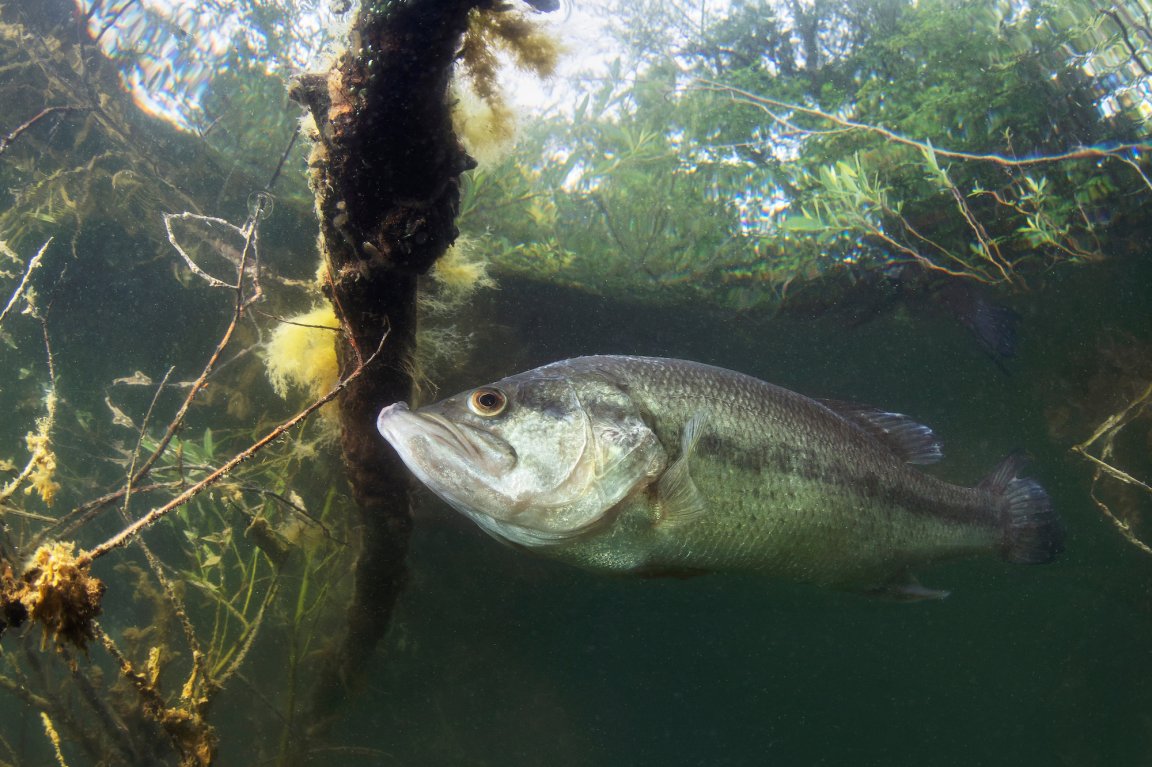
“Missed him,” I said and groaned as I reeled in a slack line. Setting the hook after I had felt a gentle tap had produced nothing but a mangled plastic worm.
“Rerig and toss it back in there,” Ralph Manns directed me. “Another one might hit it.”
Manns was right. The next time I set the hook I was rewarded with a pleasantly bowed rod. After a short fight, a five-pound largemouth bass thrashed in the landing net.
“Now, you get one,” I said and grinned as my bass splashed in the live well.
Manns complied with a cast that dropped his worm beside the same rotted stump. The line twitched, the rod arched and he quickly landed a twin to the first bass. Not a bad start for our first look at Texas’ Lake Livingston—especially after my traumatic and almost sleepless night.
It had begun innocently enough with my arrival at Livingston’s Penwaugh Marina the previous evening for a meeting of the Texas Outdoor Writers Association. Luck of the draw had placed me in the same room with fisheries biologist Ralph Manns, a pleasant mild-mannered gentleman I was meeting for the first time. I had no idea that our meeting would alter the course of my fishing life.
An insatiable appetite for more facts about bass behavior had prompted Manns to become a full-time student at Southwest Texas State University after retiring from active duty in the Air Force where he had spent 20 years as an intelligence officer and a political scientist. At the time of his retirement he was a lieutenant colonel.
En route to a masters of science degree in aquatic biology, which he earned in 1981, Manns conducted a study of black bass in Lake Travis in 1977 and 1978. The study team used electronic transmitter tags and receivers to track 14 bass while divers recorded the behavior of another 935 bass. Manns’ team also used angling techniques to obtain detailed reports on an additional 289 bass. Data on more than 20 different types of behavior and the environmental conditions that might influence the fish were fed into a computer to compile and analyze the results.
Manns’ exhaustive studies of scientific literature on bass and his extensive two-year study have led to rather innovative and sometimes controversial conclusions. During my first few hours with him, he crumbled the foundation of my bass fishing knowledge with solid scientific evidence that contradicted many generally accepted fishing theories.
Those first two bass we caught from Lake Livingston, for example, were taken from classic bass structure—a stump on the upper edge of a submerged creek bed. The bass probably had not migrated from the depths, however, to feed in the shallower water as a popular myth would have us believe.
The hypothesis that bass live in deep water, migrate to shallow water on a daily basis to feed and then return to deep water along established migration routes is generally credited to Buck Perry, the gentleman rightfully recognized as the father of structure fishing. His methods of catching bass have been so successful that other anglers and writers have perpetuated his migration theories.
Ralph Manns agreed that such structures are good places in which to fish but the analytically minded biologist could find no scientific literature to substantiate a deep-water migration theory. Manns wanted a better explanation for the appearance of bass at certain underwater structure.
“Sure enough,” Manns related, “our tracking studies verified data available in at least 15 other studies that showed the predominant movements of black bass are parallel to the shorelines and contour lines and not perpendicular to them. The movement, moreover, usually is at a nearly constant depth.”
A national magazine recently published a story entitled “When the Sun is High, the Bass Go Deep”. The author surmised that because more bass are caught in deep water during midday hours, bass obviously migrate from shallow to deep water as the sun brightens. And that’s how myths get started.
Manns’ study of Lake Travis bass showed no such tendency.
“Our research showed some bass at shallow depths, some at medium depths and some in deep water at all times,” he revealed. “And they tended to remain at that particular depth whether active or inactive. Bass do move vertically but not routinely. A deep fish might pop to the surface to run through a school of shad, but it will grab two or three and almost immediately dive to its original depth because that’s where it has established its equilibrium and can suspend without effort.”
A bass can hover effortlessly at a particular depth because its air bladder is balanced at that depth and it gets out of balance if it varies much from that point. According to Manns, it takes hours for the air bladder to adjust to a major depth change. The more out of balance a bass gets, the harder it has to swim to maintain its stability.
Manns noted that black bass usually move along contour lines for only short distances and tend to stop at any bisecting lines of structure that obstruct their movement, such as a fence, stump or rock. By casting to a fence, an angler increases his odds simply because moving bass are likely to pause there.
Most anglers will catch more bass, Manns maintained, if they fish on the better bisecting structures for several minutes during activity periods. Additional schools often stop at the same structure long enough for the anglers to catch more fish.
Some fishermen consider schools of black bass a rarity. Limit catches might be rare but, according to Manns’ underwater observations, most bass are in either a school or an aggregation.
“There are almost no loner bass,” Manns says. “The few single fish we observed underwater were either very sick, very large or totally inactive. The sick ones obviously couldn’t keep up and the larger bass were probably unable to find compatible partners in their size range.
“Rule one,” he continued, “if you catch a bass, assume it is not alone. As a minimum, it is in a group of two to five fish. Actively striking bass are usually feeding and moving bass. They tighten up their aggregations and move in small schools.”
During activity periods, of course, almost anyone can catch bass by tossing an edible-looking lure in the path of a feeding school. It’s the inactive periods that separate expert from novice bass fishermen.
“Fishermen should remember that bass are inactive most of the time, even if their stomachs are empty,” Manns claimed. “Unlike humans who have a predictable three square meals a day, a bass may be forced to exist for days without eating. That little bit of minnow it ate three days ago must last the bass a long time and it does not waste it!”
The fact that a fish is inactive doesn’t mean that it won’t eat, Manns admitted. If something passes closely and in front of a bass’ mouth, it will usually eat because bass are opportunists. But an inactive bass probably won’t move more than a few inches to hit a lure. An angler who is fishing a spot that holds inactive bass may have to cast 15 or more times before the lure passes through that tiny strike zone in front of an inactive bass.

A fast-moving crankbait offers good odds of getting a lure to an active bass. Because active fish may chase lures for 10 feet or more, each cast effectively covers a wide path on each side of the bait’s track. The same lure retrieved past inactive bass, however, may pass by many fish without eliciting a strike.
The success of an angler’s technique, then, depends on how active the bass are. Anglers who cast and crank at wide intervals over inactive bass will usually get few strikes. Fishermen who flip worms or jigs to the base of cover objects where inactive bass may hold, however, get close enough to take a few fish. If the same anglers continue to flip slow lures while bass are in an active state, though, they cannot hope to hook as many as those with fast lures. Thus, an angler must match his lure and his technique to the activity level of the bass.
One widely accepted myth claims that bass avoid sunlight because they have no eyelids. Manns’ underwater observations indicate otherwise.
“It was clear to us that bass have no requirement to live in shade,” Manns declared. “Moving bass were as likely to stop at a sunny spot as a shaded one. Although bass have no eyelids, their eyes have pigment mechanisms that compensate for excessive light. Water is an excellent light filter, too. Unless a bass is in very shallow, calm and clear water, the water serves it well as a pair of sunglasses.”
Bass that anglers catch from beneath piers, boat houses and docks are probably there for cover or food rather than for shade. In fact, even slightly colored water refracts sunlight sufficiently to destroy any distinct shade line within a few feet. Even in moderately clear lakes, bass down more than 10 feet experience little or no shading from objects at the surface.
This means that bass a fisherman finds beneath floating structures will probably hold tightly to the bottom of the structure—unless, of course, there are other attractive structural elements on the bottom. Lures retrieved just beneath floating structures, then, will probably be more effective than lures retrieved along the bottom.
Although bass do not need to avoid sunlight, Manns’ records indicate that more bass are caught from shaded areas than from sunny ones. He stressed that this statistic is not contradictory because inactive bass may suspend in either shade or in sunny open water. But for an angler to cast his lure near enough to inactive bass to make them strike, he usually must find bass that are suspended close to an identifiable target. While the target creates shade, the shade itself is incidental and not the reason the bass are there.
Another concern of bass anglers is that bass will move when they hear noise coming from above them. Manns’ study, however, clearly showed that bass learn to ignore any sounds that don’t represent a threat. Bass frequently swam beneath docks where workers were pounding with hammers or sailors were stomping in boats. Bass also ignored outboard motor noises in Lake Travis, which is heavily used by recreational boaters. Surprisingly, however, some of the lake’s bass had learned to move away from boats with electric fishing motors and it was difficult to approach such bass unless they were pushed against cover objects.
Manns suggests that a great myth of angling literature is that bass seek out preferred temperatures, water clarity, structure and so on. He stressed that the part of a bass’ brain that processes every piece of visual or physical information is about the size of a thumbnail. A bass simply does not have the ability to be intuitive.
“A bass will not run across a lake to an area that has a better temperature level,” Manns claimed, “because it doesn’t know it’s there. Now if a bass is wandering around and finds a more comfortable area, it might think, ‘Wow! Isn’t this temperature nice?’ And if it can stay there without getting hungry, it may hang around long enough for the angler with a temperature meter to catch it.”
In Manns’ study, bass did not move to deeper water to avoid surface temperatures in the 84° to 88° range. In fact, when all other factors were equal, black bass (including smallmouths) preferred the water temperature to be between 78° and 86°, not the 72° that is popularized in most fishing literature. Manns’ findings are corroborated by at least 20 other scientific studies published during a 40-year period. Bass found in cooler water are there because of a better food supply or because they are unable to compete with larger predators present in warmer water.
Manns admits that there are optimum chemical environments for bass but in most lakes the fish must be satisfied with less. They merely move into someplace tolerable, adapt to it and once they’ve adapted to that condition, any change is a negative change to those fish.
“Most people don’t realize that a bass is constantly adapting to its environment,” Manns declared. “The chemistry of its body adapts to temperature and water conditions and, if any factors change, the fish is temporarily out of balance. When cold fronts go through, for example, sudden drops in temperature disturb the fish’s equilibrium and it becomes slightly sick until it adapts to the new condition. That helps explain why bass normally don’t bite as well after a cold front.”
A common dream of anglers is catching bass on almost every cast from a “hotspot” where hungry largemouths eagerly await the next cast. The nearest thing I ever found to that fabled “hotspot” was on Lake Sam Rayburn back in 1968. My partner and I found a timbered flat near a river channel where every cast with our crankbaits hooked a chunky bass. We tied the boat line to a limb and promptly caught 60 largemouth bass from an area no larger than the average living room. In that era of 15-bass limits it was the first chance I had to cull bass to improve a stringer.
Our hopes for a repeat performance the next day were short lived. Our first few casts hooked bass, but the action ceased and we never relocated the bass. Nor did any of our friends ever find fish there on many subsequent trips. Manns offered an explanation for the phenomenon.
“They were probably transient bass, which is a major cause of confusion to anglers. Bass are generally thought of as having one type of behavior pattern. Actually, though, there are two types of black bass: transient bass and home-range bass. The concept is an old one that shows up in scientific literature as far back as 30 years ago.”
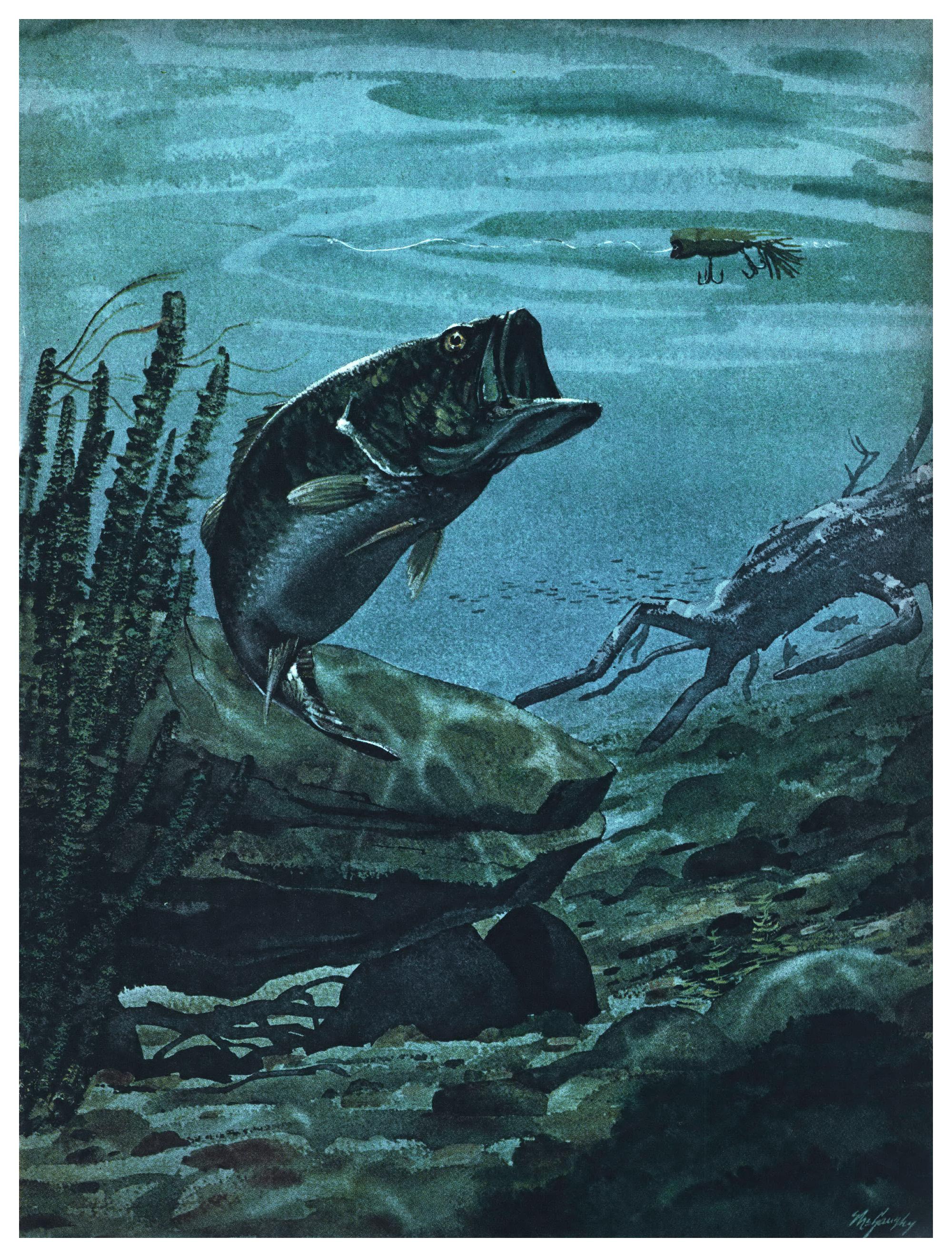
Manns theorized that the fish’s health or its ability to catch prey determines whether it is a home-range or transient bass. Healthy fish establish territories and hold them, moving as little as possible. They conserve energy by feeding quickly and remain in the same general location unless there is a major change in water conditions or the food supply.
Large bass populations or shortages of prey create competition for food, however. Those bass that feed less efficiently must feed longer and move often to find forage. A transient is one because it is a loser.
There are many transient bass in our better bass lakes and they almost always school. An angler who finds such a concentration can catch great numbers of them at one time but he should not necessarily label the area as a great fishing hole. Such catches can be the result of chance meetings with transients.
Manns says that an angler should not spend much time returning to the site of a big catch unless he has reason to believe, such as repeated success, that the place is a home-range area. An angler can more consistently catch bass by returning to locations where he has taken one or two fish over and over again. Those are probably spots that have enough food to hold home-range fish day after day.
Manns stressed that bass reactions vary according to how hungry they are. A very hungry fish will probably strike at any lure it can get in its mouth. A bass that has been feeding on shad for 20 minutes, however, will probably only take something that is similar to the shad.
Although bass can see colors, anglers should remember that bass do not perceive them as a human would. Manns recalled a day when he and his partner followed a large school of bass feeding heavily on shad. The two cast all of the traditional shad-color lures without a strike. As soon as Manns put on a gold lure, though, he caught fish on almost every cast.
The bass obviously responded to some flash of gold from the shad caused, perhaps, by the angle of sunlight. The bass had enough color discrimination that they triggered to the tiny variation. Manns, therefore, suggests that anglers who are unsuccessful in catching obviously active bass should change lure colors, sizes and actions until they find one that triggers the fish. Bass are not ambush predators as are halibut, angler fish and sculpin; nor are they chase predators such as tuna or striped bass. A black bass is a compromise fish designed to do a lot of things—none of them perfectly but all of them well. The bass is a seeker with a short sprint. It enters cover for protection and to rest, not to ambush prey. Cover actually limits and hinders a bass’ ability to strike and that is why prey fish hide in such areas.
The standard hunting pattern of a bass is to move around structure objects to see if anything strays far enough from cover to become vulnerable. It assesses its ability to catch individuals of prey and strikes only at those it thinks can be caught. The bass ignores prey that are likely to dodge and thus escape. A bass will ignore a lure that looks like a healthy bluegill just as it would ignore a real bluegill under the same circumstances.
“Bass fishing is very mathematical, very predictable,” Manns claimed. “It is a problem to be solved. Most of the false concepts arise because writers intellectualize about bass. The reaction mechanism of bass is actually very very basic: a reaction to a stimulus and a response, nothing more.
Read Next: Old-School Tips for Catching Big Bass Right Now
“A bass can’t outsmart you. All you have to do is find something that will stimulate it, put it where it will stimulate it and you will catch a bass. There’s really nothing more to fishing than that.”
Manns makes it sound simple and it looks simple enough when you watch him in action. He merely works the odds, covering as much favorable water as possible with a wide variety of lures. But he seems to catch many more bass than the average fisherman. The years he spent in their living quarters are paying off.
This story was originally published in the November 1983 issue of Outdoor Life.