
We may earn revenue from the products available on this page and participate in affiliate programs. Learn More ›
Suppressors are rapidly becoming standard kit on the modern hunting rifle, but there is still plenty of legend and lore around what they do, and how they affect your rifle’s performance. One of the biggest questions hunters often have is how it will affect the accuracy of their gun. Long-time suppressor owners will likely tell you that they’ll make your rifle more accurate, but we still see folks claiming that adding a can will hurt a finely-tuned rifle’s accuracy. What’s the truth? That’s what we’ve set out to demonstrate in the video above.
Sample Size Is the Key
Over the past several years, the Outdoor Life gun team has become obsessed with sample size — just ask our boss. We’ve written about the most reliable method for sighting in your rifle and understanding accuracy-related terms like Mean Radius. The point of all this is simple: shooters need to use larger sample sizes in order to understand accuracy nuances and the issues generations have speculated about. We’ve learned that things like nodes and load development, and a rifle’s real level of precision are easy to determine if we simply use enough shots. We’ve got to give the ballisticians at Hornady credit for turning us onto this, starting with their podcast Your Groups are Too Small, and helping us better understand the limitations of and illusions created by using small numbers of shots.
So what does this mean when it comes to understanding accuracy with a suppressor? If we use a valid sample size, we can find out exactly what adding a suppressor does to our rifle. For the demonstrations in this video, we are using a sample size of 20 shots. That doesn’t give us as consistent results as using 30 or 50 shots, but it’s pretty reliable.
More Accurate, Less Accurate, or the Same?
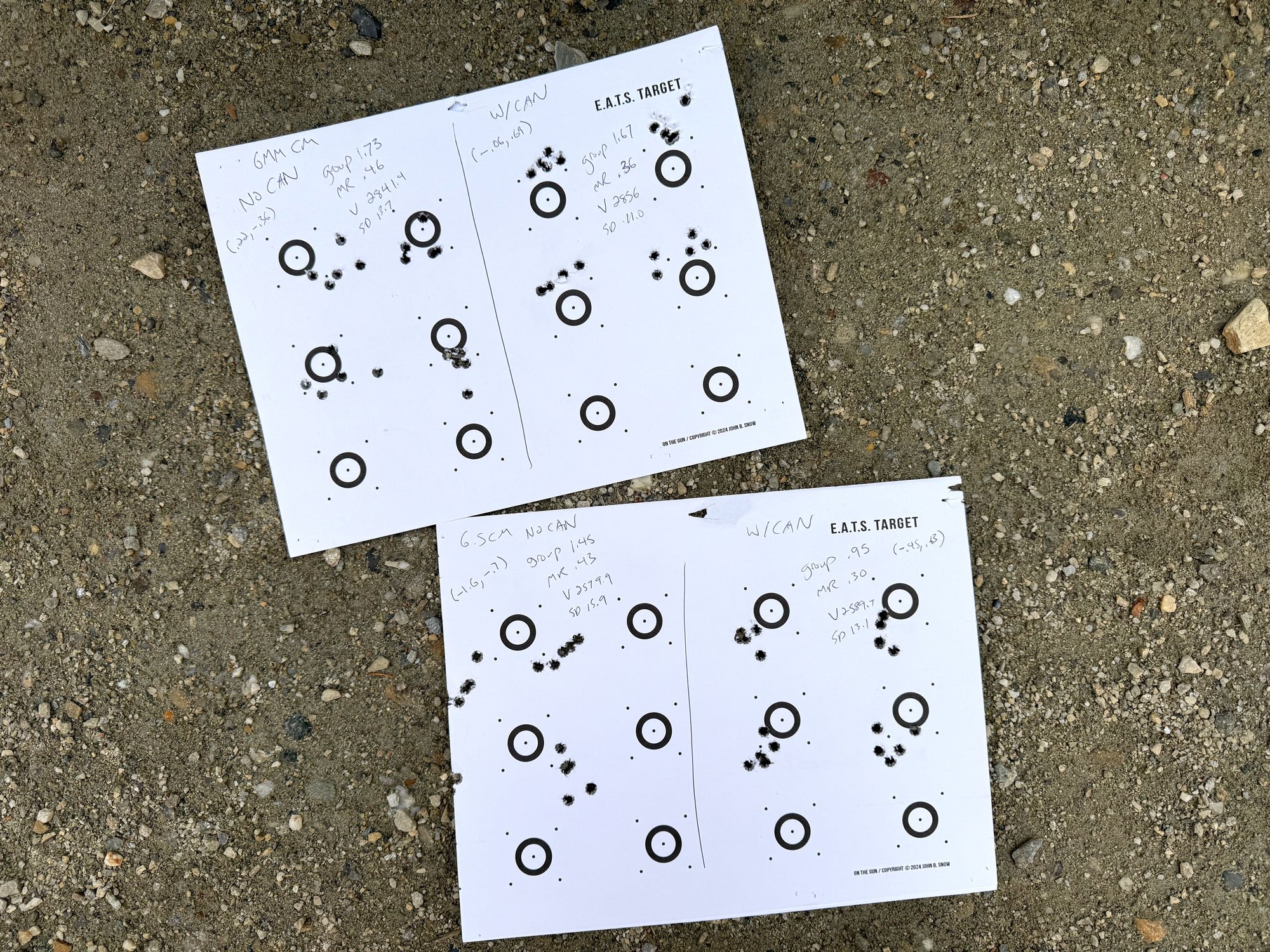
When we collect a 20-shot accuracy sample, we usually fire it in four five-shot groups, allowing the barrel to cool between. We then use software to aggregate those into one single group. Each time we do this, with the same rifle and ammo, it will differ slightly, but our figures generally fall within a range of 15 to 20 percent. We call that the noise. If results stray outside that range, that starts to mean something.
For this particular demonstration, I used a 6mm Creedmoor, 6.5 Creedmoor, and 22 LR. I collected 20-shot samples with and without a suppressor on each gun. For both of the centerfires, groups were tighter when a suppressor was added, by about 25 to 30 percent. The rimfire groups with the suppressor were less accurate by about 23 percent, which is not quite as definitive. Considering the switchy winds shooting the slow 22 LR bullets at 100 yards, it’s likely within the noise.
Anecdotally, I’ve generally seen accuracy improve when adding a suppressor. This could sometimes be because the extra weight on the muzzle dampens the vibrations of the barrel. But, often, I think it simply makes rifles easier for people to shoot. Long term, a suppressor can help you shoot the rifle more accurately because it eliminates blast along with reducing the sound of the shot and felt recoil. Using this format, you can easily test your system for yourself.
| Rifle | Group Size/Mean Radius Without Suppressor | Group Size/Mean Radius With Suppressor |
| 6mm CM | 1.73 in. / .46 in. | 1.67 in. / .36 in. |
| 6.5mm CM | 1.45 in. / .43 in. | .95 in. / .30 in. |
| 22 LR | 2.08 in. / .59 in. | 2.54 in. / .77 in. |
The Cold Bore Shot
A commonly known phenomenon with suppressors is first round pop. This term refers to the tendency, especially on older, more primitive suppressor designs, for the first round fired from a cold can to be louder and sound distinctly different than subsequent rounds fired while the suppressor is still full of smoke and hot gasses. A common theory is that the cold-bore shot with any rifle will be slightly different from shots fired through a warm barrel. People say the same thing about the first shot through a cold suppressor.
To test this theory, we took two of our rifles and fired 20 individual shots, removing the suppressor and cooling it before re-attaching it and firing again. This, in theory, gives us more consistent conditions in the suppressor to simulate 20 cold-can shots.
With the 6.5 Creedmoor, the accuracy was virtually identical, with the average point of impact, or group center, moving about half an inch. That might seem like a definitive change, but I’m not convinced. I’ve tested hundreds of 20-shot samples, and every time you shoot one, the point of impact will shift slightly. For rifles and ammo that are truly sub-inch, that variation is usually within about .25-.35 inches, or 0.1 MIL. For rifles that are between 1.0 and 1.5 MOA, for 20 shots, that variation increases a bit. Considering we totally broke position and removed the suppressor between shots, that doesn’t indicate a shift outside the normal shot distribution.
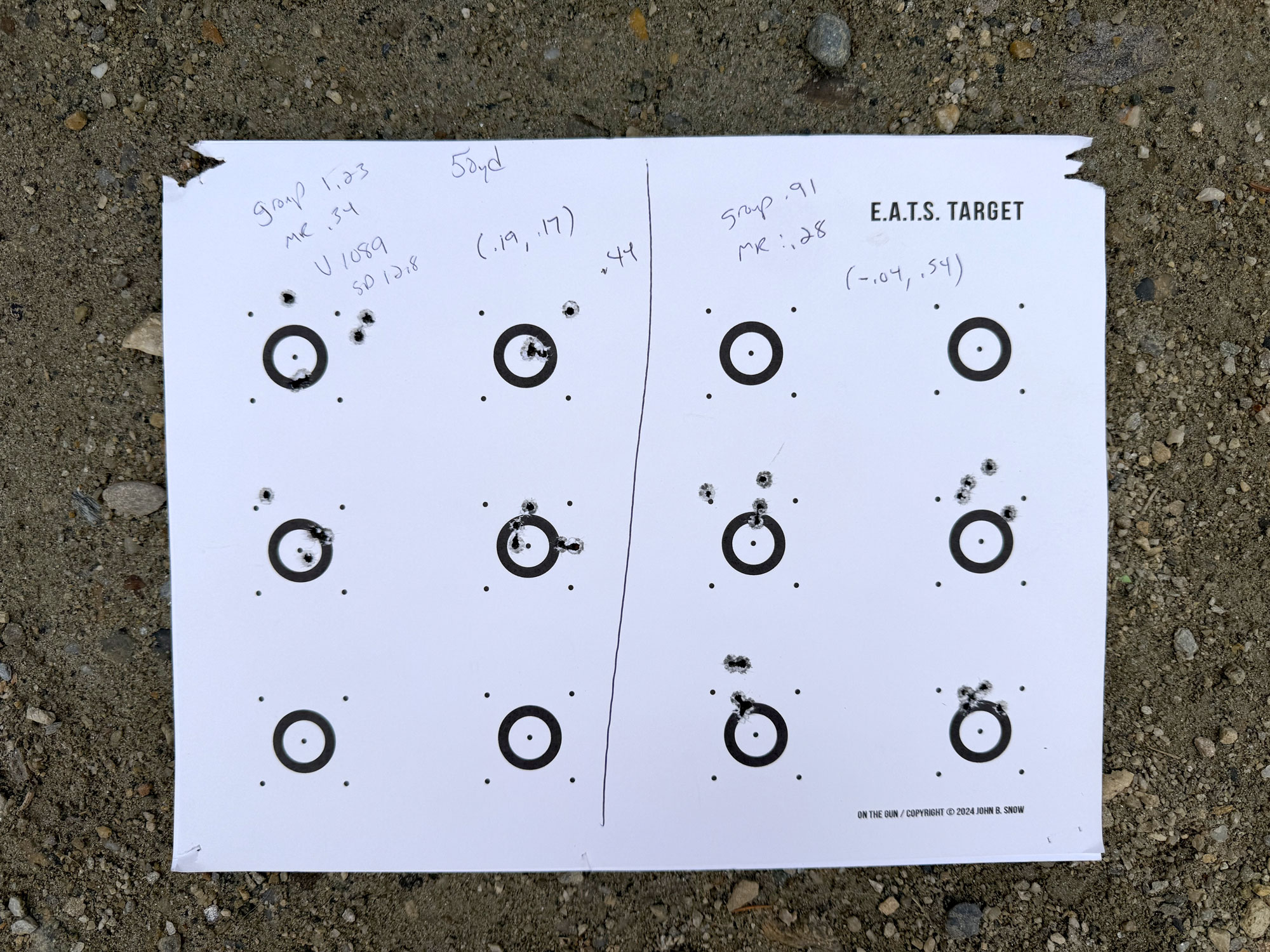
With the 22, we shortened the distance to 50 yards to reduce the wind influence, and accuracy was better when firing four five-shot groups normally. I also saw a shift of .44 inches in mean point of impact. Again, I think the nature of a cold shot with a freshly-built position has more to do with it than the influence of a cold can. But I have noted distinct first-round shifts with some 22 suppressors, so that’s something you should test on your own system to determine.
What Will Cause Suppressor Accuracy Issues
There are certainly examples of suppressors causing accuracy or point of impact problems, but the root causes are usually pretty simple. First, adding a suppressor will certainly change your point of impact, though it won’t hurt accuracy. This is due mostly to adding the weight to the end of your barrel. If you add a suppressor, you’ll need to re-zero. With a repeatable system, removing and re-attaching the suppressor won’t change your zero.
When you add a suppressor, make sure to use a cleaning rod or something similar to check alignment. I recently, and foolishly, screwed a budget-priced suppressor on my muzzle and started shooting, only to see my point of impact about six feet to the right at 100 yards. The suppressor adapter was way out of alignment and I’m lucky I didn’t get an endcap strike and destroy the can. If you notice a big change, be sure to double-check alignment.
The most common source of accuracy woes with a suppressor is a loose can. Many hunters prefer a direct-thread option, including me. But, especially before threads get fouled, cans can loosen pretty easily, and if they crack loose, it will absolutely shift your point of impact. We demonstrate that in the video by firing a 20-shot aggregate with a suppressor that is just barely loosened. Precision was still good, but the point of impact moved enough to potentially make me miss an animal at distance.
Final Thoughts
The takeaway from all of this isn’t that all suppressors will make all rifles more accurate, or less accurate. Rather, a demonstration that generally, it’s not a big difference, and you are now equipped with the tools to efficiently and effectively determine what’s true for your rifle system.