
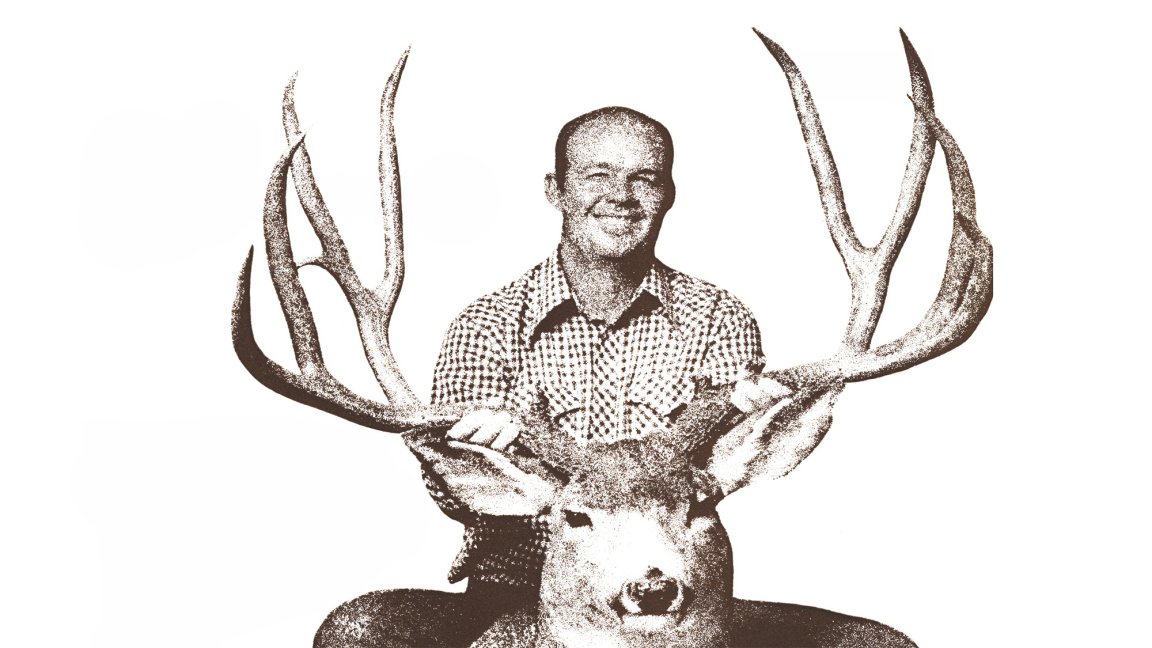
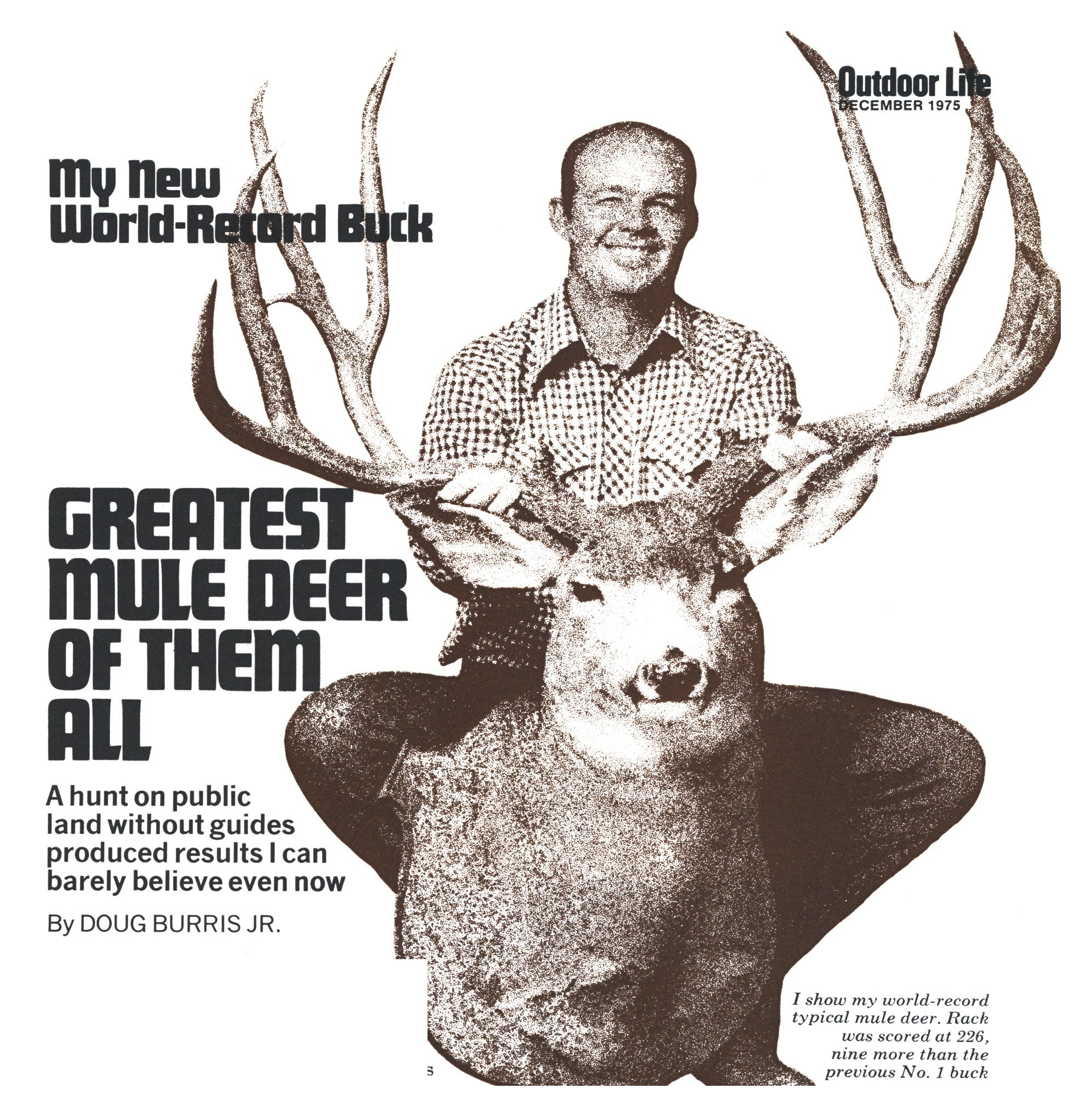
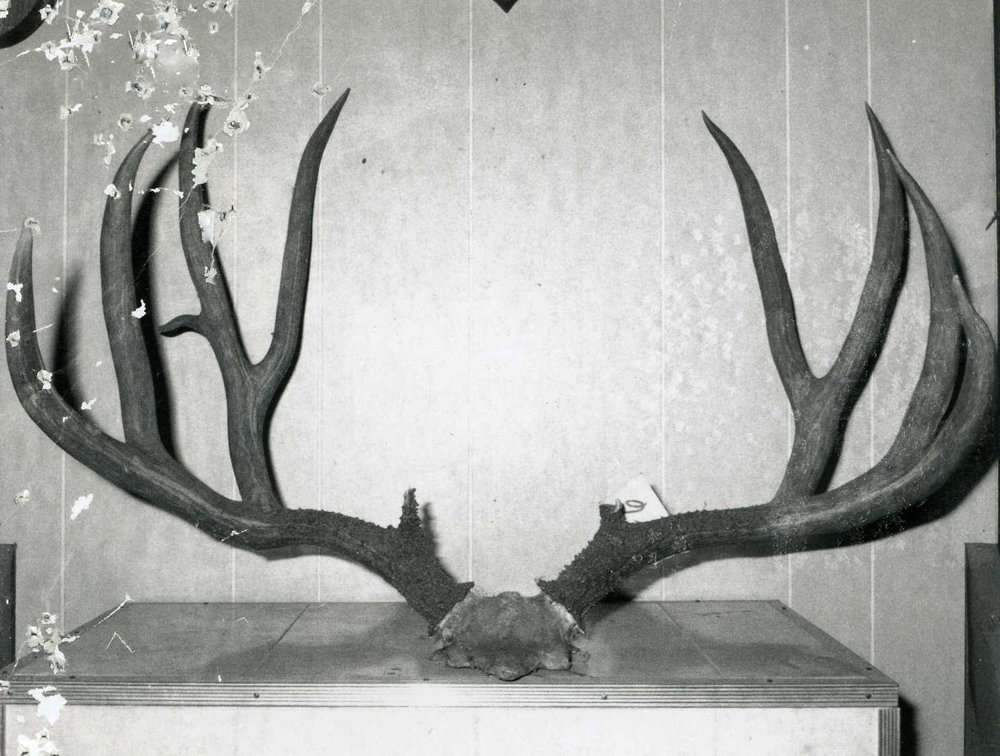
This story, “Greatest Mule Deer of Them All,” appeared in the December 1975 issue of Outdoor Life. Burris’ buck remains, all these years later, the No. 1 typical mule deer buck ever taken by a hunter, according to the Boone and Crockett Club. The antlers are now owned by Cabela’s. Burris tagged the buck on Oct. 19, 1972 in Dolores County, Colorado.
I was walking the edge of a small canyon in Colorado’s San Juan National Forest when a rifle roared half a mile or so ahead of me. Till then I’d figured on stillhunting to a plateau covered with scattered oak brush 400 yards north of me. A clump of brush there would have been a fine place to take a stand.
When I heard the shot I decided to get to a vantage point on the plateau as fast as I could, so I took off at a dead run. I was almost on the plateau when I noticed movement in the oak brush and aspens on the other side of the canyon. I slammed to a stop and stared at the biggest deer I had ever seen. His body was enormous, and his rack seemed large enough for an elk.
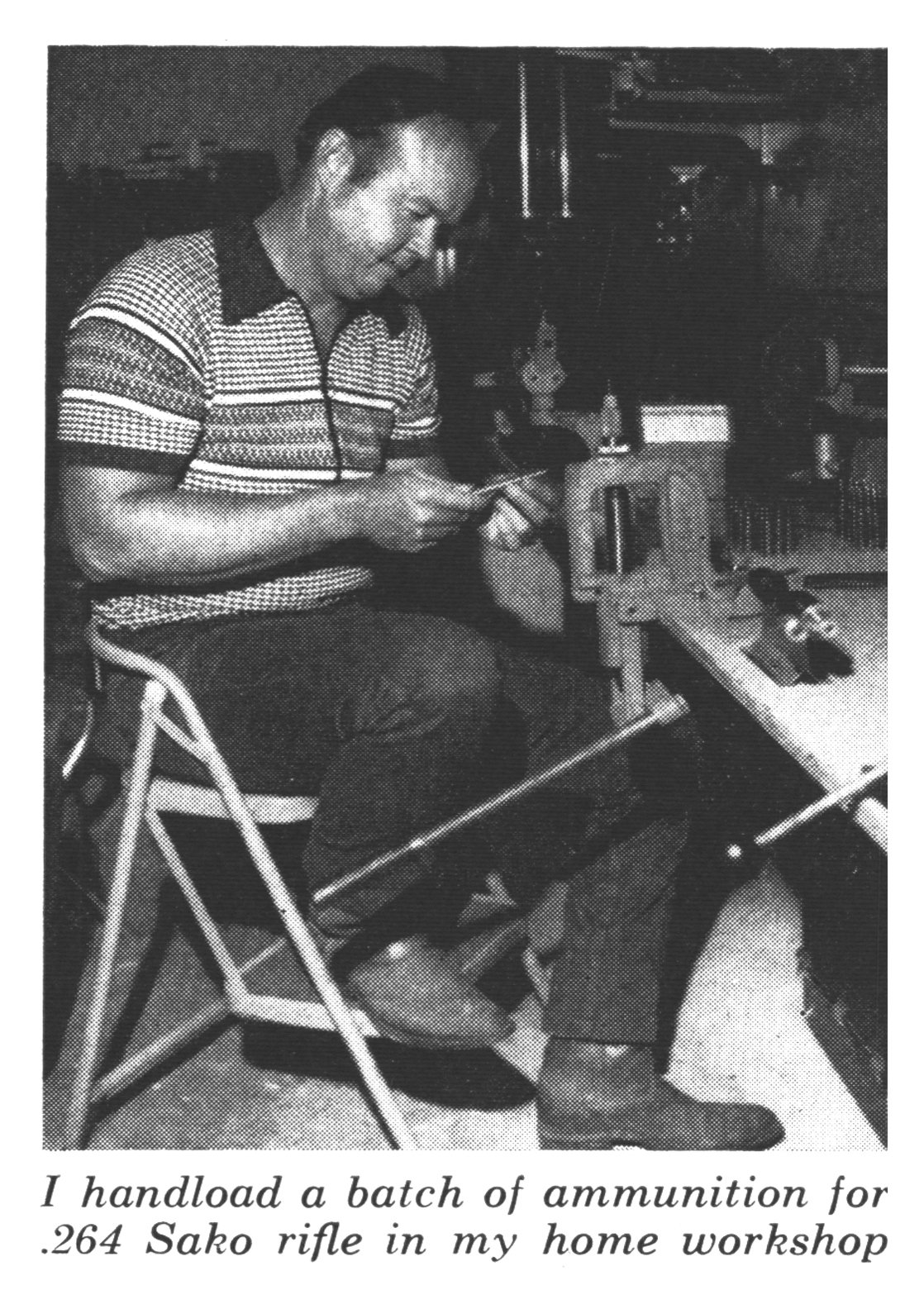
He wasn’t running flat out, but I knew I had to shoot in a hurry. The range was about 250 yards. The buck was moving up the canyon and away from me when I found him in my Leupold 3X-to-9X scope, I put the crosshairs on his back and touched off my Sako .264. He went down in his tracks. My big-game handloads consist of 125-grain Nosler bullets backed with 66.5 grains of No. 4831 powder. It’s a very potent load.
I watched him for a while to make sure he wasn’t going to get up, and then I ran down a side canyon and up the other side of the big one to the fallen buck. When I ran my hands over the huge 18-point rack, I knew the antlers were very good. I was sure the deer would score high in the Boone and Crockett Club’s record book.
If someone could have told me that my 1969 Colorado buck wasn’t even good enough to make the minimum score for listing in the record book, I wouldn’t have believed him. That’s the way it turned out, but a still bigger deer was ranging the same stretch of country.
I’m 37. My wife and I live in Seguin, Texas, with our 17-year-old son and two daughters, aged 15 and eight. I’m a construction superintendent with an outfit that builds shopping centers, high-rise office buildings, and similar units.
Except for 3½ years spent in the U.S. Air Force, I’ve lived in Texas all my life. I began hunting when I was seven. My dad got me started and taught me to be a good hunter. I killed my first Texas whitetail when I was 13, and I’ve been nuts about deer hunting ever since. Though many of our Texas deer are so small we call them jackrabbits, we do have some large whitetails in the southern brush country. Some of those bucks field-dress at 200 pounds or a bit more, and some have exceptional antlers. Many years of hunting brush-country deer gave me trophy-hunting fever.
I have always wanted to hunt Dall or Stone sheep in Alaska or British Columbia, but I’ve never had the money or the time. I finally decided that the next-best thing was to stay with deer and hunt trophy antlers.
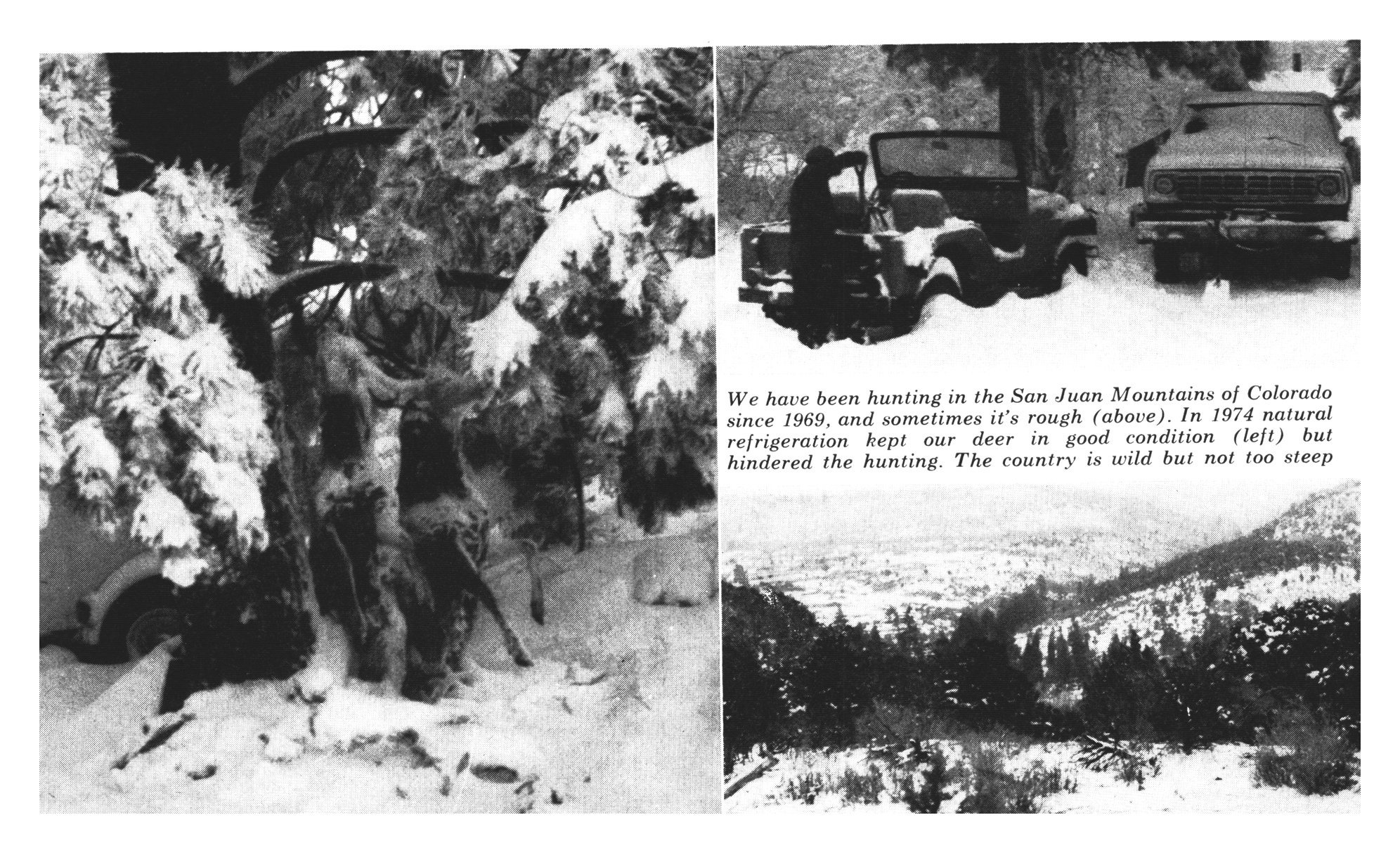
My interest in camping had a lot to do with that first mule-deer hunt in Colorado in 1969. My friends and I have several four-wheel-drive vehicles and an assortment of camping gear. Charlie Fuller of Floresville, and Jack Smith of San Antonio, do a lot of hunting with me. Jack is my age. He’s a carpenter. Charlie, a few years younger, has a fertilizer-application operation. Both like to hunt deer the way I do, and they like to camp. Early in 1969 we decided to hunt in the mountains where we could camp on public land and do without guides and outfitters. We call it a “poor-boy hunt.”
I did quite a bit of research on trophy mule deer before we chose the San Juan National Forest. From what I’d read in Outdoor Life and other outdoor magazines, I knew that many giant bucks were taken not too far from the Four Corners, where Utah, Arizona, New Mexico, and Colorado touch.
I also bought a copy of the 1964 edition of the Boone and Crockett Club’s book, Records of North American Big Game. Study of the section on mule-deer trophies backed up my contention that southwestern Colorado would be a good place to go. We knew there were better bets, such as the Jicarilla Apache Reservation in New Mexico, but we couldn’t get permits, and we wanted to go into country where we could camp on public land. We eventually drove to Cortez, Colorado, and hunted northeast of town.
The three of us all got bucks that first year, and my big buck had a rack that measured 41 inches across the outside spread. Each antler had “cheater” points extending horizontally from the outside curves of the main beams. Though the rack had a very unusual spread, the tines weren’t very long, and that’s why my trophy didn’t make the record book.
When I killed the deer, I didn’t know much about official scoring systems for big game, but I did know that where there was one grandote (a Mexican term we use for big bucks) there should be more. We didn’t need a better reason to head back into the same area. We’ve never been sorry.
The second year, I got a buck with a 33-inch outside spread. The third year, I was lucky enough to come up with another good deer. Every season I’ve hunted in those mountains, except one, I’ve taken a buck with an outside antler spread of 30 inches or better, and other members of my party have taken very good bucks too. Many hunters in the area kill deer with spreads as narrow as 12 inches. Every fall I pass up many deer to get the best one I can find.
Most of the men in our group hunt that way. We all love the mountains, and we like to hunt hard from dawn to dark. We don’t want to miss one minute of hunting on these trips. None of us will take a small buck unless time is running out on the last day.
I don’t want to imply that we’re trophy crazy. Much of our pleasure derives from the planning and preparation that goes into our hunts and the talkfests that go on for months after each trip. We make the most of camp life too. I’m usually the cook because I enjoy it. We come into camp each evening, warm up by our wood stove in the cooktent, swap stories about what happened during the day, and take our time over meals while we plan the next day’s hunt. Then we sack out early enough for a good rest so that we can do it all over again.
We go back into the Cortez area each year because it has proved itself, and because our camping gear is suited to that kind of country. We’re not equipped to backpack into remote areas or pack in with horses.
Our cooktent, which also serves as a community area, is a 14 x 16-foot wall tent. We have 9 x 12 Coleman sleeping tents. Everybody contributes something to our outfit. We found out during our first trip that it’s best to take plenty of blankets and raingear.
On the front end of our trailer is mounted a large box in which we pack all our food and some other items. If the weather is warm during our hunt, we have all our venison butchered, wrapped, and quick-frozen in Cortez. We pack the meat and dry ice in the box for our trip home. If the weather is cold, we hang our field-dressed deer from a game pole and then haul them home whole for butchering there. Either way, the venison we put in our freezers provides delicious meals far into the winter.
We make our trips from Texas to Colorado with two 4WD’s. The big unit is my three-quarter-ton Dodge Power Wagon equipped with a winch. Behind the Dodge we tow a Jeep on a 20-foot trailer. We usually ride in the wagon and pack the Jeep and the trailer with gear.
Our average cost per man totals about $155, and that includes Colorado’s nonresident deer license ($50). A big chunk of the rest of each man’s expenses goes for gas. We drive straight through from Texas. That takes 20 to 24 hours, depending on driving conditions. We use the Jeep each day to put men out in hunting areas, so we burn a lot of gas. We bring plenty of steaks and a normal supply of groceries such as beans, potatoes, flour, canned goods, breakfast mixes.
I don’t want to imply that we’re trophy crazy. Much of our pleasure derives from the planning and preparation that goes into our hunts and the talkfests that go on for months after each trip. We make the most of camp life too.
We plan to arrive in our hunting area the Thursday before the Saturday opener of the deer season, which is always in late October. It takes two days to set up camp, get organized, and do a little scouting. We figure on hunting three to five days, but we do not set up a hard-and-fast schedule.
As few as two men have gone to Colorado with me and as many as eight, but everything seems to go along smoothest with about four in the party. In 1972, the year I shot the world-record mule deer, there were four of us. Jack Smith went along, but Charlie Fuller couldn’t get away. Robbie Roe and Bruce Winters were my other partners. I knew them through my job, and we had done a lot of hunting together.
We drove up into Colorado and camped in the same spot I’d picked out four years earlier. I knew the hunting country fairly well by that time, and I had selected five specific areas that seemed to hold the most deer and the biggest bucks. They’re all laced with relatively thick oak brush, some aspens, and a few pines. Thick oak brush is the key to success. If you’ve got tangles of that stuff and lots of them, you’re going to find deer.
The oak-brush areas most attractive to deer run to broken terrain in the form of canyons and side canyons, plateaus, and mesas. The best technique for hunting that kind of terrain is a combination of stillhunting and standing. I like to stillhunt the plateaus and small canyons. I’ve learned that deer work the small finger canyons and get down into the very bottoms of them. They range back and forth through the canyons, often go up on the mesas and plateaus.
That’s why the combination of hunting techniques works so well. When I’m stillhunting I often spot deer ahead of me or across a canyon or draw. If I take a stand on a good vantage point I may have deer working toward me.
The problem is that deer may use one area today and vacate it tomorrow. So I choose an area and hunt it out. If deer are there, I stick with it; if they aren’t I move to the next area. That isn’t hard to do, because the San Juan country is mostly rolling terrain, and the altitude is only about 8,500 feet where we hunt.
Our first day of hunting in 1972 began in typical fashion. We checked the wind direction before dawn and decided on the areas each man would hunt. Then we piled into the Jeep and headed up a mountain two-track. I dropped Robbie off first and then Bruce. A few miles farther on, Jack got out of the vehicle. Dawn wasn’t much more than a dull-gray promise in the eastern sky. The black void above us was spitting drizzle.
“Robbie and Bruce will walk back to camp whenever they feel like it,” I told Jack. “You want me to pick you up at a set time, or do you want to hunt all day in the rain?”
“I’ll meet you right here at dark,” Jack answered.
I knew he’d say something like that. Jack likes to hunt as much as I do.
We all saw many deer that day, but all the bucks were small. None of us fired a shot.
But I came very close to filling my tag on the second day of the hunt. It drizzled again, and I just ambled along till 10 o’clock. Then I got real serious about my stillhunting. I don’t know why, but the really big bucks in that area seem to move mostly from 10 in the morning till about 1 in the afternoon.
About noon I spotted a deer in thick oak brush 200 yards ahead. We were both on a plateau. The animal was a big one, so I assumed he was a buck, and I started moving in on him. My stalking was quiet because everything was wet, but I couldn’t close the distance very fast in that thick brush, and the deer kept moving away from me as he browsed.
At one point I saw part of his rack, just enough to know the antlers were in the trophy class. The excitement ended when I tried to cut him off at the edge of the plateau. When I got there, he was gone. I’ll never know whether that buck sensed my presence or went off on a predetermined course.
When Jack and I got back to camp two bucks were on the game pole. Robbie had nailed a five-pointer with his 7-mm. Remington Magnum rifle equipped with a Leupold scope. Bruce’s deer was also a five-pointer, but the antlers were heavier. Bruce collected his venison with a Winchester Model 70 .30/06 rigged with a Leupold scope.
When we awoke the third morning, the dad-gummed drizzle was still with us. I suited up in my Browning raingear and filled my pockets with dried fruits and jerky. I knew it would be another long day before I could bake myself beside the wood stove in the cooktent. I dropped Jack off on the trail and then drove on and parked near the area I had hunted the day before.
A slight breeze was coming down off the mountain, so I decided to stillhunt into it and get farther back into rougher country. About 9 o’clock I started into a 400-yard-wide canyon and began working up toward one rim. I was about three-quarters of the way to the top when I spotted two bucks feeding in a clearing 1,000 yards away in the canyon. I stopped and watched them for several minutes because I was astonished that I could see their racks from such a great distance with the naked eye.
Then I looked at them through my Bausch & Lomb 7 x 35 binoculars. Both were definitely in the trophy class. It was fairly late in our hunt, so I decided it was best to cash in on one of them. I’d make the stalk and decide which rack was best when I got within range.
I was about three-quarters of the way to the top when I spotted two bucks feeding in a clearing 1,000 yards away in the canyon. I stopped and watched them for several minutes because I was astonished that I could see their racks from such a great distance with the naked eye.
I eased on through the oak brush for about 200 yards and busted out a doe. She pushed on ahead of me. I didn’t think she would spook the bucks, but I watched them for several minutes to make sure. They continued feeding away from me up the slope. I could keep them in sight at this point because they were still in a clearing.
I eased back into some cover and stalked ahead for about 45 minutes while the drizzle came on stronger and stronger. During that time I didn’t see the bucks, because they had moved into a patch of brush, but I was pretty sure they were still nearby. I would have seen them if they had moved out on that slope. There was a 75-yard-wide opening at the top of the canyon, and I would have seen or heard them if they had run back toward me or along the canyon bottom.
An additional 30 minutes passed before I decided I couldn’t be more than 200 yards from the deer, but I still couldn’t see them — the patch of brush was up to 10 feet tall. Then I busted out a doe again. She crashed along toward the bucks. I figured they’d spook, so I took off at a dead run for an opening 20 yards ahead of me. If I was going to do any good, I had to shoot in a hurry.
Just as I broke into the opening, three deer ran into view. Two were the bucks I’d been stalking; the third was still bigger. He was lagging behind, and even in the split-second I had to shoot, I knew he had the best rack by far.
My handloaded Nosler 125-grain bullet flew 300 yards, ripped into the buck’s heart-lung area, and blew up. He stumbled, hit the ground, and lay still.
When I examined the antlers — six unbelievably massive tines on the right side and five on the left — I knew I had killed the finest trophy buck I’d ever seen, but I had no idea that he was the best typical mule deer ever taken. The enormous body of the deer concerned me most at the moment.
Normally we can drive a vehicle close to our kills and then drag the deer out to the 4WD. But I was way back in rough country, and we couldn’t approach with a vehicle. It would have been impossible for me to drag that deer very far by myself.
I decided to hike out to the Jeep and drive back to camp for help. Since Robbie and Bruce had already killed their bucks, the odds were they would be in camp. They were. We went back to my deer, dressed and quartered it, and packed the quarters and the head out to the vehicle. When we returned to camp we found Jack waiting for us. He needed some help with a heavy-antlered five-pointer he’d killed with his .270 Weatherby Magnum. By the time we got that buck out, the day and the hunt were finished.
When I got home I took my buck’s head and cape to taxidermist Ed Schlier in San Antonio for mounting. He’s an official measurer for the Boone and Crockett Club, so we rough-scored the green antlers. Our preliminary figures indicated my buck would be among the top 10 listed in the typical-mule-deer category. That was exhilarating, but I didn’t think much more about it till one night several months later when my phone rang at 1 a.m.
“Doug,” Ed blurted out, “I think your buck may be the best typical mule deer ever taken. I scored the antlers this evening, and I couldn’t believe it when I came up with a total score of two-hundred twenty-six! That’s nine better than the previous world-record typical mule deer. I’ve been double-checking my figures for hours, but they always come out the same. If they hold up with Boone and Crockett officials, you’ve got a new world record. I figured that news was worth waking you up.”
It sure was, but it was just the beginning.
The North American Big Game Award Program — jointly sponsored by the Boone and Crockett Club and the National Rifle Association — requires that any big-game trophy likely to win an award must be rescored by a panel of judges. Accordingly, I sent the mounted head off to the program headquarters in Washington, DC.
In February 1974 the program coordinator phoned me and invited me to attend the Fifteenth North American Big Game Awards meeting on March 24 in Atlanta, Georgia. I guessed my buck had proven good enough to win some kind of award, but I was too busy to go to Atlanta.
That was my position till I received several more calls from other program officials. They told me that if I missed the awards meeting, I would very much regret it later, so I scraped together some cash, cancelled several appointments, and flew to Atlanta.
At the banquet I was presented with the award for the best typical mule deer taken during the most recent three-year award period. I also received official recognition for taking a new world record. In addition I won the Sagamore Hill Award, which is given only to hunters whose outstanding trophies are of great distinction. This award is the highest given by the Boone and Crockett Club. Only one may be given during any big-game-award period, and only 10 have been presented during the club’s history.
I was stunned. When I think about it, even today, I’m still stunned.
Finding the Next Record Mule Deer
Former shooting editor Jim Carmichel wrote a short sidebar about his predictions for the next record-book mule deer.
Bagging a trophy mule deer hinges on four key factors: 1) luck, 2) hunting skill, 3) a firm determination to pass up lesser deer, 4) a carefully conducted survey of the areas likely to produce big mule-deer bucks at a predetermined point in time. The last three are more or less under the control of the hunter, but the fourth requires a basic understanding of trophy development.
A look at the Boone and Crockett Club’s record book shows that a large percentage of trophy mule deer have consistently been taken from certain fairly well-defined regions. Equally significant is that the trophy heads from these regions have been taken within specific time periods. During the early 1960’s, for example, a good number of high-ranking bucks were taken at the Jicarilla Apache Reservation in New Mexico. It’s no secret that certain areas tend to provide the natural requirements (such as a rich mineral diet) necessary for the development of big antlers, and that certain genetic strains of deer tend to produce big racks. Arizona’s Kaibab area, to give but one example, is one of the regions well known for its ability to grow large-antlered mule deer. However, this doesn’t mean that these areas always abound with record-busting bucks. This is where the vital time element enters the picture.
Read Next: The Story of the Allison Buck, and the Best Opening Morning in Ohio History
If a big-buck-producing area is allowed to rest for a few seasons, with little or no hunting pressure, the bucks grow old and develop larger and larger antlers. Then word gets around about all the big bucks to be found there, and hunting pressure increases. In three or four years all the big trophy bucks have been killed off. When trophies become hard to find, the hunting pressure drops off, and the cycle begins again.
The smart trophy hunter keeps track of the best areas and keeps a discerning eye on the hunting pressure in these places. The idea, of course, is to get there a season or two ahead of the crowd.