
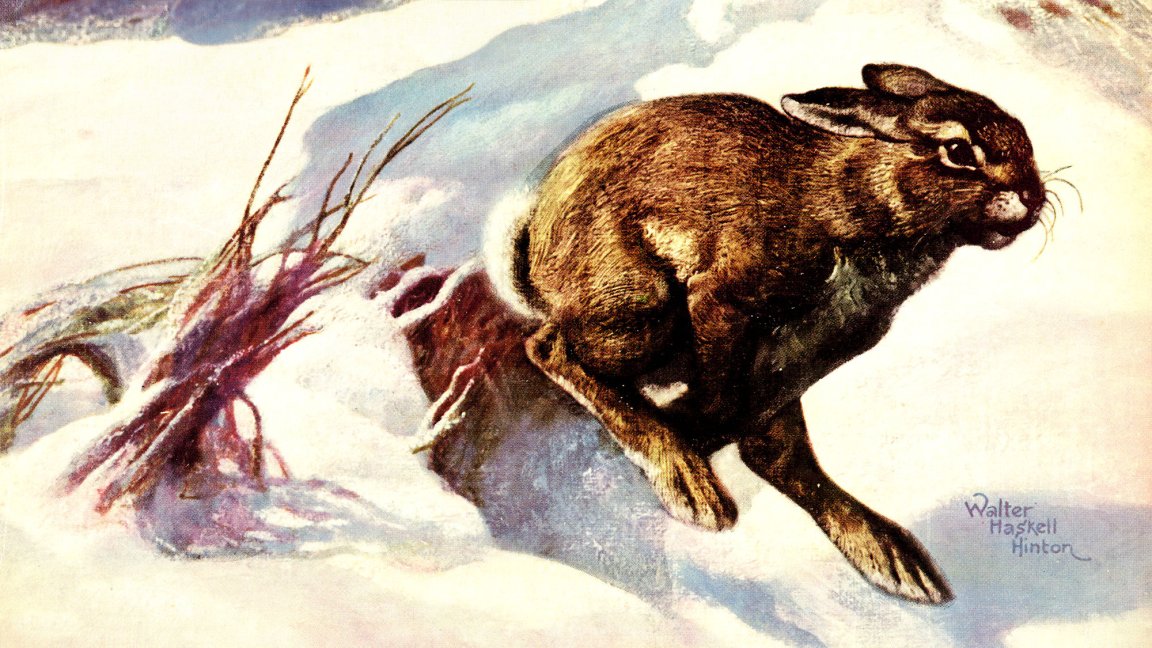
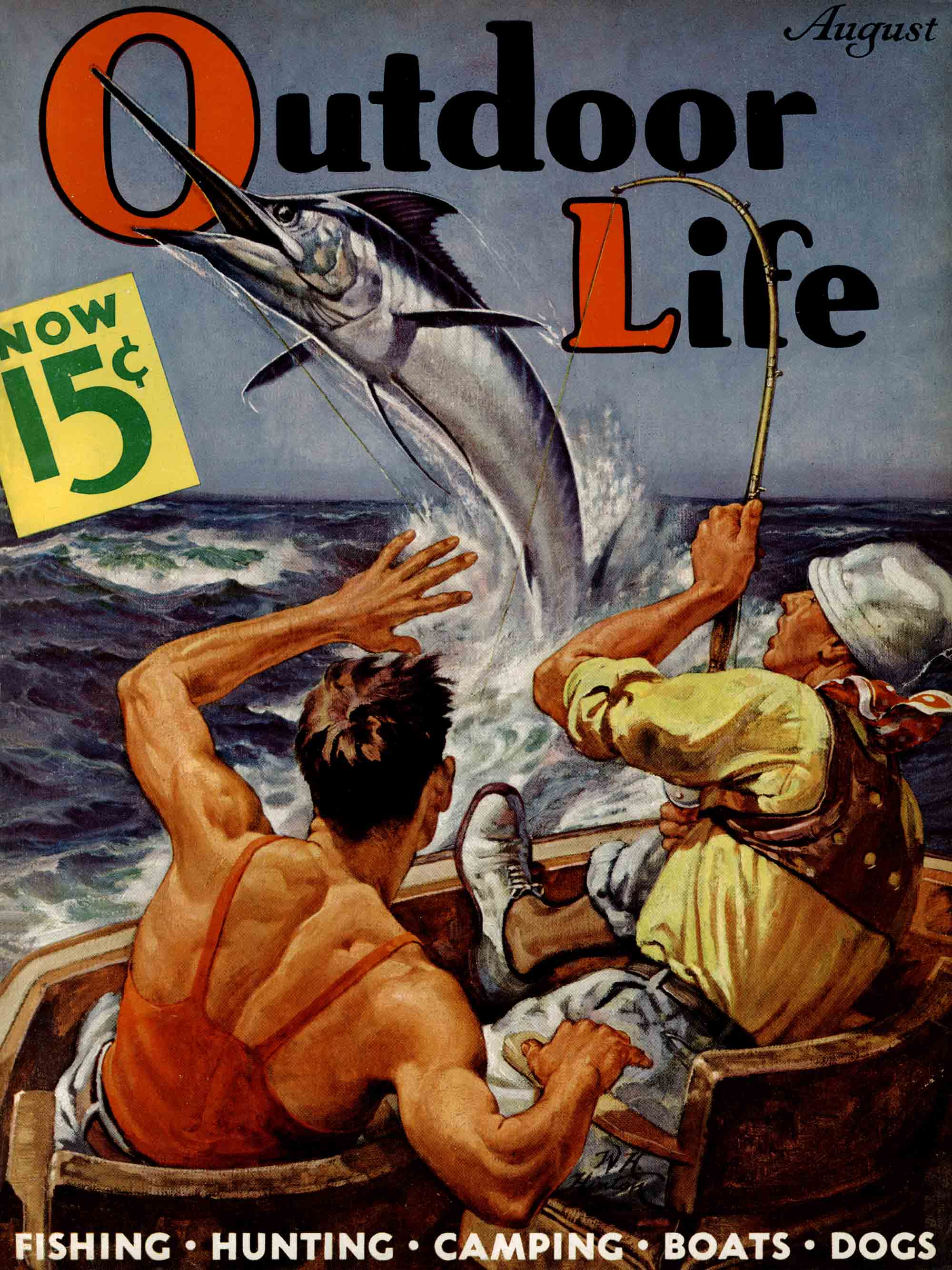
This story, “War Prisoners’ Bunnies,” appeared in the August 1938 issue of Outdoor Life. It describes the aftermath of an escape from a forced labor camp in Germany during World War I. While labor camps were notorious in World War II, they were less used — and also less publicized — in WWI. Some 4,120 Americans were held as prisoners of war in WWI; of those, there were 147 confirmed deaths. Many more POWs died from forced labor during WWII, including at the the Zollverein Coal Mine in Essen — the labor camp mentioned in this story.
A rabbit jumped into the ditch where we lay hid, and almost scared me out of my boots. Before I could recover my startled wits, it bounced out of the ditch again, and was gone. As my panic subsided, I had an idea. What starving man wouldn’t get ideas at sight of a plump rabbit?
I woke up Len Howard, who was sleeping behind me. Howard was an English soldier, who had escaped with me, two nights before, from the coal mine at Westerholt, a short distance east of Essen, Germany. I told him about the rabbit.
“A fat lot of good that does us now,” he complained.
“Ever use a sling shot?” I asked.
“What’s a sling shot?” he demanded.
I explained, and Howard”s face lit up. “Oh, yes, a catapult. Many a window I smashed with them when I was a kid,” he confessed.
“Well, when I was a kid out in Nebraska, I killed rabbits with them,” I replied, and, reaching in under my khaki tunic, I pulled out two rubber football bladders.
The bladders, and a leather casing, had been sent to me from England. The commandant at Westerholt had refused to let us play football, however, and I had brought the bladders along for Howard to use as water wings in crossing rivers on our way to the Dutch frontier. They also came in mighty handy as water containers, for that May of 1917 was sultry, and we needed plenty of water while holed up in hiding during the long, hot days.
The nature of our escape had made it impossible for us to bring food with us, and, as it was spring, there was nothing fit to eat in the fields. We had been gone two days, and I figured that it would be at least another five days before we could cross the border. After these two days of hunger, and nervous strain, I knew we couldn’t go much farther without food.
Now, our one hope of eating lay in the rubber of these bladders. With my knife, I ripped one of them into narrow strips. Then I crawled down the ditch, examining the bushes until I found a willow crotch that suited me. I cut this off, gathered an armful of dead, dry twigs, and came back to our hiding place.
“Surely you’re not going to light a fire?” said Howard, sharp alarm in his voice.
“That’s all right,” I assured him. “It’s dusk now, and what little smoke there is will merge with the mist in this low-lying country.”
He was a good, sturdy type of British regular, with plenty of guts, but he had been brought up in the city and, to him, fire meant smoke, and lots of it.
Using a French army dry-fuel cigarette lighter, I coaxed the twigs into flame, and then held the light, willow crotch over the tiny blaze until it was well charred, thus giving it strength.
Then, quadrupling the strips of rubber to give the sling shot plenty of power, I tied the ends tightly to each arm of the willow crotch. The top of one of my shoe tongues, made of good, heavy leather, I tied to the other ends of the rubbers. Now I had a weapon. It was crude, but, with luck, it would get enough food to keep us going.
“It might work, all right,” Howard admitted, “but what you going to use for ammunition?”
“Pebbles. David killed Goliath with one,” I replied. “It’ll be mighty queer if I can’t knock over a rabbit with the same thing.”
So, when, after dark, we set off again through the fields and woods, we decided to look for suitable ammunition in the first creek we saw. Around midnight, we came to a stream with a gravel bottom out of which we got smooth, round pebbles, ideal for the slingshot. Then we struck off across a level meadow. It looked like an ideal place for rabbits. We took off our boots, and sneaked along barefooted.
Suddenly, Howard grabbed me by the arm, and held up a warning hand. We froze. Then I heard the soft, muffled thump-thump-thump of a rabbit bounding toward us. When the bunny came in sight, I was as tense as if it had been a man-eating lion whose advance I was awaiting.
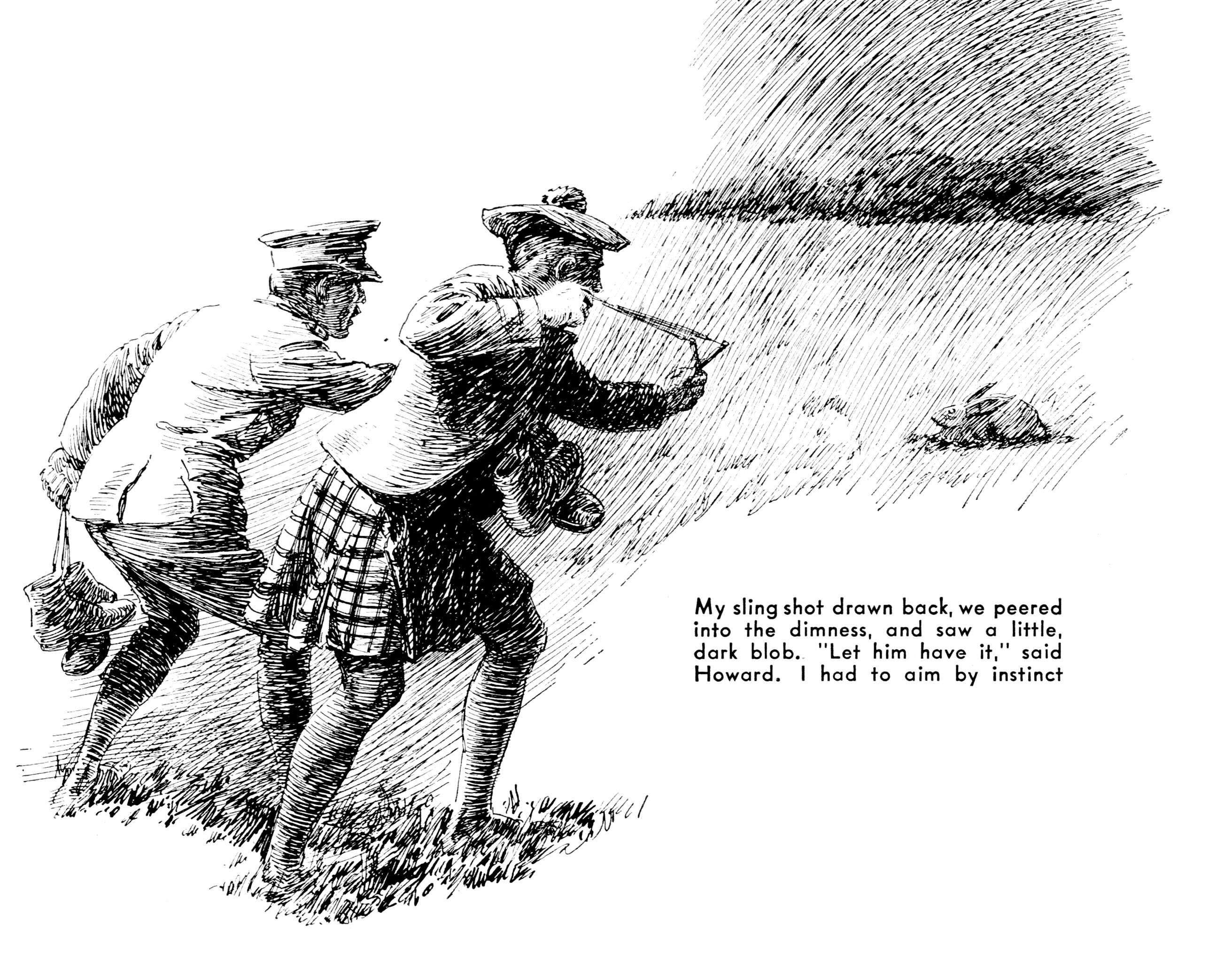
My sling shot was drawn back to full length as Howard and I crouched side by side, peering into the dimness. Then I saw a little, dark blob, about ten yards away.
“Let him have it!” whispered Howard.
I aimed by instinct, and let fly. The sling shot twanged, and I heard thesmack of the stone as it hit the turf. The rabbit gave a little bound to one side, and halted again. Feverishly, I put another pebble in the sling shot, and let go again. This time luck was with me. There was the unmistakable “thwuck” of a missile hitting flesh. The rabbit gave a faint bleat, and rolled over, kicking feebly.
No panther ever leaped on its prey with greater eagerness than Howard and I pounced on that poor, dazed bunny. We leaped with such abandon that we smashed into each other and fell. Then our clawing hands grabbed the rabbit and almost tore it apart.
“Let’s get into some woods and scoff it right now,” Howard urged.
“Too dangerous. Besides, we’ll lose time,” I demurred.
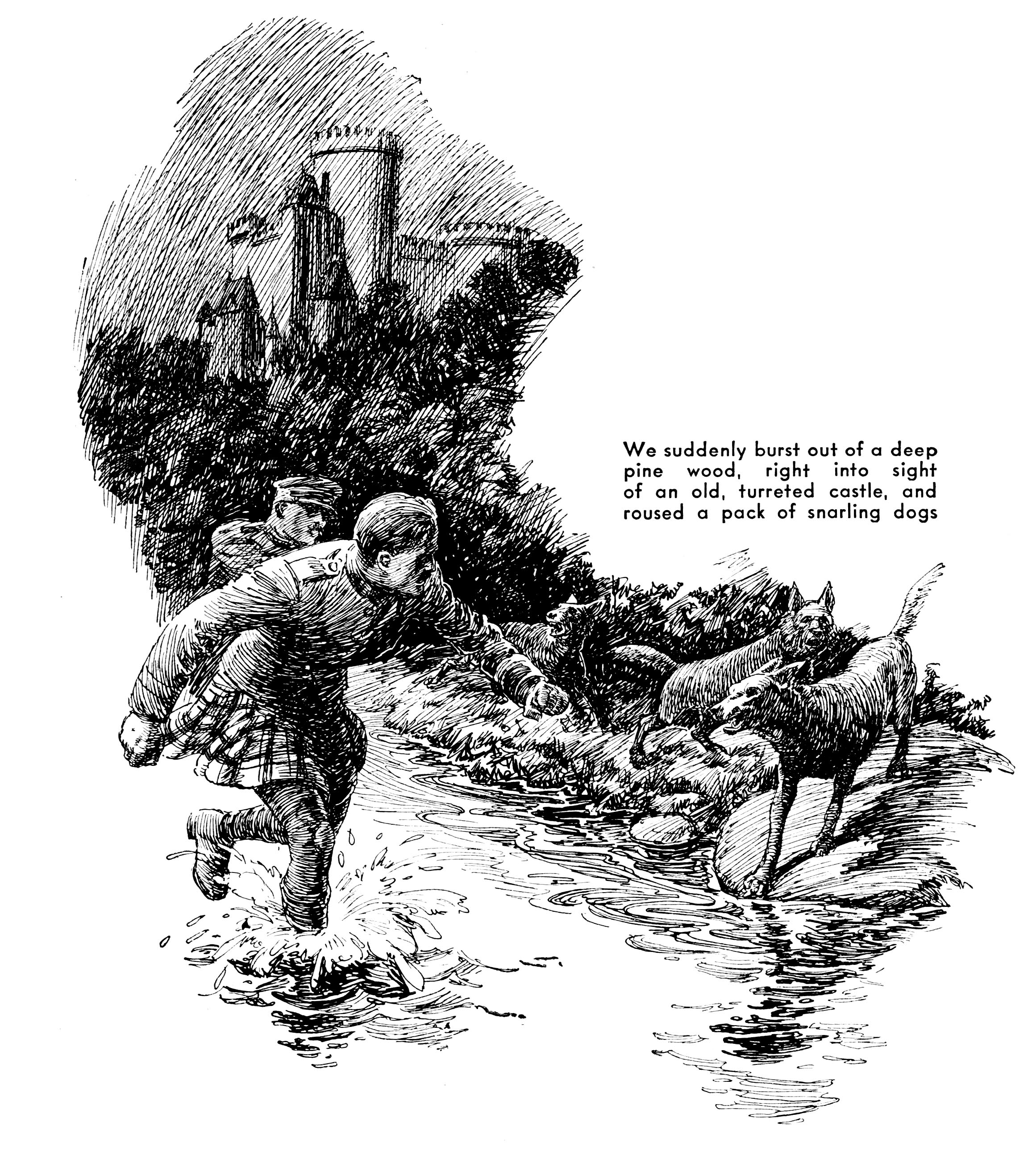
We had no trouble that night, except for an unexpected encounter with a pack of dogs later on. We suddenly burst out of a deep pine wood right into sight of a romantic-looking old castle with ivied turrets, and aroused the pack. The dogs gave us a bad fifteen minutes before we got rid of them by wading down a shallow creek for a mile or so.
Then, near daybreak, after filling our remaining football bladder in a stream, we got into a wild swamp, and in its depths, denned up in a brushy hummock, we barbecued the rabbit over a tiny fire of dry wood. We had no salt, but it was as fine a meal as I’ve ever eaten. The food gave us new confidence. Around dusk, I prowled around in the swamp for a while, hoping to get a pheasant or a rabbit, but no luck.
I was somewhat worried about getting Howard across the Lippe River, which we expected to strike that night. He could not swim. We were both somewhat worn and weak, and I didn’t feel so confident about my own ability to swim across.
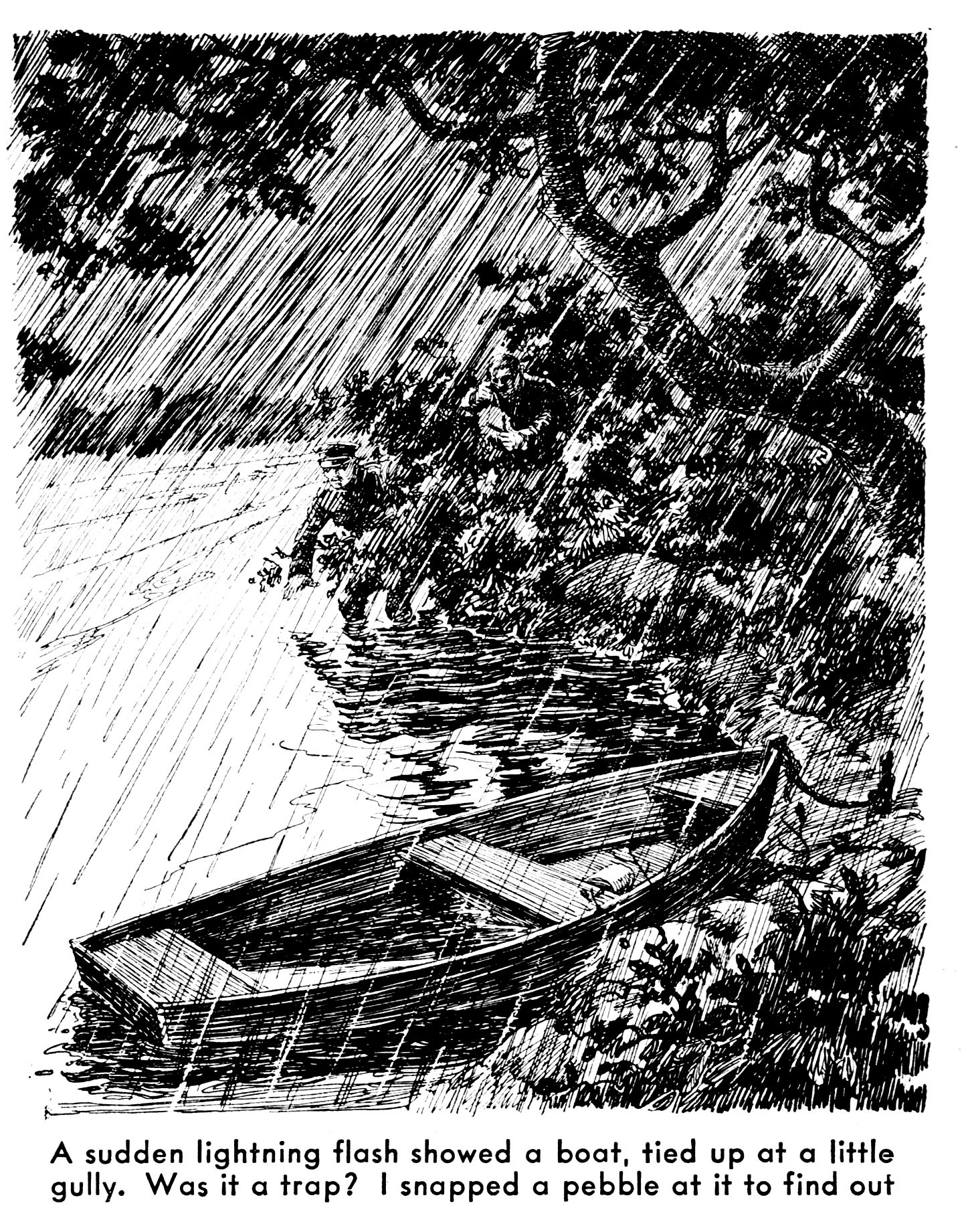
A tremendous thunderstorm came on at midnight, accompanied by a torrential fall of rain. We sloshed grimly ahead through the storm, and came suddenly onto the river, deep and dark, though not very wide. As we crept carefully along the bank, searching for logs to make a raft. A sudden lightning flash showed a boat tied up at a little gully. We lay in the bushes watching the boat. Was it a trap?
Was there a guard near that tempting boat? At each lightning flash we looked carefully, but were unable to see any sign of a sentry.
Lying flat in a kilt — I was in a Highland regiment — in a heavy rainstorm isn’t conducive to patience. I whipped out the good, old sling shot, warned Howard of my intention, and snapped two or three pebbles viciously into the dark bush by the boat. There was no sign of life, so we sneaked up to the boat.
It was a leaky, old, flat-bottomed craft, tied to a little picket. There were no oars with the boat, but a couple of tree branches served.
Howard was going to untie the boat, but I stopped him.
“Yank the picket out of the mud,” I suggested. “The river is bound to rise after this storm, and the owner will think that it was pulled loose naturally.”
Before pushing off, we dipped the branches in the river, and beat out our footprints in the soft mud. When we reached the other side, we threw the branches away, let the rope hang over the side of the boat, and thrust it out into the current,
Hitting off due north, through rolling, sandy hills, with clumps of pine and spruce here and there, we made good time toward the frontier.
“Not much chance of a rabbit here,” I complained.
“Never know your luck,” Howard replied cheerfully.
But I did know that the little rabbits hung around fields and cultivated land. I began to feel good and hungry again. Then, it began to get daylight and we were worried about a hide-out. We wanted deep woods, or a swamp. To the west we saw the dark line of heavy forest, and hit over that way. As we neared the woods, we almost ran smack into a little house. We skirted it, followed by the excited barking of a watchful dog, and came to a sandy field in which young carrots were just beginning to show.
“We stand a chance of getting something here,” I whispered.
“How about some carrots?” asked Howard.
I turned thumbs down on this idea, however. If we were going to lie up in the woods across the field, I didn’t want the farmer following the tracks of the guys who had grubbed up some of his carrots.
So we poked along, keeping as far as possible to hard ground, though it was all pretty soft and wet after the rain. Then, with a sudden whir that stopped us dead in our tracks, and almost made my heart jump out of my mouth, a bunch of pheasants flushed out of the carrots almost at our feet, and flew in a bee line for the woods.
“Watch them!” I snapped. “Maybe we’ll have a real old English dinner yet.”
I marked carefully where the pheasants had gone into the woods, and we set off hotfoot.
Stepping like a cat on hot bricks, I crept carefully among the trees. “Kawk-kawk-kawkle!”
I stopped as if a bullet had smacked me. My eyes bored into a big fir tree right ahead. Then I saw something a little darker in the heavy foliage, and knelt on one knee to get it outlined against the lighter sky. Again came that soft, warning cackle, like a cross between an indignant rooster and a deep-toned pigeon. Then I saw the long plumage of the tail.
With a prayer on my lips, I let drive with the sling shot. The pebble whacked into the branches, there was a wild beating of wings, and the pheasant fell in a fluttering heap on the ground.
Read Next: My Son’s Name Includes ‘Hunter’ as a Means of Remembrance
Once again Howard and I made a wild, flying tackle, and pinned the old cock. He turned out to be a pretty tough old bird, but we ate everything but the feathers and the viscera, and liked it! Roast pheasant au natural! Not so bad for starving men!
That was the last meat we had. Three nights later, we crawled on our bellies over the last two miles of open country, and crossed the frontier in a wild cloudburst that sent patrols under trees and into barns. At 4 o’clock next morning we were tearing ravenously into a wonderful breakfast prepared for us by a Hollander a mile over the frontier.
Since then I’ve hunted in tropical jungles and the Canadian subarctic, and done some high-toned shooting on the Scottish moors, but I shall always remember that “hunting trip” in wartime Germany as the most thrilling of them all.