
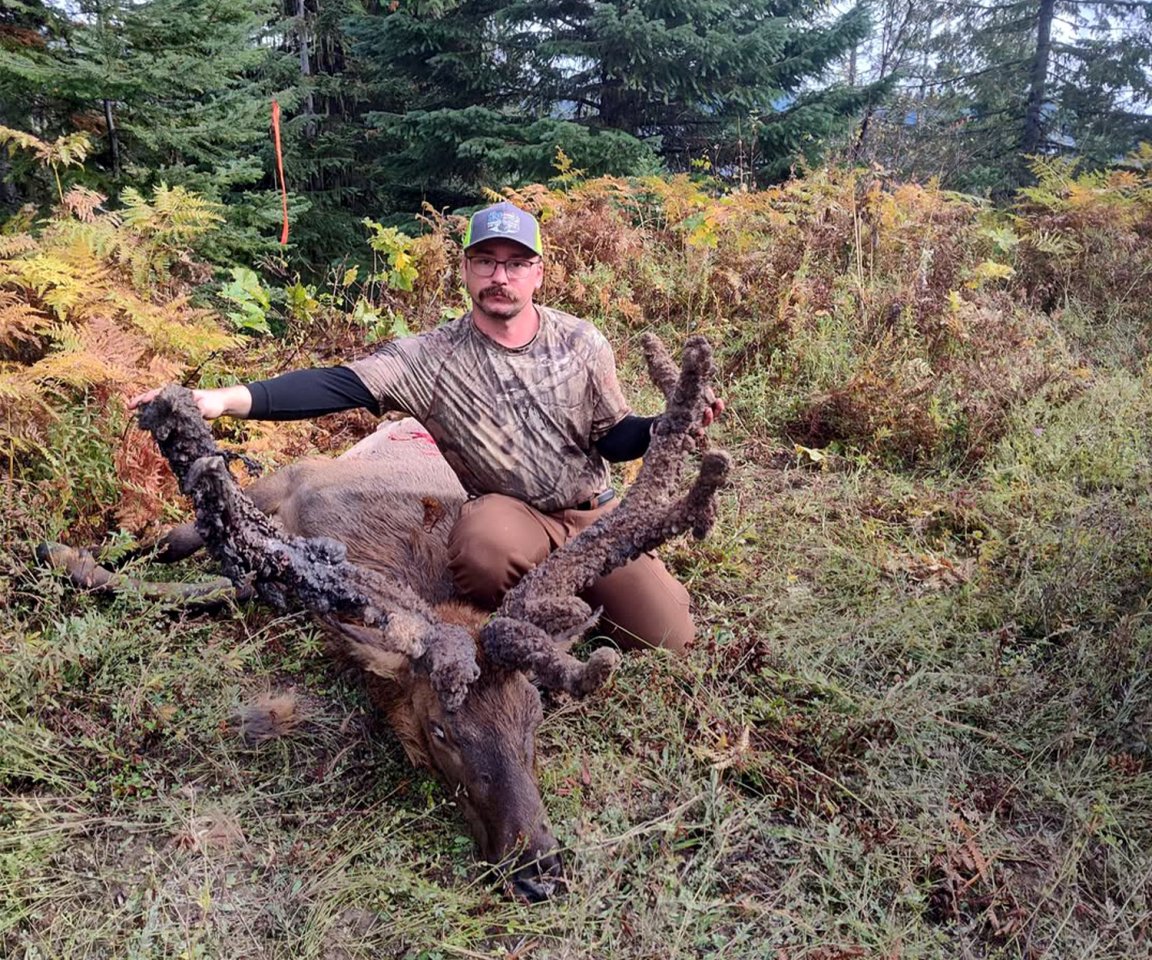
In a recent Facebook post in the North Idaho Elk Hunting group, Tonya Kiele shared a photo of her son with his first-ever elk, an extremely rare and gnarly looking “cactus bull.” The antlers are short but thick and heavy, with layers of velvet still attached. They look a lot like the arms coming off a saguaro cactus — thus the common name for such a unique animal.
“Once in a lifetime” is how Kiele described the bull, which her son killed Oct. 11 in Idaho’s Unit 12. Although she doesn’t share her son’s name in the post, she said in a comment that he killed the elk with a rifle chambered in 7mm-08.
“More like once in multiple lifetimes,” one commenter responded.
While still rare and unique, cactus bucks are more common in the whitetail world, with some taken by hunters most years. This is undoubtedly because there are far more whitetail deer than there are elk in North America. However, the cause for this kind of rack deformity is the same for both species.

In most cases, it’s either due to an injury to the animal’s testicles, or a hormonal disruption that prevents one or both testicles from descending normally. The scientific term for this is “cryptorchidism.” (Diseases like EHD and other viral infections can also cause the condition by disrupting hormone flow, but this is less common.)
Kiele spoke to the potential cause in another comment. She pointed out that the bull had “small balls” and likely had low testosterone.
“I’m guessing as big as he is it was an injury that happened after he was a few years old, and then they don’t lose their antlers after that and it just keeps adding to them,” she wrote. “It’s mostly soft like a bull in velvet, with a few spots that are hard like regular answers.”
Kiele also said that because of the bull’s odd antlers, they’re going to freeze dry them before sending the set to the taxidermist, who will then reattach them to the skull for a European mount. That way “the velvet won’t rot,” she explained.
Read Next: ‘I Hadn’t Shot a Deer All Year.’ Hunter Tags Unicorn Buck in the Final Days of Muzzleloader Season
With that extra work involved, they’ll most likely keep the mount. (Kiele did not immediately respond to a request for comment from Outdoor Life.) But at least one antler buyer has offered to purchase the rare rack.
“If he ever has the urge to sell it. Get ahold of us at J and M Antler Buyers,” one user wrote in a comment. “I’d pay him a lot of money for that one.”