
THE LITTLE four-place plane shook itself free from the runway in Nairobi and we were airborne. My third safari in Africa for OUTDOOR LIFE was underway. As we gained altitude we could see the sprawling city of Nairobi, the metropolis of East Africa—wide streets, tall new buildings, country homes, native huts.
All around us lay the mile-high Kenya highlands. We could see the snowcapped peak of Mt. Kenya with shoulders clothed in purple forest. Lower down were wooded hills, rocky outcrops, dry riverbeds white and parched. It was in October, toward the end of the long dry season, and the rolling plains were dusty and brown.
Then as we swept along 1,000 feet above the ground I saw our first game—a zebra herd in the thin shade of a group of the flat-topped acacias called thorn trees. From above they looked very small and very white.
I turned to my wife, who was sitting beside me dressed in her brand-new safari outfit of cotton khaki. “See the zebras?” I asked.
“Where?” And then she saw them. You could have knocked off her eyes with a stick. In a moment we were over a bunch of slate-gray dots that I knew were wildebeests, and a little later three giraffes, frightened by the shadow of the plane, went rocking off with their towering necks swaying.
“Golly,” said my wife. “Just like the pictures.” She tapped Syd Downey, who was sitting in front with the pilot. “It’s wonderful, Syd. We’re already seeing game and we’ve hardly started.”
“You should see a bit more,” he grinned. “We’re going to a rather nice place.”
Syd Downey, member of the firm of Ker & Downey, and dean of the East African white hunters, had guided me on my first African shoot back in 1953. Even then we talked around the campfire of the possibility of my coming back. No visitor can forget the sights and sounds of Africa—the roaring of the lions as the prides came out to hunt in the coolness of dusk, the sawing grunt of a hunting leopard in a nearby donga, the leaping impala, the great slate-gray buffalo, the zebra herds. A man’s memory holds the sight of bright close stars in the African night and the sweet, meadowy smell of the dry grass.
Since that first East African safari, I had hunted in India and Iran, in the Yukon and Alaska, and far to the west in the African continent on the fringes of the French Sahara. But always I remembered East Africa with acute nostalgia. With the increase of native population and the herds of cattle, it isn’t what it used to be before the war or even what it was when I was there in 1953. But there’s still no place like it. I know of no other hunting area in the world where one will see more game, get more interesting trophies, take better pictures, or have a more pleasant hunting trip than in Kenya and Tanganyika.
Syd and I corresponded about this and that through the years, and finally my wife and I decided to take the trip in October, 1959.
Our objectives on the trip were limited. The No. 1 trophy I was after was a leopard, something I hadn’t shot on two previous safaris. On my first trip, the game warden told me I’d save money by not getting a license for leopard. Chances were about 10 to 1 against my seeing one, he said. Those were poor odds for my $75, so I bought no leopard license. Thus I saw at least 10 leopards while I was hunting lions. About half of them offered good shots, but there was nothing I could do about it.
When I went to French Equatorial Africa in 1958, I found that my general license included a leopard. My companion, Elgin Gates, knocked over an enormous leopard. I saw not a one.
So on this third safari my principal objective was a good leopard, and Syd was taking us into a pet spot of his—a piece of unspoiled Africa where the combination of plentiful game, rocky hills for shelter, good water, and little hunting has resulted in a leopard paradise.
Also on our trophy list was a lion, a trophy that these days is one of the toughest to get in all Africa. Lions have gone down in numbers in recent years and more and more country has been closed to lion hunting. I also wanted to take another sable and to have my wife get one. And high on my list was the spiral-horned, elk-size antelope called the greater kudu.
Because the leopard range in northern Tanganyika was closed to lion hunting, we planned to fly down to southern Tanganyika for the last part of our trip, and there we’d try to knock off a lion, hunt sable, have another go at kudu, and see virgin country that’s well off the safari path.
On my previous trip I’d shot a fairly good rhino and a very good buffalo. I wanted no more buffaloes nor rhinos, and I’ve never had much yen to shoot an elephant. As a consequence, my wife and I took a rather modest battery. We shipped by air freight the old .375 Magnum Model 70 Winchester that had been remodeled and restocked by Griffin & Howe. It was equipped with a Lyman 48 receiver sight and gold bead front sight and a Redfield Bear Cub 2¾X scope on a Griffin & Howe side mount. My other rifle was a .30/06 with a Mauser action and a 22-inch barrel. The scope on it was a 2½X Lyman Alaskan. My wife’s rifle was a little 7 x 57 Mauser with a Leupold 3X scope on a Buehler mount. In addition I brought with me a 12 gauge Winchester Model 21 shotgun.
Our shotshells we purchased in Nairobi, but we shipped 40 cartridges for the .375, and 80 each for the .30/06 and the 7mm. On my first trip to Africa I took enough ammunition to last me through a small war. This time I was more modest, and at that we sent home or gave away most of the ammunition.
In our luggage we brought two Bausch & Lomb binoculars, a 9 x 35 and an 8 x 30. Our cameras were a pair of Contax IIs, a Rolleiflex, a Robot, and a Cine Kodak 16 mm. movie camera. We had a 135 mm. telephoto lens for the Contaxes and a three-inch telephoto for the movie camera.
I also shipped four pairs of khaki work pants, four cotton khaki shirts, and the top part of a suit of down underwear that I put on for warmth in the chill and dewy early mornings. My safari jacket was one I’d purchased from Norm Thompson of Portland, Oregon. In Nairobi I bought a cheap felt hat of what the British call the Terai pattern because it was designed for wear on the hot plains of northern India. I also got my boots in Nairobi—a pair of light eight-inch jobs with soft rubber soles. They were light, full-leather lined, quiet. They cost me about $20 at the African Boot Company. My wife had a safari jacket and three pairs of khaki slacks tailored at Ahmed Brothers, and a pair of boots made where I got mine. We had all the clothes we needed and no more.
Incidentally, for those planning a trip to Africa, it’s folly to ship a lot of clothes over, as they can be purchased about as cheaply in Nairobi as in the United States. A Model 70 Winchester can be bought there for the American price plus duty, and all Weaver scopes are available. American as well as British ammunition is in good supply. Film for still and movie cameras is available at the same prices prevailing in the United States. The .375 is an international cartridge, of course, and so is the 7 x 57. The .30/06 is as popular in Kenya and Tanganyika as it is here. If I ever go to East Africa again, I’ll buy all my ammunition and all my film there. The battery we took was all we needed, but if we had planned to hunt elephant, rhino, and buffalo I would have taken along a .416 Rigby or a .458 Winchester.
Our hunting camp was a little more than an hour’s flight from Nairobi. As we neared the area, the country became greener. We saw more game from the air.
Then I heard Syd say, “There’s the lorry.”
I looked down and saw a truck parked on a low ridge and white smoke trailing from a fire to show us the direction of the wind. Our little plane made a slow turn, lost altitude, and then bumped along the ground to a stop.
We were met by R. E. (Steve) Stephens, business manager of Ker & Downey, and by Dave Williams, who had driven in with the hunting car and the big lorry (truck) and set up camp. The dining tent, tents for the crew, and sleeping tents for my wife and me and for Syd had been pitched at the foot of a little rocky hill, called a kopje and pronounced “copy” in East Africa.
My wife has made many a hunting trip with me, has cooked many a meal in frying pans and Dutch ovens, and she was astounded at the plush accommodations. In our tent the beds were made with clean white sheets. Our tin trunks had been unpacked, our rifles laid out. Soap, hot water, and towels were handy.
In the dining tent, a kerosene refrigerator produced cold drinks, the table was set with silver and linen, and two messboys stood by in long white gowns and green jackets to serve lunch. In little more than an hour the plane was enroute back to Nairobi with Steve and Dave.
“Let’s have a nap now,” Syd suggested. “We’ll start the serious business of leopard hunting a bit later.”
My wife Eleanor was so excited she couldn’t sleep, though an afternoon nap is one of her favorite indoor sports. Instead she sat in a chair at the door of the tent with binoculars to look over the green meadows below. “Look,” she’d call out every few minutes. “I see a herd of zebras. Jack, there are some giraffes. Oh, come here and tell me what all these funny antelope are.”
Once a herd of zebras came wandering by not over 100 yards away. They saw the tents and went thundering off in a cloud of dust. Always we had only to look out over the green plain to see game.
Leopard hunting is at once an art and a science, and Syd Downey is one of Africa’s great leopard hunters. I’m sure he can even think like a leopard. In Asia, leopards are generally baited with tethered live goats or sometimes with dogs. A young goat is tied up in an area known to be inhabited by a leopard. The hunter waits in a machan (a platform in a tree) or in a brush blind. When the leopard shows up, he lets him have it.
In East Africa a dead bait in a tree is almost always used. Because there are so many hyenas in Africa, a leopard always hangs his kill in a tree to keep it away from those strong-jawed scavengers. Actually a leopard seems to like this meat ripe (just as many people like cheese that’s pretty far gone) and the decaying carcass of an antelope must smell to a leopard like a charcoal-broiled steak to an American.
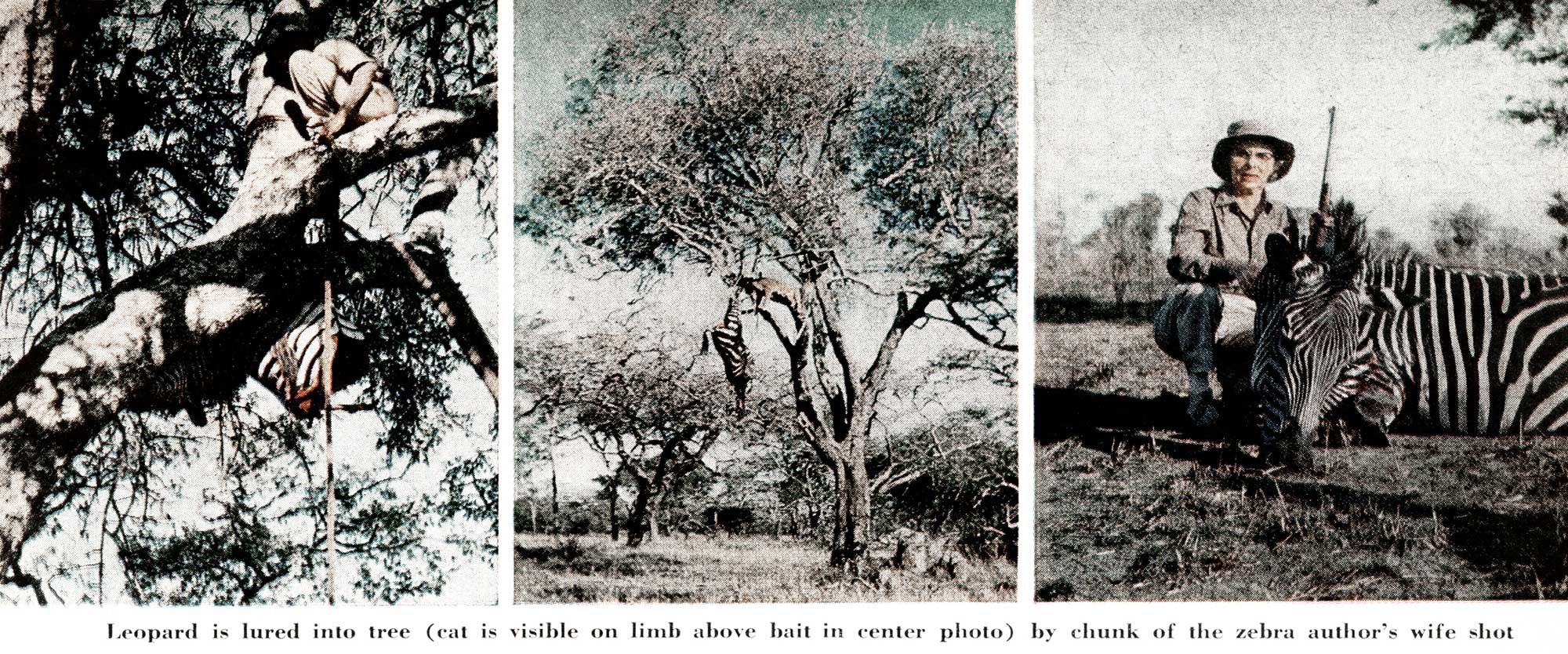
The usual practice is to shoot a bait, hang it in a tree, then come back morning and evening to see if a leopard is working on it. It sounds simple, but it isn’t. About three fourths of getting a leopard consists of picking out the right tree in the right spot. The tree should be near likely leopard country, usually a rocky hill where a leopard would like to loaf during the day. The ideal tree should have a branch suitable for the leopard to lie on and feed. It should have enough foliage to make a leopard feel secure but not enough to deflect the bullet. In addition, the tree should be near some place of concealment such as brush or rocks so the hunter can lie in wait. To complicate matters further, the shooting spot should be so located that the prevailing wind won’t carry the hunter’s scent to the leopard along the route by which it’s likely to approach.
Finding a good leopard tree is no easy matter. If the tree is right, there’s no place to shoot from. If there’s a place to shoot from, the wind may be wrong. A good tree near an excellent shooting blind may be an unlikely spot because no leopard lair is near.
All this Syd told Eleanor and me as we cruised around looking for the right spot.
Finally Syd stopped the Land Rover. “Here,” he said, “is a good spot and we’ll put up a bait.”
It was a big tree close to a series of low, rocky hills. There was water in the donga (stream bed) that ran along the foot of the rocks, and thick brush nearby. When we got out to scout around, we found leopard and lion tracks in the sand.
“And now,” Syd asked, “who will shoot the bait?”
“Mamma, grab your rifle and hitch up your girdle. You’re the meat hunter today,” I said.
“Better take the .30/06,” Syd said. “Zebras are rather tough creatures and sometimes hard to kill.”
We cruised around in the hunting car and finally Syd spotted a zebra herd. Some trees and brush downwind would make stalking easy. I sat in the car with Bitu, Syd’s gunbearer of many years whom I’d known on my previous trip, while Syd and Eleanor sneaked off. Presently a shot crashed there in the scrub and I heard the sound of a bullet striking.
I found Syd and Eleanor by a zebra stallion. Syd was smiling and Eleanor wore a slightly mixed expression. “Good shooting,” Syd said.
“I feel silly shooting one of these circus animals,” Eleanor told me. “I can’t help thinking a ringmaster is going to show up and be awfully mad about it.”
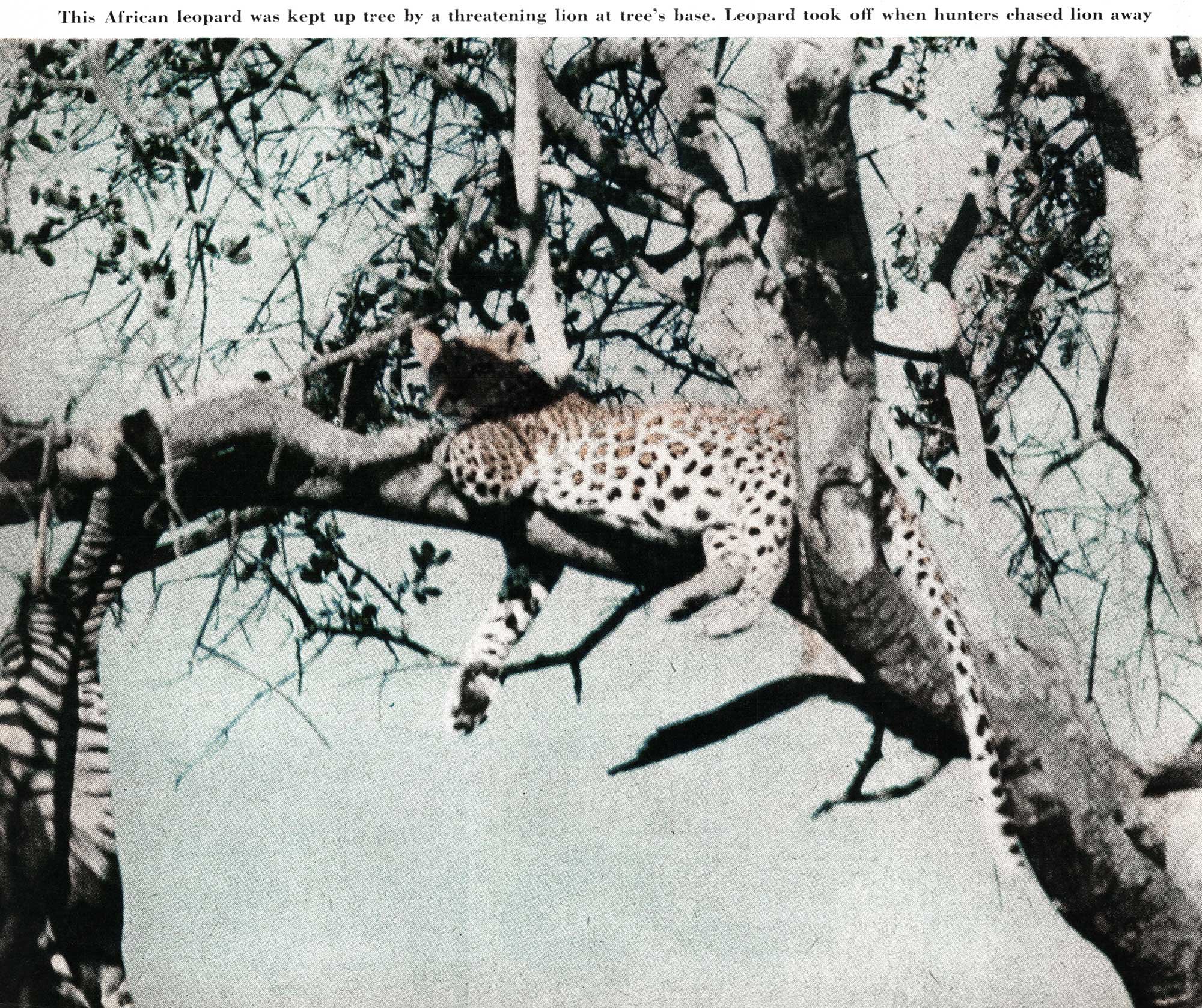
We cut the zebra in two and hoisted one half into a big tree with a good horizontal branch from which a leopard would enjoy feeding. Then we took the other half and hung it in another tree about a mile up the donga. The prevailing wind would blow our scent past any leopard that would approach from a rock hill about 100 yards away, and about 60 yards on the other side of the bait was a rock we could hide behind. We got results in short order, and if I were writing fiction instead of fact I couldn’t invent a crazier experience than the one I’m about to relate. The next morning we drove across the beautiful green plain in the opposite direction and shot a kongoni for bait. We then hung it in a perfect location on the edge of a wide donga, a spot where the wind was right and where there was a thick patch of brush to hide in. Then that afternoon we went over to see if a leopard had been on the first bait. As we stopped the hunting car on the far side of a rise, we got out with our binoculars.
“There he is, right in the tree,” Syd whispered.
The leopard was about 10 or 12 feet above the bait, lying on a limb and fairly well shielded by the leaves. It wouldn’t have been much of a task to sneak up to within 100 yards or so and pot him.
“It’s a male,” Syd said judiciously, “and a rather good one.”
“But look at the lion right at the foot of the tree,” Eleanor said.
And there was a lion there, squatting right at the foot of the tree staring hungrily up at the bait. No wonder the leopard hadn’t come down. “What a shame,” Syd said. “It wouldn’t be sporting to shoot a leopard under these circumstances.”
“To say nothing about having the lion get excited and chew your leg off,” Eleanor put in.
“We’ll have to get rid of that lion,” Syd said bitterly.
So we got into the hunting car, drove up to the tree. The leopard stared at us nervously. The lion watched us with uncomprehending eyes. He hadn’t the faintest idea what the hunting car was. This area has been closed to lion hunting in recent years, and this young lion saw no particular menace in our outfit.
Syd put his head out of the window. “Shoo!” he said. “Go away. Get out.” The lion, a handsome young male with a yellow mane, backed off about 10 feet and then stood his ground. “Go on!” said Syd again.
But the lion refused to budge. Syd jumped out of the car, rushed at the lion, waving his arms.
The startled lion ran off into the rocks. The leopard now saw its chance. It jumped from the tree and fled. “Well, Syd,” said Eleanor, “you have chased off that silly lion.”
But he hadn’t. A moment later we saw the lion’s shaggy head peering at us over a rock. He plainly had thought the matter over. For the life of him, he couldn’t figure out just what authority Syd had to run him away from the delicious smell of decomposing zebra.
Again Syd ran at him and again he fled. But there was no getting rid of that hungry lion. In a couple of minutes his head popped up at another spot.
“Oh, dear,” said Syd. “We’ll have to pull him off with a bait.”
We drove about a mile and spotted a herd of Grant’s gazelles. I shot one and we took it back to our bait tree. Once more the lion was sitting under it.
We drove past dragging the carcass of the Grant. For a moment the lion stared at it as if he couldn’t believe his eyes. Then he realized that it was a gift from us to him. What looked like a smile of joy spread over his face. He began walking hungrily toward the dragging Grant. Syd speeded up the car and the lion began to trot. Syd drove faster and the lion began to gallop. Growling ferociously he made a rush and grabbed the bait. The gunbearer in the back of the car let go of the rope.
“Now,” said Syd. “We’ve got rid of that lion. He was hungry, but when he’s fed he’ll move off.”
But we underestimated our lion. Apparently he spread the word that there were some suckers about who enjoyed feeding lions. When we went back toward dusk the next afternoon, we saw no leopard in the tree, but we did see our little pal and two more lions—a larger male and a sleek, full-grown female. Fifty yards away in the rocks was another big lion and a lioness.
“Oh, no!” said Syd. “We must go into this feeding routine again.”
“I think they’re cute,” Eleanor said. This time we shot a kongoni to lure the big cats away. The young lion trailed our drag joyfully. The others, who may have been shot at in times past, followed slowly and cautiously. But before long we saw them all congregate on the kongoni, growling and snarling as they fed. The next day they were all back again, and of course the leopard had not come near the tree. We decided we’d lost.
What with one thing and another, we were having a tough time. The lions loused up one hot prospect and the Masai natives another. A big leopard was coming to the bait in the donga across the plain, but the Masai moved in some cattle and drove them right up the donga past the tree in early morning and late afternoon, exactly the time when one would expect a leopard to feed. Although we waited several times until dark, the leopard never showed up.
We had tough luck on another bait, an impala this time. A leopard came to it, but he was an unorthodox fellow who lived in a spot where by all leopard rules he shouldn’t live, and he could get our wind as he came to feed. Once we caught just a brief glimpse of him.
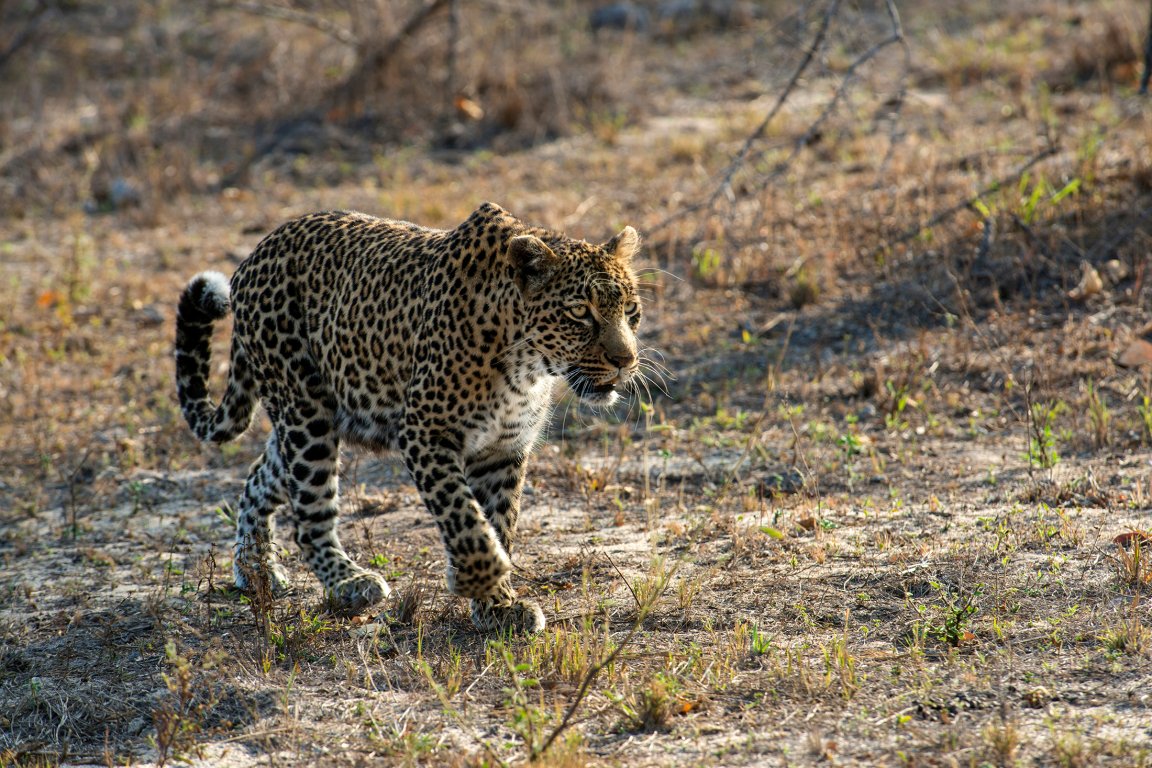
The country was lousy with leopards. One night a young one that lived in the rocks of the kopje right by our camp stole a Thomson’s gazelle hanging in a tree a few feet from where the cook was sleeping. On several occasions we saw leopards galloping home from their night’s hunting. Another time, when we drove 15 or 20 miles from camp to look over some new country, we saw a herd of topi intently looking toward the top of a hill. We got our binoculars and saw a big male leopard beautiful in black and gold sitting on a ledge of red stone, looking down on the plain. We ran across several cheetahs—those round-headed, long-legged cats that are supposed to be the fastest runners on earth. They can catch the swiftest antelope in a short race.
We saw more lions. Once we put a bait in a tree only to find when we came back the next morning that a lioness had managed to climb up, break the rope that held it, and devour it. On another bait we had about the same luck as on the first one. A couple of lions that lived in a nearby donga hung around it and kept the leopards away. We finally gave up, cut the bait down, and let the lions feed.
Then we got what should have been a break but wasn’t.
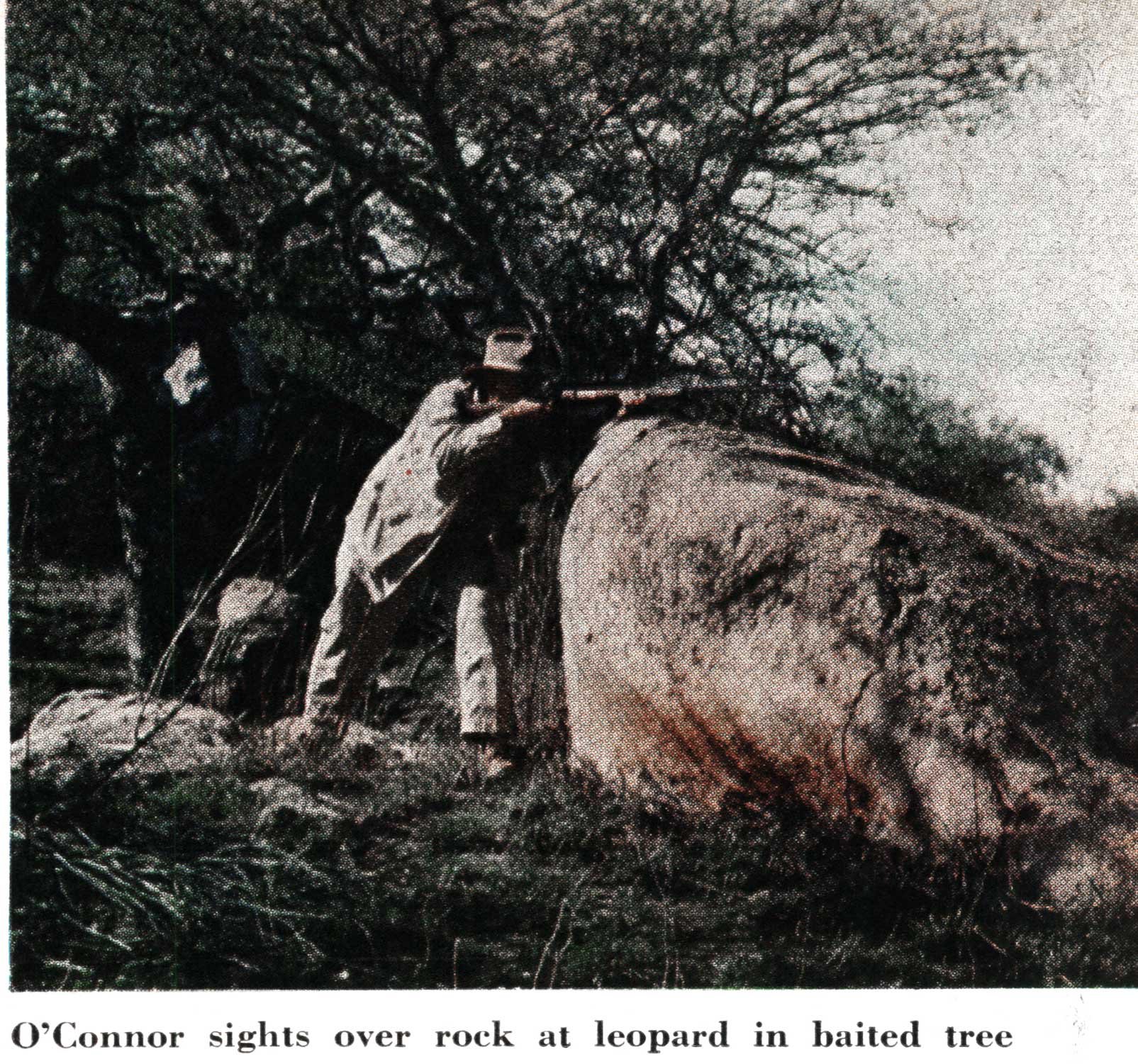
One morning we found that during the night a large leopard had come to our second bait. About 4 o’clock that afternoon Syd and I got behind the rock we’d picked out and waited.
Safari life is tough on rifles. The constant jiggling as they sit in the rack loosens scope and guard screws, and scopes are apt to get bumped. Knowing this, I had shot my .30/06 at a mark every day. At noon, I’d have one of the gunbearers make a mark on a tree with a panga and then at 100 yards I’d take a rest over the hood of the Land Rover and fire a shot. Always, the bullet had struck just right. But that day, lulled by the fact that the rifle had not changed point of impact, I neglected to do this.
Syd and I must have waited about an hour when the leopard came stealthily down out of the rocks, all black and gold and gliding smooth as a shadow. He stopped and looked around suspiciously. For about 15 minutes he sat on a rock, watching. Then he moved down toward the bait tree and lay down on an ant hill.
He was about 60 yards away, broadside but looking away from me back toward the rocks. It was a set-shot. I eased myself up, placed my left hand on the rock to steady the fore-end of the rifle. The ant hill was slightly downhill from me. Since the rifle was sighted in to strike three inches high with the 180-grain bullet at 100 yards, it should have been shooting a bit over one inch high at 60 yards. I held the intersection of the crosswires behind the leopard’s shoulder and very slightly low. The rifle was rock steady as I squeezed the trigger.
As the rifle cracked, the leopard shot about four feet into the air, roaring and growling, and when he lit he took off for the rocks just like a racehorse.
I couldn’t believe my eyes and neither could Syd.
“What have you done?” asked Syd. I had visions of a wounded leopard hiding in the rocks and our having a sticky experience in following him up. A wounded leopard is one of the world’s most dangerous animals. But investigation showed that my bullet had only grazed the leopard. We found where it had struck the ground and we found a bit of hair that had been cut off. There was not a single drop of blood. I thanked my lucky stars that I’d held a shade low. Otherwise I’d have wounded the leopard slightly and we would have been in a peck of trouble.
“Your rifle must be off,” Syd said gloomily as we got in the hunting car. “Let’s try it,” I said.
On the way back to camp we paced off exactly 60 yards, made a mark on a tree. Syd and I both shot it, and our bullets were right together but about four inches low. On the eyepiece of the scope there was a bright abraded spot as if the rifle had been dropped and it had struck with the weight on the scope. I hadn’t dropped it. The gunbearers said they hadn’t when they were cleaning it. It must have been mice, or something. So we got Old Betsy shooting three inches high at 100 yards again and sorrowfully went back to camp to tell Eleanor that I’d missed a leopard at 60 yards.
“Don’t write this up,” she advised. “All the people who read OUTDOOR LIFE will think you’re an awful boob.”
“I call them where they fall, honey,” I said, “and I have the rare distinction of being one of the few gun writers who ever misses anything with a typewriter.”
“You’re awfully funny,” she said.
We took another round of the leopard baits the next morning. Leopards had been feeding on three of them. We saw one, but found it was a female—and Syd Downey’s dudes don’t shoot female leopards. Another was the big cat that fed only at night and the third, judging by tracks and claw marks, was small.
“Not much chance at the tree where you missed the leopard last night,” Syd said gloomily as we headed back to camp. “That’s one leopard that will never be shot over a bait. He’s learned his lesson. But anyway we’re close by and it won’t hurt to stop and look.” When we were about 200 yards from the bait, Syd stopped the car and lifted his binoculars.
“Well, what do you think?” he said after a moment. “A leopard has fed since last night. Let’s come back this afternoon and wait.”
About 4 o’clock Syd and I were behind our rock and Eleanor was waiting with two gunbearers in the hunting car about half a mile away. A patrol of flies were buzzing over the bait, which by this time was very high, and a couple of vultures were sitting in the top of the tree.
The wind blew gently down the donga, and over in a tree about 200 yards away we could see some monkeys playing.
Gradually the sun slid toward the west. Then it dropped below the horizon and the light began to go.
I had about given up hope, when Syd punched me.
“The leopard’s here,” he whispered. “He’s on the bait and he’s a very large male. Don’t look now. He’s facing this way.”
For five minutes we waited and then Syd took another cautious peek around the rock.
“Now,” he whispered. “You have plenty of time.”
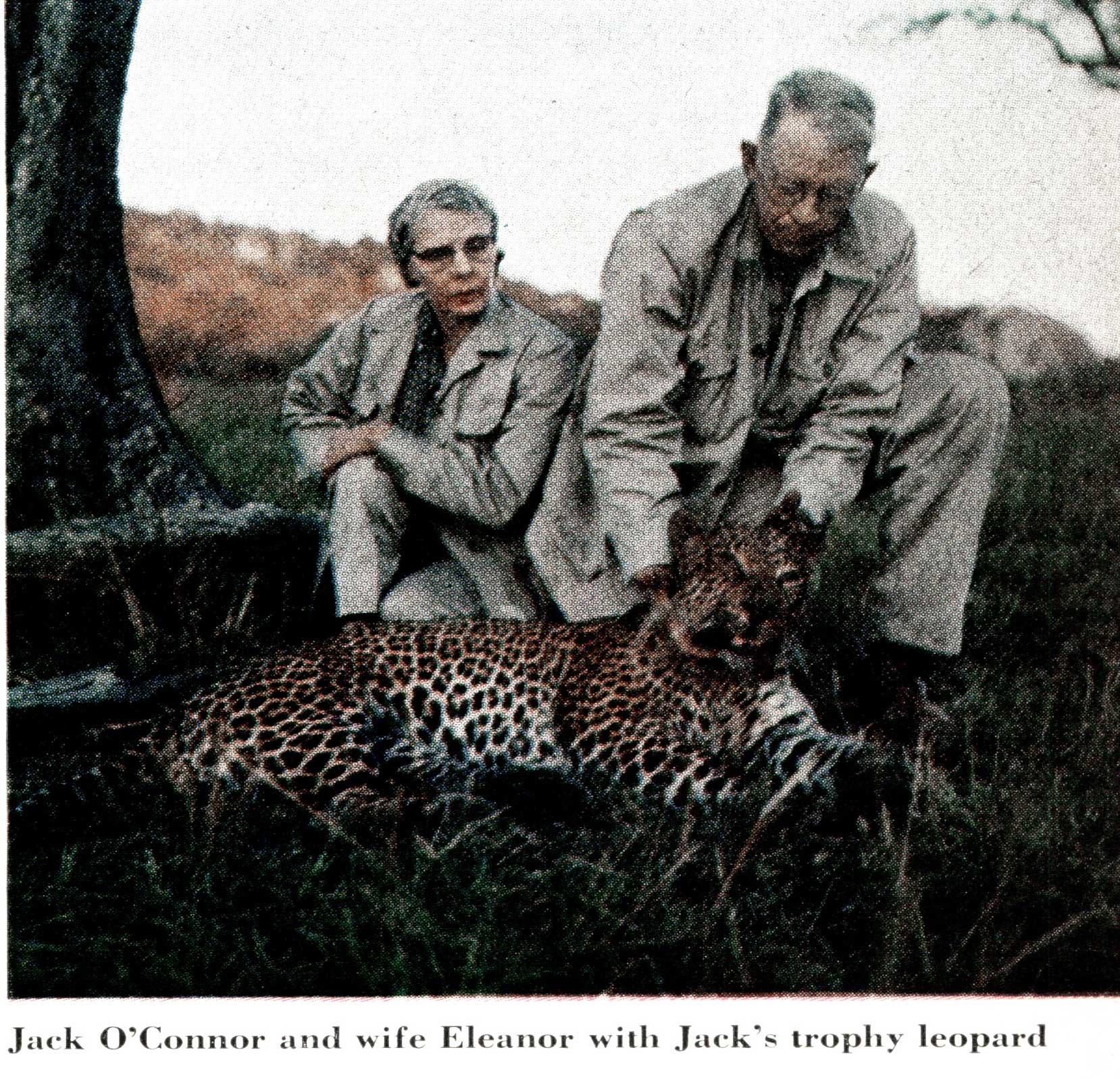
When I raised up from behind the rock the leopard was feeding on the bait, standing on the limb above it and tearing off chunks of meat. However, his rear end was toward me, so I waited for a better shot.
I had my .375 that day, a lucky rifle with which I had shot a tiger, a couple of lions, and a pair of Alaska brown bears, as well as other game. I watched the leopard, ready to duck down if he started to turn my way.
Then he shifted position so that his body was quartering. I saw that if I held back of the ribs on the left side the bullet would go up through his lungs and should break his right shoulder.
I hoisted the old .375 up and rested the fore-end over my left hand.
Read Next: O’Connor in Africa: Hunting Gemsbok in the Kalahari with a Trusted .270 Winchester
The crosswires were steady right where I wanted them. Slowly I started the squeeze. When the rifle bellowed, the leopard pitched out of the tree and fell to the ground like a bag of potatoes. Syd and I approached cautiously but he never even twitched. “Well done,” Syd said. “Whoopee!” I shouted.
We heard the Land Rover start up and presently Eleanor drove up with the two gunbearers.
We all admired the leopard. It was a big male, chunky and powerful. The 300-grain Silvertip had hit exactly right, had gone through the lungs and shattered the right shoulder. Luckily it had shed the core and had not gone through to tear up the hide.
As we put the leopard in the car, Syd gave me a sidewise look.
“I don’t think I need to tell you this,” he said, “but you’re a very lucky man.”
“You telling me?” I asked.