
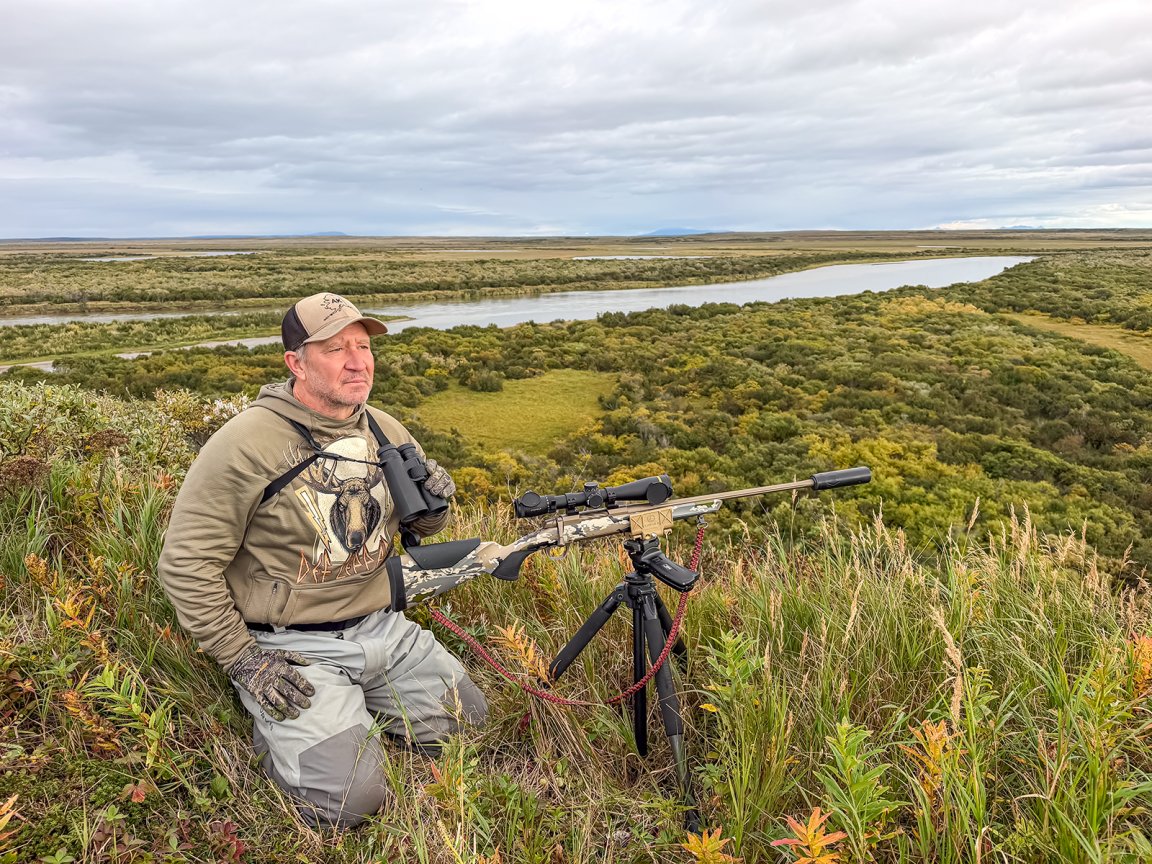
The hands pouring a hot cup of coffee shook. The fingers, more crooked than I recalled. The aging man looked at me, smiled, and kept pouring. Slowly my cup filled.
I’d just got in from a 25 mile boat ride down Alaska’s Egegik River. I was cold.
“As you can see, I’m not doing that great,” said Bruce Hallingstad as he returned to his seat at the rickety, wooden table, across from me. “Don’t think I’m going to be able to make it up river to camp this year.”
My heart sank. After all, I’d come to Alaska to hunt with Bruce. It was going to be our last moose hunt, together.
Bruce is the longtime owner of Becharof Outfitters (becharof.com). We met 19 years prior, when he invited me to film a couple episodes for an outdoor TV show I hosted. Back then, coho and ptarmigan were our targets. A few years later I hunted fall brown bear in the same area with him. Four years after that we took the biggest brown bear of my life, a 10’ 9” behemoth.
In 2017 a buddy and I joined Hallingstad for a moose hunt up the King Salmon River, northeast of the village of Egegik. We shot two exceptional bulls. At that time my back problems had intensified. I struggled to even walk, let alone pack meat. I figured it would be the last moose hunt of my life. But two back surgeries later, I felt like a new man.
“I’m thinking of selling the operation in a year or two, so why don’t you come up for one last moose hunt this fall, just you and me,” Bruce offered last spring. He had battled some health issues, himself and now he wasn’t faring as well as we’d hoped when we’d set our plans in the spring.
“Don’t worry, I’ll have you head up to Carl’s camp for your moose,” Bruce continued as we sipped coffee, gazing out the big window overlooking Alaska’s Egegik Bay. From the old house I could see where many fond memories were made.
“There are two clients in that camp, so you can help them out, pack meat, and when they’re done you’ll hunt,” Bruce said. “It’s our farthest camp upriver, lots of moose move through later in the season, as the rut approaches. Fifteen days will be plenty.”
I’ll Shoot It Tomorrow
The day before the moose opener, Carl Adams, Tom Roll—another stud of a guide—myself and two clients, Peter and Stan, arrived in moose camp. The 23 mile boat ride quickly passed. “Okay guys, we’re camping in thick alders and moose can be around us at any given time,” Adams said before we hopped out of the boat. “We need to whisper all the time and be sure to have your rifle because brown bears are thick in here.”
Both clients were well into their 70s. It was their first time to Alaska. Peter was nearly deaf. Stan, not much better. Every word they spoke was just below a shout. “Guys, inside voices, remember,” Carl encouraged more than a half dozen times in the first hour.
I glassed nonstop for 13 hours each of the first three days. In that time, Peter spent less than an hour looking for moose. He stayed in the cook tent, drinking coffee and talking to anyone who walked by.
On the evening of day two, Adams spotted a big bull across the river. “Peter, you’ll want to come take a look at this bull,” he said. It was 8:00 p.m. Peter had been in bed for an hour. An hour of daylight still remained. “Is it big?” Peter asked. “He’s pushing 60 inches,” Adams replied. “Is that good?” Peter wondered.
Adams went to Peter’s tent and whispered, “Get your waders on, we can cross the river and sneak to within 300 yards of the bull, maybe even shoot it on the river bank.”
“I’ll just shoot it tomorrow,” Peter replied.
Adams tried to urge Peter to change his mind as he knew the opportunity at stake, with three tags to fill. “Stan, do you want to shoot it?” Adams asked. “Oh no, I’ll keep going on boat rides up river with Tom; any bull around camp, Peter can shoot.”
My spotting scope was set up so I captured several photos of the big bull, along with some videos. “Here, go show this to Peter, that’ll make him get up,” I whispered to Carl as I handed him my phone.
But the hunter’s response was, “I’ll just look at it tomorrow,” not even unzipping the tent fly.
The bull got to 517 yards. I had my rifle set solid in the tripod shooting sticks and the scope on 18x. “Peter, all you have to do is come out of the tent, walk 15 steps, shoot Scott’s gun, and you’ll have your dream Alaska moose,” Adams tried convincing him, one last time. “That’s too far,” Peter answered. Adams sensed my frustration.
“That’s part of being a guide,” Carl shrugged. “It’s the client’s hunt, not mine. Sometimes these hunts aren’t about filling a tag.”
The next morning Peter drank coffee and talked loud as ever for three hours. I sat on a knob glassing for moose nearly 200 yards away and could hear every word he uttered. Tom took Stan to another spot by boat that morning. Not until almost 10:30 a.m. did Peter ask about the bull from the previous night. When I finally showed him the video, Peter said, “Wow that’s big but I don’t really care if I kill a moose, I’m just here to have fun and hang out with you guys.”
“I’m not shooting a moose until you two tag out, and that bull cost us valuable time,” I responded. “There’ll be more,” Stan hollered, stumbling back to the cook tent, tipping the bottom of his coffee cup skyward.
That afternoon, Stan told me he didn’t care if he killed a bull, either. Here were two clients paying $30,000 each to hunt moose and they didn’t care if they shot a bull. As a full time outdoor writer of nearly 30 years whose career has been built on consistently killing game, it put me in a bad place.
The Call
All of Hallingstad’s moose camps are equipped with Starlink. Having lived for several years in remote Alaska, and traveled much of the state for the past 36 years, I think it’s safe to say that this technological advancement is a game changer. It greatly alleviates the stress of being out of touch with family and it increases people’s safety in many ways.
On day five, I was glassing for moose from camp when I got a call from Bruce. “Elise just got her hunter a bull, so I’m going to have you move down with her,” he shared. I was elated.
Elise Adams is Carl’s daughter. She’s 23 years old and had just finished nursing school, where she graduated at the top of her class. I’ve known Elise since she was four years old and I watched her grow up on the Egegik River. She runs her own commercial fishing boat, has guided salmon anglers for nearly a decade, and successfully guided hunters to six brown bears in recent years, including two over 10 feet. This was her first solo guided moose hunt, and she was the first in five camps to tag out.
Before I could hang up the phone with Hallingstad, I got a call from Tiffany, my wife, who was back home in Oregon. I ignored it. She immediately called again. I was still getting details from Hallingstad. Then Tiffany texted me. “Call me NOW!”
She was bawling and could hardly speak. I feared something had happened to one of our two sons, or our aging parents. “It’s Kona, he has stomach twist and they have to put him down.”
Kona, our prized Pudelpointer, was in his prime, only 10 years old. I’d hunted with his dad, Lon, the most decorated Pudelpointer ever to set foot on American soil. Until Kona, Lon was the best dog I’d hunted with. Kona ran circles around anything Lon ever did. He was that once-in-a-lifetime dog for me, and I’ve owned a number of them. Most were good. Kona was exceptional.
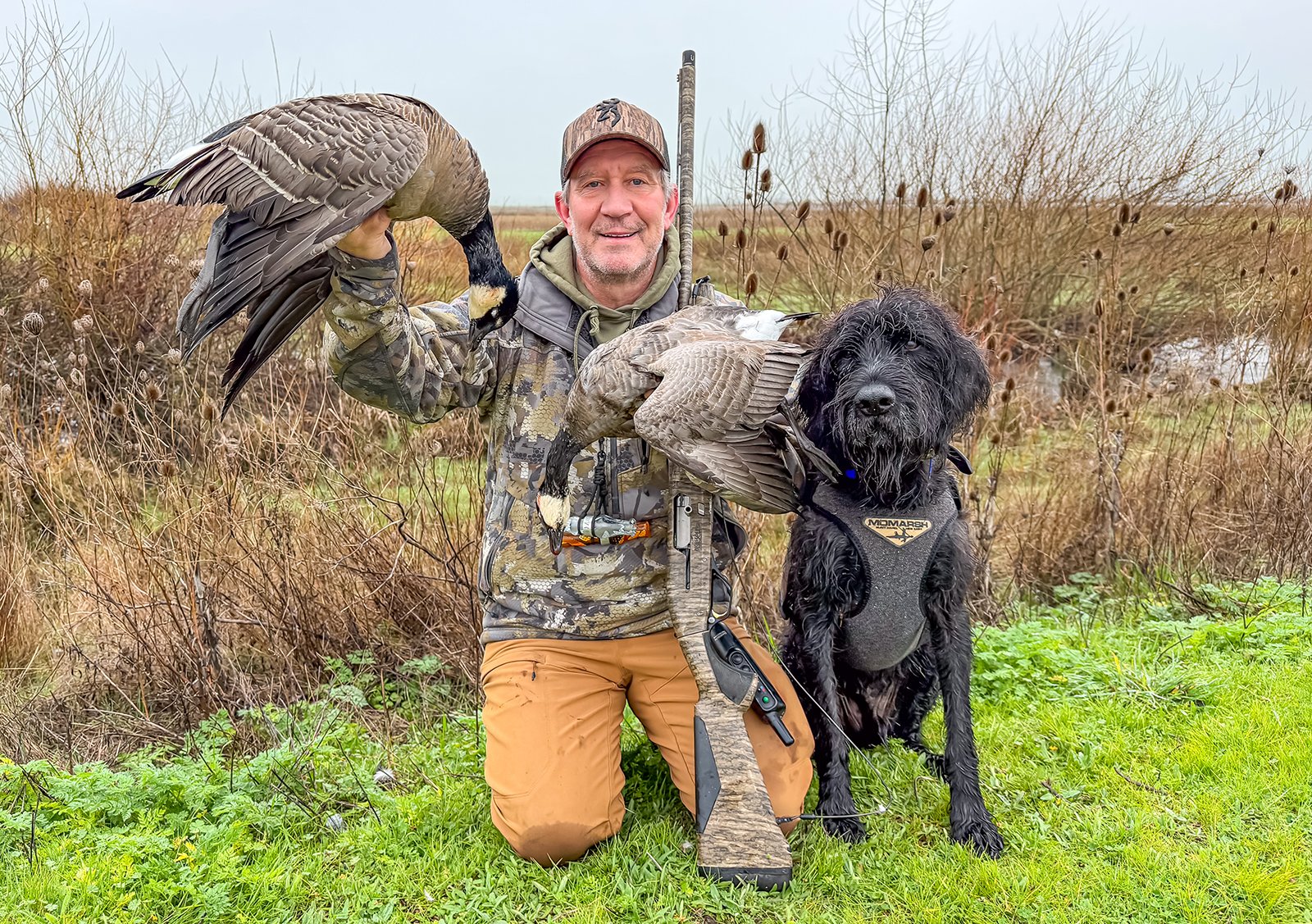
Kona survived stomach twist when he was four. We were minutes away from losing him, then. This time it struck in the intestines. Though Tiff got Kona to the vet with plenty of time, no tests, or even x-rays, pointed toward torsion. By the time it was figured out, it was too late.
I spent the next two days in my tent, alone. I didn’t want to see or talk to anyone. I tried getting home but couldn’t because the river was too rough to navigate in the extreme winds. I cried more than I can ever recall. I couldn’t eat for two days. An 80-inch moose could have stood outside my tent and I couldn’t have cared less.
I don’t know what was worse, knowing Tiffany was dealing with Kona, alone, or being helplessly stranded in isolated Alaska. I’ve survived sinking boats, a downed bush plane, a submerged Argo, getting lost in storms and being stuck for days in 45º below zero temperatures in total darkness. But this was the most desolate Alaska had ever felt. I’d never felt so helpless and trapped by the wilderness.
Carl consoled me. He was right, being a guide is about more than just filling a tag.
Finally, two days later, conditions calmed and Elise made it upriver to get me. By now, the last place I wanted to be was home. I wanted to hold my wife, but I couldn’t yet face being home without Kona. He was always at my side, his spirits high. He knew what I was going to do before I did it. We spent every day together. He hunted for upland birds, waterfowl, sheds, squirrels and was great at it all. It is not an exaggeration to say that he was my best hunting partner.
“I’m so sorry about your dog,” Peter told me in a firm voice as I left camp, putting his hand on my shoulder. “People don’t realize how hard it is losing a truly special dog,” he continued. “My wife recently passed away, then, right after that, my dog of 14 years did too. It was the best hunting dog a man can ask for,” he told me. “It’s hard but you’ll make it through this.”
That’s when I realized that amid my selfishness of trying to get a moose, I’d failed to hear Peter’s full story.
“Now, go get a big bull,” Peter said. “I don’t care if I shoot one.”
That afternoon, Elise was preparing dinner when my wife texted me with more news. “She’s okay, but your mom is in the hospital with heart issues. She’s getting ready for a long surgery. Send prayers.”
By now our oldest son had flown home to be with Tiffany. Between them and my dad, Tiff’ assured me they had things under control and that there was nothing I could do, even if I was there. “Just do what you need to do to get through this,” she followed up. Tiffany is the strongest, most caring woman I’ve ever met. We’ve endured a lot, together.
The Biggest Moose I’ve Ever Seen
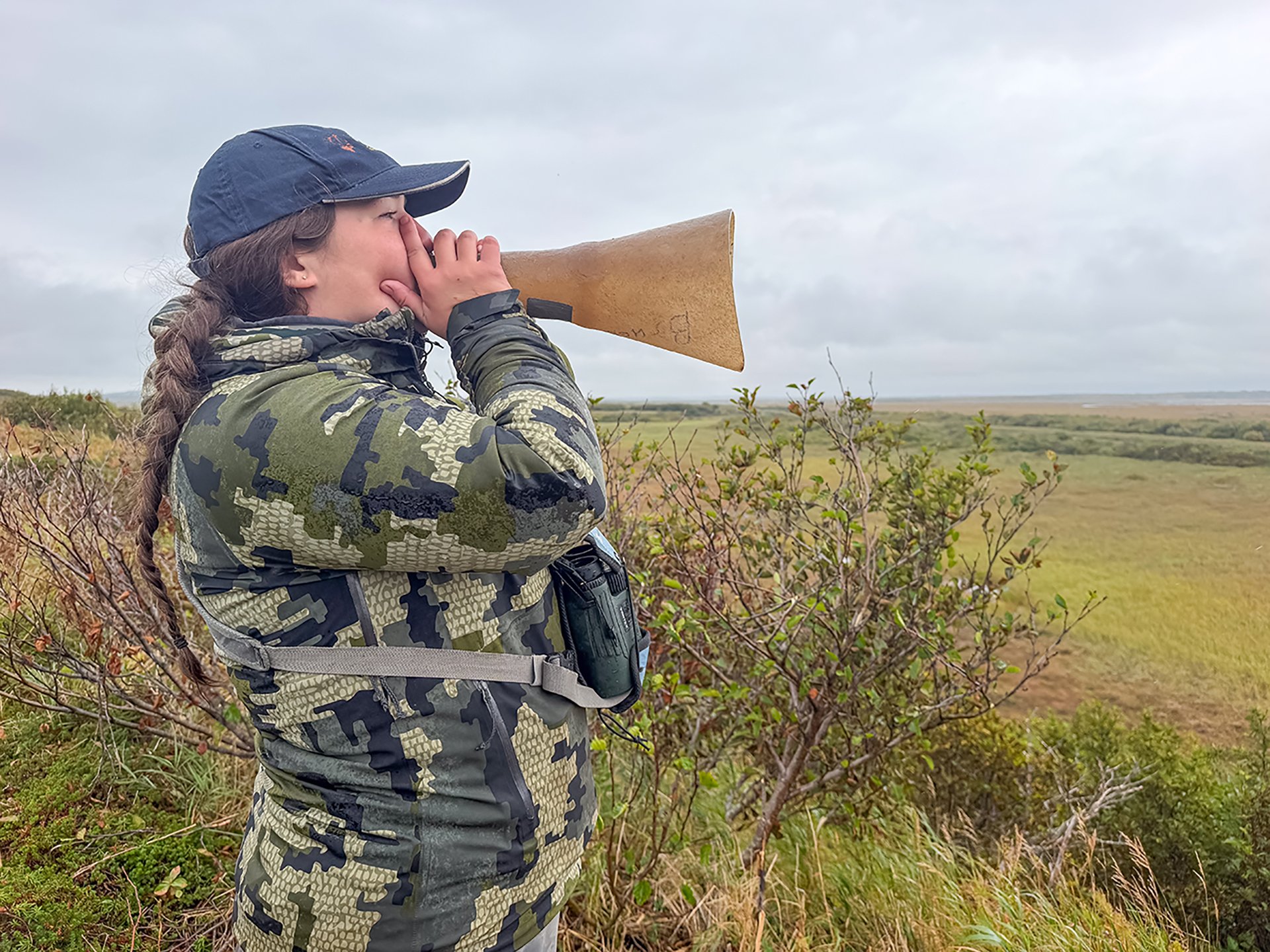
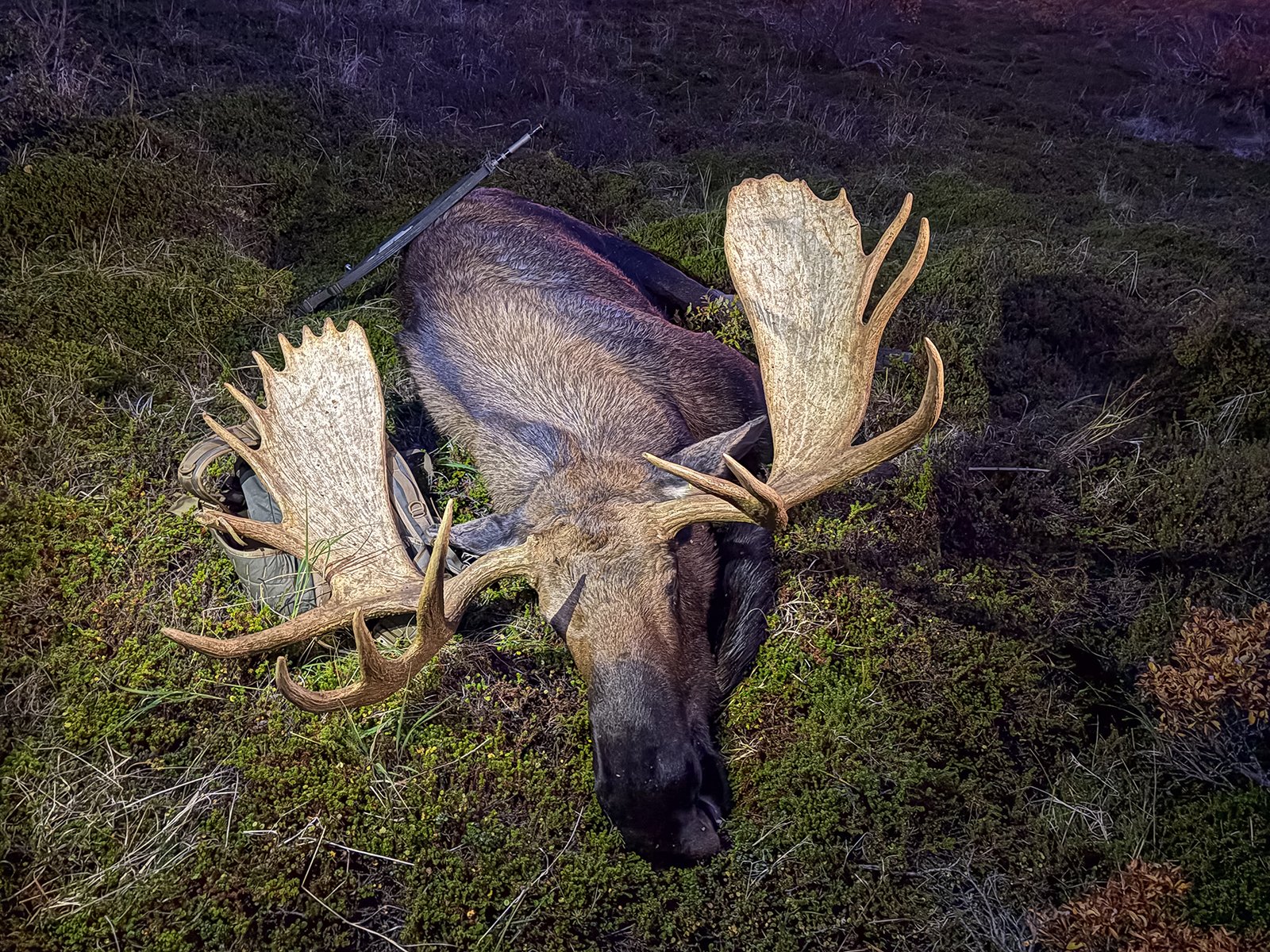
After dinner, Elise and I hiked to a high point to glass until dark. Exactly 2.18 miles away, we saw a bull moose with the naked eye. It was standing across an expansive, marshy flat and its white antlers looked like two sheets of plywood. “That’s the biggest bull I’ve ever seen,” Elise said. I agreed.
“If you’re up for it, we’ll be here at daylight, try to find that bull, then make a move on it,” Elise suggested.
The next morning we found the bull, half the distance away as the evening prior. It was in a swamp surrounded by 30-foot-tall alders. “It’s impossible to get close to that thing in this wind,” Elise said. “Let’s watch and try to see where it goes.”
After 15 minutes, the bull lay down. We watched the spot for 12 hours but never saw it move.
The following day, the bull was closer to where we’d first seen it. “Let’s get Greg and go after that thing,” Elise decided. I again agreed with my young guide.
Greg Zackar is a native kid from the village of Igiugig, Alaska, near Lake Iliamna. Elise comes from a native lineage, too.
This was a dream I so wanted to relive. I needed it.
In 1989, I went to dinner with Tiffany. We grew up together, had known each other since first grade. Our parents and grandparents went to school together. We were fresh out of college, each with teaching degrees. “What are you going to do now,” Tiffany asked. “I’m moving to Arctic Alaska to teach and learn to hunt and fish with the Eskimos,” I told her. (That was a politically correct term back then, in fact, they were proud to be recognized as such). “Well, you better do it now while you’re single because no woman will ever follow you up there,” she replied.
Four months later, we were engaged. Four months after that, we were married and living in Point Lay, Alaska, a village of fewer than 100 Inupiat people at the time. That was 36 years ago.
For the next seven years, I hunted, fished, and trapped with the indigenous people of the high Arctic. Those were some of the most memorable times of my life. The outdoors connected our two worlds. We shared a common passion in a harsh, yet glorious part of the world that few people will ever truly understand. Out there, the genuine nature of the native peoples shone. They’re among the most caring, giving, hard-working cultures I’ve met. Elise and Greg carried the same values.
Moose or no moose, just being with those two kids helped heal me. Many hours were spent glassing, exchanging only smiles. That’s what I needed. No words. No condolences. Just an occasional, heartfelt smile I knew meant something.
Following a five-mile boat ride and a four-mile hike, Elise, Greg, and I were glassing for the bull from an elevated knoll. We eventually spotted it in the bottom of the swamp, 1.4 miles away. We hiked over 12 miles that day in some of the most demanding terrain imaginable. I’ve been fortunate to make a living hunting big game around the world. Of all the habitats I’ve been in, the tundra ranks as the most challenging to navigate. More times than not, it’s simply impassable. This was one of those times.
On the last of our seven days together, the wind was finally right to make a move on the big bull. We towed a raft downriver, paddled 1.25 miles up a slough, hiked another mile through a bog and dense alders, and got to where we’d last seen the bull. Fresh rakes on tattered alders were prevalent, and the stench of bull urine in multiple dry wallows permeated the air. Then the winds picked up.
In a matter of minutes, swirling gusts up to 40 mph left us helpless. We tried calling, but the wind was too powerful. We hiked in circles amid thick alders, trying to locate the bull. With visibility through the dense cover being less than 15 yards most of the time, our efforts were futile.
Read Next: My Greatest Day in 30 Years of Guiding Backcountry Hunts
We’d put all our efforts into one bull and came up empty. I could have shot two lesser bulls, but didn’t. One hunter in camp shot the first bull, a 60-incher that appeared tiny compared to the monster we were after. Carl informed us Peter had shot a bull on day 10, and Stan filled his tag on day 12. I was happy for them.
Returning home to Oregon was hard, much harder than anticipated. Thankfully, my mom was recovering from heart surgery, slowly. But the house was so empty, so calm. With upland season in full swing and waterfowl season about to kick off, I felt lost. I still have Echo, Kona’s half-sister, to share hunts with. But the clock is chasing her, too. She’ll be 13 years old soon. Together, we’ll hunt when we can this season. It won’t be easy, but we’ll make the most of it. I owe that to her.
Kona took a piece of me with him. There’s a void in my heart I fear will forever remain. But he left me with so much more than what I had before he came into my life. Looking at pictures of Kona and all the adventures that we had together is painful. But those memories are what help heal me. For all who knew him, Kona made the world a better place. He made me a better man, and that’s the ultimate reward of getting to share time, be it brief, with a hunting dog you know can never be replaced.
Note: For signed copies of Scott Haugen’s best-selling book, Hunting the Alaskan High Arctic, visit scotthaugen.com.