
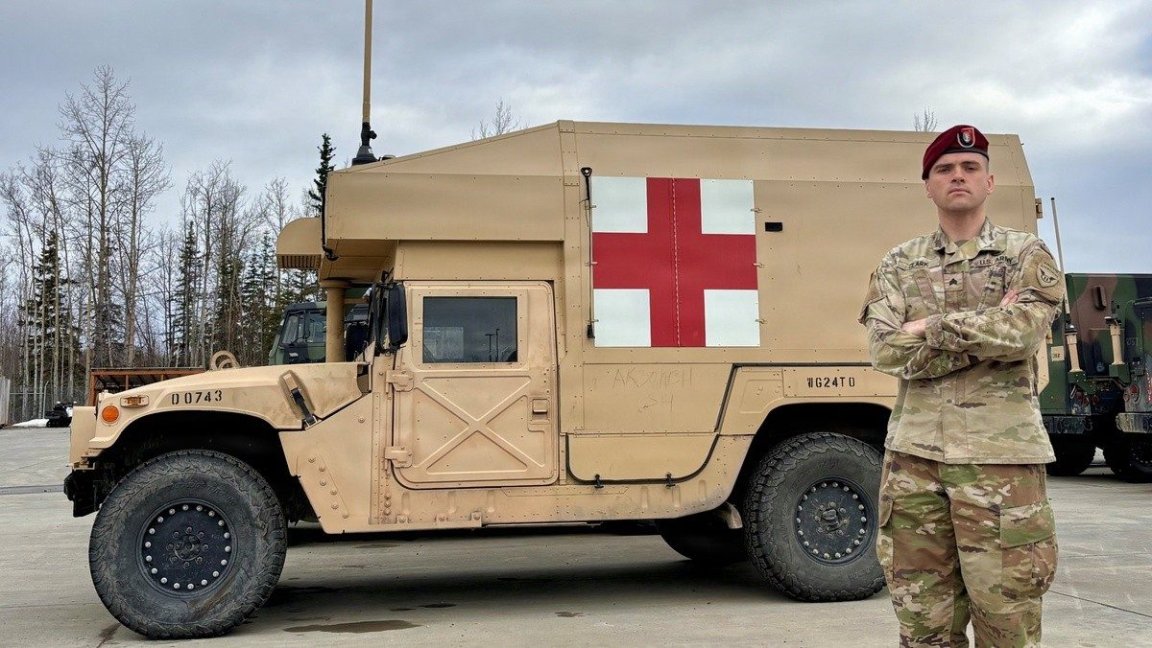
The two unidentified soldiers who were seriously injured in a bear attack during a training exercise on a military base in Alaska this month were released from the hospital. Their recovery was, it seems, thanks in part, to the quick action of a fellow soldier who administered first aid on the scene.
The soldiers were participating in a land-navigation exercise at Joint Base Elmendorf-Richardson near Anchorage when two unidentified soldiers were attacked by a brown bear that may have recently emerged from hibernation. They deployed bear spray, which Alaska Game and Fish regional supervisor Cyndi Wardlow said may have saved their lives.
Combat medic Sgt. Zachariah Clark was also participating in the training when he got news of the attack. Land nav is a core military practice requiring all ranks to find their way with limited equipment in unfamiliar terrain. When word of a potentially deadly bear encounter during training reached Clark (the Army did not specify how this news was relayed) his medic training kicked in.
“My first thought was, ‘There’s two soldiers. They don’t know where they are,’” Clark told Army.mil. “‘They’re alone. They’re afraid and they might be dying. I need to get to them.’”
Clark navigated through deep snow and dense woods to reach the victims, gathering fellow soldiers as he worked his way there.
“As we were pushing through the rough terrain, I was finding groups of soldiers that hadn’t been contacted or notified of the incident yet,” Clark said. “I said, ‘Hey, come to the sound of my voice. You follow me.’”
While Clark normally carries dedicated medic supplies in the field, he didn’t have it with him during the land nav training.
“As a medic, I prefer to work out of my aid bag, but being that I was conducting land nav, I didn’t have my aid bag with me. We went with what we had that day. We hustled. We moved to the casualties. Had we not done that, I don’t know what would have happened to those casualties.”
Clark was the only medic on the scene, but each soldier had a first-aid kit, and they pooled their supplies to triage the two bear attack victims. The team also provided “their own clothing” to help them stave off hypothermia and shock. Clark coordinated the handoff with the Air Force EMS and security forces who arrived on the scene, and also helped prepare the victims for evacuation by helicopter.
Although the soldiers were released more than a week ago, the Army’s 11th Airborne Division declined to share any updates on the attack Tuesday, including the specific nature of the victims’ injuries, citing an ongoing investigation. ADFG has taken biological samples for DNA testing to confirm the bear’s species and gender, Wardlow told OL last week.
“We’ve collected samples to try to get a positive identification on species and gender” (of the bear), “It was originally reported as a brown bear, but there were no other witnesses who saw the bear other than the victims so we’ll be waiting on genetic samples to confirm.”
Brown bears and grizzly bears are technically the same species. The difference is where they live. Brown bears weigh up to 1,000 pounds and live in coastal areas with access to nutrient-rich marine food sources like salmon. Grizzly bears are landlocked and resource limited, weighing half the size of brown bears. Alaska’s black bears, which vary from cinnamon to charcoal in coat color, weigh up to 350 pounds.
Read Next: ‘End to the Mystery.’ Body of Missing Turkey Hunter Found After 11-Day Search in Southern Colorado
Joint Base Elmendorf-Richardson is in an area known for bear encounters, but the scene of this most recent attack is in a remote and restricted section of the base that’s not accessible by the general public.