
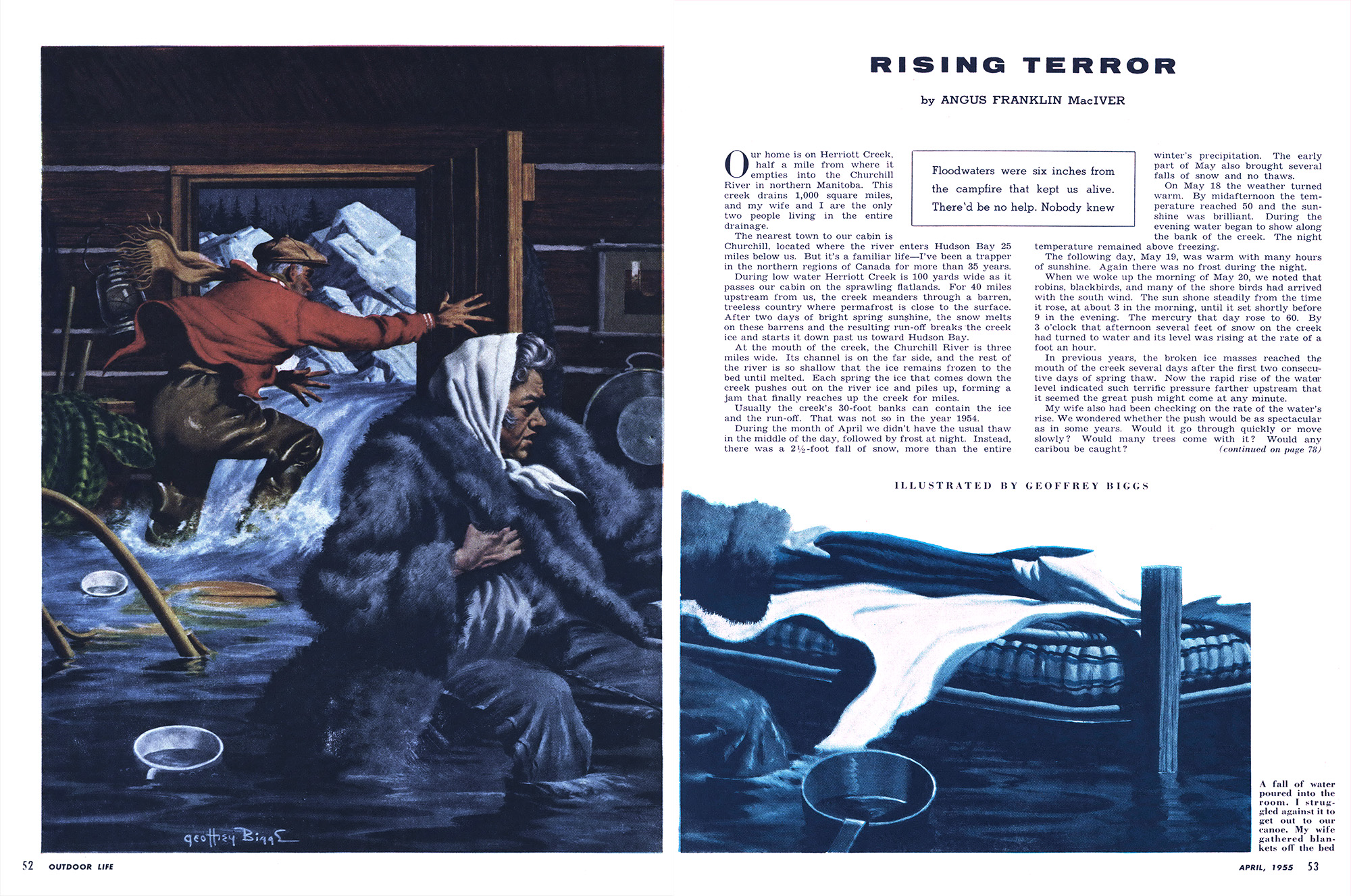
This story, “Rising Terror,” appeared in the April 1955 issue of Outdoor Life.
Our home is on Herriott Creek, half a mile from where it empties into the Churchill River in northern Manitoba. This creek drains 1,000 square miles, and my wife and I are the only two people living in the entire drainage.
The nearest town to our cabin is Churchill, located where the river enters Hudson Bay 25 miles below us. But it’s a familiar life — I’ve been a trapper in the northern regions of Canada for more than 35 years. During low water Herriott Creek is 100 yards wide as it passes our cabin on the sprawling flatlands. For 40 miles upstream from us, the creek meanders through a barren, treeless country where permafrost is close to the surface. After two days of bright spring sunshine, the snow melts on these barrens and the resulting run-off breaks the creek ice and starts it down past us toward Hudson Bay.
At the mouth of the creek, the Churchill River is three miles wide. Its channel is on the far side, and the rest of the river is so shallow that the ice remains frozen to the bed until melted. Each spring the ice that comes down the creek pushes out on the river ice and piles up, forming a jam that finally reaches up the creek for miles.
Usually the creek’s 30-foot banks can contain the ice and the run-off. That was not so in the year 1954.
During the month of April we didn’t have the usual thaw in the middle of the day, followed by frost at night. Instead, there was a 2½-foot fall of snow, more than the entire winter’s precipitation. The early part of May also brought several falls of snow and no thaws.
On May 18 the weather turned warm. By midafternoon the temperature reached 50 and the sunshine was brilliant. During the evening water began to show along the bank of the creek. The night temperature remained above freezing.
The following day, May 19, was warm with many hours of sunshine. Again there was no frost during the night.
When we woke up the morning of May 20, we noted that robins, blackbirds, and many of the shore birds had arrived with the south wind. The sun shone steadily from the time it rose, at about 3 in the morning, until it set shortly before 9 in the evening. The mercury that day rose to 60. By 3 o’clock that afternoon several feet of snow on the creek had turned to water and its level was rising at the rate of a foot an hour.
In previous years, the broken ice masses reached the mouth of the creek several days after the first two consecutive days of spring thaw. Now the rapid rise of the water level indicated such terrific pressure farther upstream that it seemed the great push might come at any minute.
My wife also had been checking on the rate of the water’s rise. We wondered whether the push would be as spectacular as in some years. Would it go through quickly or move slowly? Would many trees come with it? Would any caribou be caught?
I knew the water would be driving the ice with more force this year than I had ever seen before. I could not imagine how great the damage might be, and I was so worried that all my nerves seemed knotted. My throat was tightened and my heart thumping.
“There’s going to be a flood,” I said, “and it’s not far off.”
“If I hadn’t known that by the conditions, I’d have known it by how quiet you are and by the number of times you’ve looked at the creek,” my wife replied. “Is there any danger of our drowning?”
“If the worst happens, we can get in the canoe and take the dogs with us.” I assured her. “We can’t go anywhere, but we could keep dry.”
“Is there anything we can do, any preparations we should make?” she asked.
“Not a great deal. We’ll put everything in the cabin as high as possible. I doubt the cabin will be carried away, because the banking is still frozen.” Before freeze-up, I had banked three-foot piles of earth against the cabin walls in order to save heat during the winter.
A flood was a certainty, and I expected that the banking could hold the cabin in place no matter how high the water came. However, a much greater hazard would be the ice. I had seen trees a foot in diameter sheared by ice as if they were straws. I know of buildings that were smashed and carried away by it. Would that happen to our cabin?
As we worked, I realized the folly of trying to keep worry to one’s self. A sensitive person usually knows what is in the mind of a close companion. This is especially true when they live, as we do, without being distracted by other people. I also found that talking about the possibilities, knowing my anxiety was shared, brought a great measure of relief. My body was no longer as taut as a fiddle string and I was better able to plan for contingencies.
By the time darkness fell on May 20, we were as prepared as circumstances permitted. The five dogs, our team of huskies, had been moved to slightly higher ground. (We had no high hills near by.) Most of the perishables had been put on high shelves. Food had been our first thought and was moved first. A gunny sack containing the spring catch of fur was hanging from the ridgepole. The freight canoe, dug from under the snow, had been brought to the door and secured to the doorpost. In the canoe we put a gun, an ax, paddles, a sleeping bag, a tarpaulin, a grub box with food, a few dishes, and the tea pail — survival equipment.
That evening the wind shifted suddenly to the north and blew a gale.
Neither of us undressed that night. We slept and watched, turn about, an hour at a time. At 3 o’clock on the morning of May 21, my turn came to keep guard and I went to the creek. The water level had held steady during the past hour. The ground was frozen. The temperature had dropped to 25. As it appeared unlikely the ice would move for a few hours, I decided to take a short sleep.
It seemed I hardly had thrown myself on the bed when I was disturbed by rumbling. I leaped for the door and pulled it open.
Broken ice was hurtling downstream. While I was still looking, the movement ceased with startling suddenness. The push had come to a stop in front of our door.
Great chunks of ice were shoved high, then fell back and were swept along, carrying with them branches and trees. Some of the blocks were chocolate-brown with mud, others glowed soft, electric blue, and still others glinted like diamonds.
I looked at my watch. It was 4 o’clock. Waking up my wife, I said, “The ice is here. I’ll get breakfast. We’d better eat while we can.”
A few minutes before 6 the ice began to move again. The rushing head of water was carrying great, tumbling blocks of ice six feet thick, many of which, when upended, had a 20-foot thrust above the surface. Water reached the top of the bank. The ice was traveling as fast as a man can run. Field glasses disclosed that the height of water was carrying the ice around the curve below our cabin. If this movement continued, we were safe.
For two hours we reveled in the spectacle of sight and sounds. Great chunks of ice were shoved high, then fell back and were swept along, carrying with them branches and trees. Some of the blocks were chocolate-brown with mud, others glowed soft, electric blue, and still others glinted like diamonds. Our ears were filled by grinding, crashing, pounding, and splashing, as if the gods were composing a symphony on the liberation of the waterways from the bonds of winter.
As we watched, the speed of the ice slackened and the level of the creek dropped lower and lower. In front of our door, the creek carried only an occasional, vagrant piece of ice, a chunk that had been thrust high on the bank and later had fallen back into the stream. Never had I known the broken ice to get out of the creek in less than two days. Several years it was two weeks between the time of break-up and of open water. This time the ice and the danger apparently had gone in two hours.
And so, we thought, the most eagerly awaited event of the northern year, the opening of navigation, had come and no harm had been done us or any of our belongings. In a few days, ice in the channel of the river would go out, ice in the shallows would melt, and ice in the great harbor at Churchill would be swept into Hudson Bay. Then we could reach town, our headquarters, by canoe and outboard motor, there to see our friends, get our accumulated mail, and sell our furs.
We breathed a prayer of thankfulness and returned to the cabin for a second breakfast.
Shortly before noon, while making another of many trips to the bank to delight in the miracle of flowing water, I found much ice and noted that willows which had been two feet above water a short time before were again submerged. Somewhere up the creek a jam which I had not suspected must have broken loose.
“It’s not over,” I called.
“Impossible!” cried my wife as she hurried to join me.
“If I’d used any judgment,” I said, “I’d have realized that ice from 200 miles of creek couldn’t pass in little more than two hours.”
The channel was again entirely filled with ice passing the cabin at greater speed than before. An hour later, it was no longer vanishing around the bend below us. Soon it began to pile higher and higher in the center of the creek, and large blocks were shoved over the bank.
We ate dinner directly from the stove, my wife in knee-length rubber boots and I in waders.
Suddenly all movement of the ice stopped and water rushed at us. We made a hasty retreat. In the doorway of the cabin, at the edge of the banking, I threw up a dike of earth. Water flowed toward the cabin, surrounded it, and half-submerged the dike. The flood steadied, dropped, came up, dropped, came up, stood still.
Meantime, six inches of water had oozed into the cabin under a foundation log.
Would the next change make for a higher or a lower level? There was no way to tell. We lifted the mattress and the bedding to the table. There was nothing more that we could do. Then we wandered from chair to door, from door to chair, continually assuring each other that we were really quite all right. Had we not enough to eat, a good fire in the stove, and a roof overhead?
We ate dinner directly from the stove, my wife in knee-length rubber boots and I in waders.
An hour or so later the water around the cabin receded to the bank — but not the water inside the cabin. The door-sill is higher than the floor, and the drain under the cabin was still frozen. Every bit of water on the floor — water six inches deep and filling an area 16 feet square — had to be bailed. For a while, the job seemed endless.
Only once during that day did the temperature rise as high as 30, and evening brought a fairly strong wind from the north. But cold winds couldn’t fool us again. We wouldn’t relax our vigilance until we were sure the flood was over.
Shortly after midnight we became so sleepy that we swung the mattress back on the bed, pulled off our boots, and lay down. Again we agreed to take turns looking at the creek every hour. At 4 o’clock on the morning of May 22, I found the creek lowered and the temperature down to 22. So much ice had passed that the pressure could not be as great as before and the water was flowing. I felt confident the ice would remain stationary until there had been a measure of thaw.
I woke up my wife, told her of conditions, and assured her we were certain of a few hours’ uninterrupted sleep. We undressed and went to bed.
I was roused by the sound of running water. It was oozing under the door and had pushed across the floor halfway to the bed.
“The flood’s here! Quick, quick!” I yelled, leaping into my clothes.
I found my trousers were on backward. I changed them and bounded in my stocking feet through ice-cold water to get my waders from behind the stove. As I pulled them on I discovered I had only one leg in my trousers. Finally, I got them on right and then jerked on a sweater and cap.
My wife had on her rubber boots and hooded, otter-fur coat.
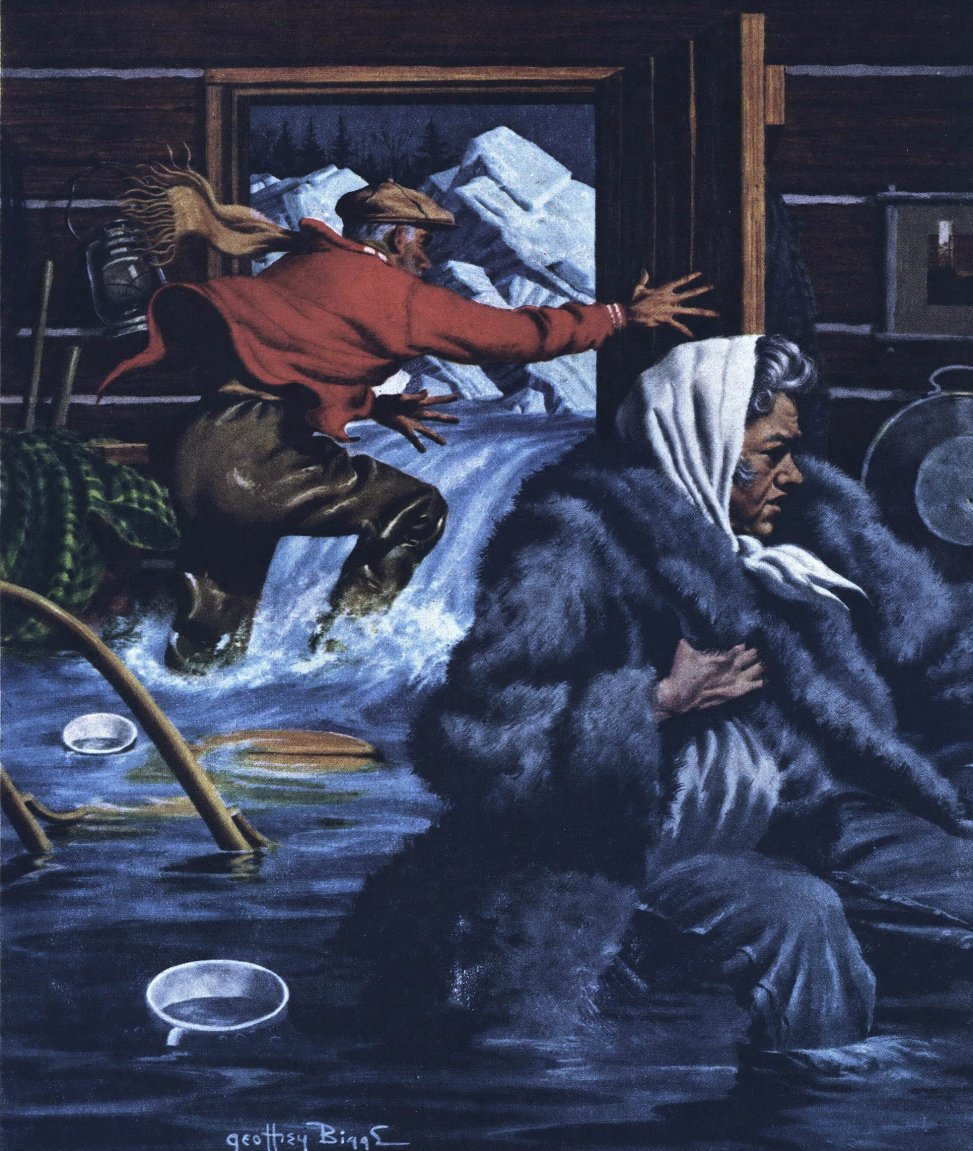
I pulled open the door. A fall of water poured into the room with such force that I had to grab the doorposts and struggle to get outside.
I swung the canoe across the doorway and got in. Where was my wife? Had she fallen? I shoved my head in the cabin. She was sloshing around in water that reached above her boot tops. She was trying to hold her coat above the water with one hand and yank blankets from the bed with the other. She splashed her way to the canoe and dumped the blankets into it. I gave her my hand.
For some reason, she could not lift her foot to the gunwale. She jerked her hand free, went back, and returned with a chair. Using it as a stepladder, she climbed in. Water drained from the top of her boots.
I paddled toward the bush, hoping to find a place to make a fire. As we passed the woodpile, I saw it was above water. Here was the spot. We got out.
I struck a match to a stick of dry spruce, with a bit shaved into curls. Ordinarily, we would have had a fire in two minutes, but a gale blowing up the creek snatched the flame away again and again.
My wife, almost crying, said. “I can’t take this for another five minutes without a fire.”
She was shivering and her face was blue. Little good it would do to be saved from drowning if we were to be frozen to death. The temperature was 20, and the raw east wind was blowing about 35 miles an hour.
At long last, the fire caught.
As my wife emptied her boots, she said grimly, “Ice water — that’s what I’ve been standing in for all of half an hour.” Her legs, as far as above the knees, were purple.
From among the blankets she pulled out stockings and hung them on a stick above the fire with my socks.
While the welcome flames were ridding our feet of the bitter chill, I looked at my watch. It was 6 o’clock.
Dry feet and a cup of tea did much to blunt the sharp edge of discomfort and raise our spirits. Cold and flood could be endured if only the water did not quench the fire. If the water rose another six inches, the fire would go out.
She was shivering and her face was blue. Little good it would do to be saved from drowning if we were to be frozen to death.
Meanwhile the dogs had been crying continuously. Dogs do not cry? You should have heard them — Red, Whitey, Snap, Porkie, and Billie. Sleigh dogs seem to think their master has power over everything, that he can produce food when there is none.
Now they expected me to control the water.
I dressed my feet, gave an extra tug to my waders and made my way to where they were tethered. They were more scared than hurt. A couple were high and dry, but the others were standing in a few inches of water. I moved two of the three wet ones to the top of some upturned roots and led one to a clump of willows on a tiny knoll. A few sympathetic words and an affectionate pat satisfied all except Porkie, the one on the knoll. He kept crying until I returned and chopped off the willow branches. The wind had them whipping him.
The cruel, steady wind was blowing with increasing strength directly on our perch. For protection, I hung the tarpaulin over a stick jutting from the woodpile. Our eyes were stung and at times blinded by the diverted smoke, but that was easier to bear than the full force of the marrow-chilling gale.
As far back in the brush as we could ft see, except where dogs were tied, no ground was above water, not even a spot large enough for a sparrow to come to rest.
Water was flowing rapidly by us, but it stayed a scant six inches from the fire, never coming nearer, never dropping away. It was as if our prayer, “No higher,” had been answered with “Thus far and no farther.”
In the early afternoon the current stopped and ice formed immediately. Cold and uneasiness did not prevent conversation. We reviewed each incident, especially our struggle to gain the refuge of the woodpile.
“What kept you from getting into the canoe?” I asked. “It wasn’t a very high step.”
My wife explained that the water had caught up to the first garment she pulled on. It had stuck and kept her from bending freely.
“At that point,” she continued, “I was glad to get into my boots. I’m no further dressed yet. This coat feels better today than it did in winter at 40 below zero.”
The passenger plane traveling from Winnipeg to Fort Churchill passed overhead. For the first time I realized that air travel can hold security and comfort denied to the earth-bound. Its passing south a bit later made us still more sharply aware of how completely we were cut off from help. Nobody knew about our troubles. Even if the plane had been flying low enough to see us, it could neither have brought nor sent help.
I have been outside an entire day when it was 60 below zero and I have slept under the snow for 24 hours during a blizzard, but no day in my life was as chilling as this.
One dim comfort was that the flood had to recede sometime. But when? And would it rise before falling?
At 3 o’clock came the first change, a welcome one indeed. Except where it clung to tree or stem, the ice dropped slightly. Some hours later there was a second drop, this time of a few inches. Not once throughout the day did the sun break through the lead-gray clouds, nor did the wind moderate nor the temperature rise.
I have been outside an entire day when it was 60 below zero and I have slept under the snow for 24 hours during a blizzard, but no day in my life was as chilling as this. I have gone three days at a stretch without eating, but this day, in spite of sufficient food and a fire, was the worst. The reason was that I was wearing summer clothing. When I had reached for my winter parka, I found that the bottom of it was in water. I truly believe my wife’s otter coat saved her life.
We slept in the canoe, the one place it was possible to stretch out. I had tied it to the radio pole so it wouldn’t float away. A blanket was under us and over us were another blanket, the opened sleeping bag, the tarpaulin, and my wife’s coat.
“A fur coverlet,” she said. “But I don’t feel like a fairy princess.”
When we had settled ourselves we regretted not having taken refuge in the canoe long before. The high side cut off the wind so effectively that I was warm for the first time since leaving the cabin, and protection from smoke was almost as great a relief. Satisfied that we couldn’t be more comfortable, we settled down for the night. Again and again I was disturbed by canoe ribs and my own ribs fighting for the same space. My wife fared better than I, because of her slightly thicker layer of adipose tissue.
She slept well, she said, quite comfortable except that her feet had been cold. Later, when the blankets were folded, we saw that the corner where her feet had been was frozen stiff, having gotten wet when the water rushed in.
Breakfast on the morning of May 23 was a handful of dates eaten in the canoe. We hated to leave its shelter, but at 10 o’clock we returned to the woodpile so that we could enjoy a cup of tea.
The wind, now from the south, brought warmer weather. Bits of ice tinkled into the water below. Birds were singing cheerfully, especially the white-crowned sparrows. Blackbirds strutted in the little pools and thrust their pointed beaks down in the mud in search of food. Sandpipers and lesser yellowlegs lighted a few yards from us and on their stiltlike legs investigated the bottom of the newly formed pond. The courting sound of Wilson’s snipes reached our ears. We heard the wild, eerie, bugling cry of swans.
“The swans have returned!” my wife cried in excitement. “They are good luck for us, I’m sure. I’ll never forget their calls directing me when I was lost in the bush.”
The most encouraging sign of all was that the water had dropped a foot during the night. Little by little it continued to recede, and the air became warmer.
Suddenly, in the middle of the afternoon, there was a torrential downpour of icy rain accompanied by strong wind. We made for the cabin.
The water was up to the doorsill, leaving our snug little home in an astounding mess. Wood and bark from the wood box and ashes from the stove were floating over the floor. Tea and coffee pots were bobbing around. The linoleum, buckled and torn, showed in places above the water. Chairs were overturned. The bed was in the center of the room. Everything reached by the flood was coated with clay from the dike. The bush cabin we had been so proud of was now a hovel.
But once an armful of wood had been brought in from the woodpile and a fire was blazing in the stove. It was not a bad place after all. It was protection from wind and rain.
As I bailed the floor, I wondered if it was for the last time. The job proceeded until I got down to the last two inches of water.
I could not get it below that point, for that was the new level of the water table around the cabin.
The underside of the mattress was saturated, the upper side quite damp. That night we slept fully dressed, sitting up, our heads resting on the table, our feet hooked over the chair rungs. A lookout had to be kept, because if the ice moved again, we might be flooded again.
The next day, May 24, the water retreated to the bank and began a slow, steady drop. The change and the fact that we could get to work made us much happier.
Using an ice chisel to cut through the frozen banking, I chopped open the drain. The water on the floor oozed away. The torn linoleum was thrown out and all the furniture restored to its place.
The floor and the lower walls had to be scrubbed free of clay or they would stay wet and rot. To reach the creek, our usual source of water, was impossible because huge blocks of ice covered the entire bank. Fortunately, one of the chunks that dropped near the door was a clear blue, the type that furnishes the best of water for drinking and all household needs. The walls were cleaned of clay that afternoon, but the floor had to be left for attention on another day.
Related: I Didn’t Trust My Sled Dog. My Poor Judgement Nearly Killed Us All
Our muscles and joints that night cried for a bed. but in spite of a fire all day, the mattress was still damp. The clay-covered, slimy, wet floor was no place to stretch out, so we slept on the bedsprings. One of us went each hour to the top of the bank to examine the creek. It continued to drop.
Not until two days later, May 26, did we feel entirely safe. Only then did we undress for a night of uninterrupted sleep, the first in seven. Great blocks of ice still walled off our canoe path to the creek, but the water was flowing free to the river. The blocks would soon melt. Then we could slide a canoe down the bank and paddle away.