
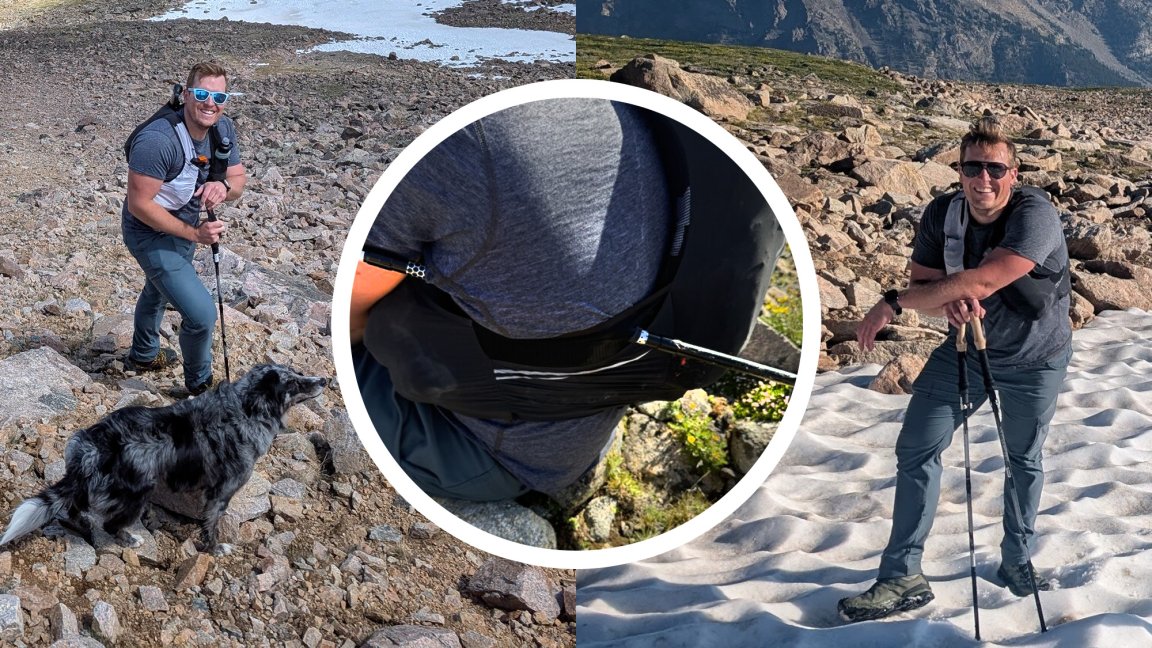
A Montana man is recovering from a gruesome hiking injury. David Cifaldi of Billings fell while hiking at high elevation and unintentionally impaled himself on one of his own trekking poles. One pole hit the ground when he slipped on some rocks. The tip of the other stabbed him in the torso, piercing the skin on his left side. It angled under his armpit, from front to back, but luckily missed his organs.
“By the time I rolled over, I kind of knew something wasn’t right,” David Cifaldi, the impaled hiker, told KTVQ. “Through my skin I could feel the trekking pole.”
Once the shock of what had happened settled, Cifaldi, who is a wound-care nurse by profession, conducted a self-assessment. He could breathe, he wasn’t bleeding and the pain was tolerable. His two friends who were with him, Jesse Ross and Brad Reich, used a satellite device to message for help, but then Cifaldi decided he wanted to try to evacuate on his own instead of waiting for a chopper rescue.
“It was really a freak accident,” Ross said. “I’m really grateful he could turn his nurse brain on and reassure us through it.”
The injury happened July 20 on Granite Peak, Montana’s tallest mountain at 12,799 feet. AllTrails ranks the 24-mile route as one of the most challenging mountaineering high points in the U.S. It’s situated in the Absaroka-Beartooth Wilderness north of Yellowstone National Park straddling the Montana-Wyoming border. Despite the remote location, Cifaldi hiked out.
“I think my nurse brain clicked on,” Cifaldi told KTMF. “As soon as I was able to self-assess and establish that this was not life threatening right now, I was pretty convinced I was going to get off that mountain under my own power.”
The trio was two miles from summiting Granite Peak when Cifaldi fell. They had to backtrack 10 miles to the trailhead with Cifaldi impaled. It took them six and a half hours. Ross and Reich walked ahead of Cifaldi so they could alert others on the trail about what was coming toward them.
“Mystic Lake is a very popular trail,” Ross said. “There’s families, and he even had us hike ahead and warn people so young kids didn’t have to see such a gnarly wound.”
Read Next: The 10 Toughest Mountain Men (and Women) in American History
Cifaldi first went to a local clinic for evaluation, which eventually turned into a drive to Billings to meet a surgeon. The surgeon attached a drain to the pole so as the pole was pulled out, the drain was pulled in. Cifaldi is recovering now; Ross has organized a GoFundMe to help cover his medical bills. He plans to do the hike again, but without trekking poles next time.
“I feel very lucky,” he said. “A couple inches the other way and this would be a very different story.”