
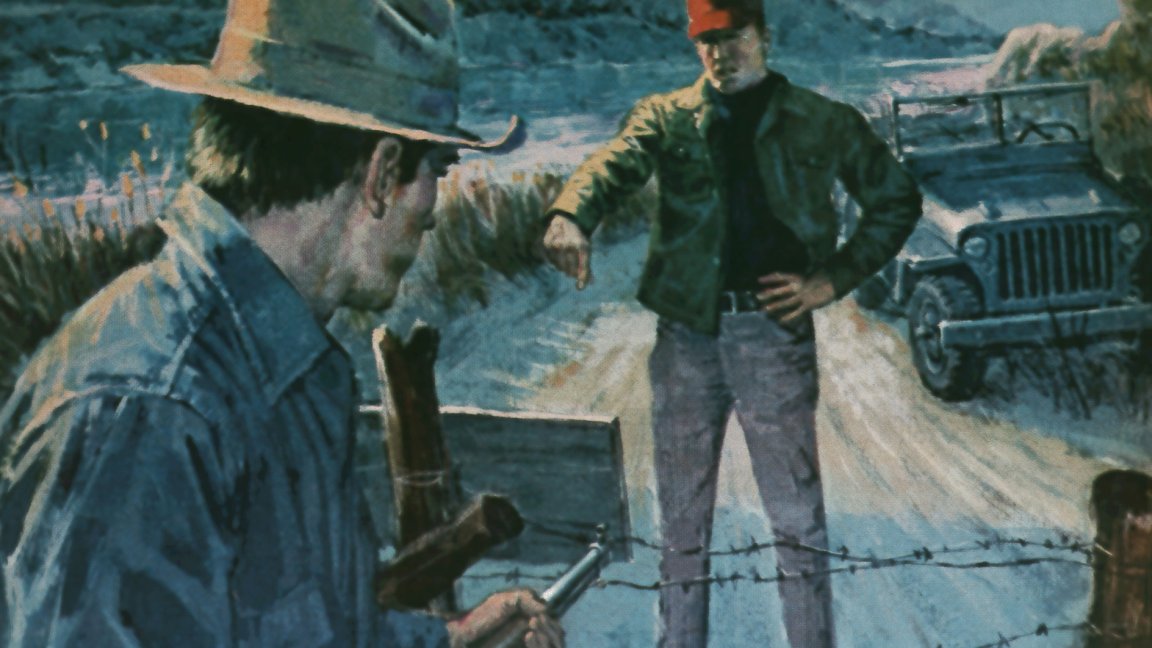
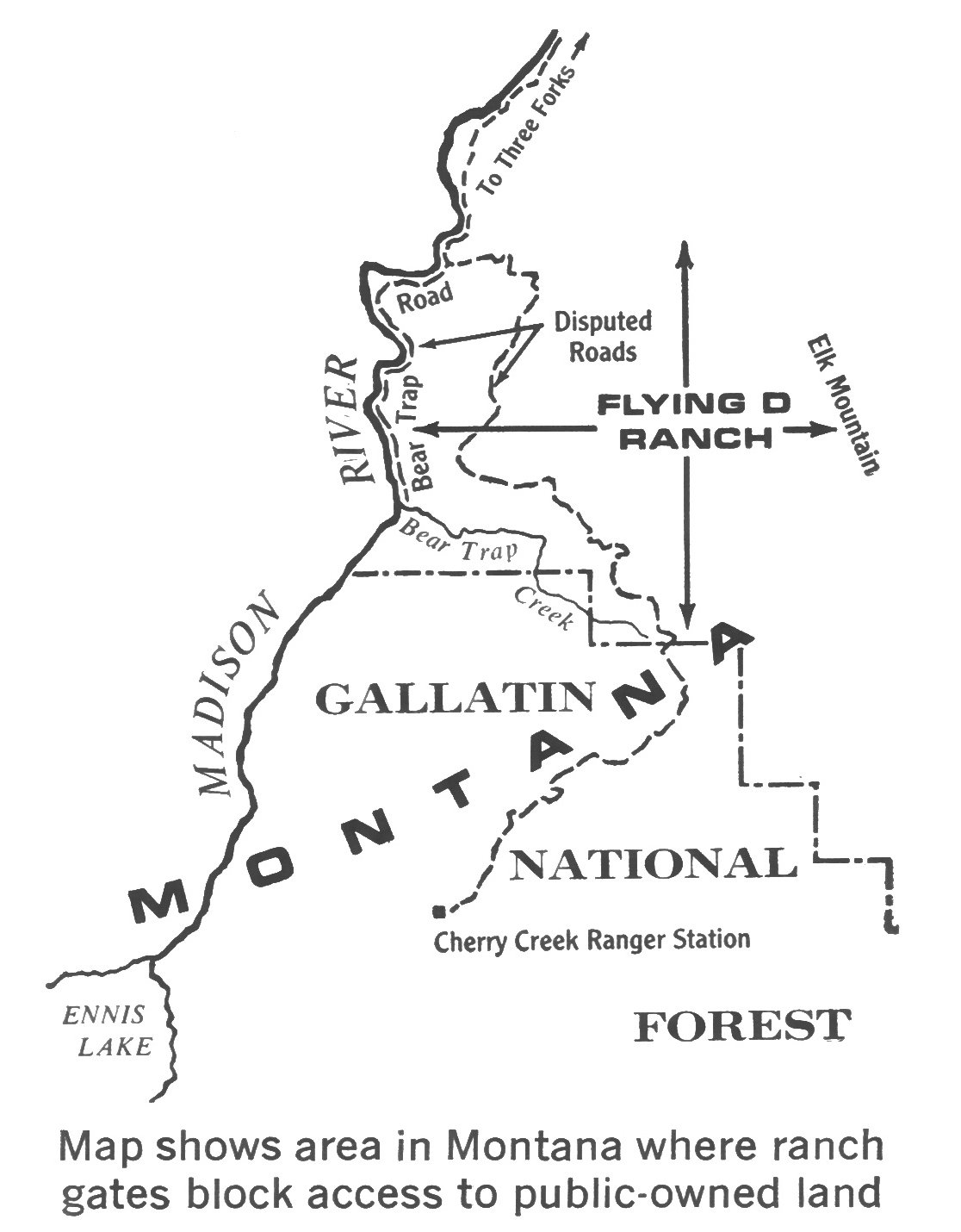
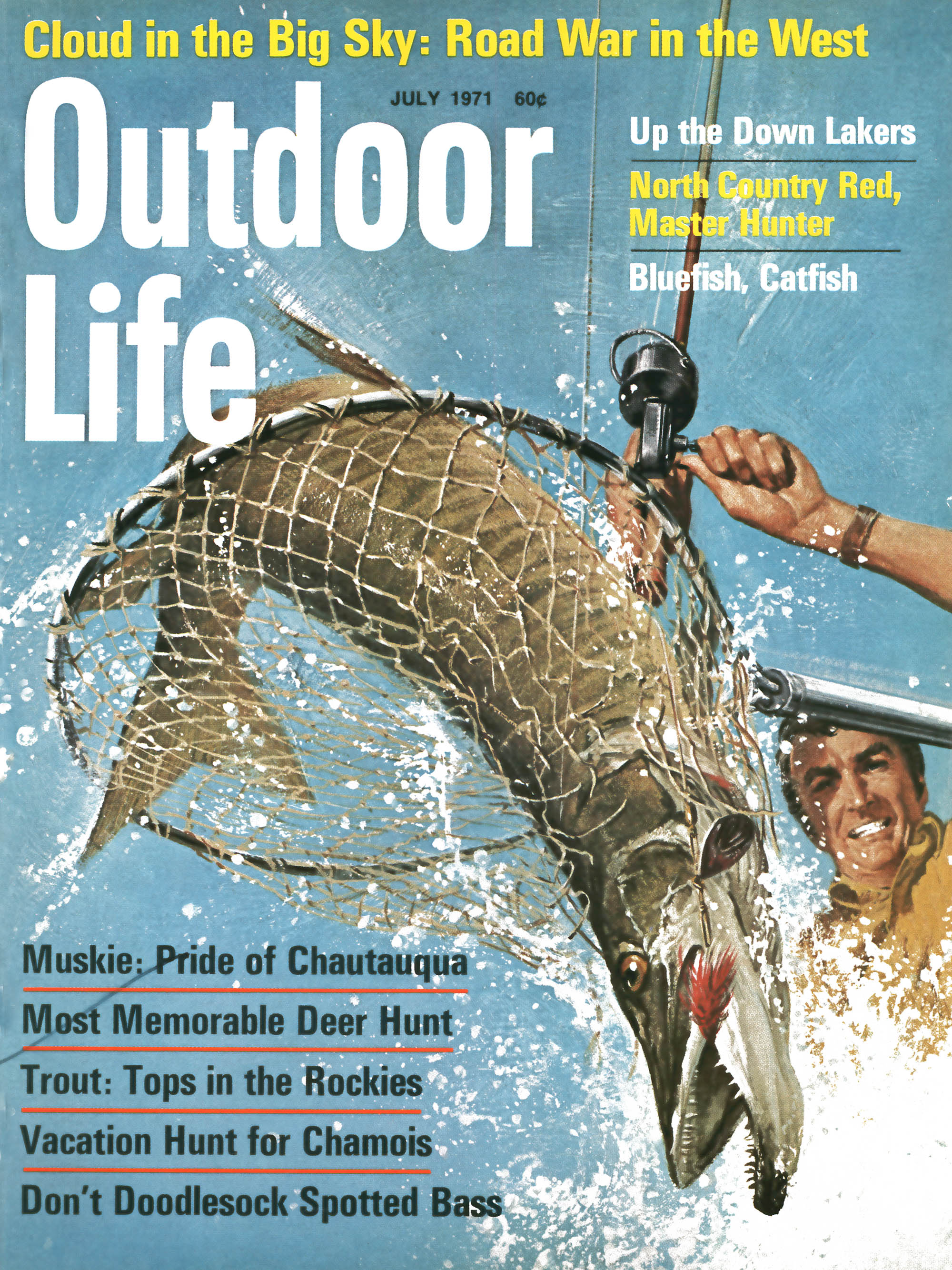
This story, “Cloud in the Big Sky,” appeared in the July 1971 issue of Outdoor Life. Ted Turner purchased the 113,600-acre Flying D Ranch in 1989 and enrolled some of it under conservation easements, though also posted it and limited public access. One of the disputed roads, the Bear Trap Road along the Madison River, was included in the Lee Metcalf Wilderness, allowing for clear public access. The wilderness was established in 1983, and became the first wilderness area ever managed by the BLM.
One morning in the fall of 1965 I left my home in Three Forks, Montana, for a deer and elk hunt in the Gallatin National Forest, about 30 miles south, where I had hunted for many years.
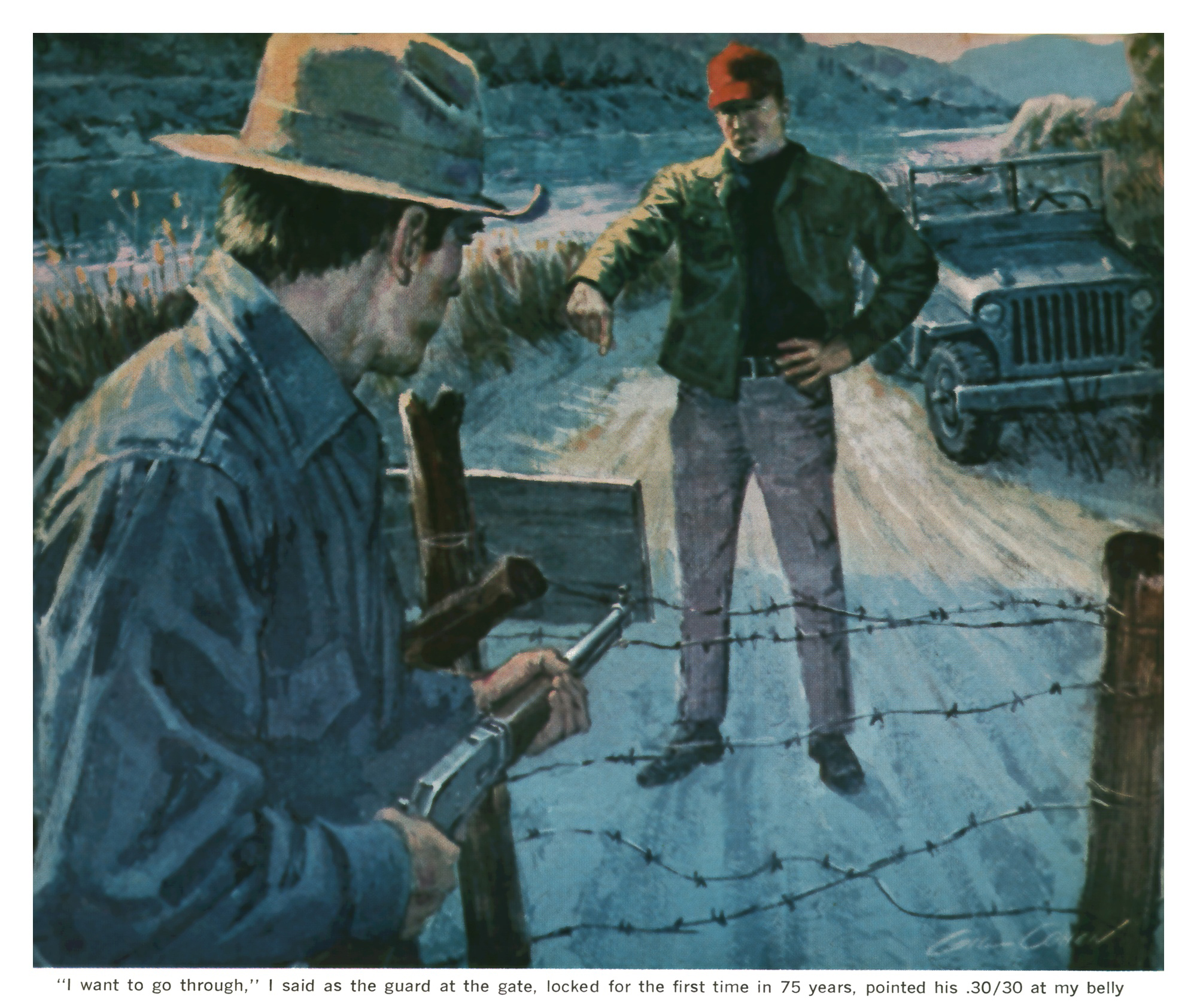
Ten miles north of Ennis Lake, I turned my jeep onto the Bear Trap Road that runs beside the Madison River. After driving a couple of miles farther, I entered a canyon, and partway through it I came to a gate.
I wasn’t surprised. The gate had been there as long as I could remember, to keep livestock from straying. But now something new had been added. There was a no-trespass sign nailed to a post, and the gate was padlocked. Just beyond it a small tent was pitched, and what came next was a real surprise.
A man carrying a .30/30 stepped out of the tent and walked toward me with the gun pointed at my belly.
“I want to go through,” I told him, nodding toward the gate. “Will you unlock it, please?”
“You’re not going through,” was the surly reply. “I’m working for Flying D, and I’m here to keep people out.”
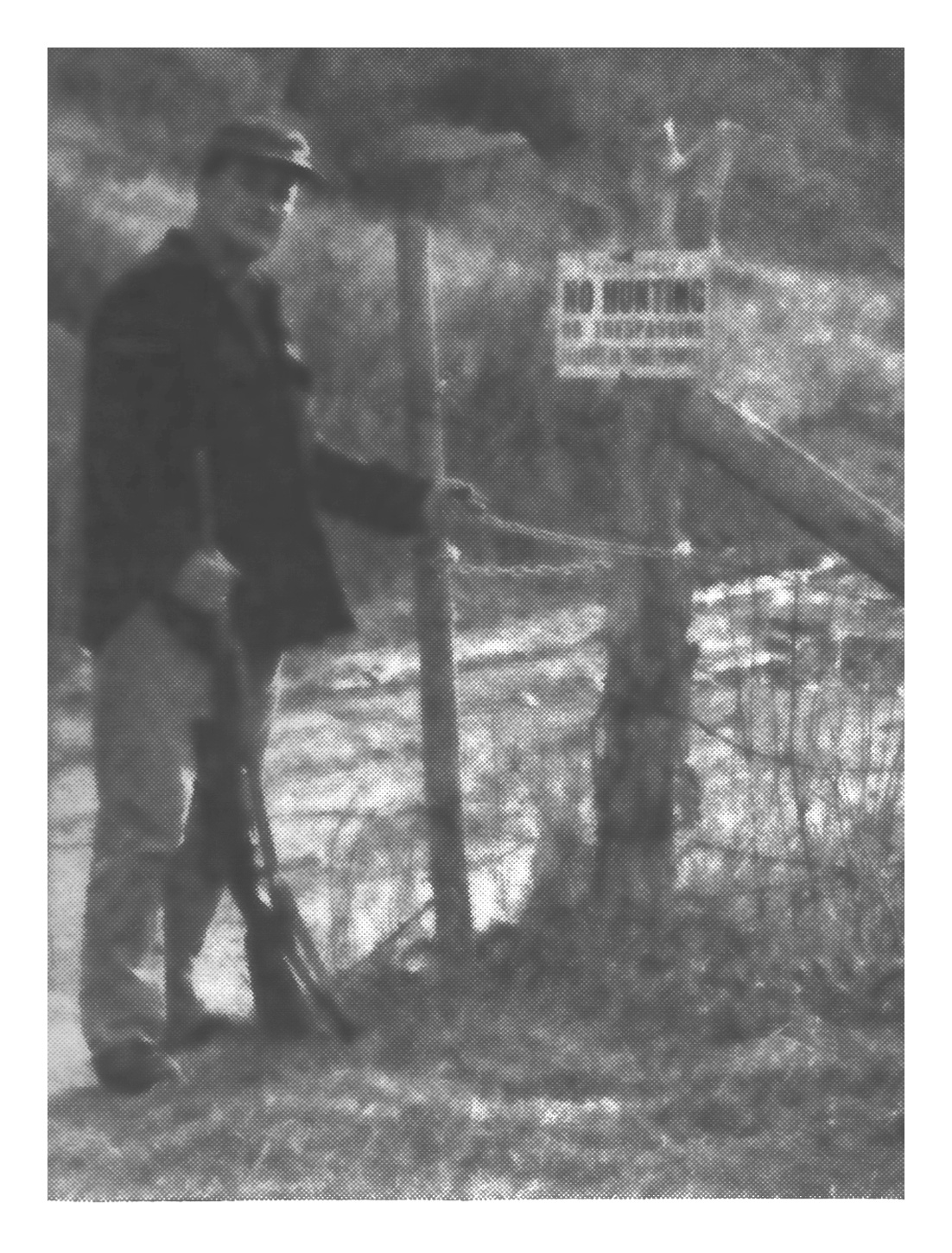
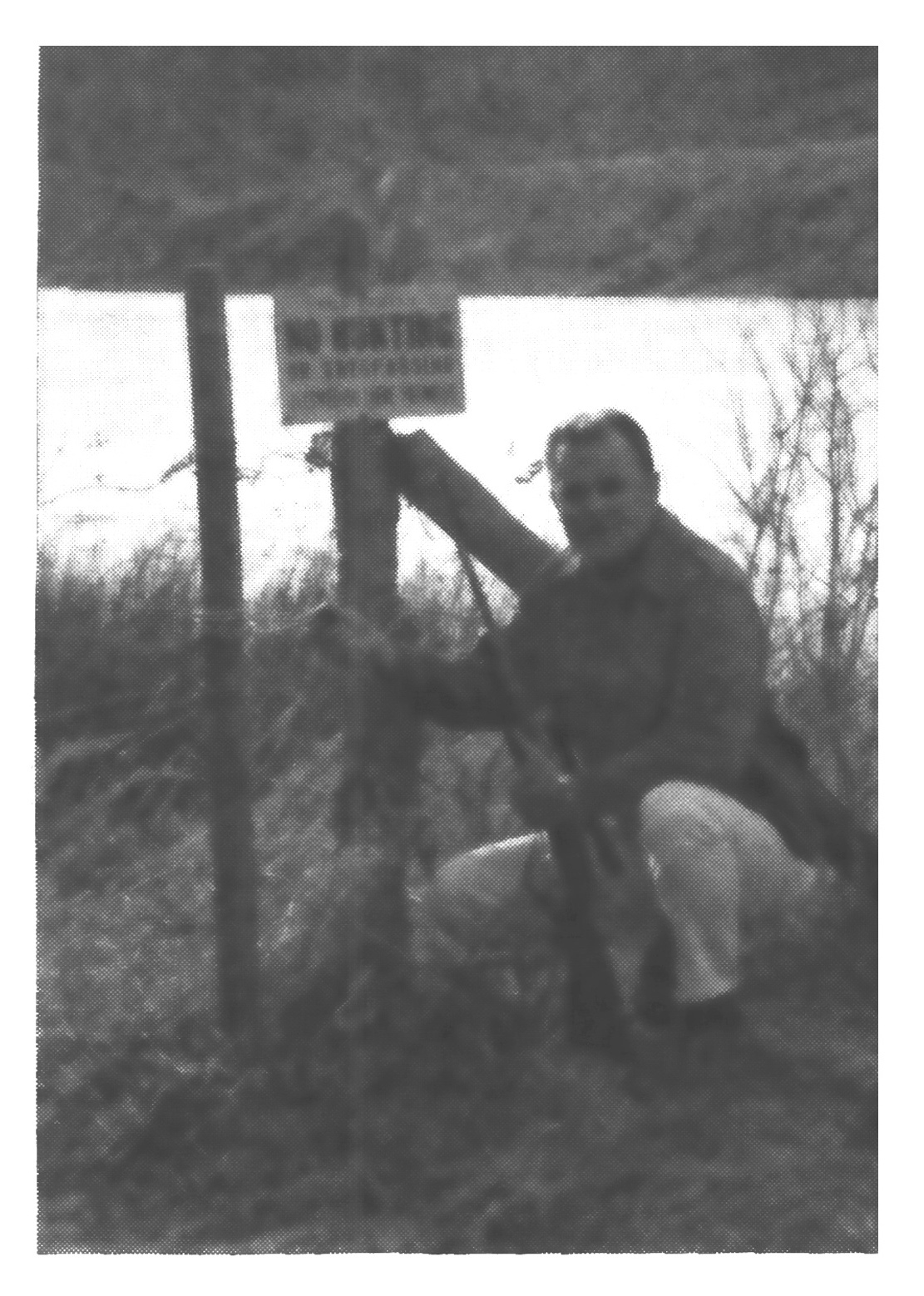
Pete Vandolah (above) and I (right) at padlocked gate on the Bear Trap Road.
I stared at him in amazement. The road was the kind known as a prescriptive-right road, leading up to U.S. Forest Service land. It had been built around 1890 by ranchers, and for three-quarters of a century it had been used by them — and by hunters, fishermen, homesteaders, forest rangers, prospectors, even moonshiners — with no objection from any landowner. It had been maintained with federal and county funds. It was a public road, by law and in every other sense, although it ran across private land, and I found it hard to believe that I was going to be prevented from using it to get to a hunting area that belonged to all the people of the United States, myself included.
I found it even harder to believe what followed. The guard wouldn’t budge, so I fired a question: “What will happen if I break the lock?”
“I’ll use the rifle on you,” he growled.
I don’t think I bluff easily. A Three Forks councilman at the time and now mayor, I’m also a captain in the Montana National Guard, and I was a Marine combat flyer in the Korean War. I’ve seen enough guns that they don’t frighten me off much.
On top of that (as a friend remarked later) out here if you tell a man you’ll use a rifle on him you’d better be ready to use it. Otherwise, if he’s big enough there’s a good chance he’ll shove it down your throat.
But there was a hitch this time. I didn’t know exactly what my legal rights were. If I was going to get shot because of a locked gate, I didn’t want it to happen on land where I had no right to be. Seething inside, I walked back to my jeep and gave up my hunt.
That chilling encounter was my introduction to a dispute that has buzzed like a hornet’s nest ever since. I have been a ringleader in a six-year campaign to get that gate and others like it unlocked, to reopen the public lands beyond them to hunters and fishermen. To date we have had very little success.
I see the lack of adequate access, or of any access, to millions of acres of Forest Service and U.S. Bureau of Land Management lands as one of the most serious problems confronting the outdoorsman, not only in Montana but also in most of the other Western States.
It gets worse each year, and unless sweeping solutions are found, some of the finest hunting and fishing in the West will be lost by default to all but a privileged few.
I am far from the only one who believes that. Says Don Aldrich, executive secretary of the Montana Wildlife Federation:
“The loss of public lands for recreational use may turn out to be a greater threat to outdoor enthusiasts than antigun legislation.”
The trouble in the Three Forks area did not start to heat up until the 1960’s, when the Flying D Ranch set out to bar access to some 100 square miles of national-forest and B.L.M. lands in the Cherry Lake area east of the Madison River. But it had been simmering in various sections of Montana long before that.
At its 1960 convention the Montana Wildlife Federation called for public access to all public lands. Three years later the federation passed a strong resolution that declared:
1) Vast areas of public land and water are inaccessible to public use.
2) Existing public roads and rights-of-way leading to public lands have in many cases been closed to public use by private landowners and county commissioners.
3) There has been a lack of aggressive action by county commissioners and other public agencies in retaining existing rights-of-way and acquiring other needed access. Some agencies that manage public land have been reluctant to seek public access.
The resolution concluded by urging all public-land agencies to seek access by every possible means.
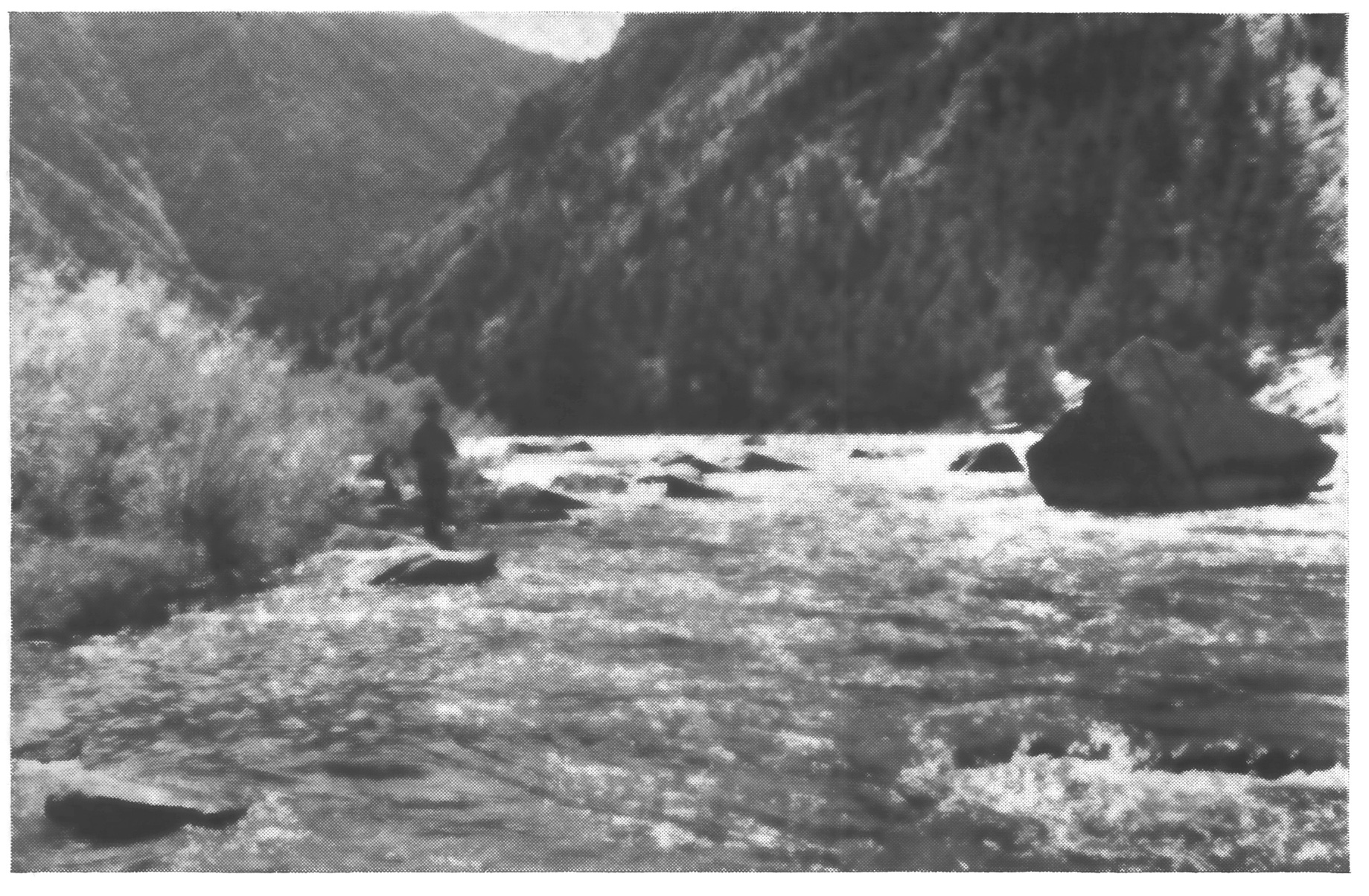
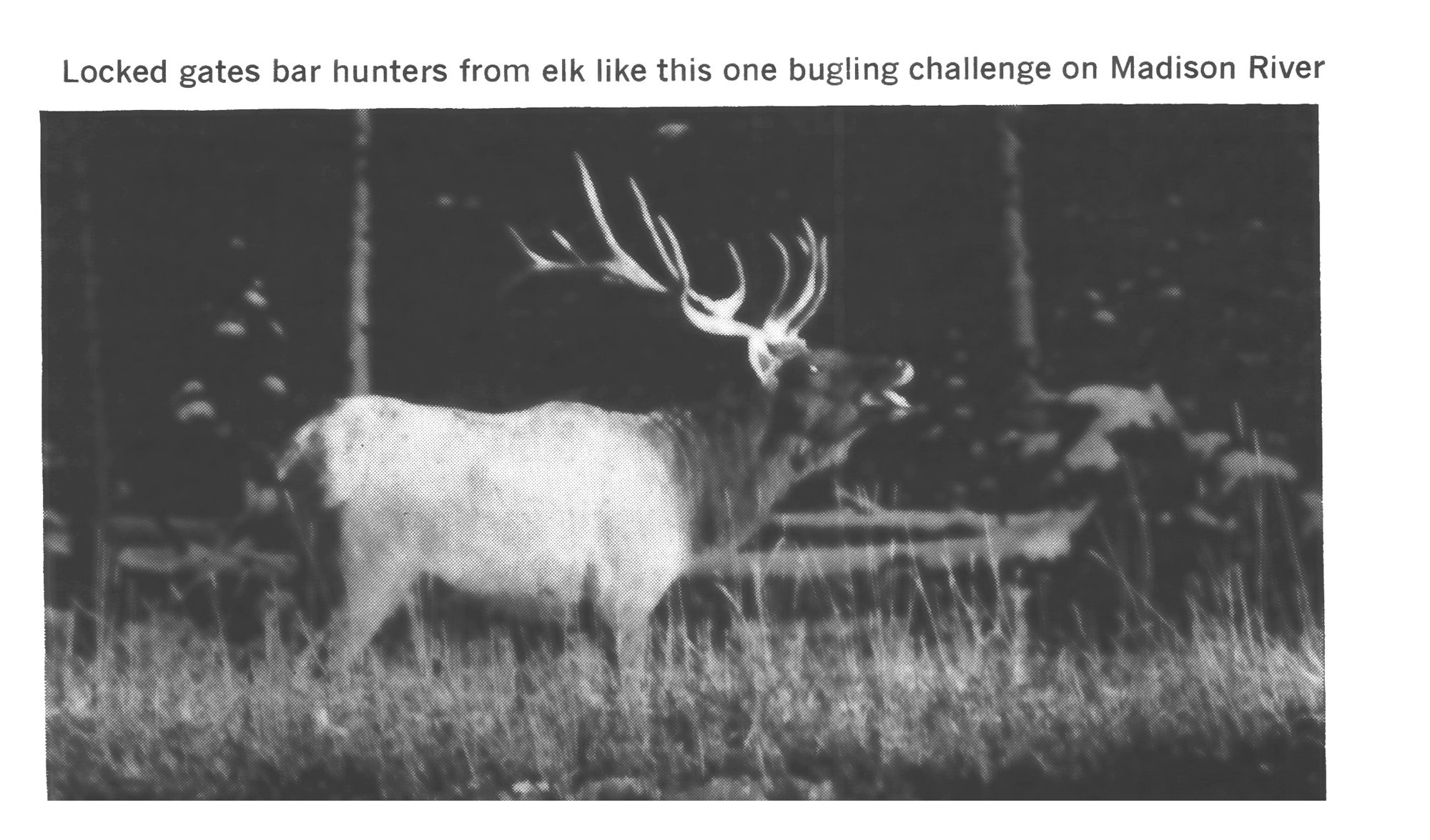
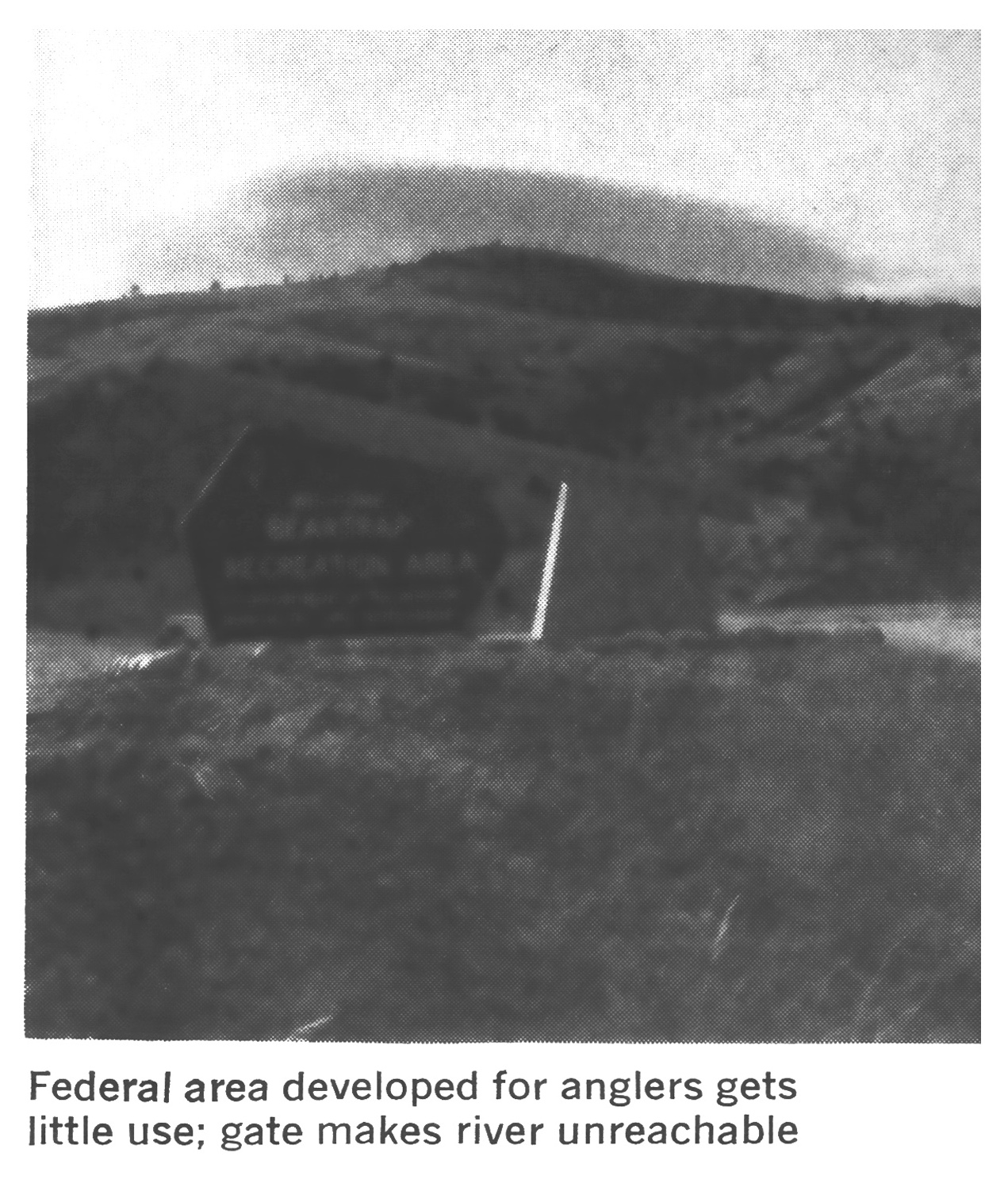
The pot started to boil on the Madison a year or two before I had my confrontation with the gate guard. First the Bear Trap Road and then the jeep road leading to the Cherry Creek ranger station were blocked off. The tract thus closed included some of Montana’s choicest big-game hunting grounds, and the closure also denied fishermen access to the east bank of the Madison River for several miles in Bear Trap Canyon, where the river is rated a blue-ribbon trout stream.
Public resentment was widespread and bitter.
“I could hardly believe anybody would lock up roads going to public lands,” complained Ed Tracy, a railroad conductor living at Three Forks. It took what he calls a hired gun to convince him that the situation was real.
In the fall of 1962 Tracy and a partner were stopped at a gate on the Cherry Creek road, in an area he had hunted for 35 years, by a rifle-toting guard who claimed to be a deputy sheriff and warned that he was ready to shoot.
Bud Mason, another Three Forks resident, grew up in a homesteader’s cabin on the west side of the Madison, opposite the mouth of Cherry Creek. “That road,” he says, “was used for more than fifty years that I know of, by anyone who wanted to use it. There was never a locked gate the length of it. There shouldn’t be today. The public should be able to use public land.”
Pete Vandolah, a local rancher, had his first brush with Flying D guards in the fall of 1963. While hunting in the Cherry Creek area, where he had hunted for almost 30 years and where his dad had hunted before he was born, he killed an elk and went back to his truck to get help in dragging it out. He was stopped on the road by two armed men who identified themselves as Flying D employes patrolling the area to keep hunters out. They gave him three hours to leave, elk and all, under threat of being locked in and prosecuted.
Three years later Vandolah bluffed down an armed guard at a locked gate.
“You open the gate,” Vandolah said bluntly, “or I’ll open it for you.” He drove through, but six other hunting parties waiting at the gate were denied entrance.
Today Vandolah’s concern about maintaining access to public land is more for the sake of his three boys than for himself.
“I want them to have the hunting and fishing I enjoyed as a kid,” he says.
One of the most revealing experiences in the course of the long controversy was that of Duane Olsen, a hunter from Billings. In a letter to the Billings Rod and Gun Club, he told of a long-planned hunting trip that was ruined for himself and two partners in the fall of 1967, when they found their way blocked by a padlocked gate and the usual armed guard.
“We had hunted for years on Forest Service and B.L.M. lands in the high country above Bear Trap Canyon,” Olsen said. “Our plans and arrangements were made months in advance. When we were turned away, there were some pretty hard feelings. Three people and three horses were stranded; we didn’t know where to go or what to do.
“Seeking the reason, we contacted the sheriff at Ennis. He said he would do nothing, because he had to live with these people and not with us. Next we tried the U.S. Forest Service and the Montana Fish and Game Department, only to be told it was not in their jurisdiction. A local forest ranger advised us to try someplace else, saying he did not want to make trouble. We spent the entire three days of our vacation trying vainly to gain entry to land that belonged to us.”
Just who or what is this influential Flying D Ranch? It’s a subsidiary of the Irvine Company, a multi-million-dollar California corporation that has extensive dealings in real estate. The ranch takes in some 64,000 acres.
Late in 1968 Al Jenkins, president of the Billings Rod and Gun Club, approached Flying D, seeking an amicable solution.
“We cannot quarrel with your right to refuse hunting privileges on your own lands,” Jenkins wrote, “but it seems punitive to close off a road that has been used for years and thus deny access to thousands of acres of public land. We ask the privilege of using this right-of-way, not for our club but for the public.”
In reply Jenkins was told by Charles S. Wheeler, president of the ranch but having a California office, to advise members of his club to use a staging area at the Spanish Creek ranger station for gaining access to the area. This staging area, Wheeler pointed out, was accessible by public roads and offered facilities for unloading horses, parking vehicles, and camping. What he did not mention was that it was located more than 10 miles east of the barricaded Cherry Creek road, across rugged mountain wilderness.
Jenkins rejected the suggestion, saying the Spanish Creek ranger station could not supply adequate access, and reiterated his request that the road to the Cherry Creek ranger station, long a public-access point, be reopened.
The final answer from Wheeler said:
“We deem public entry as not compatible with a productive cattle operation. Permission to cross more than five miles of our fee land is denied.”
What was the land that Flying D had decided to lock up? Fee land is Forest Service or B.L.M.-controlled land on which a ranch leases annual grazing rights at a fee of so much per head of livestock. The lessee does not own these lands. He buys from the federal government the right to use them during the grazing season.
Does the lessee also buy the right to keep hunters and fishermen out, by closing the roads that lead to or across them? Up to now that question has not been answered.
In October 1970, in my capacity as mayor of Three Forks and acting in behalf of the sportsmen and residents of the area, I petitioned the County Attorneys and Commissioners of Madison and Gallatin counties, and the Montana Fish and Game Commission, to restrain Flying D from obstructing the public’s right to use roads leading to public lands. I also asked for hearings.
I was swamped with phone calls and letters supporting my action, but the petition struck fire in only one quarter. Chester Jones, Madison County Attorney, moved promptly to set a public hearing in Virginia City November 5.
The hearing was heated. It disclosed that Flying D was chaining and locking both prescriptive-right and county roads. Jones ruled that the locking of gates on the county roads was a violation of state law, and the County Commissioners then ordered Flying D to remove these locks. But they left unsettled the matter of prescriptive-right roads, saying that such roads were outside their realm of authority.
Flying D retaliated promptly. First, a small country store in the area, whose owner had spoken out against the locks at the hearing, was boycotted. Next, an ad appeared in the leading daily papers of Montana announcing the intent of the ranch to continue keeping the public out.
“Flying D will defend its fee property against trespass,” the ad read. “It has opened county roads, but anyone leaving such roads will be subject to prosecution.”
Again, the fee property in question was leased for grazing from the U.S. Government; it is not owned by the company.
There the matter now rests. I carried my appeal to Montana’s two U.S. senators, Mike Mansfield and Lee Metcalf. They asked for an explanation from the Forest Service and the Bureau of Land Management.
“In the past, landowners have allowed hunters to use private roads to reach national-forest lands,” explained M. M. Nelson, deputy chief of the Forest Service. “Recently there has been a strong trend toward closing off such roads. In some cases county governments have contributed to the loss of access by vacating road segments at the request of landowners.”
It was an explanation that offered no remedy. Neal Rahm, regional forester at Missoula, did better.
“We have been reluctant to acquire rights-of-way that will not serve the ultimate forest-development road,” he told Senator Metcalf. “But the closing of many primitive roads by private landowners has occasioned a change in this policy. We now recognize the necessity of acquiring rights-of-way for primitive roads to provide access to forest lands.”
Let’s hope they hurry the process along.
A spokesman for B.L.M. wrote Senator Mansfield:
“As problems of posting or locking gates on B.L.M. lands are discovered, corrective measures are taken.” He said nothing about locked gates on private land that close off access to B.L.M. holdings.
So far no official — county, state, or federal — has come to grips with the central question, the legal rights of the public on prescriptive-right roads.
When I got back to Three Forks after looking down the muzzle of the guard’s .30/30 that day, I started digging into Montana law. I learned that a prescriptive-right road is one established over private land through years of public use. Unless the landowner has blocked it for at least one day a year — thereby asserting his ownership and registering his objection to trespass — common law puts it in the public domain after seven years of continuous use. I’m told that the same doctrine prevails in many other states.
Two things stand in the way of enforcing the public’s rights. First, a separate court action might have to be brought for each individual road, at least until a clear legal precedent had been established. Second, in the Western States where politics is dominated by livestock interests, elected officials are reluctant to incur the wrath of ranchers, especially the influential owners of big corporation ranches.
It is the rapid growth in such holdings that is aggravating the problem. In a 40-mile stretch of the Ennis Valley of the Madison, for example, at one time there were nearly 50 family-size ranches. Today there are 12 ranches, all owned by large corporations. The big spreads have absorbed the small ones.
And, as in the case of Flying D, the well-heeled new owners often want to convert their holdings (including public land on which they pay grazing fees but in which they are likely to feel they have a vested right) into private hunting-and-fishing preserves for themselves and their friends.
While this article was in preparation, the authors talked to the top game official of another Western State, who asked that his name be withheld because of the danger of political reprisal. He was quick to put a finger on the crux of the whole matter.
“If I owned a mining claim on federal land, I don’t think I’d have any trouble maintaining access to it over a prescriptive-right road,” he told us. “If I acquired the right to carry on a logging operation or graze cattle on such land, I doubt that a private owner would try to put a locked gate or an armed guard in my way.
“The Forest Service and B.L.M. have recognized the concept of multiple use. Under that concept, isn’t the use of public land for recreation as legitimate as for cutting timber, raising a cow, or taking out minerals? Isn’t watershed management as important as grass or tree management? Isn’t big-game management as important as all of these?
“The multiple-use concept is talked about; what we need to see are results,” the game official continued. “Hasn’t the time come to give legal recognition to the idea that the right to fish 10 miles of wild river is fully as essential, in the light of today’s conditions, as the right to work a mining claim?
“Maybe the answer has to rest in a major court decision, and a federal court would probably be preferable to a state court because more state courts in the West, like most Western legislatures and governors, are attuned to the wishes of the livestock people first of all.”
That opinion is echoed by many sportsmen. Says Jim Gay, a well-known outfitter, guide, and taxidermist at Laramie, Wyoming:
“Probably our public lands should have recreation as No. 1 on the multiple-use list, and we should cut down all other uses where they conflict, as grazing does with wildlife. But Western politics is still stockman-controlled, so it will have to be a national ruling. And they’d better get to it soon.”
While all efforts to open the Bear Trap and Cherry Creek roads seem to be at a standstill, controversies of the same kind are cropping up in many other sections of Montana.
Last January, for example, the Fish and Game Commission served curt notice on a landowner in the Twin Bridges area that unless he unlocked a gate across a prescriptive-right road, the commission would begin action against him.
Since October 1968 Glen Childers of Brusett, currently president of Montana Outfitters and Dude Ranchers, has battled unsuccessfully for the opening of a gate, locked by a nonresident landowner, on an access road that controls almost a township of hunting land south of the Fort Peck Reservoir. Part of the land lies within the Charles M. Russell National Wildlife Range. The rest is about half privately owned and half public domain.
In 1967, Childers charges, the locked gate was located on public land, and he forced its opening. A year later the owner moved it a short distance, onto private land, and since then Childers has had no success. The gate is locked only during hunting season, making its intent clear, but the county commissioners have made it known that they do not want the road declared public. So far their wishes and those of the landowner have prevailed.
Another access quarrel is simmering north of Livingston, where the Double U Ranch has begun closing roads leading into the Gallatin National Forest.
Where access for fishing is concerned, the problem is not yet so severe as it is for the hunter. For one reason, many Montana streams are near public roads. For another, many ranchers will let anglers cross private land to reach a stream.
But the future of fishing access is far from unclouded. The buying up of streamside land by nonresidents is fast gaining headway, and private clubs are starting to acquire many of the spring creeks that supply some of the state’s finest flyfishing. Finally, landowners are voicing growing concern over the mounting number of fishermen.
Trouble spots are showing up with increasing frequency. In the spring of 1969 the Flying D Ranch posted some 3½ miles of the West Gallatin River, which has some of the best rainbow and brown-trout water in that section of Montana.
Along the Yellowstone River, as the purchase and leasing of land increases, so do the no-trespass signs. Even the famed Big Hole, one of the great trout streams of North America, faces a troubled future. The river’s reputation draws more and more anglers, and the tolerant attitude of landowners is showing signs of wearing thin.
Public fishing on one of Montana’s finest small streams, Armstrong Spring Creek, has been protected at least for now through the efforts of the Yellowstone Chapter of Trout Unlimited, spearheaded by Dan Bailey of Livingston, a national director of T.U.
This creek offers two miles of unexcelled fly water, with a staggering population of 5,700 catchable trout to the mile. When it seemed that the stream might be leased to private interests, the T.U. chapter started a drive for funds and negotiated a lease of its own. The $6,000 needed was contributed by T.U., tackle companies, Bailey’s fly shop, a local brewery, and private individuals.
But it will take at least $6,000 a year to keep Armstrong Spring safe, and Bob Tusken of Bozeman, president of the Madison-Gallatin Chapter of T.U., asks the key question: “How many more such streams can we afford to lease?”
Despite the arrogance of some landowners, the blame for road closing does not rest entirely with their side. A minority among hunters and fishermen, by their misbehavior, too often bring honest wrath down on all sportsmen.
Bob Tusken cites a classic example of the consequences of such abuse. On the West Gallatin the owner of a mile or more of river frontage allowed fishing until July of last year. He posted his land then, after a fence was cut, but announced that he would reopen it if the party who cut the fence would come forth. Nothing happened, and another stretch of topnotch water was lost.
Tusken also tells of a case in which his T.U. chapter put up stiles along a creek after a fence-cutting, to stave off posting. Last summer, on the same ranch, vandals burned a haystack.
“How much more can the landowner be expected to put up with?” Tusken asks.
He believes that the problem of fishing access will be decided by how fishermen treat private property. Other sportsmen, however, pointing to such examples as the Flying D, say it’s not all that simple.
Ever since that day in 1965 when the Flying D guard held a rifle on me, I have feared that sooner or later an argument over a locked gate was bound to explode into gunfire. Some hunter, infuriated by verbal abuse (the guards have called more than one law-abiding sportsman a fighting name to his face), would start a fistfight, and one thing would lead to another. Or maybe accumulated bitterness would cause someone to lose his head, and blood would be spilled.
It finally happened in Wyoming last fall, in the area between Cody and the southeast corner of Yellowstone Park.
Robert Meyers, a New York artist, had come west in 1960, bought a ranch on Ishawooa Creek just upstream from the South Fork of the Shoshone River (to the east of the famous Thorofare hunting country), and settled down.
Almost from the beginning, Meyers found himself involved in angry quarrels over a road that crossed his ranch. The road had been built 50 to 100 years before and had been used freely ever since by hunters and neighboring ranchers. But Meyers refused to recognize it as a public road. He took to carrying a gun, threatened “trespassers,” and even fired over their heads. Once, finding a pickup truck on his land, he smashed it with an ax.
The closure did not block the Ishawooa Creek packtrail, one of the two major access routes into the Thorofare. Packtrains could bypass the Meyers place. But his gate did prevent vehicles from getting onto land above him, and the county and Forest Service made plans to build a road around his ranch.
Most directly affected was Anson Eddy, old-time hunter and guide who had homesteaded in 1927 just above what later became the Meyers property. When Meyers undertook to block Eddy’s access to his place, the old homesteader went to court.
The court upheld his right of access but denied the same right to seven of his friends to whom he had given parcels of land from his homestead.
There matters stood on the afternoon of October 28, 1970. Meyers and his wife were building fence along the road near the ranch gate. There was a rifle in his pickup, and he had a .44 Magnum sidearm hung on his belt.
“That tells a lot,” was the terse comment of a Cody law-enforcement officer later.
Meyers was digging postholes when two rifle shots rapped out from a nearby ridge, and he fell dead. Although the bullet that killed him was not recovered, it is believed to have gone through a fencepost lying in his truck before striking him in the head. It was a true Western dry-gulching, a killing reminiscent of the range wars of long ago. My fears had been borne out.
While this article was being written, 78-year-old Anson Eddy was charged with the murder.
There is not a state in the mountain West where the problem of access to public land does not hang like a black cloud over the future of hunting and fishing.
In Colorado’s Rio Blanco County, for example, a 12 x 18-mile area along Piceance Creek — taking in about half the wintering grounds of one of the biggest mule-deer herds in the country — is completely closed to free public hunting. You must pay to get in, although more than 90 percent of the land belongs to B.L.M.
The access fee for hunters runs $25 to $100 per person. Private landowners control the situation because the B.L.M. lands do not quite touch the county road along the creek. When a field supervisor of the Colorado Division of Game, Fish and Parks pressed for the purchase of public access, local ranchers tried to get him fired.
Here’s another example: Ladd Gordon, director of the New Mexico Department of Game and Fish, told Outdoor Life that in his state up to last year there had been a puzzling lack of access complaints, maybe because only 90,000 big-game licenses are sold there annually. But in the 1970 hunting season enough trouble spots showed up to make it evident that the no-problem days are at an end.
So far the headache in New Mexico is more severe on state than on federal lands. Each year sees a few cases of locked gates on roads leading to Forest Service or B.L.M. holdings, but both agencies are prompt to move in, and up to now they have been successful in getting the locks removed.
On state lands hunters and fishermen do not have an unrestricted right of access. Title to all such lands is vested in the State Land Commissioner, and no use can be made of them without compensation to him. As a result, the Department of Game and Fish pays an annual fee of one-half cent per acre for the hunting and fishing rights on 9-million acres that belong to the state — a total of $45,000.
Gordon considers the deal a bargain for the sportsmen. But of the 9-million acres only 6-million to 7-million are accessible by road, and last fall witnessed a startling upsurge in the problem of access to the rest.
If we ever lose the right to tote a rifle over the hills and mountains we own, or the right to fish the streams, lakes, and rivers that lie within our public lands, our Western heritage will be lost as well. Some of us are not going to let that unthinkable loss occur if we can help it.