
Anyone who turns his nose up at catfishing should have been with me on a recent summer evening along a southern Ohio stream. Smallmouth fishing was slow, so I turned a few stones and collected half a dozen scrambling hellgrammites.
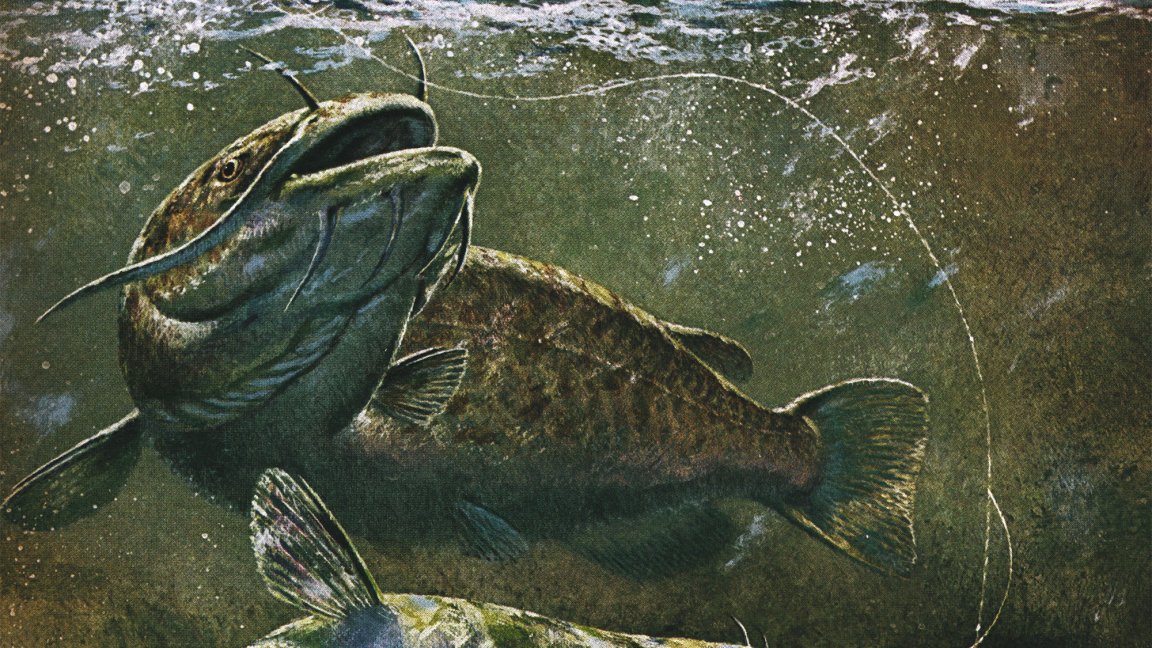
I cast the first one into the riffle above a quiet pool. As it tumbled down through the swift waters I felt a jolting strike. The fish bent my fly rod as it raced from one side of the pool to the other. When it was finally close to my feet, I slipped a net under it and hoisted it in. That fine channel cat, weighing better than four pounds, was the catch of the evening. Besides, it ended up on the family table, a fitting destination for most catfish anytime. Members of the far-flung catfish tribe are caught by anglers from one end of the U.S. to the other in streams, lakes, ponds, bayous, and canals. They are without scales and are equipped with “whiskers” or barbels around their mouths. The seven freshwater species that draw the most attention from fishermen include blue, flathead, channel, and white catfish and three kinds of bullheads — yellow, brown, and black. But let’s take a closer look at the big ones that draw the greatest attention from fishermen, the blue, flathead, and channel cats.
Read Next: Polish Anglers Say This Enormous Catfish Is a New World Record
Catfish are naturally night feeders, but happily most of them can be caught during daylight hours as well, especially before noon and on dark days. In murky or muddy waters they often feed by relying on their barbels to guide them to tastes and odors. The variety of baits on which they feed seems endless. Included are worms, grasshoppers, live fish, cut bait, and stink baits concocted of such delicacies as “high” meat and the most malodorous cheese. Sometimes they’ll hit artificials.
Fishermen learn young that catfish can inflict a painful sting when one of their dorsal or pectoral spines punctures a hand or finger. The sting is caused by a poison gland at the base of these spines. Poison flows down over the spine into the wound, and the sting is likely to last for five or 10 minutes, enough to convince anyone that catfish should be carefully handled.
Catfishing tackle comes in a remarkable variety ranging from trotlines to fly rods. Light spinning outfits and even canepoles account for millions of catfish, especially bullheads. But the serious catfisherman who’s after bigger game is more likely to outfit himself with a stiff-action casting rod and a reel loaded with 15-to-25-pound-test line.
Channel Catfish
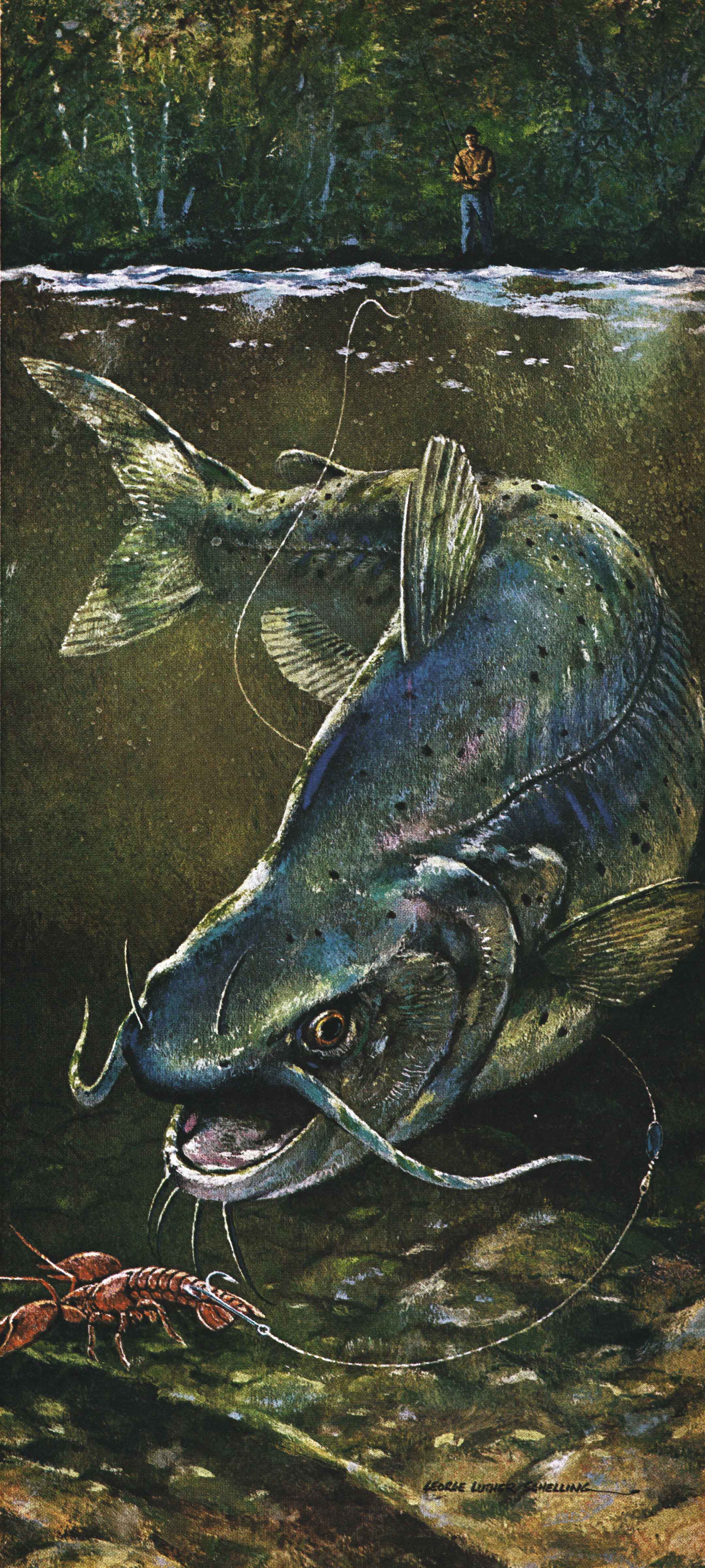
“big 3″ of North American fresh waters.” Illustrated by George Luther Schelling / OL
For most catfishermen the prize of the lot is the channel cat, a stream-lined, blue-gray, torpedo-shaped beauty with milky white undersides. The deeply forked tail and often, especially in the young and the females, a dappling of spots on the sides help to identify this rugged fish, which in its way can provide as much challenge as rainbow trout or largemouth bass.
Before man began moving American fish to new waters, the channel cat was at home in a broad block of the American heartland ranging from the Ohio Valley to Montana, the prairie provinces of Canada, and the Great Lakes country southward to Florida and northern Mexico. But its excellent qualities, both as table fare and as a sporting challenge, earned it many a transfer into new waters. It was taken to California as early as 1874.
Studies of the channel cat have shown that it will eat just about anything that is or was living. Elm seeds and wild grapes, clams, insects, crayfish, snails, and fish (living or dead) all are fair game for the channel cat. As it matures, it may shift from the· insects and larvae to more fish in its diet.
At times channel cats will hit arficials very well. Even surface plugs have taken feeding channel cats. So have spinners, silver spoons, lead; heads, and deep-running lures.
Channel cats occupy a variety of waters, both clear and murky, but they are at their best in clean water where the bottom is sand or gravel. They may still be caught from cloudy waters, however, because like all catfish they are capable of finding food where the light level is low.
Channel catfish are stocked in many small lakes and farm ponds. They do well in these smaller waters if there are natural places for them td nest and reproduce. The channel cat will look for a hollow sunken log, a rocky ledge, or a muskrat run in which to deposit its eggs. An artificial nesting device can be made from an old nail keg with one end removed.· This nest box is sunk in three or four feet of water and held in place with stakes. After water temperatures climb above 73° the female will lay several thousand eggs. The male then guards them.
Read Next: Hot Dogs Are Still the Best Bait for Catching Channel Catfish
Because they will prosper in ponds, channel catfish have been popular additions in pay-to-fish lakes. But they are not always easy to catch. Among the most skilled catfishermen I ever fished with was my neighbor Arthur Neudigate, who understands channel catfish so well that pay-lake owners hate to see him arrive. His techniques will work wherever small lakes are fished for channel cats. One of Art’s big jobs is gathering bait for one of his catfishing trips. He often carries along shrimp, minnows, crayfish, doughballs, nightcrawlers, chicken livers, black roaches, smelt, and cut strips of fish or red meat plus anything else he thinks might work.
Art uses a plugcasting reel on a stiff-action 1O-foot-long bamboo pole. His reel carries 100 yards of 20-pound-test line. Though this line is stronger than needed to hold the usual channel cat, it resists the terrific strain put on it as it is whipped out in a two-handed cast over the water for 200 feet or more. By making long casts, Art can fish from the bank and still cover practically all the water in many small ponds.
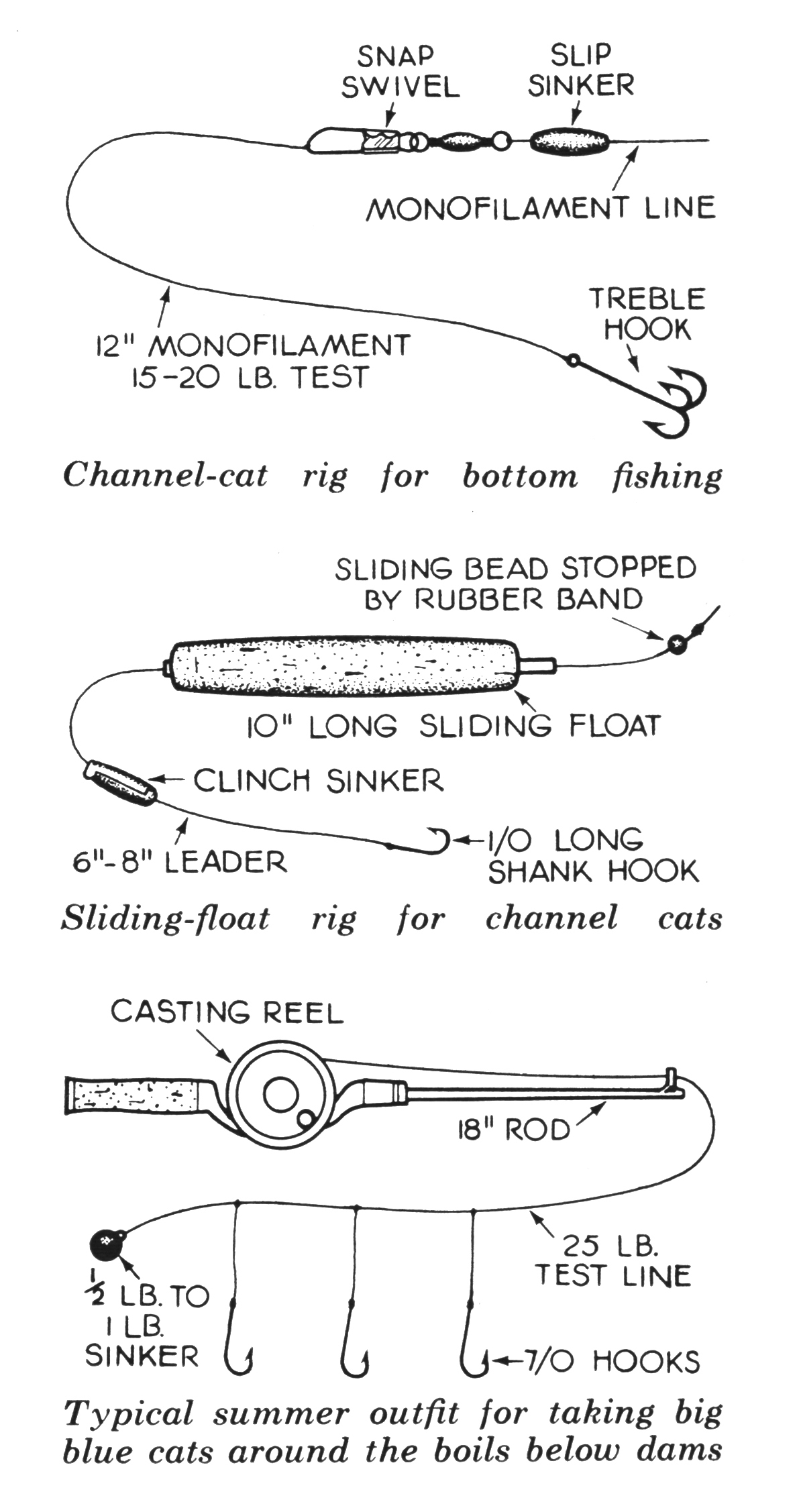
Art attaches a one-ounce sinker six inches above a No. 1/0, long-shank hook. Then comes a float 10 or 11 inches long with a hole through it lengthwise. The line passes through the hole so the float slides freely on the line. Above the float a small bead is threaded on the line. This can be arranged to stop at any point by looping a bit of rubberband or fastening a bobber-stopper on the line above the bead. When a cast is made, the bait will sink until the rubberband stops the bead and the float. Art also carries a smaller rod with an open-face spinning reel. The terminal tackle on this outfit is similar to that on his heavy outfit except the float is lighter and the sinker weighs about one third of an ounce.
With either rod the fishing technique is to send the bait as far out across the water as possible, then work it all the way back very slowly. Art believes that catfishermen too often drop a bait onto the bottom and leave it lying there in one spot, when it would be better to retrieve it half a turn of the reel at a time, stopping, waiting, then giving it another half-turn.
The bait doesn’t have to be on the bottom for channel cats. These fish are likely to feed at just about any depth. One good system worked out by Art is to start off fishing six feet deep in a lake. Cover the water thoroughly at that depth. If there is no action, change baits and start again. If you still have no fish, change the depth at which you are fishing.
Drop the bait a foot or so, then another foot until you are fishing on or near bottom. Then try fishing it shallower. When you discover the right combination of depth and bait, stick with it as long as it produces.
Though Art has great success with his techniques, the system that probably takes more catfish than all others is fishing with a tight line and the bait on the bottom. Louis Smith, South Dakota conservation officer and noted catfisherman, told me:
“I always fish on the bottom uness the water is thick with silt.” His favorite game is catching channel cats on rivers such as the Grand and the Moreau. “When I’m fishing waters I know well and don’t begin catching catfish within five minutes,” he said, d”I might as well go home.”
His tackle is a 6½-foot rod with a stout butt section that enables him to set a hook with authority when-ever a catfish begins moving with the bait. He uses an open-face spinning reel loaded with 1O-pound-test line at night or six-pound-test in daylight when the fish spook more easily.
To the end of the line Smith ties a snap swivel, and onto this goes a 12-inch snell carrying a strong No. 10 treble hook with a short shank and straight points. He uses treble hooks because they are best for the kind of bait he carries. He finds that the small hook catches more fish than larger trebles do.
He threads a small sliding sinker on the line above the snap swivel. For bait he sticks to one of the prepared dough baits and uses just enough to cover the hook. Another bait worth trying is a piece of sponge soaked with the fermented Jmce squeezed from dead shad. Smith favors catfish holes that have hard bottoms and a gentle current.
This technique often produces or more catfish for Smith in a morning’s fishing. They come in a wide range of sizes.
“But the ones I want for eating,” he says, “range from three quarters up to 2½ pounds.”
The best daylight hours for catching channel cats often are in the early morning and again in the evening. On cloudy days or in murky rising water they may strike well anytime, and even when the water is clear cats can be taken from the better fishing holes. Night is a good time for all catfishing, and during the darkest hours the channel cats may come into shallower waters to feed along sand bars or around riffles.
In some areas, especially the tailwaters below large dams, catfish are caught all year. But the best fishing usually comes with summer and the rising of the water temperatures to 60° or warmer.
Blue Catfish
This catfish has the potential becoming a giant, and those who pursue it year after year can never quite forget that the next one hooked may weigh 40 or 50 pounds — or maybe 100. The current rod-and-reel world record is a 97-pounder that South Dakota angler Edward B. Elliott hauled from the Missouri River in 1957. A still larger one taken from the swift waters below Kentucky Lake Dam some years ago failed to qualify because it was handlined into the boat. In Missouri’s Osage River some years ago a trotline fisherman took a blue cat weighing 117 pounds.
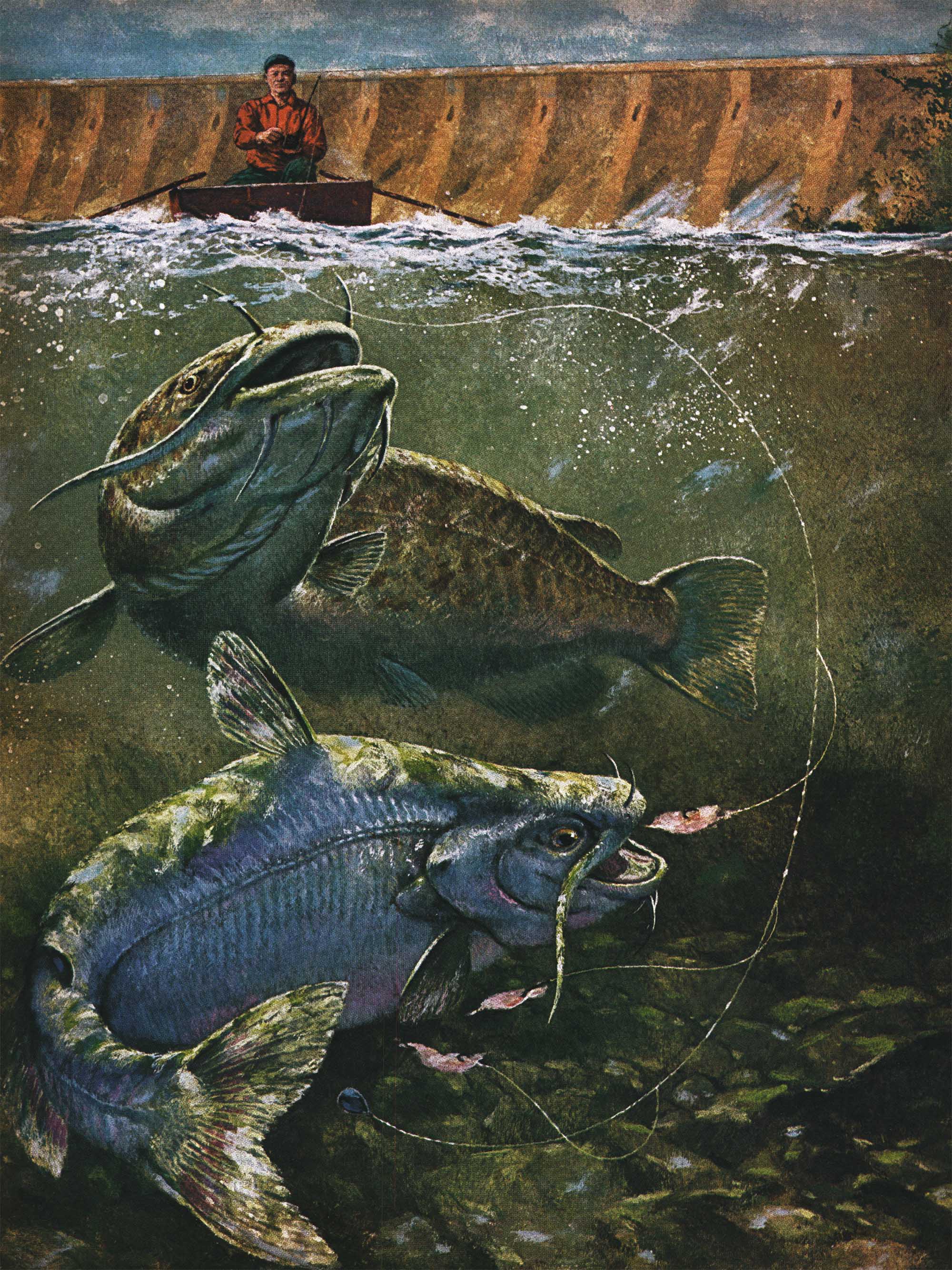
Some know the blue cat as the white catfish, which is actually a separate species native to the East Coast. They do resemble each other in color, but in the large streams of the Mississippi Valley area any catfish with a deeply forked tail and weighing more than 10 pounds is most likely a blue cat.
The home range of the blue cat is the larger rivers from Minnesota and Ohio down the Mississippi Valley and into Mexico. These giants of the big rivers were more abundant before dams were built in the streams. They flourished in cleaner, fast-moving waters, mostly over rocky or gravel bottoms. Such conditions exist today in some of the tailwaters below large navigation dams in the Mississippi River and its tributaries. One of the better places for catching blue cats is below Kentucky Lake Dam and the nearby Barkley Dam in western Kentucky.
Throughout summer and fall, parking lots below these dams are lined with trailers whose owners have come in, often from other states, to go catfishing. During a recent trip to these catfish waters, I pulled alongside Charley Patterson’s 14-foot metal johnboat while he showed me his fishing methods. Charley was alone in his boat, as are most serious catfishermen in these fast waters. I had been looking for him since William (Hack) Chambliss, the local conservation officer for the Kentucky Department of Fish and Wildlife Resources, told me, “I once watched Charley catch a catfish every five minutes for an hour and 10 minutes straight. A lot of times he’ll pull up two at a time.”
Charley’s catfishing dates back to a 10-pounder he caught when he was 10 years old. “I got hooked worse than that catfish,” he says.
He pulled a waterproof marking pen from his pocket. “This is what you carry,” he said. “I always have it along, and when I get the first bite of the day I mark the line. Then I fish at that depth all day. I usually keep the bait moving, and I seldom fish on the bottom.”
Charley’s rig consists of an 18-inch steel rod fitted with a rugged handle and equipped with a large-capacity casting reel loaded with more than 100 yards of 45-pound-test line. Onto this he attaches a leader to which three No. 7/0 hooks on droplines are attached 12 inches apart. To the end of the leader he attaches a one-pound sinker to carry the bait down through the swift water. This rod is designed only to carry the reel and line, and it is standard equipment in western Kentucky catfish country. The moment a fish is hooked, the rod is dropped into the bottom of the boat and the catch is handlined up.
Some fishermen anchor their boats and stillfish the quieter pools below these dams. They catch a lot of smaller catfish. But there is a daring breed of catfisherman who, like Charley Patterson, practice what is known below the big dams as “fishing the boils.” The boils are house-size eruptions caused when water from the lake above is let through to power the generators. The crew up on the dam sounds a warning whistle to give fishermen time to get downstream out of the danger zone. They usually make it. But up in that fast water close to the dam, big blue cats live in remarkable numbers, and that’s where the boils fishermen drop their baited hooks.
In Charley’s boat was a cutting board and a sharp filleting knife for preparing bait. “The first thing when you come out in the morning,” he explained, “is to get your bait. That takes maybe half an hour.”
For big catfish in the summer the standard bait is chunks or strips cut from gizzard shad. These fish are caught below the dams with cane-pole rigs carrying several small jigs that are swept back and forth on the surface. This bait has become so popular among catfishermen that commercial operators now catch gizzard shad, cut it into chunks, pack it into pint jars, freeze it, and sell it along regular routes all the way to Kansas. Usually it is best if allowed to sit out in the sun to thaw and ripen for a day before being used. Charley baits his hooks with strips cut from each side of the shad.
After the bait is dropped over the side, the boat is allowed to move downstream with the current. After riding a quarter of a mile or so, Charley picks up the bait and moves back up for another run.
Nearby was another catfisherman following a different approach. Borris Parzatka sat in the boat by himself, expectantly holding a stout six-foot glass rod carrying a reel loaded with 115-pound-test line.
“I give them just as much chance as they give me,” he said. Parzatka drives 250 miles to fish these waters every weekend. That weekend he had taken one blue cat of 68 pounds. He does most of his fishing at night. But I last saw him out on the water in midday, and he said he’d had only five hours of sleep in three days.
Why was he anchored? I looked at where he was and figured I knew the answer. Some years ago the late Jewell Copeland, a famous local catfisherman, hauled a blue cat of 100 pounds from these waters where a sunken section of an old coffer dam attracted giant catfish. Parzatka was mighty close to that same spot.
If there is a lesson to be learned from this, it is the value of knowing the water you fish. The best catfishermen, or any fishermen, are generally the ones who fish the same water time and again and come to know it thoroughly.
Another Kentucky catfisherman who stresses this point is Howard W. Fox of Calvert City, a tall, gray-haired gentleman in his 70’s. His summer fishing methods are much like Charley Patterson’s. Using his stubby rod and reel, Fox once took 435 pounds of catfish in one day. What can a person do with all those catfish? In western Kentucky he can sell them on the local fish market. When winter comes and water temperatures drop, Fox is unwilling to give up catfishing. He has developed a very effective cold-weather fishing method. He turns to a lighter outfit — an eight-foot one-piece rod and a casting reel with 25-pound-test line, a leader rigged with two No. 3/0 hooks, and a three-ounce sinker. He has a good supply of these leader rigs made up and waiting.
For winter fishing Fox turns to the smaller threadfin shad for bait and uses small portions about an inch long. When water temperatures drop below 55° he quits fishing the boils and heads for the dead water. There he continues to take fine catfish in January and February.
“You just ease him in like a Jog,” says Fox. “This winter system,” he adds, “will work anywhere the water is open and catfish live.”
How would Fox approach the challenge of catfishing in unfamiliar rivers? “I’d look for the deepest holes and the rockiest places,” he says.
About the only time of the year catfishermen on the big waters of western Kentucky may switch from their standard bait of cut fish comes in late August and September, when catfish feed heavily on grasshoppers. Grasshoppers can be frozen and kept indefinitely. They can be deadly on catfish.
Using the wild baits plentiful at any time is a good plan. In a small lake that I often fish, I watch for crops of young frogs. Channel catfish conditioned to eating them can’t resist one. Crickets sometimes work too.
Flatheads
Another catfish that sometimes grows to 100 pounds or so is the flathead, which some fishermen call the shovelhead or mudcat. It is likely to be found in sluggish waters of long, deep pools. This cat is often taken on river trotlines.
My acquaintance with the flathead goes back many years to when I helped my father run his trotline on the Muskingum River in the hills of southeastern Ohio. Six and seven-pounders were common, and I recall one of about 40 pounds. In warmer climates flatheads reach 50 pounds in eight to 10 years.
Like the blue catfish, the flathead is at home, in the large streams of the Mississippi Valley. It can be caught all the way south into Mexico. Conservation officers report that about one out of 10 big catfish taken in the tailwaters below the big dams of western Kentucky is a flathead, with proportions running higher in the quieter pools. Flatheads also flourish in large lakes.
Below Pickwick Dam in western Tennessee catfishermen frequently take big flatheads by drifting and bouncing a large bait along the river bottom. A favorite bait is a quarter pound of overripe meat. The fisherman runs his boat up close to the dam and then drops the offering over the side. He drifts with the current while heavy lead sinkers keep the bait on or close to the bottom. If he ties into a heavy catfish he may be a quarter of a mile downstream before he can bring it to the boat. Typically, he runs upstream again and floats back.
Read Next: The Complete Beginner’s Guide to Noodling Catfish
The lower jaw of the flathead juts out in front of its upper jaw, and the tail is not notched. Its colors can vary with the water in which it lives — darker on the sides and top in clear water, lighter and sometimes yellowish where the water is muddy much of the time. In such waters the flathead is often called the yellow cat.
Flatheads depend largely on live food. During their first year they feed on the larvae of insects. By the time they are six inches long they have switched to small fish and crayfish. Adults mainly eat fish.
Trotline fishermen after flatheads often bait their lines with live fish. In Texas, and elsewhere, the favorite catfish bait is live bream (bluegill) or other sunfish. But the usual stink baits will also attract flatheads. Their food habits can vary with conditions, and anything from chicken guts to nightcrawlers may draw their attention. Some catfishermen swear by a bait made by letting a half-grown chicken decay somewhat and then using half of the bird on a big hook. Try still-fishing these “high” baits on the bottom of the deepest holes, using either a trotline or a heavy rod and reel for giant-size fish.
Catfishing Methods
Some catfishing specialists expand their fishing methods well beyond the standard rod and reel. In considering the following methods, keep in mind that some of them may be illegal in some states. Always check the state fishing regulations, or contact your local wildlife officer if there is a question.
In a few parts of Arkansas, Kentucky, and other states fishermen are still permitted to take catfish by grabbing or noodling, the most primitive method of all. The fisherman wades along the shore, feeling back under the bank until a catfish is encountered. Then he throws it up on the bank for a companion to stuff into a gunny-sack. Sloppy but productive.
Limb lines are simple rigs consisting of lengths of fishing line tied to limbs overhanging good catfish holes. The hooks are baited and the rigs checked every day or oftener.
Trotlines are long lines to which a number of droplines are attached. A hook is attached to each dropline. Fishermen in a boat run their trotlines frequently; taking off fish and rebaiting hooks. Strict laws govern the methods of setting trotlines and the number of hooks.
Jugging is a system of letting the current carry a catfish bait downstream or downwind while the fishermen drift along in a boat. Droplines are attached to floats, which may be fashioned from various materials. Corked jugs used for floats gave the method its name. One half of a styrofoam boat fender also makes an excellent float.
Read Next: 24 Fascinating Photos of the Master Catfish Trotliners Who Are Keeping This Southern Tradition Alive
Some catfishermen make floats by soldering two quart oil cans together. In parts of the Mississippi River system this brand of jugging is known as blocking because the floats used to be fashioned from cedar blocks. About eight or 10 feet of line hangs from a wire ring soldered into the end of one can. A one-ounce sinker is attached to the line. The float tips up when a fish takes the bait. Changing the length of line beneath a float will sometimes bring more action. This kind of fishing can be frantic. Sometimes the catfish begin hitting before all the floats are on the water.
There is room for experimenting.
The serious catfisherman is always alert for the top combination of bait, time, and place. Happily, productive techniques, plus the usual dash of luck, put millions of catfish on the table every year and keep the ranks of the catfishermen growing.