
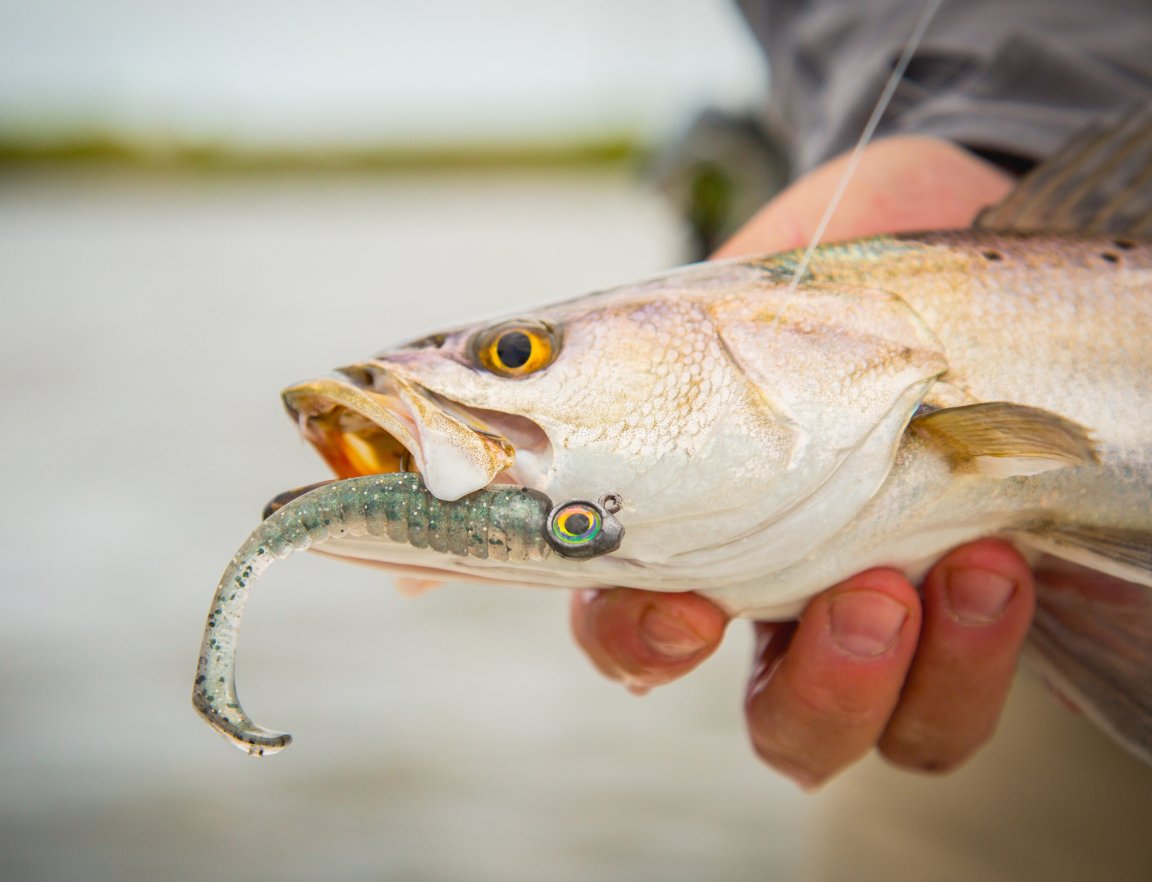
Emmett Gowen and I were baking under a torrid Gulf sun, that spring morning, while small croakers stole our live shrimp one by one. The shrimp were intended for trout, meaning weakfish. When there were two shrimp left I said, “I’m sure glad we aren’t fishing for our lunch.”
That gave Gowen the idea… Plop!
He tossed our lunch overboard. The bag of sandwiches floated bravely for a moment, then foundered. Emmett grinned and rubbed his hands.
“Now, start fishing as if you were on a desert island,” he said.
That’s how we decided to eat what we caught—and to eat only if we caught something.
I promptly lost my shrimp to a croaker. Presently Emmett’s rod dipped sharply in salute to a more powerful fish, which made a strong, short run before breaking off.
“Trout!” he cried. “I knew we’d get into them.” We baited up with the last of the shrimp. I felt a tap and struck. Nothing. A damned croaker had cleaned me. Then something picked up Emmett’s bait and ran with it. At the sting of the hook a fine weakfish danced briefly in the sun.
“Big enough for both of us,” Emmett said. The fish dashed toward the beach, jumped again, then began that helpless but savage yanking a well-hooked fish so often tries. “We’ll broil him over driftwood coals and…”
Our lunch was suddenly gone.
“Let’s run back to the dock and get more shrimp,” I said.
Emmett thought for a moment. “Wouldn’t be sporting. Rule 1.”
We laid out an array of lures and cast the place into a fine froth. But no lunch fish. And then, as so often happens in the Gulf of Mexico—we were off Fort Morgan, on the Alabama coast—sea birds revealed a concentration of fish. Half a mile downshore from us a flock of pelicans began wheeling and driving off a little point.
Emmett yanked the starter. As we drew close we found the big birds frenziedly working a tide rip about the size of a football field. Minnows darted from the choppy green water in glinting windrows and fell back with a sound like hail on a lake. In mounting excitement I snapped on a white-nylon jig and attached a small silvery spoon to Emmett’s line.
A pair of short casts into the tide rip and we were in business, trolling against the tide and jerking the rods so the lures danced and fluttered in the chop. You couldn’t be sure what fish were out there driving up into the bait, and therein lay a new charm. If they were ladyfish—skipjacks in that area—we’d have fun but no feast, for these fish are notoriously dry and bony.
On the other hand they might be bluefish or weaks. Spanish or king mackerel, even a large school of the tasty little blue runners.
“If they’re jack crevallé I’m resigning from the project,” Emmett said. “I’m too weak from hunger to fight those mules.”
Three trips around the tide rip found us thoughtful but still hopeful. Nothing had touched us; nothing had broken water but the desperate bait. Emmett put on a big spoon. Then he changed to a medium-size darting spoon.
“Funny if you caught a pelican with that thing,” I said. “Say, they’re thinning out. This is almost over.” Emmett gunned the motor to present our lures swiftly to a little patch which had just erupted minnows. Almost immediately each of us was fighting a fish—obviously we’d been trolling too slowly. The jerking, fast-running thing I had hung turned out to be a Spanish mackerel of about two pounds. Presently, Emmett boated another.
Then for several wild minutes we charged about the tide rip. Every strike was a rod jerker. And for a moment or two those little mackerel could wring a few yards of line from a star-drag reel. But, as Emmett put it, “A little Spanish won’t go far—he’s all nerves and no strength.” By the time it was plain our little flurry was over, we had boated seven, which I gutted and tossed into the ice chest.
That first lunch was memorable for its shortcomings. No utensils, no seasonings—all we had were matches, fish, and cold coke. I built a driftwood fire on a white sand beach while Emmett rolled a log down from the high-tide line for us to sit on. Four mackerel were broiled whole on forked green sticks.
They were pretty good, too. The broiling sealed the juices in so that the fish were moist and tender, and the fire’s smoke imparted a pleasant tang. Afterward we lazed in the shade of a pine tree, smoking and watching the boats and speculating upon the fishing when Fort Morgan was young. It has been there a long time. Spaniards made a log fortification against Indians in 1558. The United States obtained the site from Napoleon in 1803 and the fort was completed in 1828. Now the fine old brick structure—a fivepointed star built on a design of Michelangelo’s—is the focal point of an Alabama state park populated chiefly by fishermen.
Fort Morgan, at the foot of Mobile Bay, lies at the western tip of a long finger of sand, accessible by boat, car, and plane (there’s a small airfield). Charter boats and skiffs are reasonable, and there are the usual boating facilities. The only place to stay is the roomy old Fort Morgan Inn. Gowen and I headed there now to prepare for the late afternoon fishing and to borrow a cooking outfit for the following day.
When we started out the next morning I remarked how good the Spanish mackerel were going to taste fried in butter with a dash of fresh lemon juice squeezed over them at the last moment.
“Spanish?” said Emmett. “We can’t eat them two days running. Not with all the kinds of fish you can catch in these parts all through spring and summer. That’ll be Rule 2—every day the fish has to be different.”
And so it was. We trolled the shore out toward the open Gulf with the dual purpose of finding fish and a new beach from which we could swim before lunch. Before long we came upon a fine place, a desolate strip of hard sand that seemed remote from civilization. There was only one fault with it—no driftwood for a fire.
“Let’s run over to the deserted lighthouse,” said Emmett. “Lots of dry wood up on the rocks from the last hurricane.”
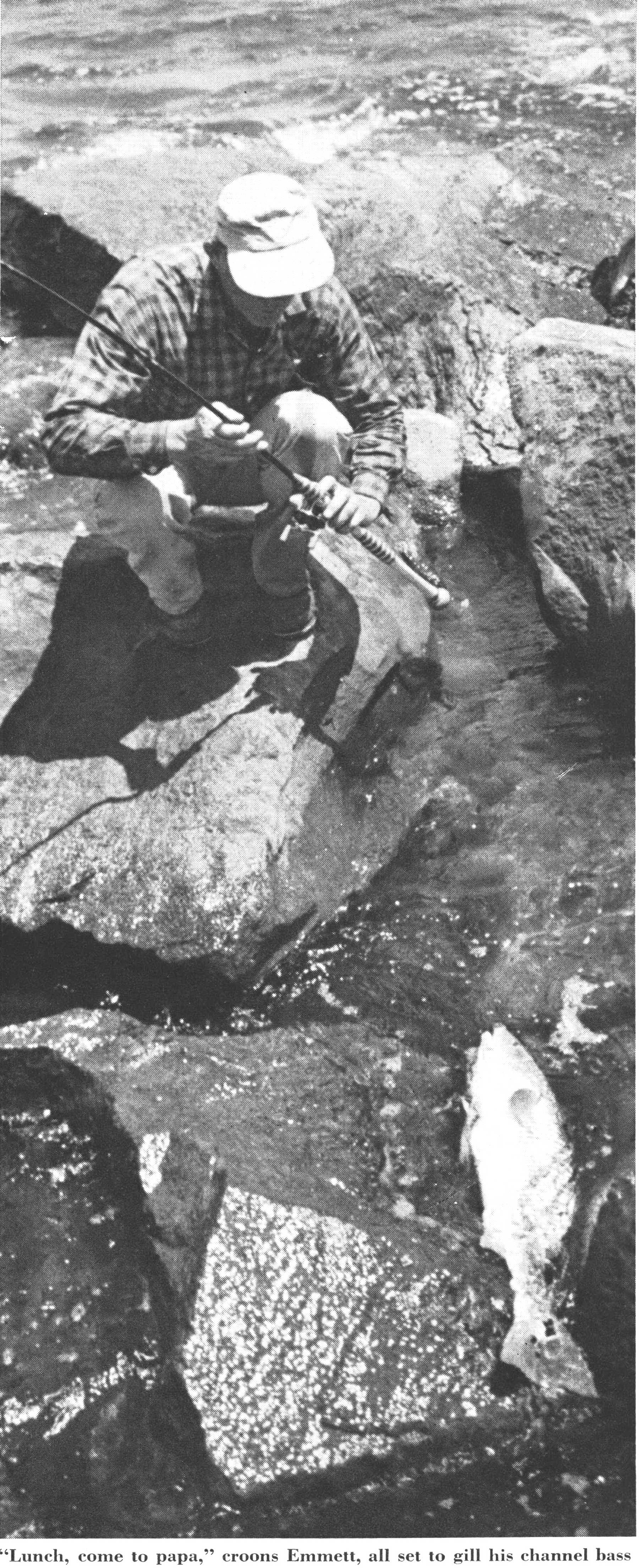
The search for wood led us to the weather side of the lighthouse rocks, great blocks of granite quarried at a New England prison about 100 years ago and transported as ships’ ballast to this site. The wood, in turn, led us to fish. Emmett happened to look down at the precise moment a channel bass turned on its side in the shallows. At his shout I looked in time to see the fish too. Then we were leaping from block to block in a crazy race back to the boat.
“All we’ve got for bait is some dead shrimp,” I said as we began the tricky descent to the boat.
“If those bass are feeding it’ll be like throwing steaks at lions.”
We grabbed light boat rods, tackle box, and bait, and scrambled back up the rocks.
Lf^here was no coppery flash of a feeding bass when we _L returned but the set-up looked perfect. A rising tide, aided by a breeze, worked head-on at the rocks below us, no doubt rinsing loose a quantity of bait. Because of the snaggy bottom we rigged up with short monofilament leaders and cast the baits—half a big shrimp—without sinkers.
Presently a pair of dead shrimp began settling in the green swirl about 20 feet out. My line darted forward; so did Emmett’s. I struck. Emmett struck. Praise the Lord.
My fish ran strong and wild into the teeth of the tide, wrenching spasms of line from the reel against the drag. It was pure pleasure to ease the tension a little so he could stretch that first run to a good 40 yards.
Meanwhile Emmett, on a high rock, dueled one-handed with a fish that plainly didn’t take to the choice of weapons.
With the light rod I was able to enjoy the sort of tussle one so often longs for in fresh water—honest flexing of the bamboo’s fibers right down into the grip. I don’t want to give the impression our bass fought on indefinitely; they didn’t. But while a red drum (the local name) is unwinding himself he is definitely interesting.
Emmett stepped down into the water to gill his fish.
“Puppy drum!” he shouted happily, holding aloft an eightpounder. “Nothing pussle-gutted about this fish!” It was indeed a trim bass. Before long I laid its twin beside it on a granite block for admiring before they went on the stringer.
Our technique went aglimmering. I snapped off a shrimp on my next cast and had the treat of seeing a bass rise deliberately toward the bait like a trout to a fly. Emmett hooked another fish which promptly got into the barnacled rocks and cut the line. On my next cast I got a backlash and was fiddling with it when a fish dashed into the shallows almost at my feet and streaked for deep water with my bait. I lost him. The line actually went boing! just before it snapped back limp with the hook partly straightened. The snarl was now buried so deep that Emmett hooked and landed another fish before I got into action again.
I have never seen fish more eager to be caught. They were downright reckless. As I was playing my next bass I noticed that another fish, swimming close to it, duplicated its every maneuver and when my bass spat out the shrimp the other fish seized the bait without hesitation. This ruffian managed to cut loose neatly with the help of an insignificant-looking rock. I wound in and started to dig out some leader material.
“Don’t bother,” Emmett called. “Tie a hook right on your line and whale it out.”
The line was bright green. They loved it. They went for everything we tossed at them—even a frayed bit of shrimp that had dropped from the mouth of a fish being unhooked.
It became a matter of no concern at all when a fish got off. And then, as if someone had blown a whistle under water, they quit us cold. We had put five on the stringer and released I don’t know how many; maybe 10 or 12 each.
Slowly we motored back to the beach, where I unloaded the driftwood and built a roaring fire while Emmett cut steaks from one of the bass and got the lunch things ready. Then we went swimming.
By the time we came out the fire had died to a deep bed of coals. I pan-broiled the steaks and was not stingy with salt and pepper. We squeezed lemon juice on the fish and ate them with fresh white bread. Needless to say, they were delicious.
“We’re millionaires,” said Emmett. I had been feeling that way nearly all morning.
The following day was just as surprising, in its own way. The memory of those steaks was still so strong that we decided to go out to deep water for king mackerel, which had been running around 15 pounds, and repeat the lunch but with a different fish. Before long the pale green of the bay deepened to emerald and then we ran through those incredible color changes that take you abruptly to the blue-purple of the Gulf’s deep water. We began to fish seriously.
The ship channel stretched before us, well marked with buoys. We worked it clear to the farewell buoy and back under a blaze of sun so powerful that I was sunburned through my shirt.
“Well, I guess this ain’t a steak day,” said Emmett. “We set more store by the meal than the fishing and now we’re doomed. We may not eat till dark,” he concluded gloomily.
I had an idea. “Let’s drag the beach and eat the first fish we hook.”
“Even ladyfish?”
“Only fair thing to do, by way of penance. Rule 3—fisherman, cleanse thy soul.”
Soon we were cruising off the nearest beach, which happened to be part of Dauphin Island. In a most unlikely looking stretch of water I had a strong hit. The fish began a curving run against the drag, at the same time making the rod vibrate in tune to an incredibly rapid tailbeat. I tinned and noticed Emmett was busy with a fish too.
Mine swung ahead of the boat, dived, then shot under the bow. I had to stand up to deal with him.
“If this is some kind of mackerel,” I said, “we’ve been missing a good thing.”
“He jump yet?”
“No.”
“Good. Can’t be a ladyfish then.”
Suddenly my fish swung out from beneath the boat and bored downward just opposite me. I found I could hold him now without losing line. Presently I began pumping and he came up, circling and still driving powerfully for the bottom. I flipped into the boat a blue runner about 10 inches long and weighing less than a pound.
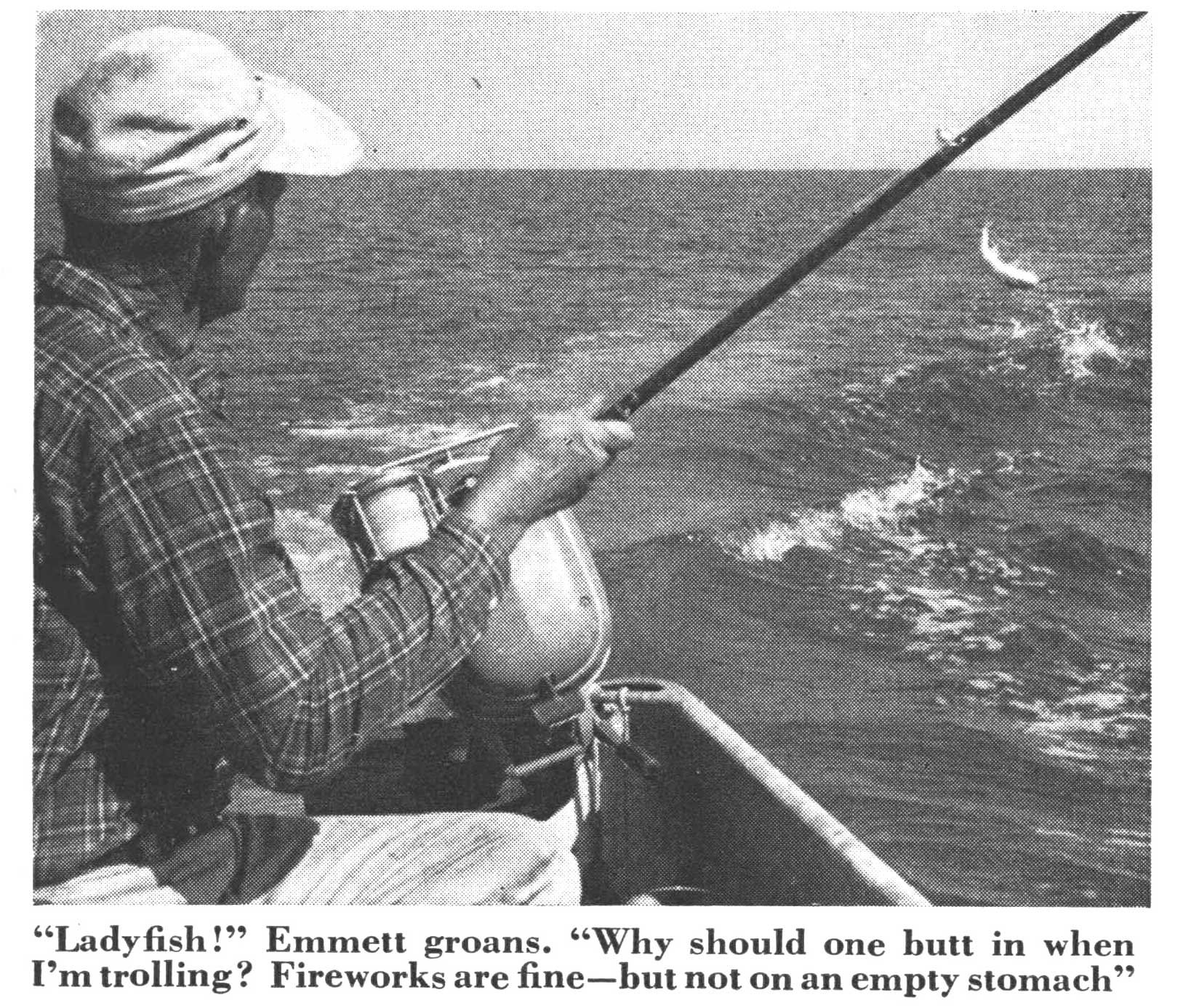
Emmett sighed with relief, then gave his rod a vicious yank. Talking astern to his fish, he said, “Go ahead and jump!” Whereupon a lean ladyfish made a brief, shimmering appearance.
“You don’t know how I was sweating you out,” he said. “This ladyfish is hooked for keeps.”
A blue runner is one of the smallest crevallé. You catch a five-pounder and you’ve got a big one. Like its larger cousin, the jack crevallé, you have to catch one to believe that a fish of its size can actually fight so hard for so long. Even when your boat is dead still, the rod feels as if the blue runner were rushing headlong down a fast river.
Emmett let his ladyfish jump itself tired, then released it so we could swing back to cast for blue runners. Presently he shut off the motor and we laid out a pair of casts; my lure was a diamond-shaped spoon, his a little blackstriped yellow plug. We began flirting these back to us and two fish said “Gotcha!” at the same moment.
They were both blue runners. We let them run, reels lightly set. And those stubborn little racers put on a real show. Mine got away in a neat boatside maneuver that briefly provided slack.
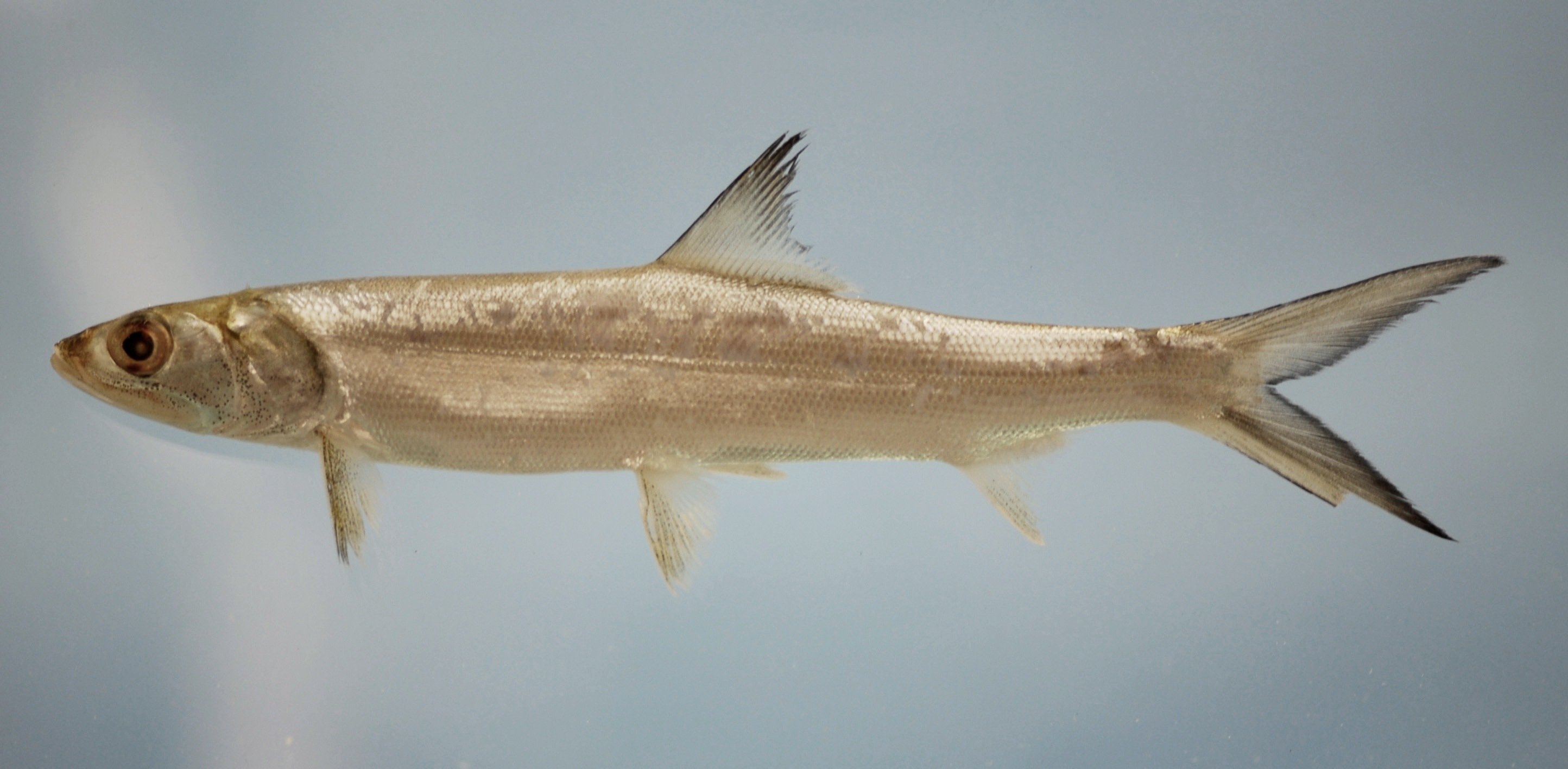
Then Emmett hung a ladyfish. I perhaps have given the wrong impression about ladyfish. We didn’t despise them. Indeed, when fishing got slow we often sought them out just for the spectacle they invariably staged. A ladyfish has nearly as much stuff as a blue runner and it can also jump superbly.
Emmett’s fish seemed to leap in two places at once, it performed so dizzily. The disturbance from one jump would still be plainly visible when the fish flashed into the air again, high and twisting and yards away from the first place.
“They’re spooked wildcats,” said Emmett happily. “Now that we know we don’t have to eat ’em, how could we get along without ’em?” He gave a creditable version of the rebel yell and the fish danced on under the sledge-hammer sun.
There was a fair-size school of blue runners where I’d hooked the first one and we spent a pleasant half hour taking a mess and jousting with ladyfish. And then we were heading full tilt for the abandoned lighthouse and shade. To eat our lunch in deep shade, with maybe a cool rock to sit on and a breeze to waft away the smoke, seemed the ultimate reward.
We had the blue runners fried with the lid left on the pan so they’d tenderize themselves in their own steam and juices. They were on the rich side—a little like common mackerel—yet with a delicate flavor that kept you interested. We put away three apiece; also cold fruit and a coke, which we badly needed to help replace water lost through perspiration.
There was shade aplenty where we sprawled. A breeze fanned us continually from the open Gulf so that there were no flies—just the sort of place for a nap after lunch. The boat cushions made perfect pillows.
Next morning it became plain that the day’s lunch might be hard to find. There were supposed to be bluefish around Fort Morgan in early June but a heap of trolling hadn’t found any for us. Deep-water stillfishing seemed too chancy since we didn’t know the location of the wrecks where the tasty red snappers hid. Of course, there were trout aplenty — both common and spotted weakfish—but the best times for them were at daybreak and from late afternoon into the evening. Sometimes we’d pick up a lone-wolf trout or two while hunting bluefish but you couldn’t count on it.
Still, we set out with a minnow bucket crowded with live shrimp and headed for the pencil of low dunes called Sand Island with the hope of finding a few trout. An incoming tide and a Gulf breeze usually made a light surf at each end of the island, and could be we’d hit it just right. Lord, he was so right! The fish was a somersaulting idiot. He came cartwheeling toward the boat, which was still trolling, as if he meant to jump into it. But by the time he drew abreast he was fairly well spent, and after a short run I swung aboard a two-pounder.
If nothing else it would be refreshing to wade about in the light chop at the island’s south end. A sandbar ran out and sloped interestingly into a deep, over which we began to cast our shrimp, using bobbers and a long trailing line. A tremendous mass of shore birds that had arisen at our approach now claimed the tiny island and watched us in dense ranks of gray and white.
Emmett yelled at his first strike and the nearer birds jumped uneasily. The effect was like a wind rippling the edge of a giant carpet. The fish was a blue runner. We caught and released several before switching to sinkers.
My first cast lay long at the bottom of the deep place before I felt the lightest of taps. The twitch of the rod touched off a searing run.
“Trout?” asked Emmett.
“If it is, it’ll make our whole lunch. This thing is strong.”
It proved to be a channel bass of about eight pounds which we put on the stringer so we could have it baked at the inn sometime. We surrendered a few more shrimp to a lively crew of puppy drums, then switched in desperation to small plugs.
Ladyfish murdered every cast.
“Wouldn’t you know?” mourned Emmett. “Wonderful fishing but we’re so worried about eating we can’t really enjoy it. Let’s try the other end of the island.”
It was just the same—plus even more ladyfish. The water teemed with schools of minnows and you could see blue runners and ladyfish knifing after the bait under the curl of the occasional big wave.
We left to try our luck off a rock jetty on Dauphin Island, a spot that we had trolled past many a time with the remark that it certainly looked fishy in there. Fifty yards from the rocks Emmett cut the motor and we coasted and drifted in. He had just made the stern line fast, and had pushed* away from the rocks so I could anchor the bow, when I saw him stiffen.
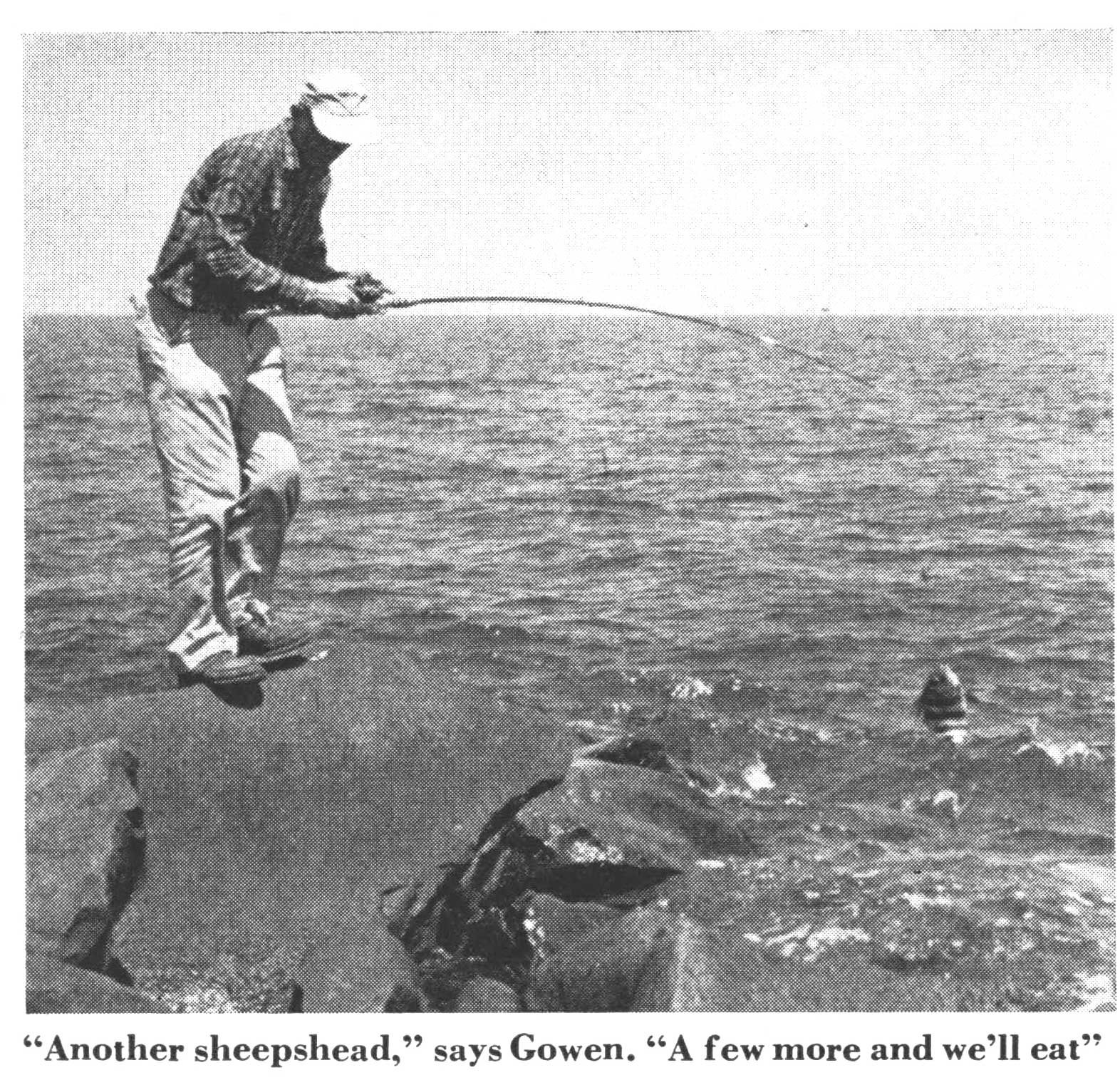
“Look down,” he said softly. “What a passel of sheepshead!”
The water was 10 or 12 feet deep over a sandy bottom. Black rocks had spilled out onto the sand in places, offering fine cover. You could see down as clearly as if the place were a swimming pool. Sheepsheads by the dozen roamed among the rocks and rested in the shade of our boat.
We put on a live shrimp apiece and lowered them without sinkers. You could see the shrimp till it was about halfway down, then it merged with the bottom coloration. I stared at the end of the line—what I could see of it. It twitched once, gently. I struck and wound in. Cleaned! The fish knocked off Emmett’s shrimp just as easily.
But the fish disdained shrimp suspended near the bottom, so we removed the bobbers and raised and lowered the baits ever so slowly after they reached the bottom, hoping to feel a hit while elevating the bait. But those striped rascals would nip off our shrimp as the bait settled back down.
I made a miscalculation when dunking the next shrimp and thereby solved the problem—my shrimp landed on a flat rock and I could see it plainly. I could also see the sheepshead that investigated and then inhaled the bait. I socked him. The fight was brief but vigorous. A sheepshead is shaped like a big, elongated sunfish and he’s adept at using the flat of his body against you. This one went about 1 pound.
We promptly called our find “dinnertable rock” and concentrated on guiding shrimp to it. The game became more and more difficult as the fish watched their brethren get into trouble. By the time we’d taken five, not another sheepshead would venture above the rock.
“I’m going to fillet these fish.” said Emmett, “so we really need a couple more.”
Although there were still some 20 sheepshead down there we had to quit them and find an innocent bunch. So we left the boat to range the jetty, and Emmett finally caught a pair of sheepshead that swam trustingly into a little rocky basin to sample our shrimp.
We put in at a narrow half moon of the beach, got the lunch things ready and a fire started, and took a long swim. Emmett filleted some of the fish and we had them French fried with onion rings and a touch of catchup.
“These are the best yet,” I said. “Let’s pan-broil the others with sliced tomatoes and see which way is better.” In the end we had to call it a tie. Those sheepsheads would have been good rolled in sand and browned.
That following morning was our last. “Friday—fish day,” I said. “What’ll it be?”
“Trout,” said Emmett with assurance. For a starter I nominated Sand Island because of all the bait we had seen there. Even if we caught only one old tide runner there’d be enough for lunch. First time around—the island is only about 4 miles long—the blue runners and ladyfish were pests, particularly in the surf at each end. Emmett moved out a bit and then made the circuit but we dodged them not.
“Big lures for big fish.” pronounced Emmett.
We switched to large diamond-shaped spoons, working one at the end of the prop wash and the other farther out. Nothing. We came in closer. Nothing. We trolled slower. We trolled faster. Still nothing.
Then I resorted to an old pickerel fisherman’s trick. I ripped a short strip off my red bandanna and impaled it on the hook of a smaller spoon. Next trip I caught two blue runners; that was good because they had showed so little interest in the spoon. That meant we were working an area where there was probably some bait.
As we followed the north shore I got another hit and struck. A fish jumped. “Ladyfish,” I said automatically. “Bluefish!” yelled Gowen.
I put a flaming tag on Emmett’s spoon and we continued around the island. In about the same place as before, I hooked another blue. This one was bigger and stronger. Without hesitation it streaked for deeper water. Emmett had to halt the boat because I was losing so much line.
The fish interrupted its flight to jump magnificently. Bluefish are such fierce, unpredictable fighters they break up marriages and spoil many a blossoming business career. They are savage, dogged, uncontrollable. They are balm to a bitter man’s soul. I would rather catch one than find a wallet on the sidewalk and right now I was fiddlestring tight to a robust specimen.
The rod quivered in a tight arc as the spool continued to turn backward. You had but to clamp on that spool a little and the bluefish would be out in the sunlight. Then I lost him.
Emmett shifted the motor into gear and we continued to the end of the island where I handed him my rod. There was only one spoon of that make and size in the boat.
Read Next: Why Amberjack Are the Underrated Gamefish of the Gulf
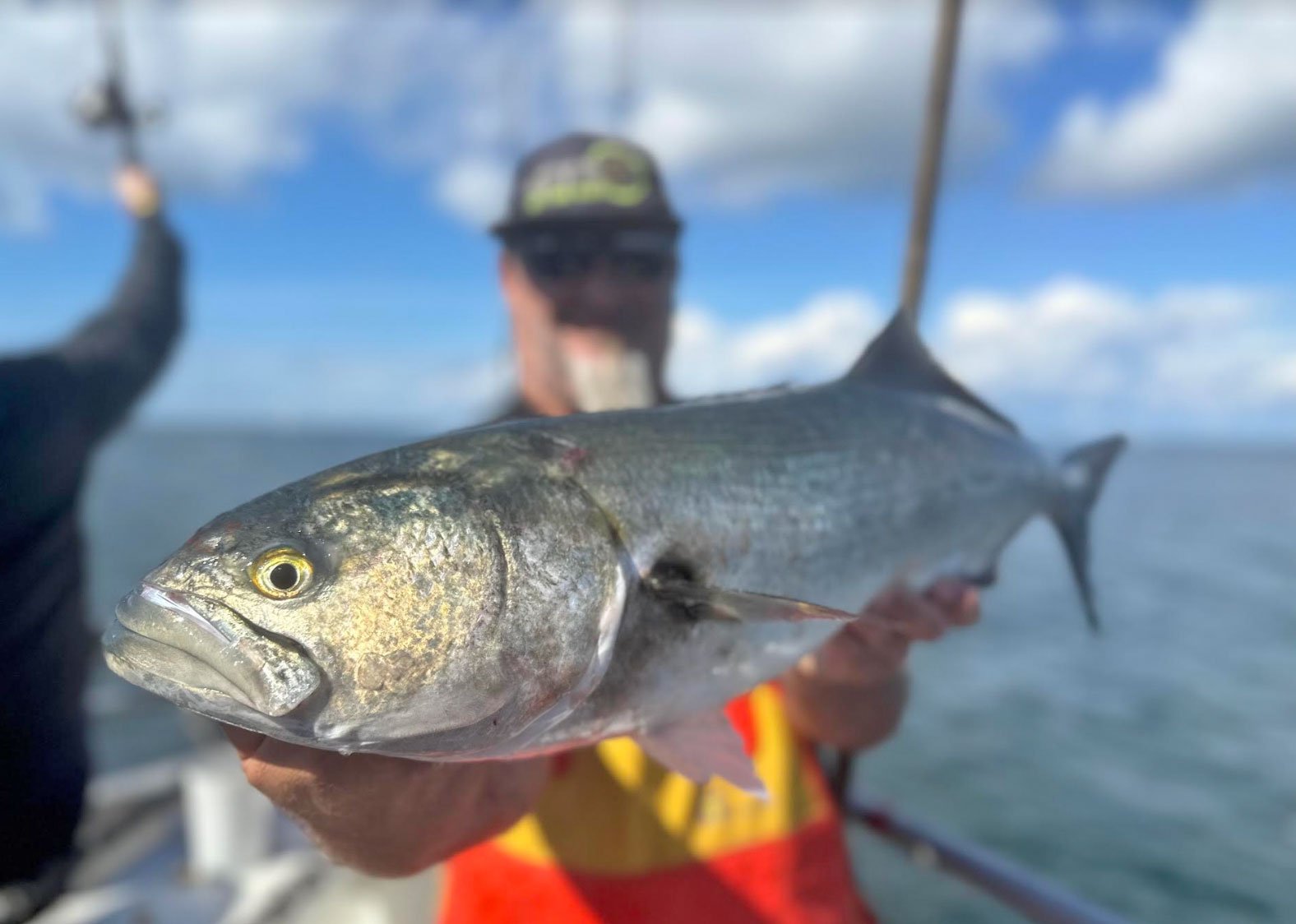
“Fish was five pounds easy,” he said presently. I felt better.
They weren’t’overrunning the place, those bluefish. But on every other pass or so one of us would hang one on my rod and then the boat would stop and the lucky one would do battle. We lost some because they tore holes in their mouths fighting, and the hook would pull out.
Whenever it was Emmett’s turn to fish he’d use both rods, the butt of his own stick tucked under one leg. Theoretically this left him a free hand for steering. Finally the unexpected happened while coping with a freshly hooked blue Emmett got a powerful strike on his other rod and the water erupted around the form of a good-size trout.
I snatched back my rod. Emmett banged the motor into neutral and for about five minutes we enjoyed one of those rod-swapping circuses as our fish ranged the shoreline, now and then crossing each other. At length we landed both of Emmett’s fish.
“Let’s stop right now,” he said when he got a smoke going. “Before we get into serious trouble.”
I stared at him. not quite getting it.
“If we catch another trout,” he said, “we’ll have to eat two whole lunches to find out which fish is best. And after yesterday I couldn’t take it.”
I reached into the ice chest for cokes. I was too weak myself to work out Rule 4.
This story was originally published in the AUGUST 1953 issue of Outdoor Life.