
We may earn revenue from the products available on this page and participate in affiliate programs. Learn More ›
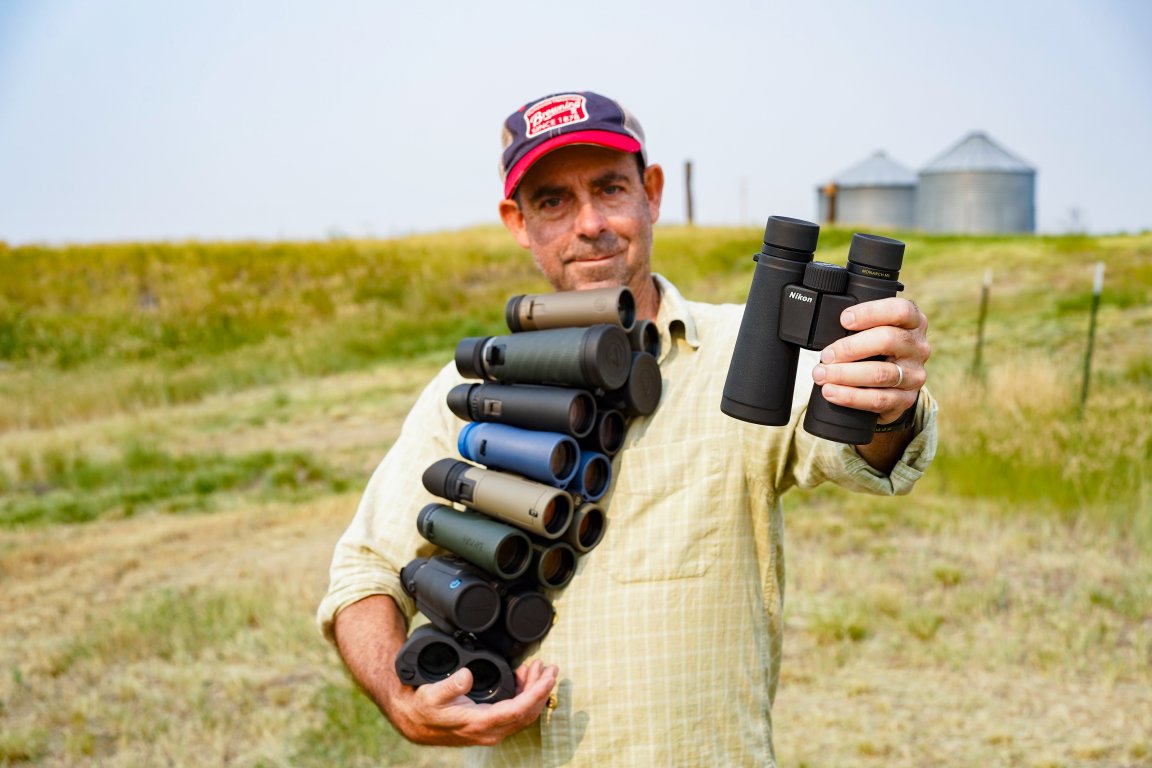
Even after peering through thousands of models, binoculars still amaze me with their magical capability to reveal hidden worlds. How else can you describe the knowledge you gain by viewing and identifying a distant bird, but also notice fine details in its plumage and expression?
For hunters, a good binocular will save many miles of hiking, owing to its ability to compress distance and verify if that far-away buck is worth the walk.
Binoculars belong in every pickup truck console, kitchen window sill, and around every hiker’s neck in order to positively identify distant objects, inspect close-up insects (and sometimes the fine print on roadside history signs), and to make your world larger, wider, and more interesting.
While binoculars share many attributes—parallel magnified tubes governed by a common focus control—they’re more different than their generic appearance might suggest, and their wide variation complicates buying decisions. Do you prioritize magnification, or field of view? Do you want a durable closed-bridge bino, or a more nimble open-barreled design? Do you need an integrated internal stabilization, or is low-light capability more important to you?
This review is designed to help you answer those questions in order to find the best binocular for your specific combination of use, mobility, and budget.
2026 Optics Test Winners
- Nikon Monarch M5 10×50 (Editor’s Choice)
- Nocs Provisions Field Issue 8×42 (Great Buy)
Budget Binoculars
Compact Binoculars
Stabilized Binoculars
Large Frame Binoculars
2026 Optics Test Winners
Nikon Monarch M5 10×50 (Editor’s Choice)
Pros
- At 22.6 ounces, lightweight
- Fiberglass-reinforced polycarb chassis
- Excellent ED glass and premium coatings
- At $390, fairly priced
Cons
- Square eyecups don’t fit all faces
- Disappointing close focus
Key Features
- Extra low-dispersion glass
- Closed-hinge design
- Right-barrel diopter
- ¼-20 tripod adapter
- 3-position eyecups
- Lifetime warranty
- Price: $390
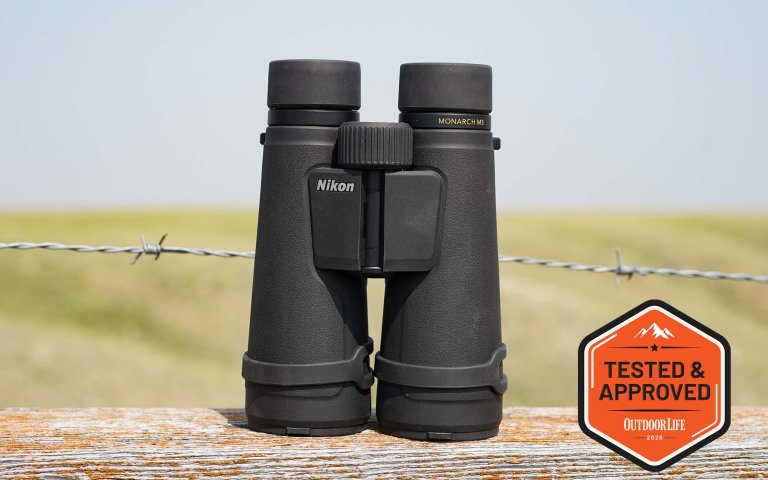
That there’s little to say about this binocular except its pretty good image and nice handling says everything about it. It’s not trying too hard to wow you with boutique glass, or seduce you with racy styling. It’s about as plain Jane as a binocular gets, and yet Nikon’s Monarch M5 won our Editor’s Choice award as the top binocular of 2026 by being reliable, bright and crisp enough, and affordable.
The 10×50 version we tested has a little more image brightness than a 10×42, and the 6 ½-inch tall chassis is a handful. But the image is crisp right to the edge with excellent color rendition and contrast, the controls are pleasingly responsive, and the ergonomics encourage you to glass all day. The 10×50 Monarch M5 sells for $390, which we think is a bargain.
By stacking performance, value, and utility in a durable package, Nikon topped 14 other new binoculars to take our top award.
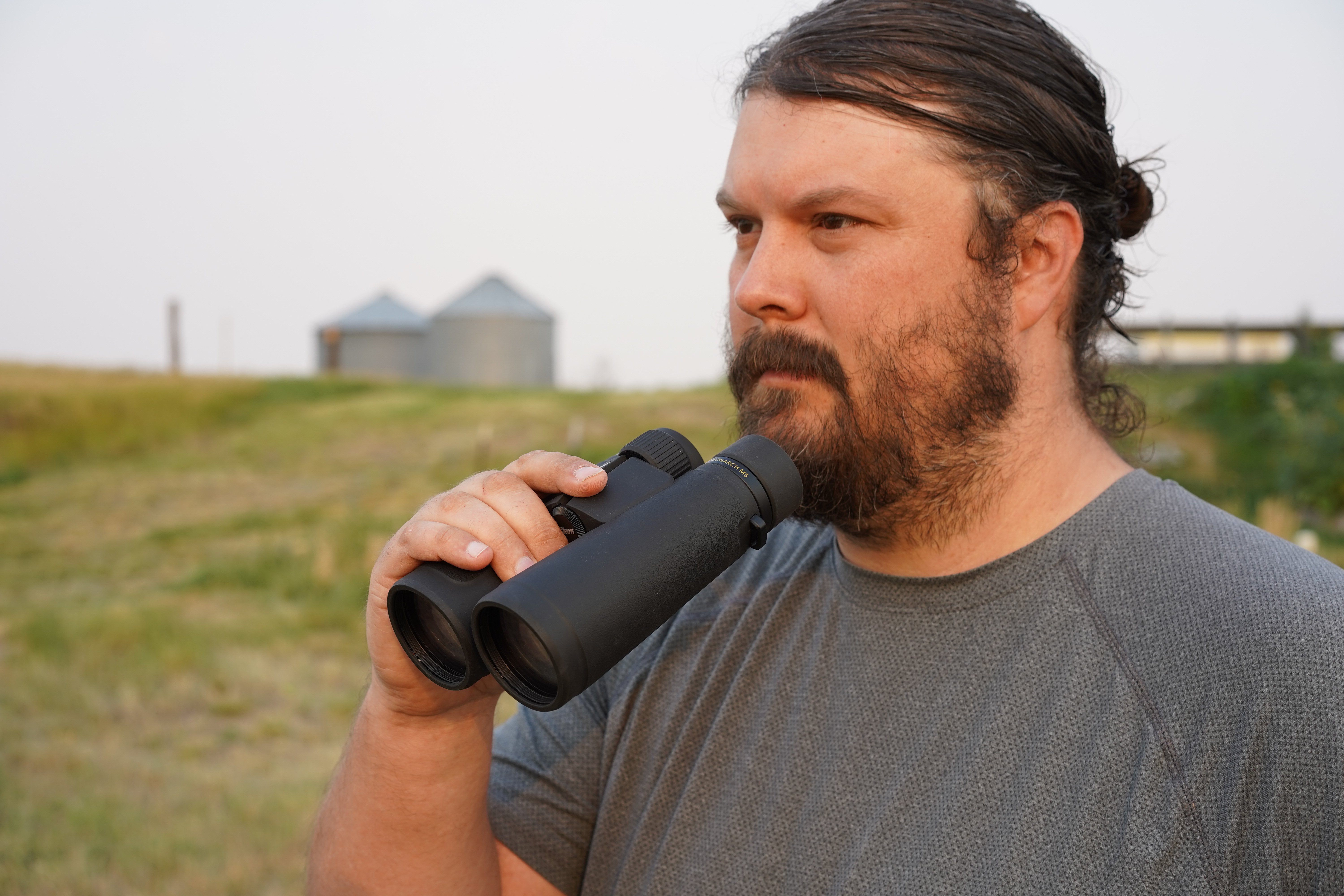
Testers especially liked the image quality and solid hand feel, but wished for a locking diopter. The 3-position eyecups are a little too square for some testers’ faces, but the lightweight 22-ounce build — the chassis is fiberglass-reinforced polycarbonate — balances nicely in hand and in a chest harness.
“It’s an all-day hunting binocular,” noted tester Nate Ward. “The image quality is surprisingly good for the price.”
The Nikon fared poorly in our low-light test, despite its big 50mm objective lenses. That may be evidence of sub-par glass, but in daylight conditions we could find no flaring, optical aberrations, or color shifting.
For a workaday binocular that is durable, reliable, bright, and affordable, we can’t recommend Nikon’s Monarch 5 10×50 strongly enough. The consensus of our test team is that Nikon doesn’t charge enough for it.
Nikon Monarch M5 10×50 Specs
- Magnification: 10-power
- Objective Lens: 50mm
- Stated Light Transmission: N/A
- Exit Pupil Diameter: 5.0mm
- Twilight Factor: 22.36
- Field of View: 315 feet at 1,000 yards
- Close Focus: 14.8 feet
- Weight: 22.6 ounces
- Length: 6.5 inches
Read Next: What Do Numbers on Binoculars Mean?
Nocs Provisions Field Issue 8×42 (Great Buy)
Pros
- Fun, distinctive colors
- Full-chassis ribbing
- At under $200, fairly priced
- Excellent close focus
- Contoured eyecups
- Lifetime warranty
Cons
- Uncoated internal lens surfaces
- Focus wheel a bit too close to eye
Key Features
- Distinctive colors result from collaboration with Audubon Society
- 3-position eyecups
- Field of view: 394 feet at 1,000 yards
- Front-hinge tripod mount
- Also available in 10×42 version
- Price: $200
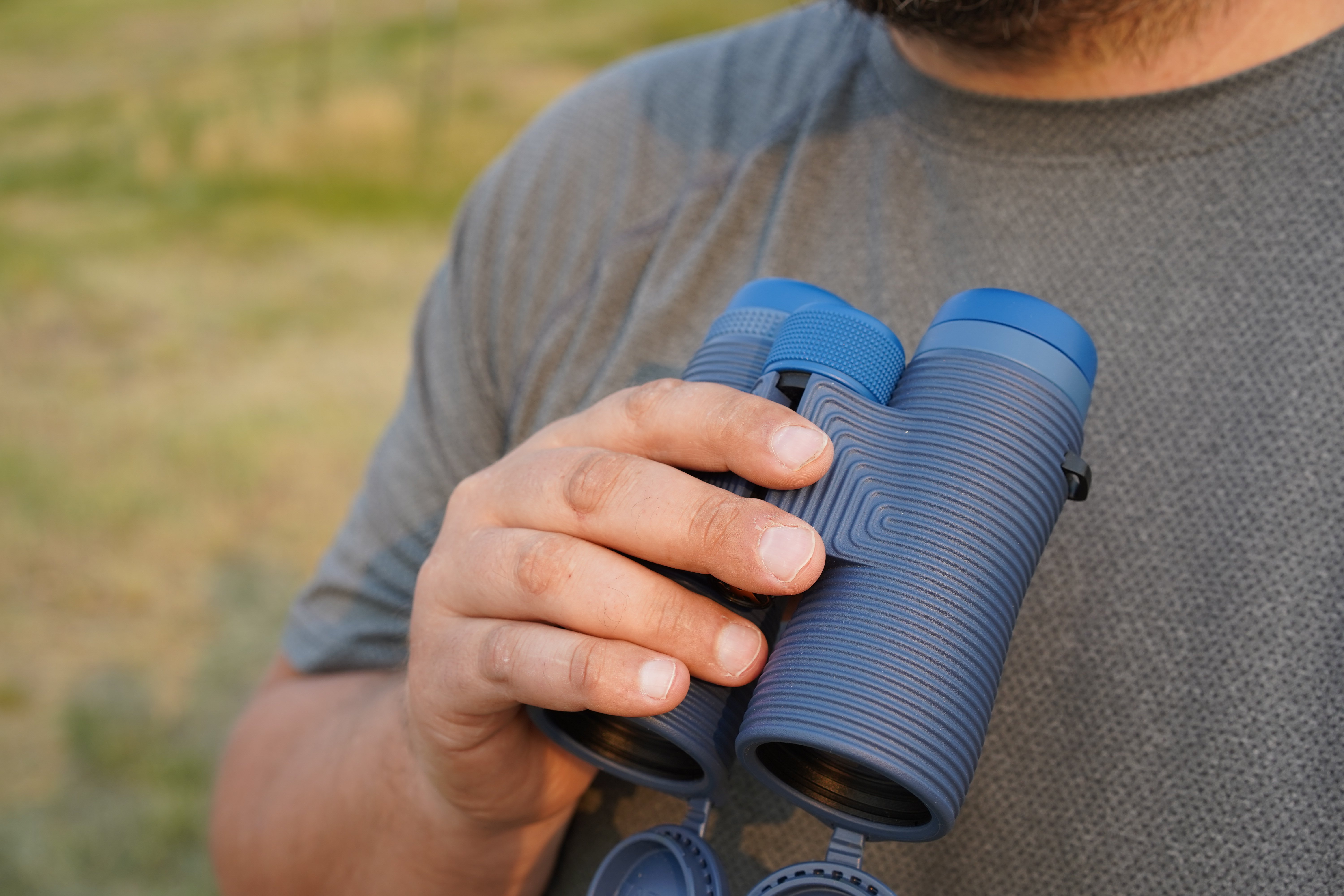
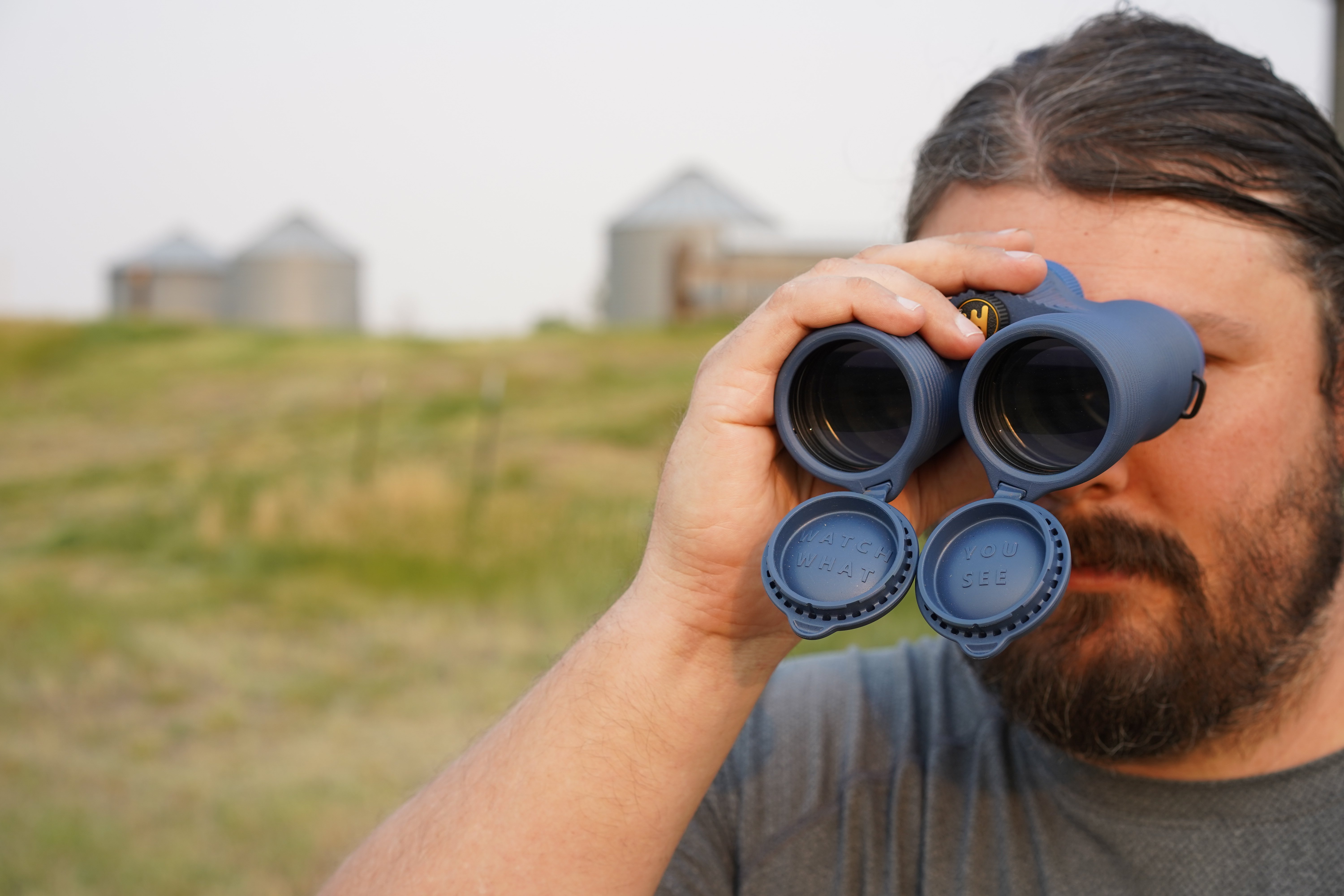
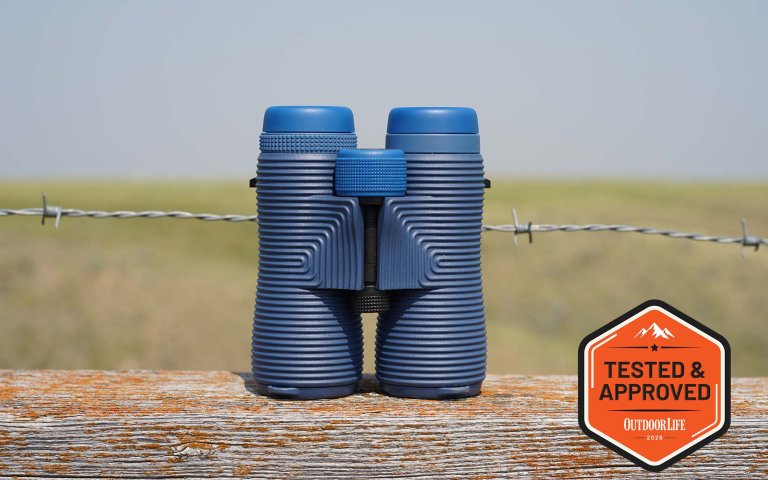
The box that holds this distinctive, ribbed-for-pleasure binocular has instructions about how to use it, an illustrated guide to twisting out the eyecups to your liking and setting the diopter focus. That tells you a bit about the Nocs Provisions’ audience: This might be their first encounter with a binocular.
First-timers, or anyone else for that matter, makes a good choice with this fun but hard-wearing and very good do-everything binocular. It might be intended for bird-curious bro-dudes, but it’s right at home in a whitetail stand or as a walk-about optic for serious hikers or backcountry hunters.

We tested the Eddy Blue colorway, but you can get this in Jade Green, Audubon Crested Caracara (Google it), or 10×42 versions in Sage, Brick Red, or Great Cormorant (again, Google). Nocs Provisions, a fresh presence in the optics world, collaborates with the Audubon Society on conservation initiatives, and features bird plumage in its colorways. If that’s off-putting to you, Nocs doesn’t care. They’re more interested in producing optics that function well, are durable, and are priced right.
Priced at under $200, this Field Issue 8×42 delivers so much utility and style that it earned our Great Buy award as the binocular in this year’s test with the highest price/value score. That it beat out seven other budget binoculars priced under $400 for the award says a lot about the Field Issue’s chops.
“Nice balance and in-hand feel, and I love the aesthetic,” noted one Outdoor Life tester, who praised the Field Issue’s wide field of view.
“Insanely close focus – this would be a good butterfly binocular,” said another, who noted that not all internal lens surfaces are fully multi-coated, creating a bit of flaring when pointed toward the sun.
Another tester noted that the focus control and barrel-belly thumb indentations were a bit too far back for his hands, but he allowed that they’d nicely fit most women and smaller-handed men. Maybe that’s intentional, as Nocs’ brand vibe seems to be to outfit anyone interested in looking carefully at the outdoors, regardless of glove size or adventure destination.
Nocs Provisions Field Issue 8×42 Specs
- Magnification: 8-power
- Objective Lens: 42mm
- Light Transmission: Not available
- Exit Pupil Diameter: 5.4mm
- Twilight Factor: 18.3
- Field of View: 394 feet at 1,000 yards
- Close Focus: 6.6 feet
- Weight: 21 ounces
- Length: 7.5 inches
Budget Binoculars
Hawke Vantage HD 8×34
Pros
- Open-barrel design enhances one-hand operation
- Great travel optic
- Lightweight polycarb body
- At 15.2 ounces, very lightweight
- Tripod mountable
- At about $170, priced right
- Lifetime warranty with registration
Cons
- Some uncoated internal lens surfaces
- Spongy focus
Key Features
- Dual-hinge, open-barrel design
- 2-position eyecups
- Front-hinge tripod adapter
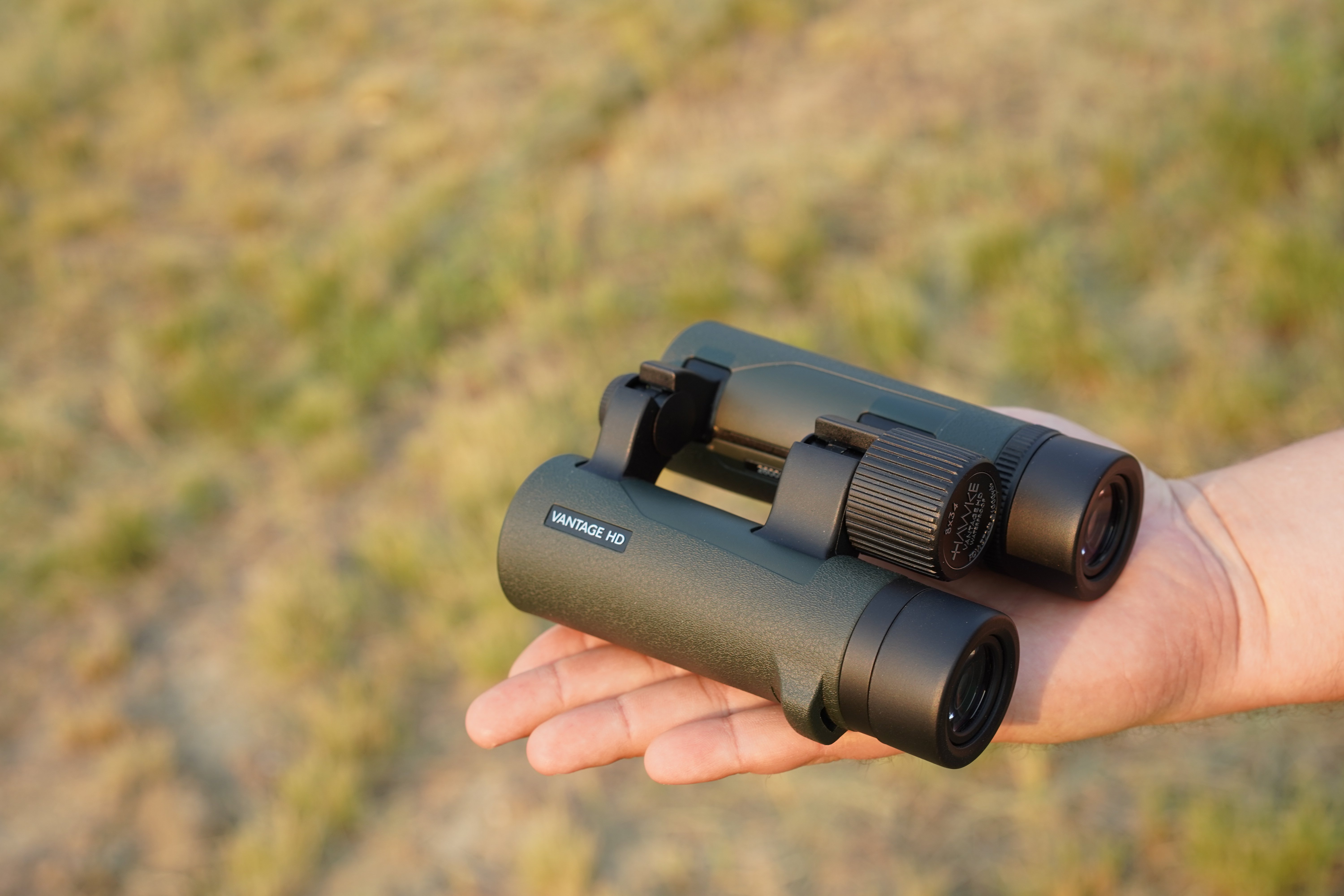
For walk-about bowhunters, a binocular that enables one-hand operation is a gift. The alternative of two-hand deployment means they have to set their bow down on the ground or place it in a belt rest or somehow free up their other hand.
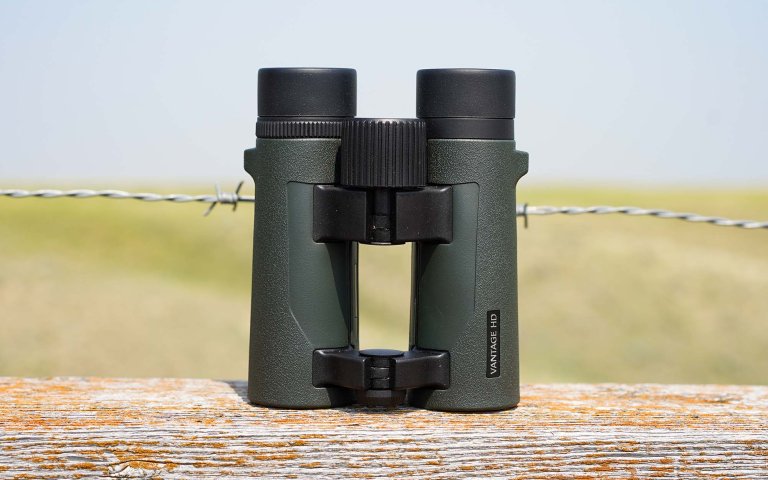
Hawke’s new super-compact 8×34 Vantage HD is the ultimate one-hand binocular. Its open barrels allow users to confidently grip the bino, and it’s so lightweight (less than a pound) and compact that it’s easy to grab out of a harness or a jacket pocket. This little powerhouse might also be the ultimate travel optic, easy to pack and produce when you want to see the details of a gargoyle gracing a Medieval cathedral, for one instance.
I packed this binocular on an Argentine dove hunting expedition, and used it to identify birds that were similar to their North American cousins, but just different enough that I spent nearly as much time observing birds as I did shooting them.
Hawke has wisely noted that 8-power is the perfect magnification for this super-compact build. Many brands put 10-power magnification in this micro frame, but that’s wrong, since it produces a tiny exit pupil and it’s hard to hold the powerful magnification in a chassis that doesn’t have hand-filling heft.
We worried about the durability of the polycarbonate chassis and noted some uncoated internal lens surfaces, but at about $170, this binocular is priced right for its abundant utility and outrageous per-pound performance.
Hawke Vantage HD 8×34 Specs
- Magnification: 8-power
- Objective Lens: 34mm
- Light Transmission: Not available
- Exit Pupil Diameter: 4.25mm
- Twilight Factor: 16.5
- Field of View: 372 feet at 1,000 yards
- Close Focus: 9.8 feet
- Weight: 15.2 ounces
- Length: 5.2 inches
Leupold BX-3 Alpine HD 10×42
Pros
- Durable magnesium chassis
- Interchangeable Form-Fit eyecups
- Scratch-resistant coatings
- Front-hinge tripod mount
- Transferable lifetime warranty
- At under $300, priced right
Cons
- Noticeable edge distortion
Key Features
- Ships with three eyecups
- 3-position eyecups
- Oversized focus wheel
- Ships with binocular harness
- 3-position eyecups
- Open-barrel design
- Price: $300
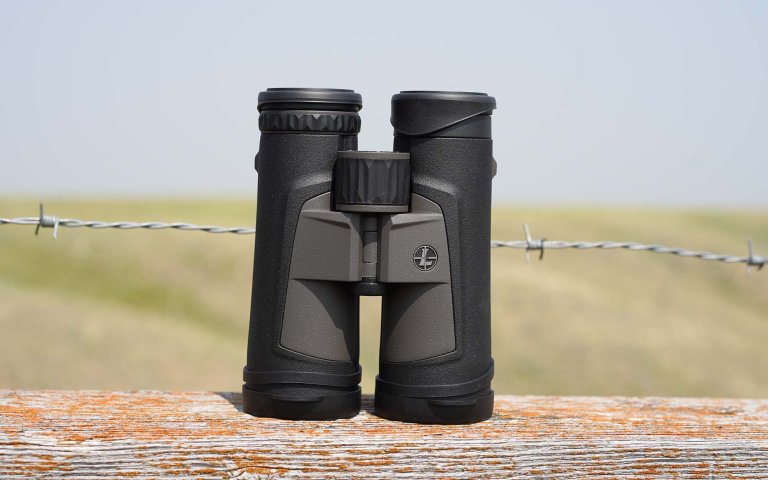
For years now, as Leupold has trotted out its BX-4 Pro Guide and even some configurations of its premium BX-5 Santiam binoculars, we’ve felt they were either overpriced or underperformers. Sometimes both. But with the BX-3 Alpine HD, Leupold has produced a binocular that’s worth every penny by simply and solidly checking the boxes of price, performance, and style.
“This is the best Leupold budget bino I’ve seen in the past few years,” noted tester Dale Manning. “The eyecups lock well with solid detents, and the focus control is smooth and precise.”
The BX-3 Alpine HD is built around a durable magnesium chassis, which lends it a heavyish but settled in-hand feel. It also comes with Leupold’s Form-Fit eyecups, with a square and batwing pair to go with the contoured cups that it ships with. Those features, and the very good bino harness that comes with the optic, are premiums you don’t expect at the sub-$300 price.
The Leupold was the highest-finishing 10-power binocular in our low-light test. We liked the image of both the 10×42 and the 10×50, though we detected some blue color fringing and slight edge distortion in both models. We’d recommend the 10×50 for open-country Western hunting. The 10×42 is compact and nimble for any need, but it’s best suited for mobile hunters who want a fast, durable, unfussy optic that won’t break their budget.
Leupold BX-3 Alpine HD 10×42 Specs
- Magnification: 10-power
- Objective Lens: 42mm
- Light Transmission: Not available
- Exit Pupil Diameter: 4.1mm
- Twilight Factor: 20.5
- Field of View: 342 feet at 1,000 yards
- Close Focus: 6.2 feet
- Weight: 22.6 ounces
- Length: 5.7 inches
Premium Glass
Swarovski NL Pure 10×52

Pros
- Premium field-flattener lenses
- Tapered tube design enables shake-free holding
- Premium glass and coatings
- 12.5-foot close focus
- Lightweight
Cons
- At $3,449, a wildly pricey binocular
- Non-locking diopter
- Tripod mount sold separately
Score Card
- Optical Performance: Excellent
- Mechanical Performance: Excellent
- Design: Excellent
- Price/Value: Good
Key Features
- Wasp-waist, open-barrel design
- Center-wheel diopter control
- Oversized focus wheel
- Field of View: 426 feet at 1,094 yards
- Also available in 32mm and 42mm models
- Weight: 36 ounces
- Price: $3,800
Once you recover from the sticker shock of this Austrian-made binocular, find a way to experience the image and the design that starts to justify its price of $100 per ounce. In terms of image quality, low-light performance, and ergonomics, the NL Pure is one of the most remarkable binoculars Outdoor Life has ever tested.
Its distinctive external lines are purposeful. Swarovski introduced the roof-prism NL Pure four years ago in three configurations: 8×42, 10×42, and what seemed like a crazy magnification at the time, a 12×42. That high-power binocular works as a shake-free hand-held optic because of its balance and the balance-enhancing barrel shape.

Swarovski calls the NL Pure a “wasp-waist” design, and a new optical prescription and redesigned prism allow the chassis to accommodate big objective lenses, a slender mid-section, and large eyepieces fitted with field-flattener lenses that enhance edge sharpness. The design also enables a monstrous field of view. The 10-power NL Pure has a 426-foot FOV at about 1,100 yards (the strange math is because I’ve converted from metric meters). That’s even wider than most 8-power binoculars, and far wider than any other 10-power that we’ve tested. If you’re a glasser that appreciates panoramic images and the ability to take in wide swaths of landscapes, the NL Pure is for you.
This binocular is decidedly not for you if you want to mount it to a standard tripod. One of the more frustrating aspects of Swarovski’s design is its proprietary front-hinge tripod socket. Instead of being fit with a standard ¼-20 thread, the NL Pure has a special click-lock socket that only accepts Swaro’s tripod mount, which sells for an additional $200. A cheaper alternative is to buy the $60 NL Pure adapter at Outdoorsmans and install it yourself. But either way, it’s an affront to working-class glassers to have to buy an aftermarket tripod mount after spending $3,500 on the binocular.

Testers also dinged the NL Pure for its non-locking center-dial diopter, which features a tab that can easily get bumped off plumb, especially if users employ enclosed bino harnesses. Evaluators had mixed reviews of Swaro’s proprietary harness mounting system, which features push-to-turn locking studs that hold straps to the chassis. The system, while elegant, requires users to stick with Swarovski’s hardware, and to buy expensive replacements when they inevitably lose one or both of the studs.
But these external nuisances distract from the NL Pure’s astonishing image. The binocular easily won our low-light test, thanks to premium glass and coatings and those huge 52mm objective lenses. The image delivered by the NL Pure is so vibrant, bright, and pleasing that testers gravitated to the Swarovski any time they wanted to get a better look at a distant object. That’s the best testament to a world-class optic: that users spend more time behind it. And as hunters know, the more you look with an optic, the more you’ll see, and the more successful you’ll ultimately be in the field. It’s hard to put a price on that level of performance.
Zeiss SFL 10×50
Pros
- 10×50 performance in 10×42 frame
- SmartFocus fast-turning focus wheel
- Light for configuration
Cons
- At nearly $1,800, expensive
- Requires larger bino harness pouch
Key Features
- Open-barrel, dual-hinge design
- Right-barrel diopter
- Oversized focus wheel
- ¼-20 tripod adapter
- Magnesium housing
- Lifetime transferable warranty

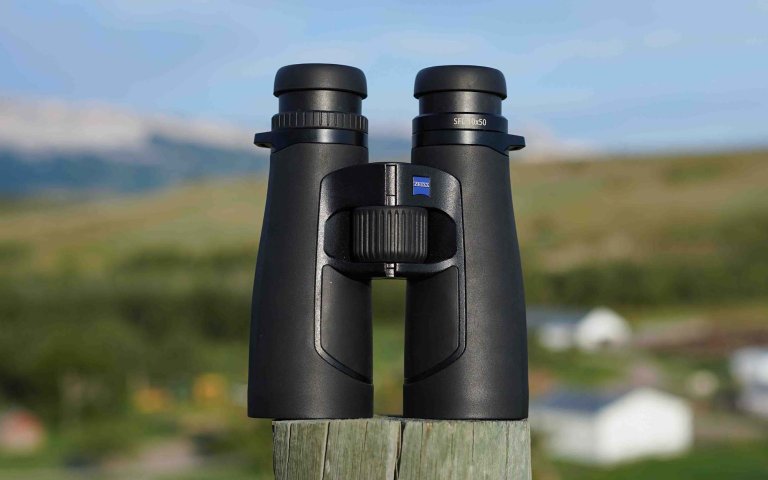
A year after Zeiss introduced its SFL binocular in 8×40 and 10×40 versions, the German brand has achieved a pinnacle accomplishment with 10×50 and 12×50 models in the line, delivering 50mm performance in a 42mm-sized chassis.
The result is a powerful, bright, and extremely well-balanced binocular that is optimized for hunters and birders who value walk-about size and weight but want a little more optical horsepower than a standard 10×42.
The combination of excellent glass, a responsive and tactile focus wheel, excellent ergonomics, and what we consider a fair price for a premium optic earned the Zeiss SFL our consensus pick for Editor’s Choice as the top binocular of 2025. While the award went to the 10×50 SFL, Zeiss’s 12×50 SFL accrued nearly the same score.
Both binoculars achieve their compact frame and relatively light weight through a redesigned optical prescription that uses thinner, lighter lenses stacked relatively close together in the magnesium chassis. The result is a 6.3-inch binocular that weighs just under 31 ounces. Those dimensions are standard for 10×42 binoculars, but the Zeiss models give users 18 percent more magnification (in the 12x version) and a significantly larger exit pupil in both versions, delivering more light to users’ eyes and contributing to overall image brightness compared to 10×42 binoculars. The 50mm objective lens, with 42 percent more surface area than a 42mm, is similarly capable of delivering significantly more light to the eye.
Manufactured in Japan, the Zeiss’s glass is excellent, with no observed edge distortion or flaring, and testers noted the vivid color rendition and remarkable image brightness.
“A do-it-all, take-it-anywhere piece of gear for hunters, wildlife watchers, spectators, etc.,” noted tester Luke Coccoli.
And tester Ky Idler, who noted some stickiness in one eye cup and some tooling marks in the interior of one barrel, said “The glass is clear. I would not be afraid to glass with this for hours. Zeiss nailed it.”
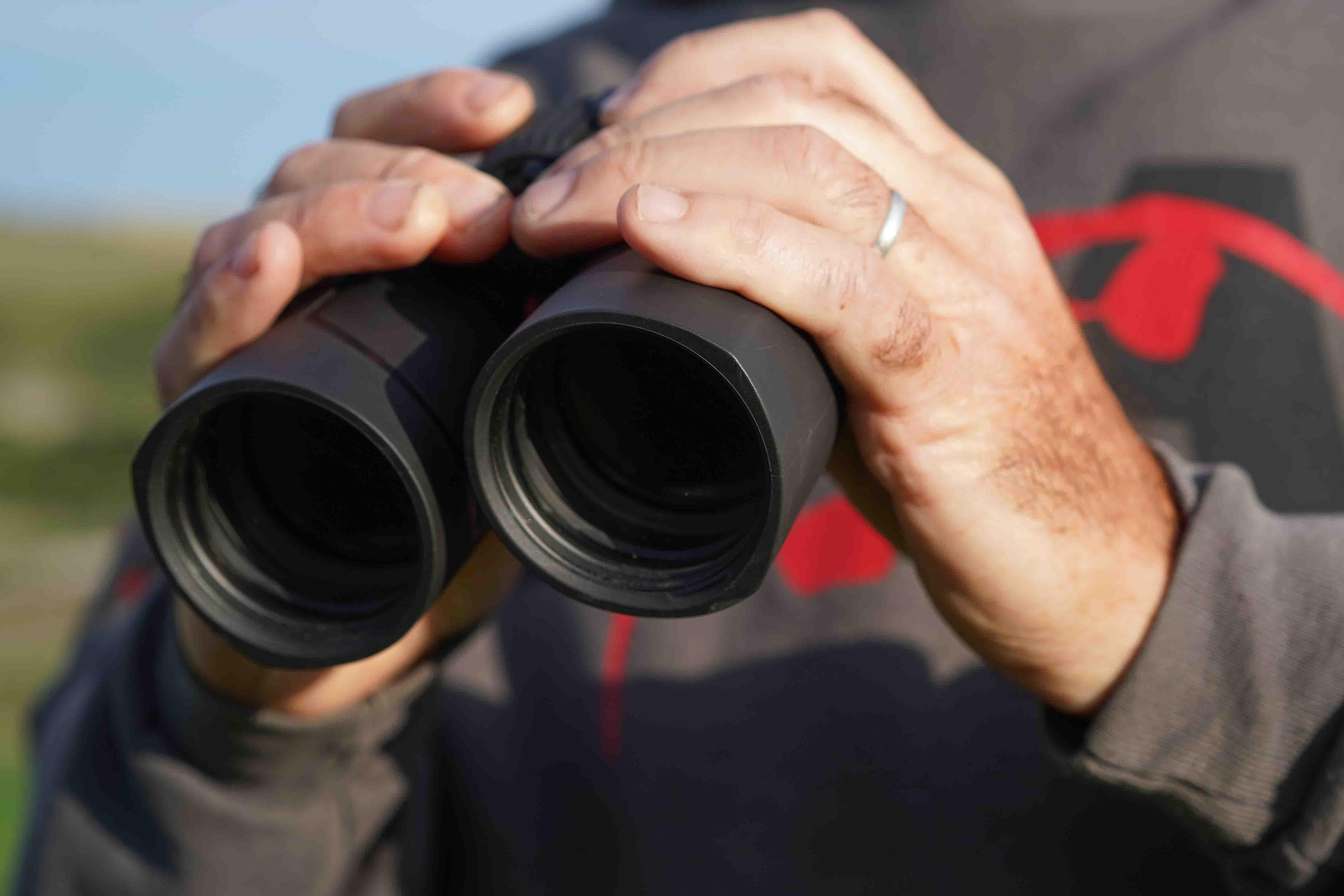
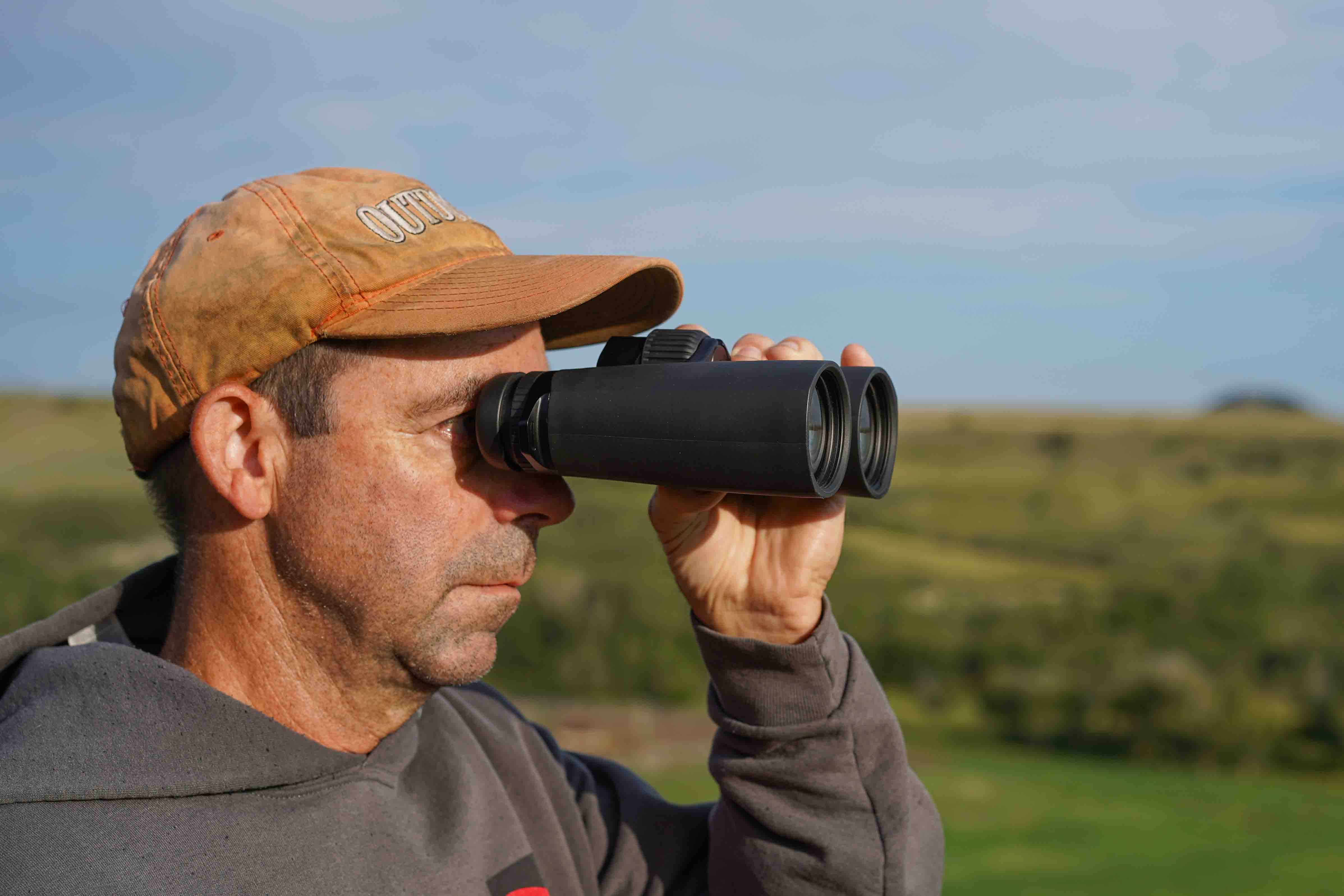
The open-barrel build and light weight enables one-hand operation, and the balance is excellent, settling in both hands without feeling forward heavy. The fast-focus wheel is especially useful, even under gloved fingers. In fact the SFL naming convention comes from Zeiss’s term for this control: the very Germanic SmartFocus Concept. The oversized focus wheel turns from close focus of 6 feet to infinity in just 1.4 turns of the wheel.
The rest of the unit has the features you’d expect: a good tripod mount on the front hinge, right-barrel diopter control, and three-position eyecups. The SFL is covered by a transferable warranty.
Of the two units we tested, I prefer the 10×50. The wider field of view makes images seem more panoramic, and the 12×50 version has just a little hand-shake unless I lock my elbows in. But for users who stabilize their binos on a tripod or other support, the 12×50 offers just a little bit more reach with the same vibrant, bright image.
With the addition of the 50mm models, Zeiss’s SFL line now includes an 8×30, 10×30, 8×40, 10×40, 8×50, 10×50, and 12×50.
The 10×50 and 12×50 SFL models retail for $1,799 and $1,999, respectively. It’s an investment, for sure, but we think between the optical performance, ergonomics, and disruptive design, the Zeiss SFL is an heirloom-grade binocular that will produce years of satisfying viewing.
| Zeiss SFL 10×50 Specs | |
| Magnification: | 10-power |
| Objective Lens: | 50mm |
| Light Transmission: | 90 percent |
| Exit Pupil Diameter: | 5.0mm |
| Twilight Factor: | 22.4 |
| Field of View: | 366 feet at 1,000 yards |
| Close Focus: | 5.9 feet |
| Weight: | 30.8 ounces |
| Length: | 6.3 inches |
Compact Binoculars
Tract Toric UHD 8×32
Pros
- Tight and durable build
- Bright Schott high-transmission glass
- Light at 23 ounces
- Easy one-hand operation
- Tight and positive controls
- Lifetime warranty
Cons
- Relatively expensive for a compact bino
- Slight blue edge aberration
Key Features
- Closed-bridge design Locking right-barrel diopter
- Front-hinge ¼-20 tripod thread
- Magnesium-alloy chassis
- 3-position eyecups
- Easy one-hand operation
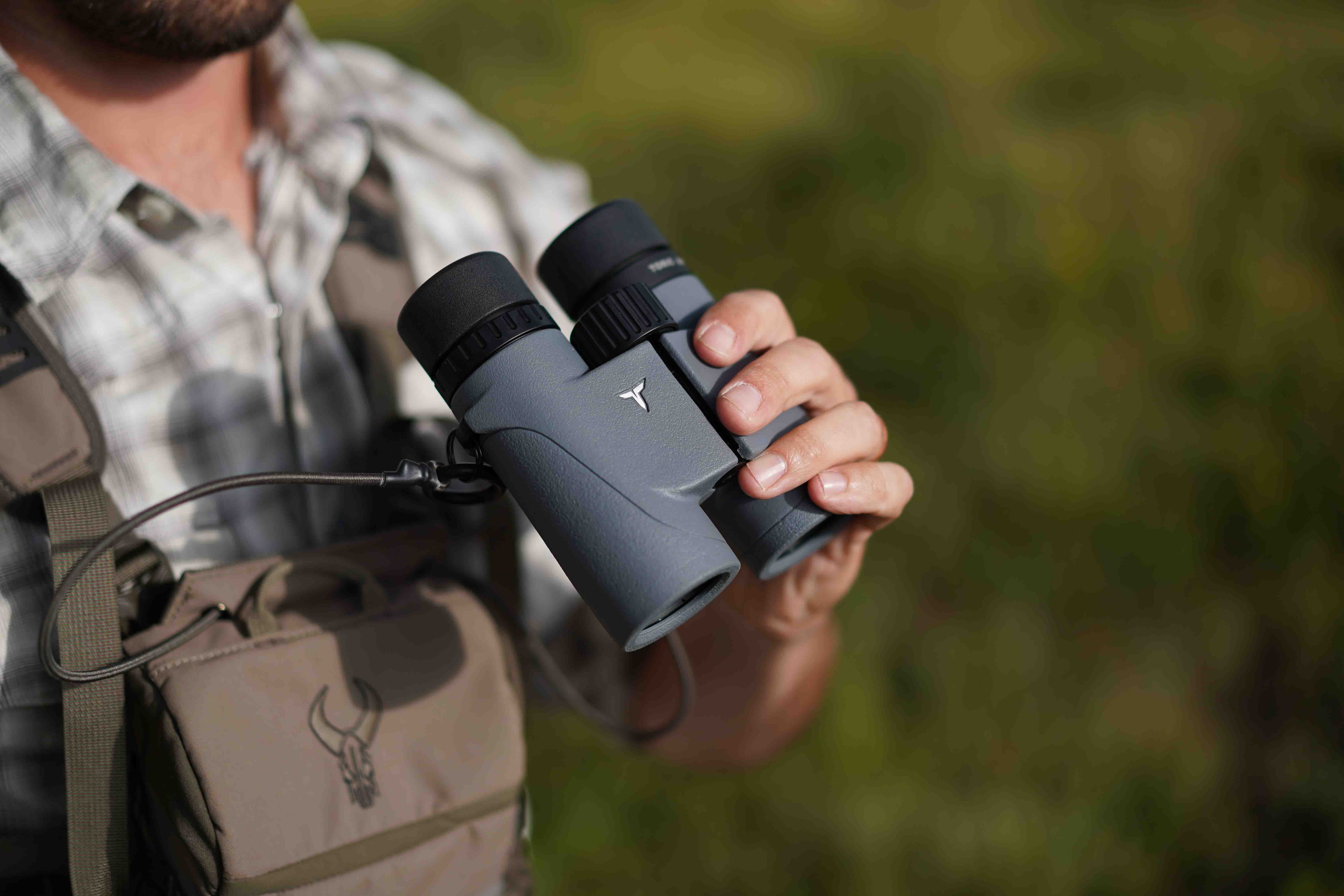

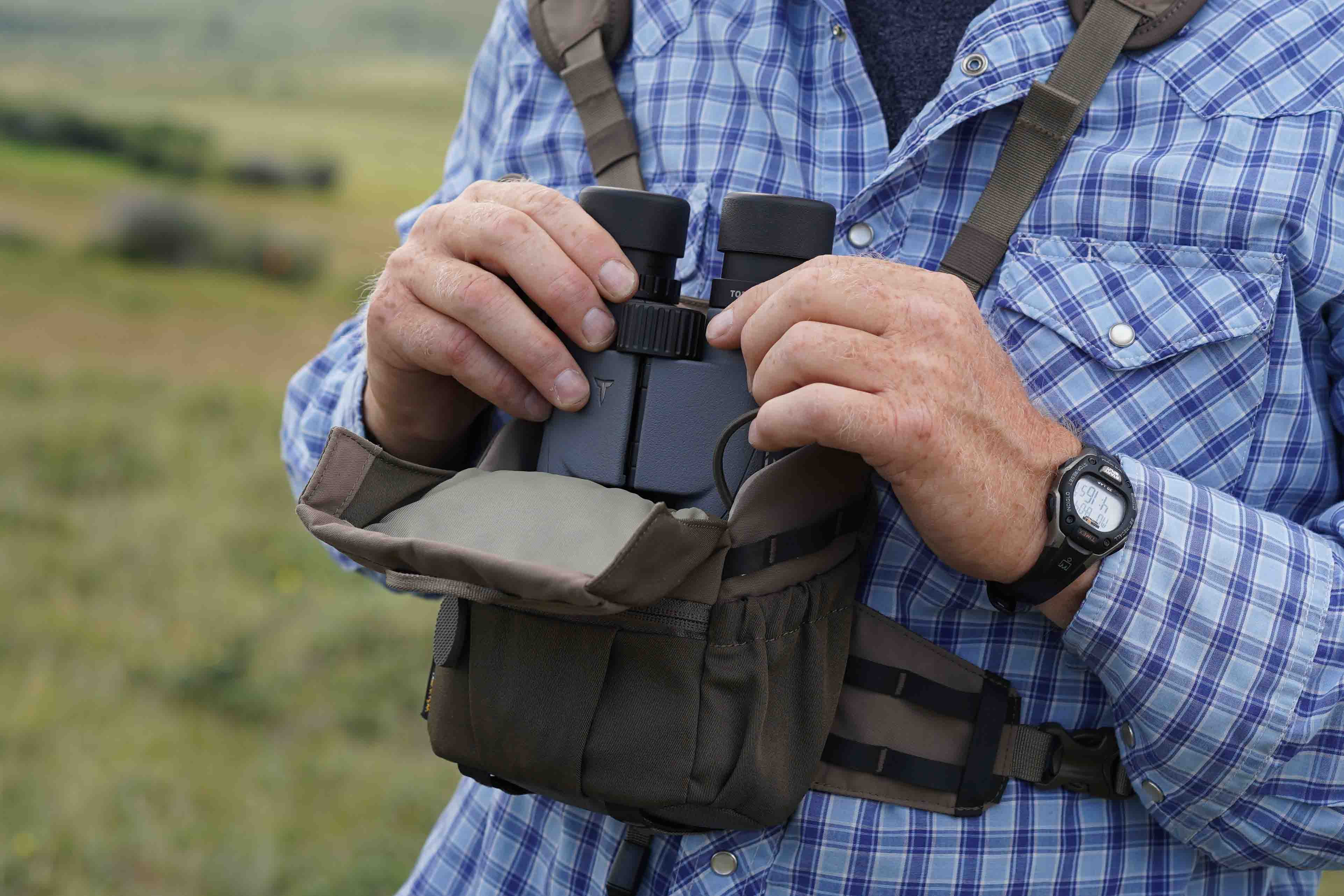
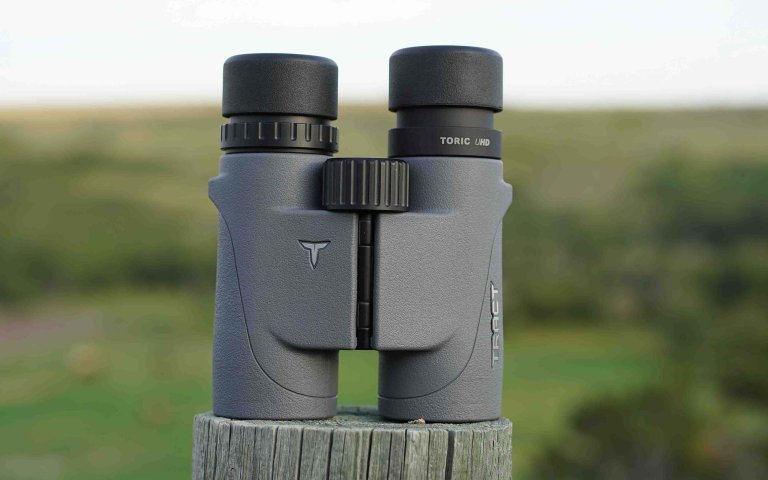
This binocular from a direct-to-consumer company punches way above its size. Add the lifetime warranty and versatility from whitetail stands to turkey vests to every truck console in America, and this is the binocular you will reach for above all others.
We’ve tested the big brothers of the 8×32 in previous tests, but this configuration hits a sweet spot. Its image seems like it was delivered by a big 10×42, but the small frame of the 8×32 fits in places the larger chassis doesn’t.
Then there’s the tight build of the Toric. Those who have followed the evolution of Tract Optics know one of its distinctive features is smooth, positive, extremely tactile controls. Scope turrets move with smooth precision and binocular eyecups feel like they glide on ball-bearing races. Those controls extend to the focus wheel, locking diopter control, and eyecups of this smallish binocular.
The Tract Toric has an excellent lifetime warranty. I doubt you’d ever use that coverage, but it’s useful to know that you have a binocular for life. In the field, you’ll use it for a one-handed spot-and-stalk bowhunting optic. You’ll have it in your bino pouch for turkey hunting or hiking. Or you’ll throw it in your luggage for a travel optic.
Testers subtracted points for a fairly clunky build and some blue color fringing. Testers who gravitate toward full-sized 10×42 binos thought the compact Tract was underwhelming.
“My first impression was that I didn’t want to like this binocular,” noted tester Ky Idler. “But surprisingly it fit my hands. Good glass. It would be a very good spot-and-stalk binocular.”
The Tract seems bigger than it is largely because of its excellent glass. It’s built around high-transmission Schott glass, manufactured in Japan, and has a wide field of view. Normally, I like open-barrel designs for one-hand operation, but the closed-bridge build of the Toric, while a little center-weighted, has enough heft that it settles in hand, whether one hand or two.
I’d readily use this binocular for bowhunting, when single-hand operation is required and where positive focus control helps parse close, medium, and far range targets. The Tract capably handles this chore with aplomb, if not distinctive style.
Maybe this helps answer the question: Is $724 too much to pay for a quality compact binocular? In the case of the Tract Toric UHD, the answer is decidedly no. While I’m not eager to pay more, this is a solid deal for a very good and versatile hunting optic.
| Tract Toric UHD 8×32 Specs | |
| Magnification: | 8-power |
| Objective Lens: | 32mm |
| Light Transmission: | Not provided |
| Exit Pupil Diameter: | 4.0mm |
| Twilight Factor: | 16 |
| Field of View: | 424 feet at 1,000 yards |
| Close Focus: | 6.5 feet |
| Weight: | 23 ounces |
| Length: | 5.2 inches |
Maven B.7 8×25
Pros
- Highly textured focus and diopter controls
- Excellent treestand or turkey-vest optic
- Distinctive orange accents
Cons
- Too small for open-country glassing
- Controls hard to manipulate with gloves
Score Card
- Optical Performance: Good
- Mechanical Performance: Very Good
- Design: Very Good
- Price/Value: Good
Key Features
- Double-hinge, closed-bridge design
- Right-barrel diopter control
- Extra-low-dispersion glass
- Extremely compact design
- Also available in 10×24
- Weight: 12.4 ounces
The B.7 is a compact version of the direct-to-consumer company’s excellent B.3 line.
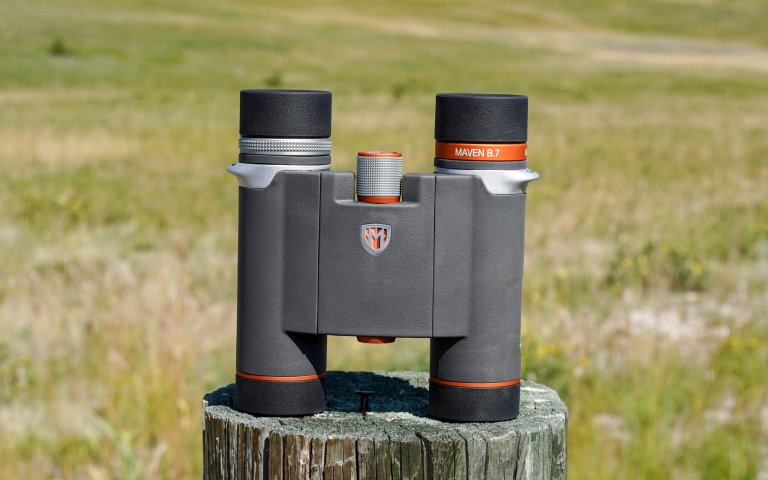
It should be said at the outset that this is a fairly specialized optic. It’s configured for portability and use in tight quarters and in close ranges. Think whitetail hunting out of a treestand. A travel optic when weight and space is at a premium. Turkey hunting just about anywhere. I use sub-compact binoculars when upland hunting, tucked in a pocket of my upland-bird vest, in order to positively identify distant birds, to find my dog, or confirm a distant point.

The Maven is one of the best-rendered versions of this class of diminutive binocular. The double-hinge design allows the barrels to nest under the bridge, and can fit inside a roomy shirt pocket. The glass is surprisingly good for this mini optic. Maven uses extra-low-dispersion glass that reduces glare and boosts colors and contrast of images. But the ED glass is also responsible for the fairly steep price; the 8-power B.7 retails for $600; the 10-power version sells for $625.
Outdoor Life’s optics test team gave the binocular good price/value scores, and they praised the solid build and responsive controls. But several testers noted the limitations of the platform.
“This would be a good spot-and-stalk bino for those times when I don’t want to carry a pack or even a binocular harness,” said tester Ky Idler. Tester Dale Manning further noted that the B.7 would “make a great optic for sporting events, turkey hunting, deep-woods treestand hunting, but for me it’s too small to be a go-to field bino.”
Fair enough, but for those hunters looking for a combination of outsized optical performance in a very trim package, this binocular fits just about anywhere.
Vortex Razor UHD 8×32
Pros
- Durable magnesium chassis
- Premium glass
- Easy to use with a single hand
- Oversized focus wheel
- Ships with premium GlassPack Pro harness with rangefinder pouch
Cons
- At nearly $1,500 street price, expensive for an 8×32
- Thumb indents could be larger to accommodate large hands
Score Card
- Optical Performance: Excellent
- Mechanical Performance: Very Good
- Design: Very Good
- Price/Value: Very Good
Key Features
- Open-hinge open-barrel design
- Right-barrel locking diopter control
- Tripod-mountable
- 5.9-foot close focus
- Weight: 21.9 ounces
- Field of view: 472 feet at 1,000 yards
- Price: $1,450
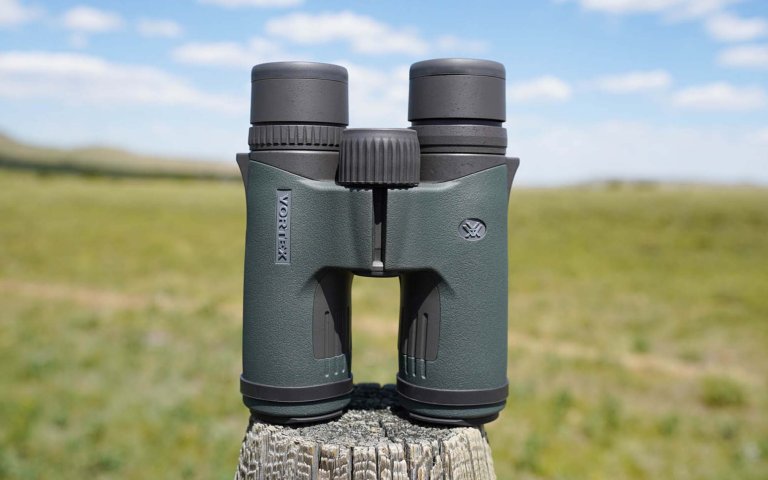
Vortex’s flagship binocular has it all: excellent glass, nice handling, a durable build, and wonderful field of view. The compact 8×32 in our test produces a big image out of proportion to its size, and testers noted it’s a perfect bowhunting optic, since it can be capably handled with a single hand and offers excellent mid-range performance. Enhancing its handling, whether you use one hand or two, the Razor UHD features thumb indentations in the chassis that are placed at the balance point of the binocular. That added touch allows for good gripping, though one ham-handed tester wanted these depressions to be a bit larger to fit his silver-dollar-sized thumbs.

Vortex’s excellent Razor UHD line, which also includes the 8×42, 10×32, 10×42, 10×50, 12×50, and 18×56 models. The literalists of our test noted that the term UHD, which stands for Ultra High-Definition glass, doesn’t have a defined meaning. It’s a marketing term to refer to a higher grade of glass and coatings than those used in Vortex’s HD (pedestrian High-Definition) optics.
Regardless of semantics, its exceptional glass and coatings allowed the 32mm Vortex to hang with big 42mm and even a 52mm binocular in our low-light test. Other accolades for the Razor UHD include a locking diopter, fast-focus wheel, and thin eyecups that fit most brows. Perhaps recognizing that $1,500 is a lot to spend on a binocular, Vortex adds its very good GlassPak Pro harness and rangefinder pouch to the deal. Those accessories retail for around $150.
We did note a surprising aberration. Testers recorded noticeable flaring when they peered toward the sun, an optical anomaly that may be caused by dust on an interior lens. We didn’t expect to see that in an optic at this price point.
But most users are unlikely to notice that demerit, one of the very few in an otherwise capable, fine-handling, and extremely bright binocular. Given Vortex’s fully transferable lifetime warranty and exceptional customer service, any deficiencies that users note are bound to be covered by the company.
Stabilized Binoculars
Kite APC Stabilized 16×42 ED
Pros
- Small size for stabilized binocular
- Fits most binocular harnesses
- Excellent ED glass
- Powered by twin AAA batteries
- Tripod mount on belly
- Limited lifetime warranty
Cons
- Narrow field of view
- Small and awkwardly placed focus knob
Key Features
- Electronically stabilized
- 120-hour run time
- Bottom-mounted ¼-20 tripod thread
- Motion-adjusted stabilization engine
- 3-position eyecups
- Easy one-hand operation
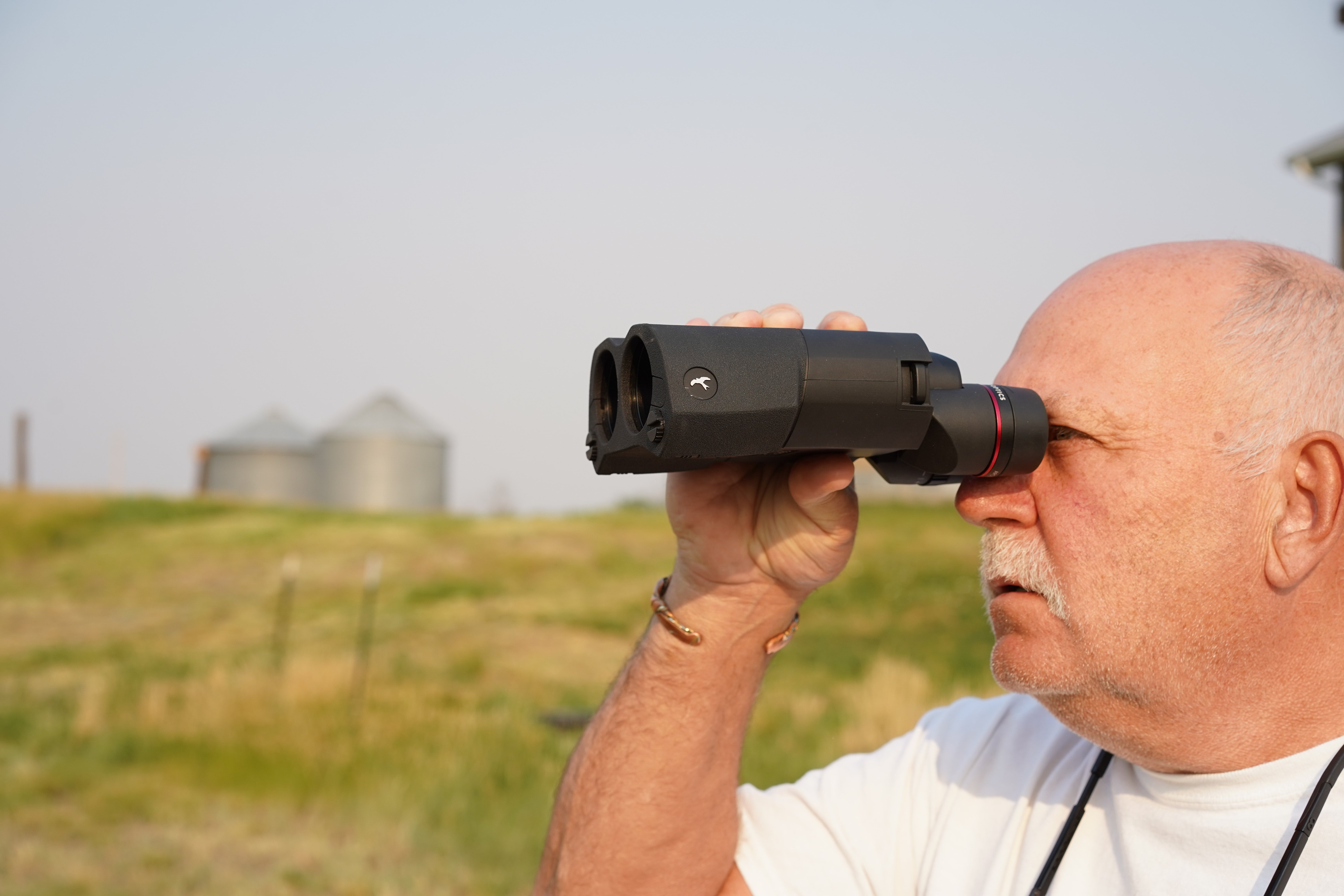
Along with Sig Sauer, Kite is aiming to own the new and necessary category of stabilized optics. Both brands have multiple configurations of their flagship stabilized binoculars, but by bringing a true walk-about binocular, Kite may have surged to the lead.
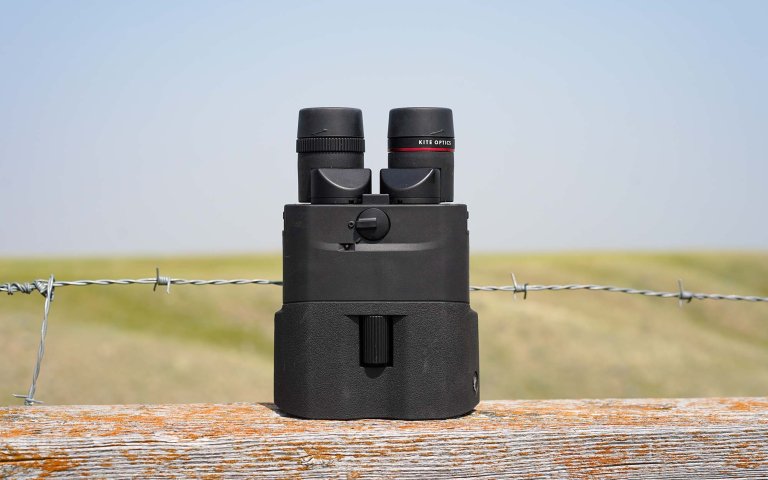
The 16×42 APC capably fills the gap between high-magnification conventional binoculars and compact spotting scopes. That it does it in a small enough form factor to fit in a chest harness and brings excellent glass as well makes this a standout optic. The Belgian company has 12×42 and 20×42 versions of this platform.
Like the Sig stabilized binoculars, the Kite runs on standard AAA batteries (the company also sells a version that runs on rechargeable lithium-ion batteries). It has an astonishing 120 hours of run time and a responsive gimbal that adjusts to movement to tame micro shakes and vibrations. The result is a smooth, almost cinematic, view of the world.
The 16×42 Kite APC is made for hand-held viewing, but the image is even more chill when the unit is mounted to a tripod. We worried a little about the square, blocky handling after a long day in the field, and some testers had to stretch their pointer finger to reach the focus knob. The Kite is pricey, with a real-world street price of about $1,350. But for hunters who want more reach than a standard 10-power binocular without the bulk of a higher-mag stabilized optic, this 16×42 is a smart choice.
Kite APC Stabilized 16×42 ED Specs
- Magnification: 16-power
- Objective Lens: 42mm
- Light Transmission: 85%
- Exit Pupil Diameter: 2.6mm
- Twilight Factor: 25.9
- Field of View: 240 feet at 1,000 yards
- Close Focus: 9.5 feet
- Weight: 30 ounces
- Length: 7.5 inches
Read Next: Best Spotting Scopes
Sig Sauer ZULU6 HDX PRO 18×50

Pros
- Image stabilization enables hand-holding of high-mag optic
- Runs on standard AA batteries
- HDX software tunes stabilization to use
- Good image
- Lifetime transferable warranty
Cons
- Ergonomically awkward
- Tripod mount should be integrated into chassis
- At $1,700, it’s expensive
Key Features
- Stabilization makes tripod use optional
- 10-minute auto shutoff
- Independent diopter controls
- 40+ hours of run time
- Relocated battery compartments provide enhanced grip
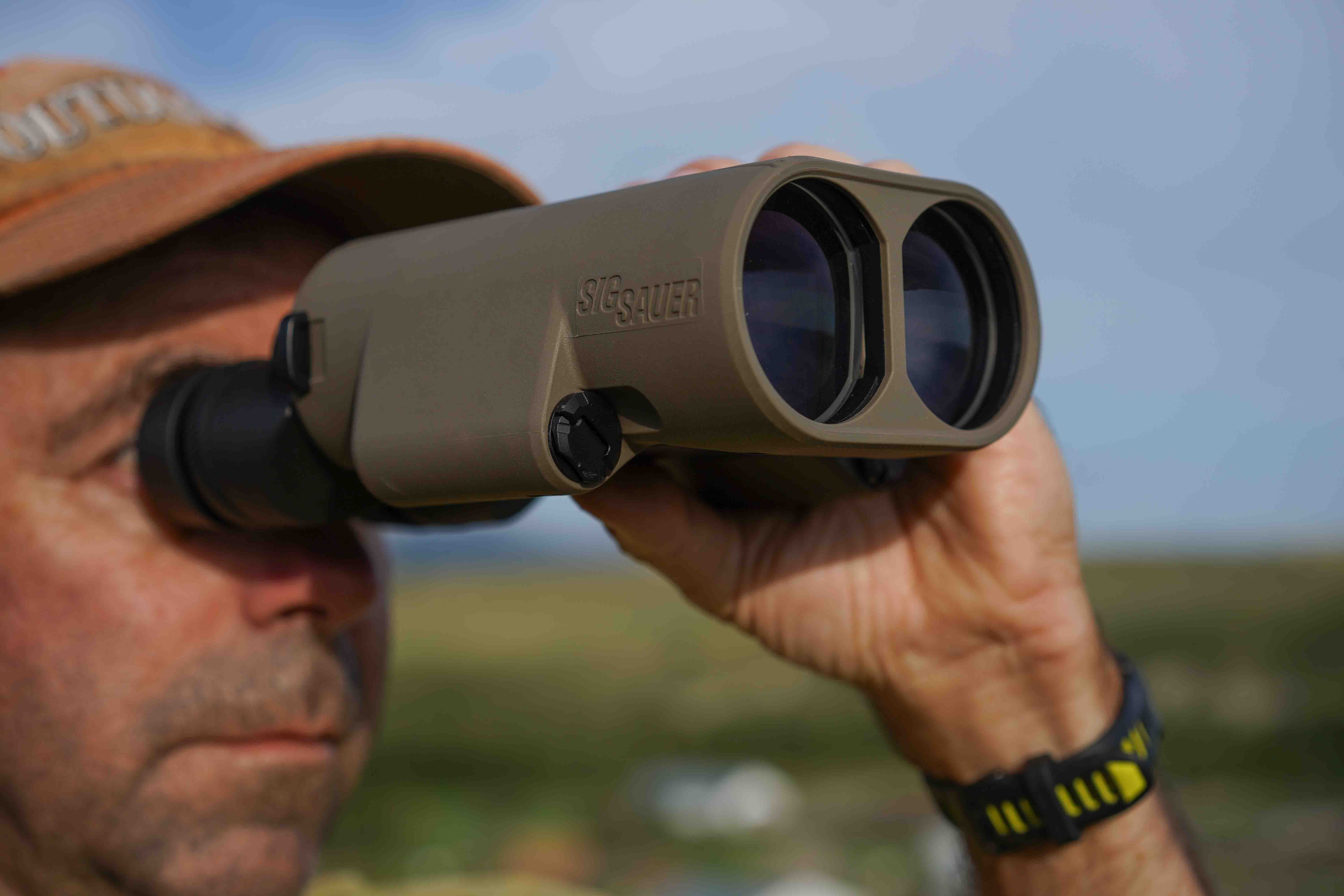
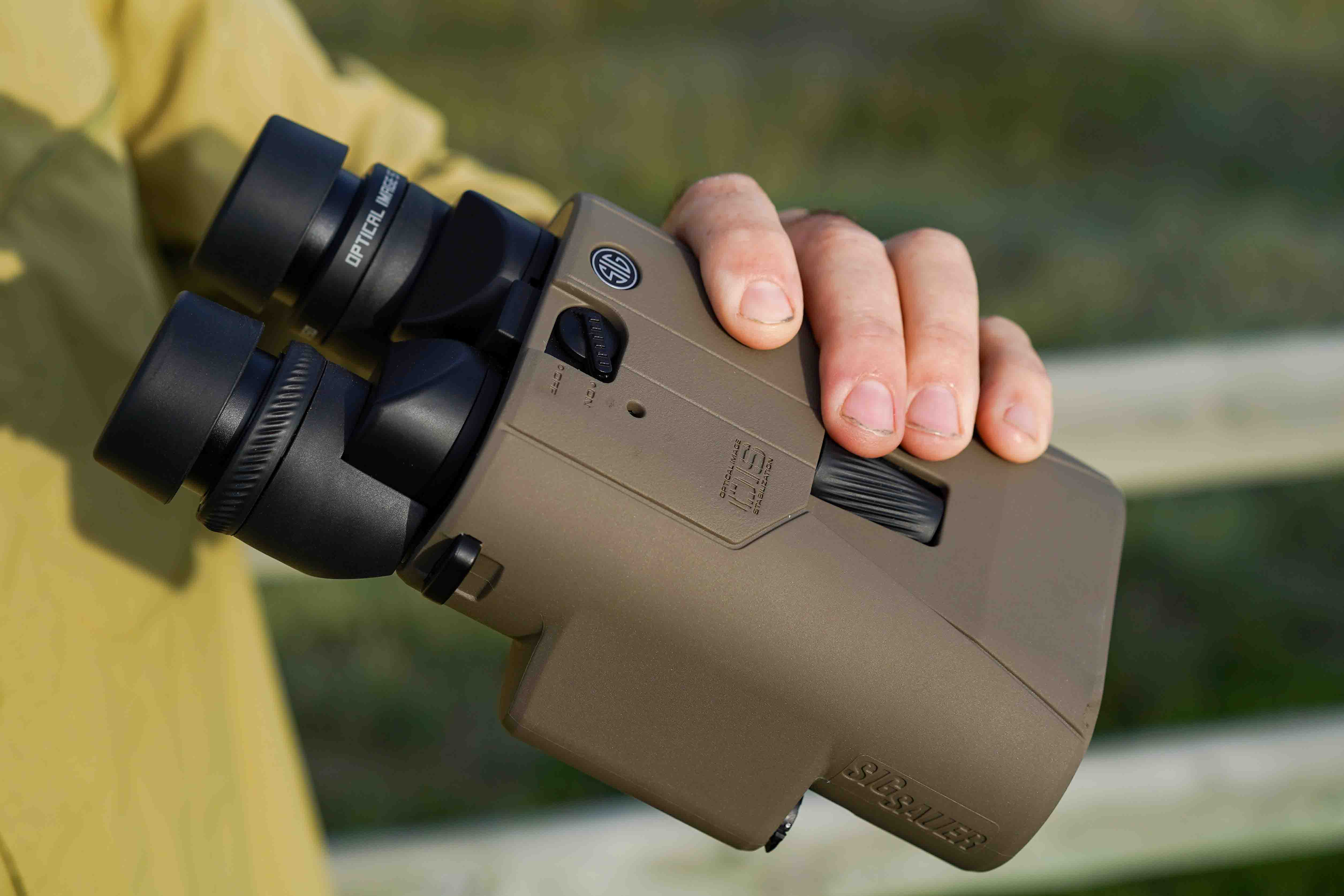
Testers had a complicated relationship with this ground-breaking binocular. On the one hand, the stabilized 18-power image is astonishing. To be able to hand-hold such a powerful binocular with no noticeable vibration is freeing. We managed to spot and classify a herd of elk three miles away with the hand-held ZULU6. Try that with any conventional binocular.
If only the Sig was more enjoyable to hold in the hands. The reality is, it’s not. It’s about as much fun as holding a motorcycle battery. The binocular is square and angular and doesn’t balance particularly well and the too-small focus wheel is located too far forward to comfortably reach.
One tester said the Sig was at its best when mounted to a tripod, but that sort of defeats the purpose of stabilization. Plus, the ZULU6 doesn’t have a built-in tripod mounting port. If you want to mount it, you have to buy a sold-separately ($60) clamshell adapter that has both a threaded adapter and Arca-Swiss foot.
Those ergonomic quibbles out of the way, this is a remarkable optical instrument. It allows for both tack-sharp viewing of far-distant objects and its built-in accelerometer adjusts to the speed of panning to keep the stabilization in time with your own movement. That’s the HDX PRO part of the ZULU6’s name. It allows users to glass from a moving vehicle, or on horseback, or on a pitching and rolling boat.
Sig has poured a number of upgrades into the latest versions of the ZULU6, including moving its twin battery compartments to the belly of the bino, where they serve as small purchase points for users’ hands. The glass and coatings are better, too, and we had no quibbles with image quality, though the small exit pupil means the image often appears dark. The Sig finished in the middle of the field in our low-light test.
But we long for the day when the stabilized ZULU line looks and feels, and handles, like a traditional binocular.
Tester Dale Manning captured the team’s sentiment by commenting, “The stabilizing technology is amazing. I do think there should be some sort of tripod attachment, because when the stabilization is turned off – or when the batteries fail – this is a difficult bino to use and a rest is required.”
| Sig Sauer ZULU6 HDX PRO 18×50 | |
| Magnification: | 18-power |
| Objective Lens: | 50mm |
| Light Transmission: | Not provided |
| Exit Pupil Diameter: | 2.8mm |
| Twilight Factor: | 30 |
| Field of View: | 194 feet at 1,000 yards |
| Close Focus: | 18 feet |
| Weight: | 34 ounces |
| Length: | 8 inches |
Large Frame Binoculars
Zeiss Conquest HDX 15×56 LRP

Pros
- Excellent range spotter
- T-style MIL-based reticle in left barrel
- Reticle leveling feature
- Ships with excellent tripod mount
- Dual diopter adjustments
- Reticle can focus out of image plane
Cons
- At $2,000, expensive
- Limited utility
Key Features
- Replaces compact spotters for range aid
- Precise and responsive controls
- Reticle’s floating center dot enhances target visibility
- Reticle offers 10 MRAD of windage and 5 MRAD of drop references
- Tripod mount has Arca-Swiss-compatible foot
- 3-position removable eyecups
This super-sized binocular has a very specific niche as a spotter for precision rifle shooters. Match the milliradian-based reticle to the reticle in a shooter’s rifle scope, and it’s a cinch to call hits and misses and relay corrections to the shooter.
The benefit of this 15×56 optic is that its magnification is low enough to reduce the target-obscuring mirage that is amplified with larger spotting scopes. When stabilized on a tripod, the Zeiss Conquest HDX enables both-eyes-open viewing, allowing users to spend more time behind the glass than they can squinting through a single-barrel spotting scope. Zeiss acknowledges the purpose of the binocular in its promotional materials. “Tailored to enhance the performance of competitors in Precision Rifle Series (PRS) and National Rifle League (NRL) events.”
We judged the merits of this tight, bright, and durable binocular as it’s intended, but we also appraised it as a large-frame binocular that could be used for general wildlife observation. This latter talent, as a very good super-sized binocular, is enabled by a key feature: the reticle can be unfocused to the degree that it drops out of the image. Focus the reticle using the left-barrel diopter when you’re ready to spot for a shooter or use it to range a distant object. The HDX has another key feature, a reticle leveler, that allows users to straighten the reticle to the horizon. Most binos with built-in reticles achieve leveling by moving the barrels, which changes the interpupillary distance — or distance between the two barrels — and makes it uncomfortable or impossible to center the eyes in the eyepieces.

The MIL-based reticle is smartly designed. Its T-style offers 10 MRAD of windage references, with 5 MRAD on either side of a floating center dot, and 5 MRAD of elevation references. It’s open enough to witness hits but detailed enough, with horizontal and vertical hashes every .1 MIL, to allow spotters to easily communicate shot locations to the shooter.
Optically, the Zeiss HDX is bright and free of aberrations. The 15×56 won our low-light test, largely on the basis of its large objective lens. But given that the binocular has an additional lens element — the one containing the reticle — that restricts light transmission, this low-light performance was impressive.
While we liked the positive controls, testers noted that it takes time and attention to tune the reticle, focus, and diopters.
“One drawback is the time you have to spend adjusting both tubes if you intend to use the reticle,” notes tester Luke Coccoli. “You can give yourself a headache if you adjust them incorrectly.”
The Conquest HDX is intended to be mounted to a tripod, and Zeiss enables this deployment by shipping a very good mounting adapter with the binocular. If you want to get the best out of this system, invest in one of Zeiss’s new Pro-Series carbon tripods.
| Zeiss Conquest HDX 15×56 LRP Specs | |
| Magnification: | 15-power |
| Objective Lens: | 56mm |
| Light Transmission: | 90 percent |
| Exit Pupil Diameter: | 3.7mm |
| Twilight Factor: | 29.0 |
| Field of View: | 240 feet at 1,000 yards |
| Close Focus: | 11.5 feet |
| Weight: | 46.2 ounces |
| Length: | 8.3 inches |
Burris Signature HD 15×56

Pros
- At $960, excellent price for 15-power
- Good optical performance
- Heavily textured armor
- Lifetime warranty
Cons
- Unwieldy to use without tripod
- Loose diopter control
Key Features
- Front-hinge tripod mount
- Durable closed-hinge design
- 3-position eyecups
- Fast-focus wheel
If you’re in the market for a big 15×56 binocular, you could do worse than this solid, unsurprising entry from Burris. If that sounds like faint praise, it’s because the Signature HD does its job without fuss or failure. It reaches across landscapes to deliver images with good enough clarity and brightness. It easily mounts to a tripod but can be used adequately without stabilization. In short, it’s an honest optic.
Its biggest selling point is its price. You get an Asian-sourced large-frame binocular for under $1,000. That puts it in the league of Nikon’s Monarch 5 (20×56), and 15×56 models from Bushnell (Match Pro ED), Athlon (Cronus G2), and Steiner (Predator), but its image and handling are a bit better than those peers, based on previous year’s testing.
The Signature HD was runner-up in our low-light test, thanks to its large 56mm objective lenses and also generally good glass and image brightness. Testers reported good edge-to-edge clarity with only a little color fringing in bright daylight conditions. While users aren’t typically in the market for 15×56 binos for close-up viewing, the 23-foot close distance of the Burris was disappointing; most large-frame binoculars can focus inside 15 feet.
We also dinged the Burris a bit on its handling. The closed-bridge design and overall heft make it hard to use with a single hand, which is unsurprising considering its configuration. It behaved much better on a tripod, where the focus is tight and the aggressively textured armor is easy to handle, even when wet or with gloved hands.
| Burris Signature HD 15×56 Specs | |
| Magnification: | 15-power |
| Objective Lens: | 56mm |
| Light Transmission: | Not provided |
| Exit Pupil Diameter: | 3.7mm |
| Twilight Factor: | 29.0 |
| Field of View: | 215 feet at 1,000 yards |
| Close Focus: | 23 feet |
| Weight: | 43 ounces |
| Length: | 8.2 inches |
The Test Protocol

We put all submissions to our annual binocular test through the same criteria. First, we measure optical resolution, using the diminishing black-and-white lines of a 1951 Air Force Resolution Target to score the optical performance of each submission. We also measure the low-light performance of each binocular by mounting them to tripods and focusing them as a group at 200 yards at a black-and-white resolution target starting at twilight and then well into the gathering dark, all in order to measure the brightness of the glass. This is an important consideration for both hunters and wildlife watchers, since animals are more visible in the early morning and late evening than at any other time.
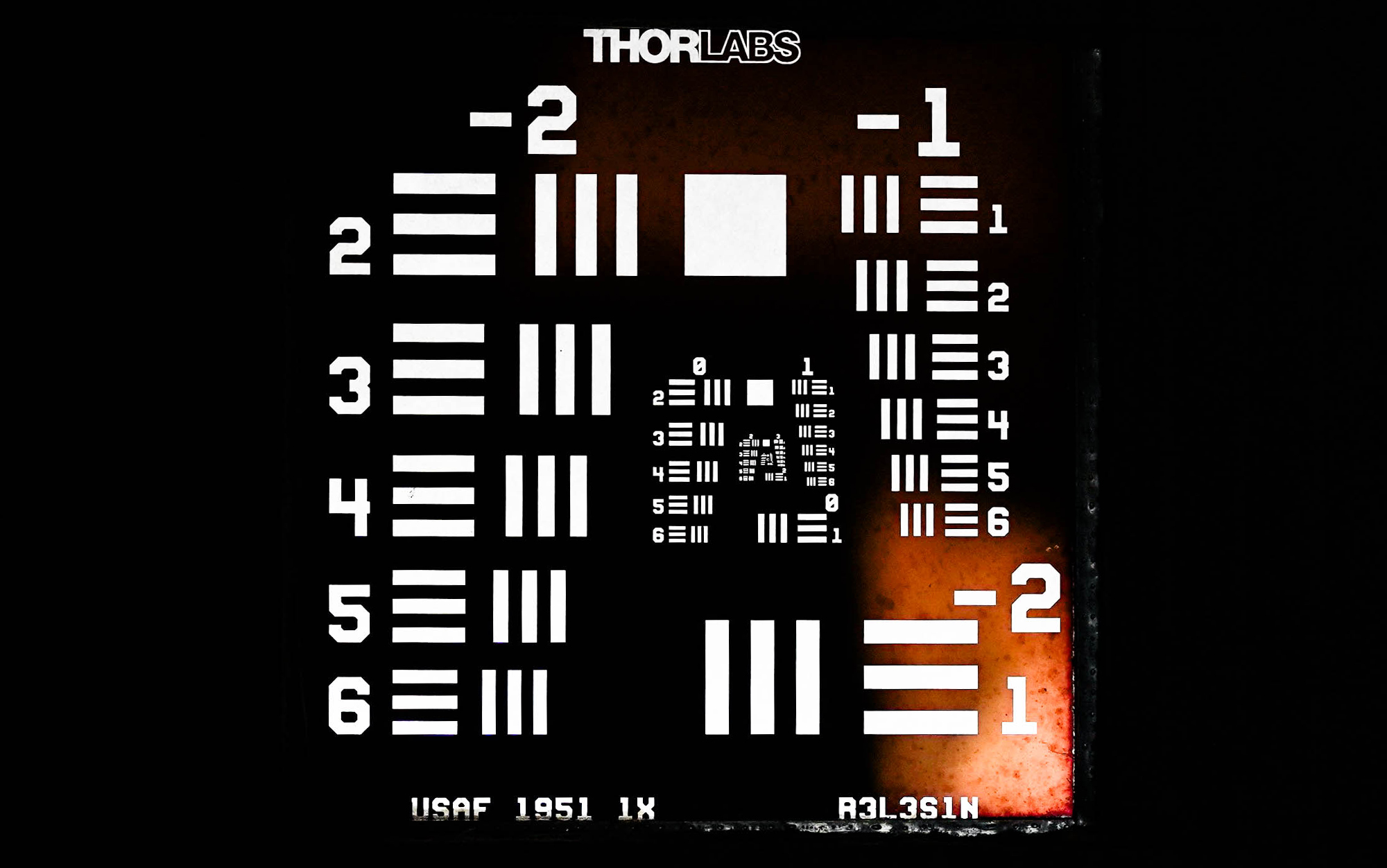
The binocular that can “see” the longest into the dark gets top marks. The model that loses its night vision earliest gets the lowest score. Binoculars in the middle receive weighted scores somewhere between those two poles. We averaged the results over at least three nights, with a different pair of eyeballs behind the binoculars each night, to arrive at our adjusted score.
How We Scored the Results
We break our 10-point scoring into four general categories: optical performance, mechanical performance, design, and value. The average of these categories is the basis of our grades, detailed below.
Optical performance includes the resolution and low-light tests plus the more subjective assessments of image quality and brightness. Mechanical performance assesses the durability of the submission along with its controls: focus and diopter controls, eyecup extension, and comfort. In the case of rangefinding binoculars, it also factors the electronic interface and performance. Design considers the exterior finish, interior blacking, tripod mount, and its innovation and versatility, along with its comfort. We ask testers to evaluate this critical question: how long could you glass with this binocular?
And then our price/value score rates how much optic—along with warranty and amenities such as carrying case or harness—you get for your money. The binocular that gets the highest overall score wins our Editor’s Choice award for the best in the category; the optic with the highest price/value score wins our Great Buy recognition.
Our 10-point evaluation adds up to a total numeric score, but we translate those to grades for each submission. The optical performance grade combines the scores from resolution, low light, image, and brightness. Our mechanical performance grade aggregates the mechanics and durability score. The design grade considers construction, innovation, versatility, and comfort. And then the price/value grade is our value grade.
To earn an “Excellent” grade, the average of that category must be 9 or higher, which is extremely hard to achieve. “Very Good” is an average score of 7 to 9. A “Good” grade is 5 to 7. Our “Fair” grade is 3 to 5, and “Poor” is anything under 3.