
We may earn revenue from the products available on this page and participate in affiliate programs. Learn More ›
I grew up deer hunting in the woods of north-central Wisconsin where a 100-yard shot would be a long one. We needed only a simple 3-9X riflescope that gathered enough light to let us shoot a half-hour after sunset. In other words, any streamlined riflescope with decent glass would work just fine.
A lot of deer hunters still hunt this same way. But riflescope offerings have grown exponentially. So the best riflescope for deer hunting really depends on where, and how, you intend to hunt.
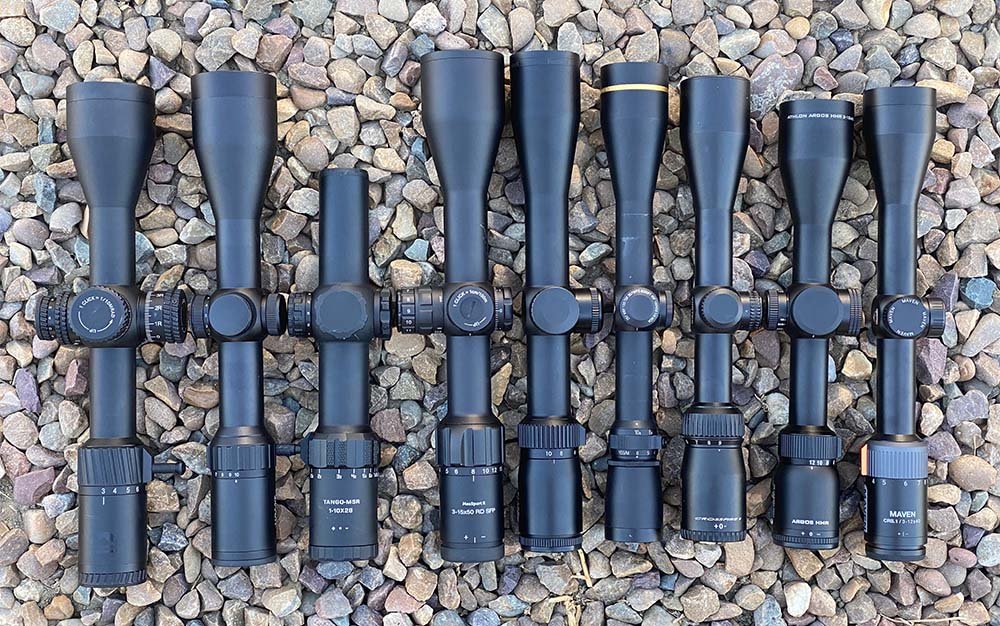
With this roster of scopes I’ve attempted to select a good variety of styles that will work in the northwoods, the open country of the West, and everywhere in between. All of my picks are based on data from in-depth testing conducted by OL’s Optics Editor Andrew McKean and our Gear Editor Scott Einsmann. I focus mostly on affordable options, but there are a couple high-end picks included, too.
Best Riflescopes for Deer Hunting
- Best Value: Burris Fullfield 3-12×42 SFP Plex
- Best High End: Nightforce NX6 3-18X50 F1
- Best LPVO: Trijicon Accupoint 1-8X24
- Best Affordable LPVO: Sig Sauer TANGO-MSR Compact 1-6×24 BDC6 Reticle
More Great Scopes to Consider
- Vortex Crossfire HD 4-12×44
- Zeiss V3 3.5-10×42
- Bushnell R5 4-12×40
- Maven CRS.1 3-12×40
- Athlon Talos HMR 1×24
Best Riflescopes for Deer Hunting
Best Value: Burris Fullfield 3-12×42 SFP Plex
Pros
- Familiar hunting configuration
- Distinctive red accents
- Simple set-it-and-forget-it operation
- At about $260, priced right
- Also available in Ballistic E3 and illuminated wind plex reticles
- Fully transferable lifetime warranty
Cons
- Limited adjustability
- Green coatings
Key Features
- 1-inch tube
- Available only in MOA adjustments
- Rezeroable turret dials
- Parallax correction fixed at 100 yards
- 42mm objective enables low-profile mounting
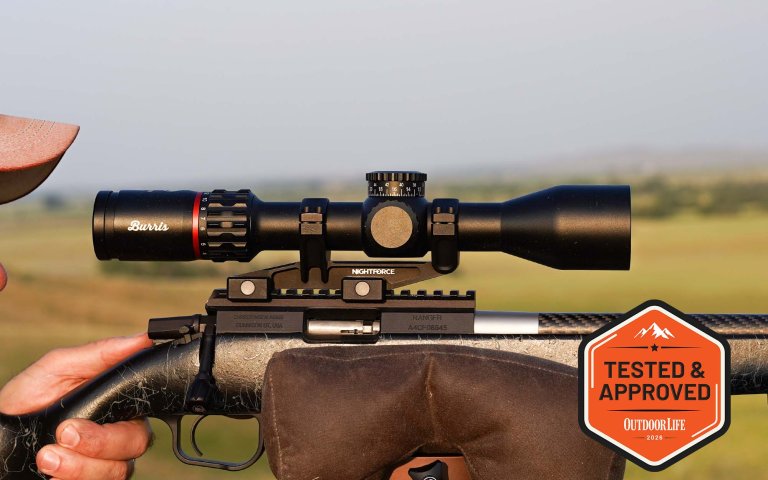
The Burris Fullfield is a classic deer scope, built on a 1-inch tube with capped turrets and a second-plane duplex reticle. It’s a simple, capable scope that’s offered for under $300.
This scope has some nice features, including distinctive red accents on the power-changing ring and turret dials and re-zeroable turrets. But it’s not perfect either. It has a distracting greenish coating that’s especially noticeable in low-light conditions. Its turret indexing is so tiny that it’s hard to confirm when you’re zeroed.
But for a good image, plus simple and repeatable controls, the Burris Fullfield 3-12×42 checks every box for the workaday deer hunter.
Burris 3-12×42 Specs
- Magnification: 3-12
- Objective Lens: 42mm
- Tube Diameter: 1-inch
- Light Transmission: Not provided
- Exit Pupil Diameter: 14-4.7mm
- Twilight Factor: 11.2-19.4
- Field of View: 36-9.25 feet at 100 yards
- Reticle Plane: Second
- Reticle Type: Plex
- Turret Click Values: ¼ MOA
- Adjustment Per Revolution: 25 MOA
- Total Internal Adjustment – Elevation: 72 MOA
- Total Internal Adjustment – Windage: 72 MOA
- Parallax Correction: Fixed at 100 yards
- Weight: 14.7 ounces
- Length: 11.1 inches
Best High End: Nightforce NX6 3-18X50 F1
Pros
- Battle-proven durability
- Capped turrets
- Capped turret can be converted to exposed FieldSet dial
- Free custom BDC dial with voucher
- Abundant internal adjustment range
- Excellent glass
Cons
- Locking eyepiece takes time to set
Key Features
- Re-zeroable turrets
- Push-button red and green illumination
- 10 yards to infinity side parallax control
- Field-proven MOAR reticle
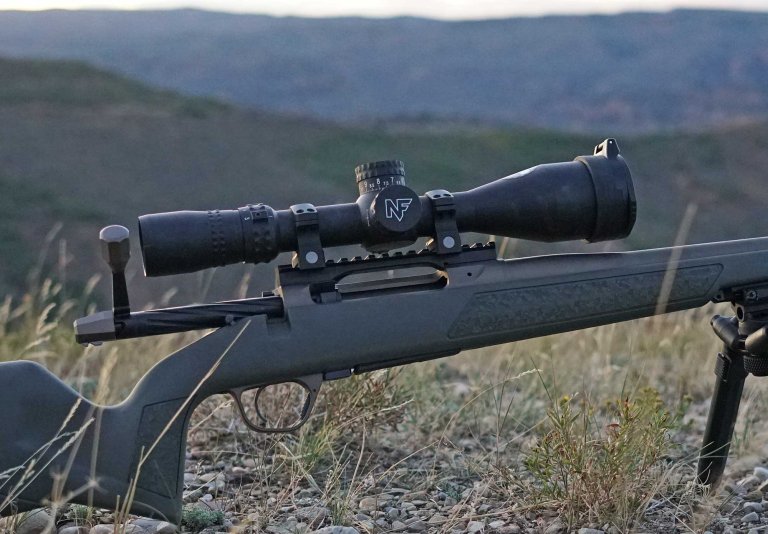
Nightforce is known for building battle-ready riflescopes for long-range precision shooting. But their new NX6 product line is designed specifically for hunters. I used the 3-18X50 F1 version with a MIL reticle on an elk hunt this fall and found it to be an excellent open-country hunting scope. It had strong image quality and low-light performance. It’s a hefty scope, but not absurdly so, like some other precision optics.
One of the key features of the NX6 line is the new FieldSet turret system. Once you’ve established your zero, any simple tool — a coin, knife, or flat rock — will loosen the exposed turret cap, allowing you to reset your zero and set the zero stop. The stop can be set a full revolution above zero, or 2 MILs.
One of the many cool things about this system is that any NX6 model except the 1-6x can be converted from capped to exposed turret, and the standard exposed turret can be traded for a custom BDC turret. It’s another indication that the NX6 is positioned to be the ultimate versatile scope family.
The scope comes with a versatile illumination system that lights up the entire reticle. This is a relatively advanced and expensive scope, but for spun-up riflemen who are looking to shoot deer at longer ranges, it’s an excellent option.
Nightforce NX6 3-18×50 Specs
- Magnification: 3-18-power
- Objective Lens: 50mm
- Tube Diameter: 30mm
- Light Transmission: Not provided
- Exit Pupil Diameter: 7.4mm to 2.8mm
- Twilight Factor: 12.2-30
- Field of View: 35.3-7.3 feet at 100 yards
- Reticle Plane: First
- Reticle Type: MIL C (tested)
- Illumination: yes
- Turret Click Values: .250 MOA or .1 MRAD
- Total Internal Adjustment – E: 120 MOA/34.9 MRAD
- Total Internal Adjustment – W: 85 MOA/24.7 MRAD
- Parallax Correction: 11 yards to infinity
- Weight: 21.0 ounces
- Length: 13.9 inches
Best LPVO: Trijicon Accupoint 1-8X24
Pros
- Battery-free illumination
- Excellent glass
- Simple green illuminated center dot
- Liberal mounting dimensions
- Rezeroable turret dials
Cons
- At about $1,300, expensive for an LPVO
Key Features
- Up to 100 MOA of internal reticle adjustment
- Reticle illumination adjusted by fiber-optic dial
- Promoted both-eyes-open aiming
- Hash-style BDC references for distance work
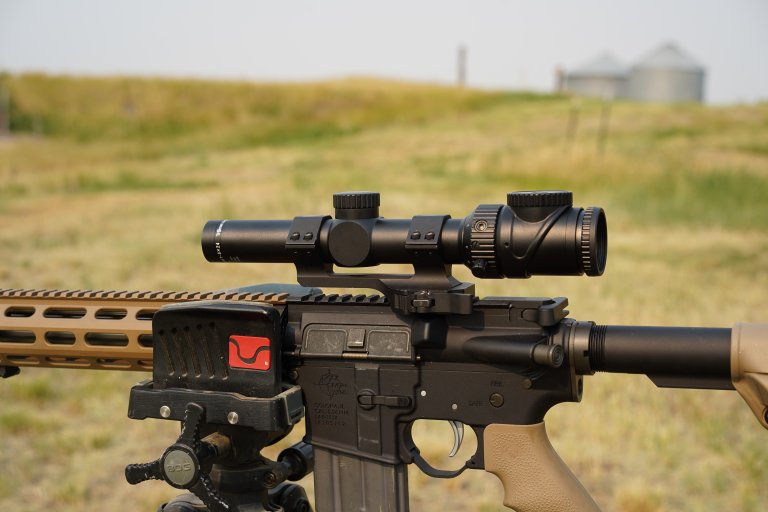
The latest incarnation of Trijicon’s legendary AccuPoint line, this durable LPVO is designed to withstand the recoil of big-bucking magnums. Its always-on illumination doesn’t require a battery to fire. Its balance, style, and grit befit a bespoke rifle that’s imagined as an heirloom but used as your ride-or-die hunting gun.
Instead of relying on a battery, the Trijicon’s illumination is activated by sunlight that hits the windows of a fiber-optic receptor and translates photons into intensity of a fine 0.25 MOA green dot at the intersection of a bold second focal-plane duplex reticle. In low-light situations, the element tritium does the work of the sun and supplies the energy to light up that aiming point.
It’s an elegant and durable system that’s optimized for this 1-8×24 build, which neatly fits every AR and straight-wall cartridge carbine made. The scope’s Dangerous Game BDC reticle in MOA is built for close-in and medium-range target work. The tough detail is its price, which is steep.
The excellent glass, tight but understated controls and tasteful lines elevate the Trijicon to a level of sophistication that most grubby LPVOs can’t reach.
Trijicon AccuPoint 1-8×24 Specs
- Magnification: 1-8-power
- Objective Lens: 24mm
- Tube Diameter: 30mm
- Light Transmission: Not provided
- Exit Pupil Diameter: 24-3mm
- Twilight Factor: 4.9-13.9
- Field of View: 120-13.1 feet at 100 yards
- Reticle Plane: Second
- Reticle Type: illuminated Dangerous Game Hunter Holds BDC
- Illumination: Infinitely adjustable depending on fiber-optic control
- Turret Click Values: ¼ MOA
- Total Internal Adjustment – Elevation: 100 MOA
- Total Internal Adjustment – Windage: 100 MOA
- Parallax Correction: Fixed at 100 yards
- Weight: 19.4 ounces
- Length: 11 inches
Best Affordable LPVO: Sig Sauer TANGO-MSR Compact 1-6×24 BDC6 Reticle
Pros
- Includes factory-mounted ALPHA-MSR mount
- Versatile dual-purpose reticle
- Daylight-bright illumination
- Throw lever enables fast mag changes
- Includes lay-flat lens caps
Cons
- Forgettable glass
- Stingy eyebox
Key Features
- 30mm tube
- 6-step red center-circle illumination
- Reticle has distance and windage holds out to 600 yards
- Lifetime warranty
- At just 8.4 inches long, extremely compact
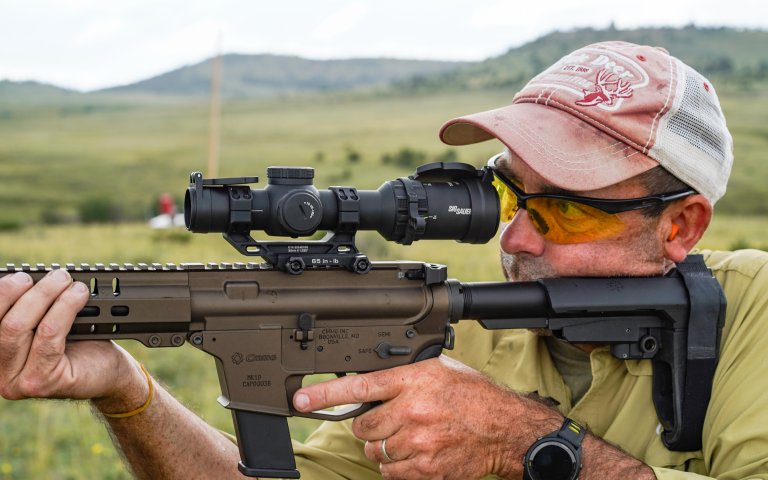
The TANGO-MSR Compact brings plenty of versatility in a package that measures 8.4 inches and comes pre-mounted on a very good cantilever unimount for the screaming price of $399.
The glass in this scope isn’t great, but everything else about this little marvel is spot-on. The second-plane arrangement in the TANGO-MSR is simple and useful. The inverted-horseshoe center aiming arrangement blazes bright in daylight conditions, and the BDC grid is useful for placing bullets with precision on targets out to 500 yards. The only real tradeoff is that the scope must be set at its highest magnification for the bullet-drop subtensions to be accurate.
We put the scope through a battery of close-range fast-fire drills, and atop an AR carbine, then we slowed things down and rang steel out to a quarter-mile with the scope. It performed admirably in all cases.
The TANGO-MSR is optimized for AR, but it would be great on a straight-wall cartridge carbine or muzzleloader.
Sig Sauer TANGO-MSR Compact 1-6×24 Specs
- Magnification: 1-6-power
- Objective Lens: 24mm
- Tube Diameter: 30mm
- Light Transmission: Not provided
- Exit Pupil Diameter: 24-4mm
- Twilight Factor: 4.9-12
- Field of View: 122.1-20.1 feet at 100 yards
- Reticle Plane: Second
- Reticle Type: BDC6 inverted horseshoe plus MOA aiming grid
- Turret Click Values: ½ MOA
- Adjustment Per Revolution: 44 MOA
- Total Internal Adjustment – Elevation: 80 MOA
- Total Internal Adjustment – Windage: 100 MOA
- Parallax Correction: Fixed at 100 yards
- Weight: 26.5 ounces with mount
- Length: 8.4 inches
More Great Deer Scopes to Consider
Vortex Crossfire HD 4-12×44
Pros
- Choice of three reticle designs
- 15-yards-to-infinity side parallax correction
- At about $250, an excellent value
- Rezeroable turret dials
Cons
- Reticle references valid at highest mag
- Forgettable glass
Key Features
- Capped turrets
- 1-inch tube
- Many reticle designs have elevation and windage holds
- Available in illuminated version
- Fully transferable lifetime warranty
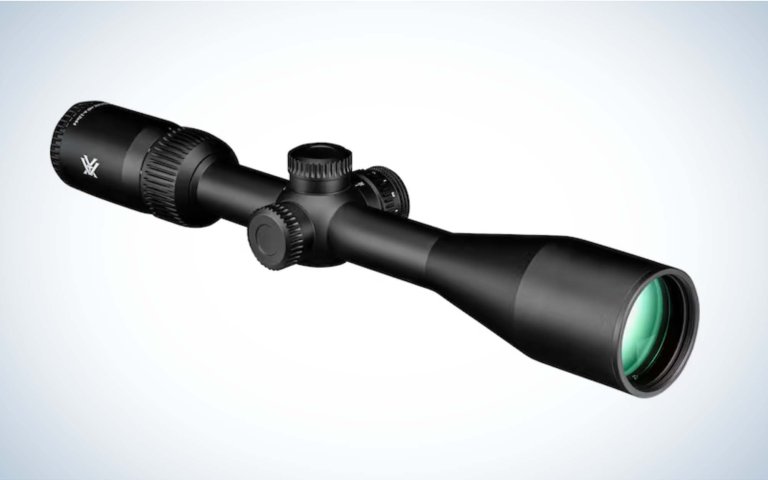
The Crossfire HD line, slowly replacing the Crossfire 2 line, has a scope for every hunter, from a handy LPVO to a big 6-18×50 model to this mid-mag optic that’s optimized for America’s deer hunters.
The 4-12×44 model is priced at only $300, and is an excellent budget option. It’s built on the second focal-plane arrangement and with MOA-based aiming points. There’s the classic Dead-Hold BDC that’s a non-illuminated plex design with three bullet-drop references and windage hashed. Or you can opt for an illuminated version of that reticle, with a pin-point illuminated center dot for a $50 upcharge. Or you can go old-school and use the Widerange Plex, which is basically a German #4 duplex without illumination.
The glass in the Crossfire HD line didn’t blow us away, but the magnification range is right in the sweet spot for whitetail hunters, and we found it to be an easy, simple, and budget workhorse.
“I think your average hunter would take this over the other $300 scopes in our test. It’s worth that price all day long,” noted Outdoor Life optics tester Todd Netto.
Vortex Crossfire HD 4-12×44
- Magnification: 4-12-power
- Objective Lens: 44mm
- Tube Diameter: 1-inch
- Light Transmission: Not provided
- Exit Pupil Diameter: 11mm to 3.7mm
- Twilight Factor: 13.3-23
- Field of View: 26.9-8.6 feet at 100 yards
- Reticle Plane: Second
- Reticle Type: Dead-Hold 2A BDC MOA (among others)
- Illumination: Yes, center dot. Some unilluminated models
- Turret Click Values: ¼ MOA
- Adjustment Per Revolution: 15 MOA
- Total Internal Adjustment – Elevation: 70 MOA
- Total Internal Adjustment – Windage: 70 MOA
- Parallax Correction: 15 yards to infinity
- Weight: 20.7 ounces
- Length: 13.4 inches
Zeiss V3 3.5-10×42
Pros
- Brand new design
- Exposed elevation turret with ballistic stop
- Hash-style
- Smart Hunting Reticle
- Optional precise center-dot 10-step illumination
- Impressive internal adjustment range
- Also available in capped turrets and plex reticle
Cons
- Reticle references are crowded
- Exposed elevation turret turns too easily
Key Features
- Parallax correction fixed at 150 yards
- Premium glass and coatings
- 5-turn revolution indicators
- Two-screw adjustment for ballistic stop
- Transferable limited lifetime warranty
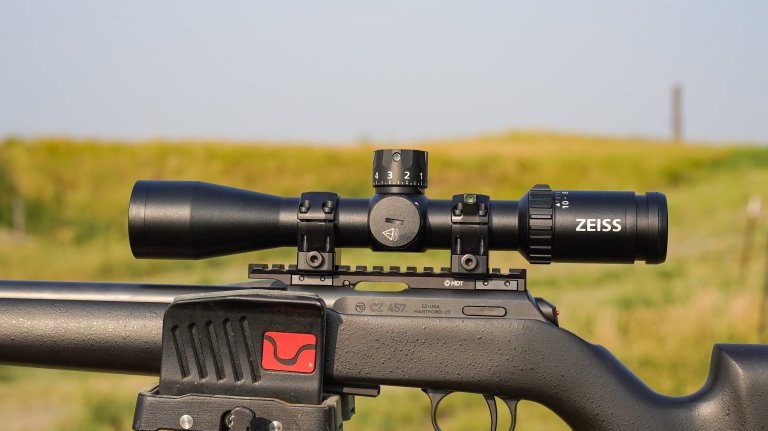
For $450, you get some great features and performance from the V3. It is offered in three versions of its second-plane reticle build, a non-illuminated No. 6 plex and both non-illuminated and center-dot illuminated versions of the SHR (it stands for Smart Hunting Reticle) hash-style design with MOA-based holdover and windage references. The illuminated version has a crisp center dot that shines with a red illumination.
Zeiss V3 3.5-10×42 Specs
- Magnification: 3.5-10-power
- Objective Lens: 42mm
- Tube Diameter: 30mm
- Light Transmission: 90 percent
- Exit Pupil Diameter: 11.7mm to 4.2mm
- Twilight Factor: 12-20.5
- Field of View: 34-11.8 feet at 100 yards
- Reticle Plane: Second
- Reticle Type: Illuminated SHR #87
- Illumination: yes, 10-step intensities
- Turret Click Values: ¼ MOA
- Adjustment Per Revolution: 10 MOA
- Total Internal Adjustment – Elevation: 100 MOA
- Total Internal Adjustment – Windage: 80 MOA
- Parallax Correction: Fixed at 150 yards
- Weight: 15.3 ounces w/ Ballistic Stop
- Length: 12.4 inches
Bushnell R5 4-12×40

Pros
- At around $250, extremely affordable
- Useful BDC-style reticle
- Versatile magnification range
Cons
- Finicky controls
Key Features
- Capped turrets
- 10-yards-to-infinity parallax correction
- Distance-informed windage holds
For a price-point scope, Bushnell’s R5 has some surprisingly sophisticated features. The most useful is its second focal-plane DOA-LRH800 reticle.
The modified tree-style reticle is extremely tunable, meaning that for shooters and hunters willing to invest the time, the Bushnell Ballistics app can produce customized drop tables for your specific load and magnification setting. Not too shabby for a $250 scope.
The R5 doesn’t have quite the smooth and confident controls of its big sibling, the R7 introduced earlier this year, but it’s a more responsive and precise build than most scopes in its price range. If you’re willing to spend a little more, consider the R7 line which won our 2026 Editor’s Choice award for best all-around hunting scope.
Bushnell R5 4-12×40 Specs
- Magnification: 4-12-power
- Objective Lens: 40mm
- Tube Diameter: 1-inch
- Light Transmission: 88 percent
- Exit Pupil Diameter: 10mm to 3.3mm
- Twilight Factor: 12.6-21.9
- Field of View: 27-9 feet at 100 yards
- Reticle Plane: Second
- Reticle Type: DOA-LRH800
- Illumination: Yes
- Turret Click Values: ¼ MOA
- Adjustment Per Revolution: 15 MOA
- Total Internal Adjustment – Elevation: 70 MOA
- Total Internal Adjustment – Windage: 70 MOA
- Parallax Correction: 10 yards to infinity
- Weight: 19.6 ounces
- Length: 12.4 inches
Maven CRS.1 3-12×40

Pros
- At just over 14 ounces, extremely light
- Basic, simple operation
- Useful simplified holdover reticle
- Very good glass
- At $425, priced right
Cons
- Limited utility
- Holdover references trued to highest magnification
Key Features
- Excellent C-Series Japanese glass
- Liberal mounting dimensions
- Very good field of view
- Enables low-profile mounting
This is a throwback deer scope in all the best ways. It’s hardy and durable. It’s simple and reliable.
The Maven brings a second focal-plane MOA-based reticle that’s clean and easy to see. The heart of the scope is the wire-frame CSHR-W reticle, which provides 20 MOA of windage references on the horizontal stadia at 10x, along with 20 MOA of elevation holdover. At $425, the Maven is priced in a sweet spot for deer hunters.
Maven CRS.1 3-12×40 Specs
- Magnification: 3-12-power
- Objective Lens: 40mm
- Tube Diameter: 1-inch
- Light Transmission: 88 percent
- Exit Pupil Diameter: 13.3mm to 3.3mm
- Twilight Factor: 10.95-20.91
- Field of View: 34-8.5 feet at 100 yards
- Reticle Plane: Second
- Reticle Type: CSHR-W
- Illumination: N/A
- Turret Click Values: ¼ MOA
- Adjustment Per Revolution: 18 MOA
- Total Internal Adjustment – Elevation: 50 MOA
- Total Internal Adjustment – Windage: 50 MOA
- Parallax Correction: Fixed at 100 yards
- Weight: 14.2 ounces
- Length: 12.4 inches
Athlon Talos HMR 1×24
Pros
- Purpose-built muzzleloader scope
- Fixed 1-power magnification
- Super simple operation
- Rezeroable turret dials
Cons
- Spongy turret action
- Limited utility with 1x magnification
Key Features
- Second focal-plane duplex reticle
- Center X design focuses eye on aiming point
- 30mm tube
- ½ MOA click values
- Fully transferable lifetime warranty
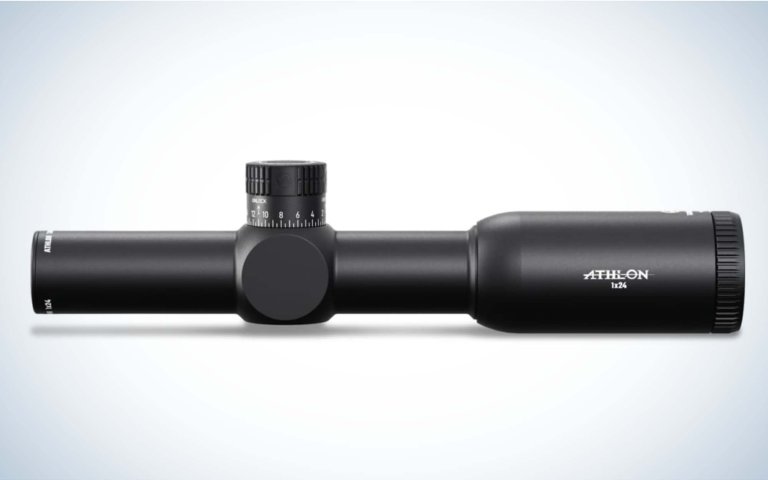
Sometimes you just need a simple, old-school optic for your deer gun. This stripped-down fixed-power scope from Athlon is designed for muzzleloaders, but it could just as easily work on a lever gun.
There’s remarkably little to say about this Talos HMR. Its 1x magnification is pretty solid, without the fishbowl distortion of some low-power scopes. The duplex reticle is proven. There are no illumination or parallax controls to worry about.
All that simplicity holds the Athlon back, of course. It’s not going to help you reach out beyond 300 yards to ring a steel target, and it’s not going to offer any windage or hold-over marks. But it should be durable and fast to target at shots at deer inside 100 yards.
Athlon Talos HMR 1×24 Specs
- Magnification: 1-power
- Objective Lens: 24mm
- Tube Diameter: 30mm
- Light Transmission: Not provided
- Exit Pupil Diameter: 24mm
- Twilight Factor: 4.9
- Field of View: 96.6 feet at 100 yards
- Reticle Plane: Second
- Reticle Type: Center X duplex
- Illumination: No
- Turret Click Values: ½ MOA
- Adjustment Per Revolution: 30 MOA
- Total Internal Adjustment – Elevation: 100 MOA
- Total Internal Adjustment – Windage: 100 MOA
- Parallax Correction: Fixed at 100 yards
- Weight: 11 ounces
- Length: 9.8 inches
Final Thoughts on the Best Rifle Scopes for Deer Hunting
Sure there might be brighter, more powerful, and more feature-rich scopes on the market. But those optics aren’t what most deer hunters want, or need. The best deer scope is functional, reliable, and simple. Hopefully, it’s affordable too. So that’s how we built this list of scopes. For more detailed coverage on how we conduct our riflescope testing, check out our reviews on the best LPVOs, Best Hunting Scopes, and Best Precision Rifle Scopes.
Best Riflescopes for Deer Hunting
- Best Value: Burris Fullfield 3-12×42 SFP Plex
- Best High End: Nightforce NX6 3-18X50 F1
- Best LPVO: Trijicon Accupoint 1-8X24
- Best Affordable LPVO: Sig Sauer TANGO-MSR Compact 1-6×24 BDC6 Reticle
More Great Scopes to Consider