We may earn revenue from the products available on this page and participate in affiliate programs. Learn More ›
Debating the merits of hunting rifle cartridges has been a hot topic for more than a hundred years. Magnum cartridges have maintained a strong following with the “bigger is better” crowd, but one of their biggest drawbacks has always been recoil. If you’re a fan of belted cases and large-diameter bullets at sizzling speeds, there’s never been a better time to be alive, because we have more practical tools for making these rifles easier to shoot than ever. For this story and video I set out to see just how much I could cut the recoil of my 10-pound 300 PRC.
What Recoil Does
Recoil is often talked about as a reason to avoid larger cartridges and embraced as a token of manhood. But before getting into how much modern muzzle devices can cut down the punishment your magnum dishes out, it will be helpful to break down what recoil does and how reducing it can improve your shooting.
The discussion around recoil is most widely viewed within the context of how each of us operates as a shooter. Most of us, myself included, grew up in a time when spotting your impacts was unheard of. Recoil management simply meant that you were grown up enough to fire a rifle without mangling your face with the scope or crumpling from the rifle’s kick. Many shooters still hold this perspective, and the whittling deacons of the shooting world are quick to denounce your manhood should you show interest in reduced recoil. A more informed perspective from that worldview is that you could fire a hard-kicking rifle without developing a flinch which, to some degree, is valid.
In a modern context, managing recoil does not mean tolerating or simply enduring it. We’re not on the school bus playing bloody knuckles. It means driving the gun and building positions that minimize its physical effects on your shooting position.
Mental Effects of Recoil: The Flinch
What most people call flinching from recoil is actually your brain telling your body to brace in anticipation of the recoil in order to counteract it. You know the shot is coming, the explosion of a muzzle blast and recoil into your shoulder, and your brain doesn’t like that. So just as you anticipate the shot, your body braces for impact. This is something that you develop through repetition and everyone is affected.
This issue often presents most substantially when hunters are shooting large magnums, but any rifle can slowly cause a shooter to start flinching — it’s just much easier to overcome with lighter-recoiling rifles. The bigger the explosion or disruption, the more difficult it is to mitigate.
Every shooter can get better at managing the mental effects of recoil, and Joel Turner, who started Shot IQ has also applied the science behind shot anticipation movements to archery. Ultimately, it takes purposeful practice to manage these effects.
Recoil’s Physical Effects: Sight Picture and Positional Disruption
The simplistic view of recoil as a measure of how bad it hurts your shoulder isn’t helpful to a shooter who wants to be more consistent, accurate, and efficient. Before the influence of precision field competition like NRL Hunter and PRS, there wasn’t much concern among hunters with maintaining a shooting position once the bullet left the muzzle. Most hunters would completely break position, look over the scope, and even bring the rifle down from their shoulder to chamber an additional round. Many still do. While that can be good enough to get the job done, modern practices have made lots of target-influenced shooters better riflemen and more effective at executing consistently precise shots.
A more useful way to view recoil is a measure of how much it disrupts your position and sight picture. We make a big fuss about the ability to spot impacts — something that never crossed grandpa’s mind. But shooters have learned that, like in plate matches, seeing the precise location of your bullet’s impact is a benefit for hunting. It helps you verify good hits, make corrections and follow-up shots if needed, and keep the animal in view. And anyone who’s hunted very long and says they haven’t had to make a follow-up shot or blindly fire a follow-up shot without knowing where they hit is a liar.
The second part of “spotting your impacts” that many overlook is that when you’re able to see your bullet’s hit, that means you have had minimal disruption to your position. The rifle’s recoil pushes on you and affects the relationship between your eye and the scope. When that gets out of alignment, you are “blown out” of the scope. Part of the equation is certainly building good positions, but under heavy or even moderate recoil, you can only do so much. Good shooting positions and recoil management aren’t exclusive to any cartridge, but they require lots of practice and repetition and are easier to master with less recoil, and less recoil will result in less disruption when your position isn’t perfect.
How Much Can You Cut Recoil?
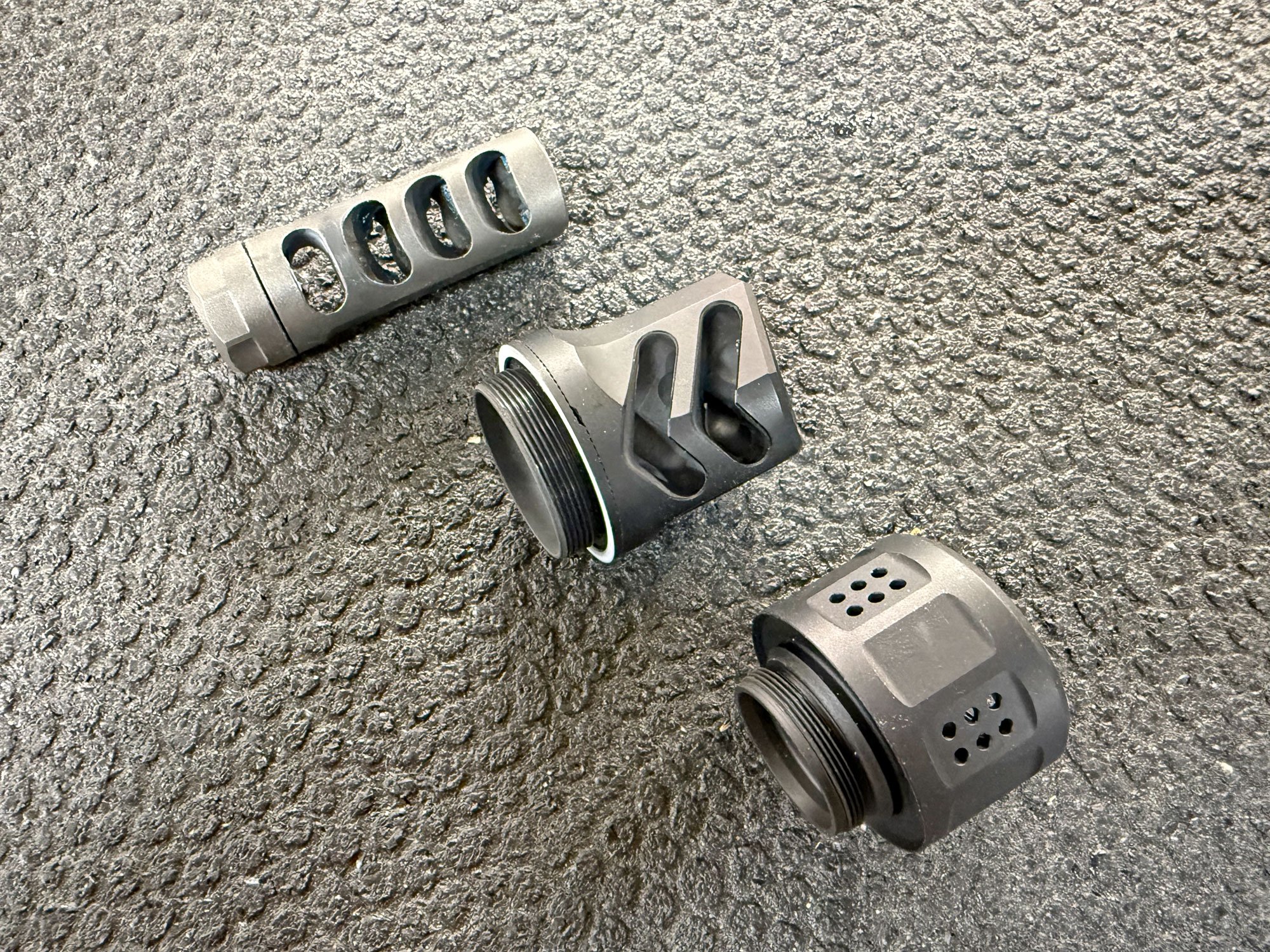
In the video, I used my 300 PRC to demonstrate the effects of shooting with a bare muzzle, a suppressor, two different endcap brakes, and a four-port muzzle brake. I filmed shots with a Triggercam to get an idea of how much the gun itself is moving, noting what I’m actually seeing through the scope. In the video footage, I was able to roughly measure the movement of the gun with each device. I also fired a follow-up shot drill to see how quickly I could get back on target and fire again.
I fired all shots from the same position, using a shooting bag on a large rock, at the same target, from approximately 350 yards. Since I was swapping muzzle devices, my zero shifted around, which happens any time you add or remove weight from the barrel. Because of this, I wasn’t too concerned about hitting the target. Rather, I wanted to see if I could actually spot my shots.
As you can see in the video, starting with a bare muzzle, the rifle has substantial recoil and I was blown completely out of the sight picture. Adding just a lightweight titanium suppressor cut the disruption down dramatically and I was able to see the dust fly shortly after impact. Adding a proprietary endcap brake cut recoil slightly more. A beefy aftermarket endcap brake made another incremental improvement, knocking the movement seen through the scope down nearly to what I recorded with my 22 ARC, but because of the rifle bumping me out of the scope, I still couldn’t quite see my impacts. Using a muzzle brake produced relatively equivalent recoil reduction to that of the aftermarket endcap brake and suppressor, but added the brain-rattling concussion and distracting dirt blown back in my face.
Read Next: Yes, a Suppressor Can Make Your Rifle More Accurate
Final Thoughts
Ultimately, whether you prefer magnums or not, it’s possible to make them much easier to shoot. While a muzzle brake is the most economical for just cutting recoil, it presents its own hazards. Adding a suppressor alone cuts the largest portion of recoil but also eliminates muzzle blast. Aftermarket suppressor endcap brakes are likely going to give you the best recoil reduction while eliminating concussion and gas blown back into your face. I’d recommend getting a suppressor first. Then, if you want even more recoil reduction, add an aftermarket endcap brake. If recoil reduction is your primary motivator, do some research and pick a suppressor with interchangeable front caps that are compatible with existing aftermarket brakes. If you like big cartridges, this will give you a better foundation to develop consistent, accurate shooting.