
We may earn revenue from the products available on this page and participate in affiliate programs. Learn More ›
THE .22/250 CARTRIDGE is right now just about the hottest thing in the field of varmint cartridges. Since Remington took the gamble and introduced it as a factory cartridge in 1965 and at the same time chambered the Model 700 and the 40XB match rifle for it, the cartridge has really taken off.
Remington was first under the wire with factory ammunition, but Browning, a firm known for keeping its ear to the ground and doing its best to interpret the vague snorts, gurgles, and rumblings of the consumer, brought out a .22/250 rifle in 1963 when the hot cartridge was still an untamed wildcat load.
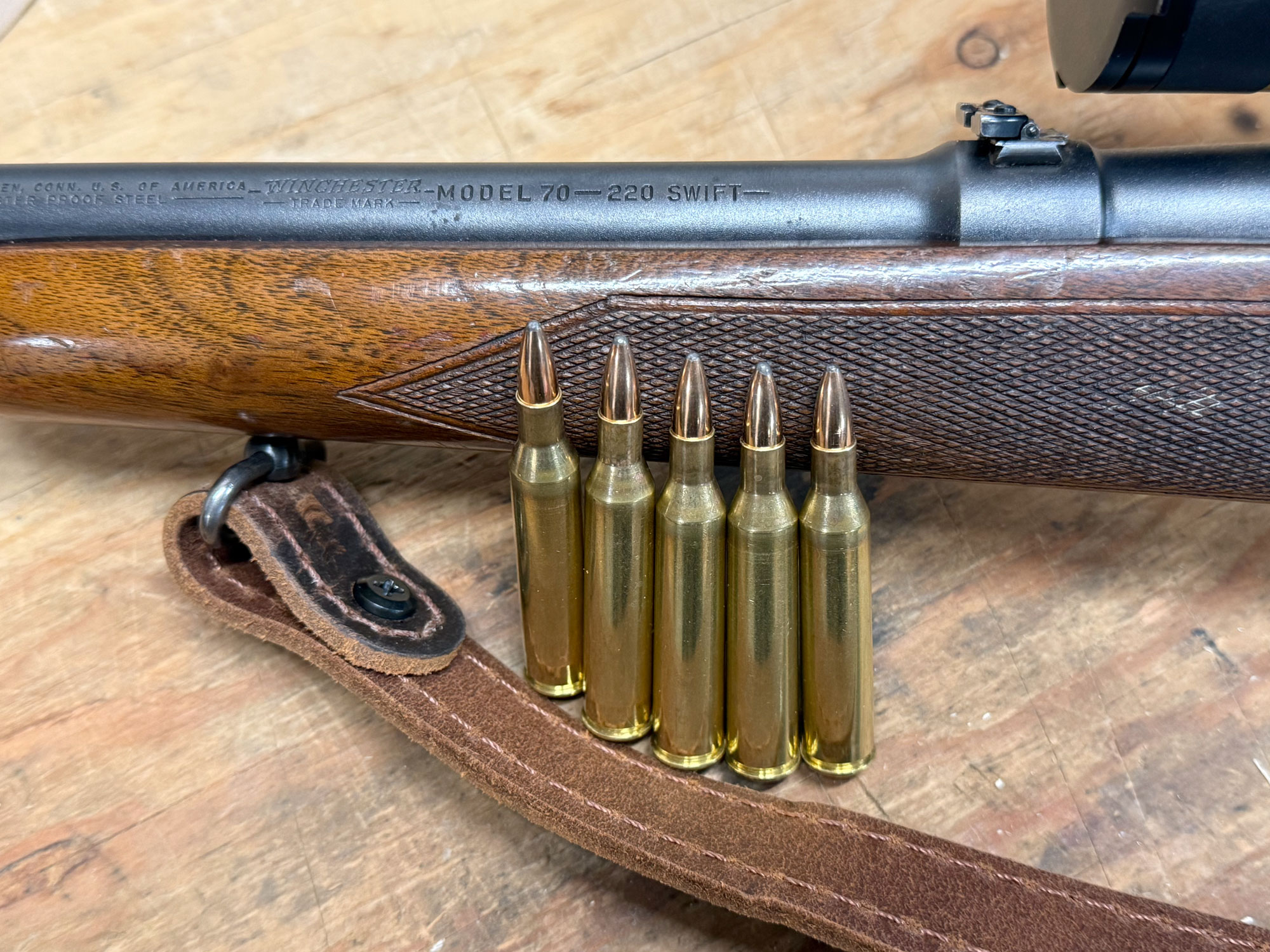
Right now both Winchester-Western and Remington-Peters load .22/250 ammunition. In addition to the rifles made by Remington, .22/250’s are turned out by Sturm, Ruger in the No. 1 single shot and the M/77 bolt action, by Winchester in the Model 70, the Model 770, and the Model 670, and in the Model 70 varmint model with factory-furnished scope blocks. Remington has now added a Model 778 in .22/250. Quite a slew of .22/250’s.
Like the girl next door who is a scrawny, freckle-faced lass with greasy pigtails at 11 but beautiful at 19, the little .22/250 was a late bloomer. Savage introduced the .250/3000 cartridge in 1915 and it quickly gained a reputation for fine accuracy even in light Model 99 Savage lever-action rifles and plenty of killing power for deer, black bear, sheep, and similar game. Just who was the first daring soul who necked down the .250 case to .22 I do not know. As far as I know someone may have taken a whirl at it as early as the 1920’s. But whoever he may have been, his name is probably lost to history.
I first heard of the cartridge back about 1935. A retired army officer and rifle-nut named Capt. Grosvenor Wotkyns had necked down the .250/3000 Savage case to .22, loaded it with the then-available .22 caliber jacketed bullets, and got very remarkable velocity and accuracy. He named this new cartridge the .22 Swift. He got Winchester interested in the cartridge, and eventually the Big Red outfit brought out a .220 Swift. But as it turned out all they used was the idea and the name.
The ultrahigh-velocity cartridge for which Winchester chambered the Model 54 rifle was based not on the .250 Savage case but on a considerably modified 6 mm Lee-Navy case. The case is semi-rimmed (meaning that the diameter of the rim is greater than that of the body forward of the extraction groove) but headspaces on the shoulder.
It used to be thought that considerable body taper facilitated extraction and a fairly gentle shoulder slope helped keep pressures within reason. The Swift case decreases .0419 in. in diameter from a point just forward of the extractor groove to the beginning of the 20° shoulder. By comparison the 7 mm. Remington case, an example of more modern design, tapers only .17 in. and has a 25° shoulder.
The shortcomings of this design were complicated by the fact that Winchester, for promotional purposes, wanted to get very high velocity with the Swift and really poured the coal to it. A prewar Winchester catalog shows a velocity of 3,720 f.p.s. with a 55-gr. bullet and 4,140 with a 48-gr. bullet. This last is the highest velocity ever obtained with a regularly loaded commercial cartridge.
Back in those innocent depression years of 1935, 1936, and 1937 the .220 Swift was the ringtailed wonder of the varmint-shooting and experimenting world. Enthusiastic Swift users wrote how they slew elk, moose, and grizzlies with those tiny, fast bullets so suddenly that the poor creatures never knew what hit them. Enthusiastic long-range shooters wrote of 400, 500, and 600-yd. kills on woodchucks.
The early history of the .220 Swift cartridge reminded me of the early years of a famous automobile that was a good deal faster than competitive makes when it appeared. The advertising laid great stress on speed, and as a consequence those who bought it felt that if they drove at less than 70 m.p.h. (in those days of 40-mile-an-hour roads) their best friends wouldn’t speak to them. The result was that they were always bumping off cows, slaughtering dogs, or wrapping those automobiles around trees with no good to the tree, themselves, or the reputation of the automobile. Because of this carnage there was dark talk of banning those crazy cars from the road.

More or less the same thing happened to the Swift. Most of those who bought it reloaded for it and almost all of them felt that if they used a load that would drive a bullet at less than 4,000 f.p.s. they would be penalized half the distance to the goal. Presently they discovered that those nice new 26-in. Swift barrels were showing a good deal of throat erosion and that in some cases accuracy was falling off. They also discovered that with all that fuel they were putting in those Swift cases the pressure it was generating was making the necks lengthen and thicken. In effect the whole case was flowing forward.
This is an ailment common to cases with gentle shoulder slopes when used at high pressures. I have seen .300 H. & H. Magnum cases with those long sloping shoulders stretch so much they eventually pulled themselves in two. As the brass flowed the necks thickened. This meant that the bullets were held with greater tension and pressures went up. Now and then a surprised Swift owner would find he was getting primer leaks and blown primers with loads he had thought all right. The Swift was always a hot cartridge loaded to about 54,000 p.s.i. Let the necks of the case thicken and lengthen and the pressure jumped way up yonder!
So the Swift started getting bad press—and it was bad press that finally killed it. The cartridge started out as a 9-Day Wonder. It ended up with everyone throwing stones at it. Some of the stuff written about the Swift was true. Much of it was not. Gun writers have a way of rewriting each other (which is a nice way of saying that they often steal each other’s stuff) and the untrue things about the Swift were repeated as often as the truth.
To cure the short-barrel-life problem, Winchester went to chrome-molly barrels and later to rustless steel barrels so corrosion-resistant that they could not be blued, instead had to be iron-plated. Then the iron plating was blued. Barrel life was better with chrome-molly, still better with the rustless barrels. Winchester also reduced those high pressures a bit, I believe.
One of the canards repeated by writer after writer was that the Swift was not accurate if it was operating at less than full throttle. Then when used at 55,000 p.s.i. necks lengthened and thickened. The customers grew weary of trimming and reaming the necks of the cases about every third shot. All in all the Swift about the time it had been on the market for three years or so began to get the bad press that finally did it in.
Read Next: Modern Bullets Can Turn the Old .220 Swift Into an Even Better Hunting Cartridge
Most of the boys were not smart enough to realize that all they had to do to cure the faults of the Swift was to stop trying to blow all those bullets along at over 4,000 f.p.s. I used a Swift for years with great satisfaction, with long barrel life and little case trouble. All I did was to throttle back a little, drive the bullets at 3,650–3,700 instead of 4,000—something like going 60 m.p.h. instead of 80.
At the same time that the gun writers were turning up their collective noses at the Swift, they were swooning into their beer over the original Swift—now known to fame as the .22 Varminter. Who invented that name for the .250/3000 case necked down to take a .224 bullet I do not know as it had been in use for two or three years when a Midwestern gunsmith named J. E. Gebby copyrighted it. He and a custom handloader named J. Bushnell Smith had a lot to do with making the cartridge popular.
This story was originally published in the July 1969 Issue of Outdoor Life.