
We may earn revenue from the products available on this page and participate in affiliate programs. Learn More ›
The best seller among shotguns in the United States is the 12 gauge pump gun with a 30-in. full-choke barrel. It is what the customers demand and, naturally, what the manufacturers supply. Such a gun is all right for deliberate pass-shooting at ducks at from 45 to 60 yd. And when fixed up with a special straight stock and ventilated rib, it is also a fine weapon for trapshooting.
But pass-shooting at ducks and trap shooting account for perhaps 10 percent of the shotgun shells expended annually in the U. S. The humble cottontail, which is usually found in the brush at ranges of around 20 or 25 yd.—and which zigs and zags through the cover like a mad thing—is the No. 1 shotgun target in this country. Then there are the bobwhite and several sorts of Western quail, John Pheasant, woodcock, grouse of various kinds, and what not. Even decoyed ducks are generally taken at from 25 to 35 yd.—and for that shooting the hunter needs a full-choke gun with 30-in. barrels about as much as he needs a 10-ton truck to take Susie to the movies. Then by accident I made a discovery. I had got my brand-new bride a little 20 gauge Ithaca double with 26-in. barrels. Came a day when she wasn’t feeling right pert. The vagrant notion to try her gun came over me, so I laced on a recoil pad to lengthen the stock and went out to a brushy spot where I knew several large coveys of quail hung out. In fact, I’d been bombarding them with my Model 12 Winchester pump, and its full-choke 30-in. barrel had little effect on them. To my astonishment I found I could hit them quite neatly with the 20. I could get on them before they ducked behind a bush, follow them and cut them down when they tried to zig. I made one run of five straight, something I’d never done before in my life. The larger the gauge, of course, the more a barrel can be opened up. A modified 12 gauge puts as many shot pellets into a 30-in. circle at 40 yd. as a full-choke 20, and a 12 patterning 40 percent (about Skeet No. 1) throws 1 1/4 oz. of shot into as dense a pattern as a 20 gauge bored modified does with 1 oz. of shot. The common belief that a 20 gauge throws a smaller pattern than a 12 of the same boring is erroneous. The 20 simply throws a thinner pattern.
We are a logical people—we think. We shake our heads in astonishment when told that the Hindus starve for protein while India is overrun by sacred cows. We chuckle at the quaint superstitions of the Navajo and Apache Indians, who refuse to eat wild turkey or trout. Yet we arm ourselves with smoothbores which, for 90 percent of our shooting, handicap us almost as much as if we went into the uplands with a 20-lb. weight tied to each foot.
How come? Why this strange fixation on long-barreled, slow-handling, full-choke guns?
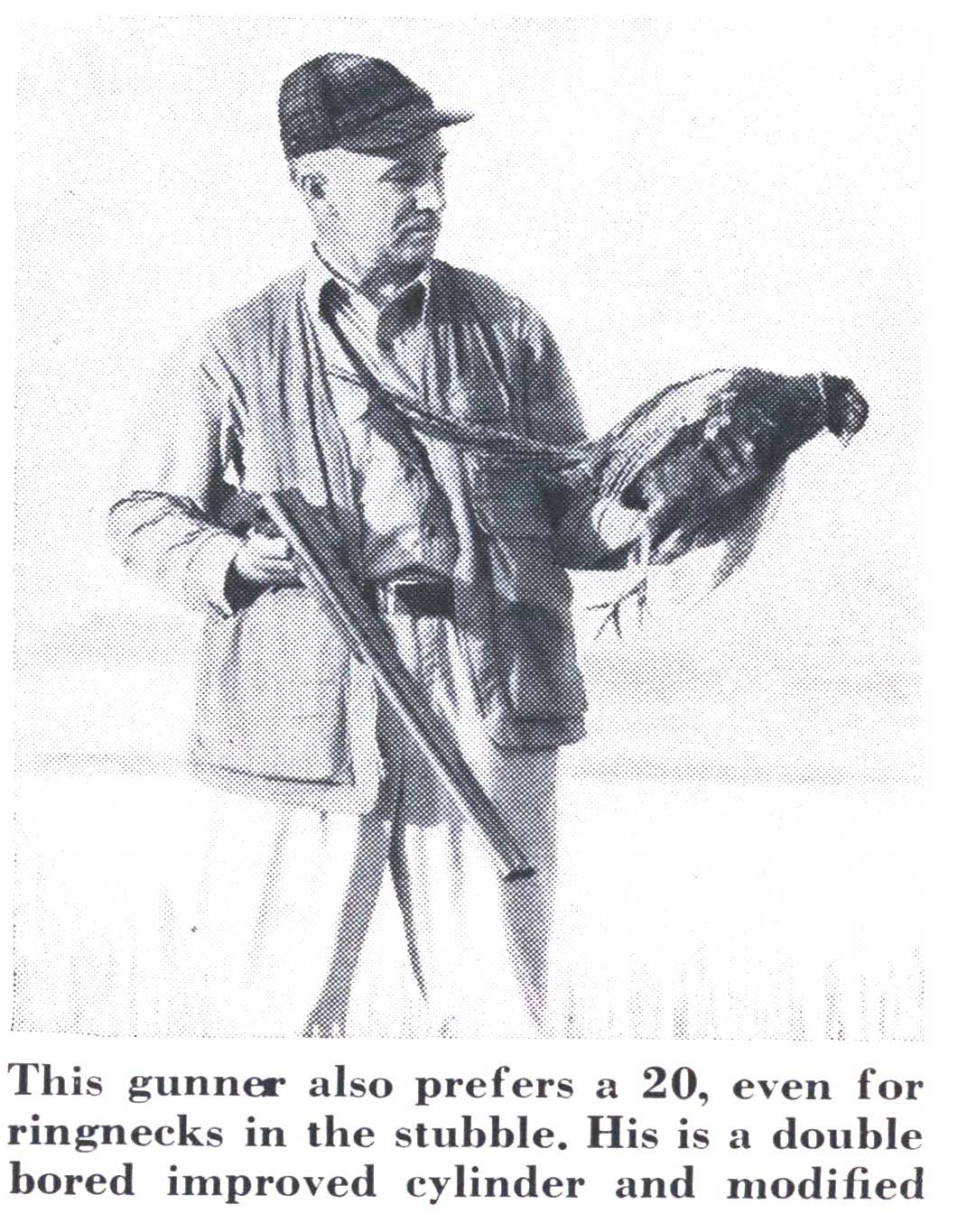
The average gunner is still sold on the ancient myth — a hangover from black-powder days—that the longer the barrel the “harder” a gun shoots. I get a stream of letters telling me about the marvelous ranging qualities of some fantastic old cannon or other, one with a 36 to 40-in. barrel, and described as the hardest-shooting gun in the community, capable of killing single ducks at 125 yd.
Actually the standard 12 gauge load —3 3/4 drams of powder and 1 1/8 oz. of shot—reaches maximum velocity in a 30-in. barrel. The maximum loads— containing 3 1/4 drams of progressive burning powder and 1 1/4 oz. of shot— reach maximum velocity in a 32-in. barrel.
But (and here’s the catch) velocity loss when a barrel is cut below maximum is only 6 ½ to 7 1/2 foot seconds for each inch amputated. The difference, then, between the velocity delivered by a clumsy, slow-handling 30-in. barrel and that of a fast-handling 26-in. barrel is only about 30 foot seconds—and there’s that much difference among shells from the same box fired in the same gun. A man could use a 30-in. barrel and a 26-in. barrel alternately until the cows came home and never discern any difference in killing power, penetration, or necessary lead.
Another myth that needs exploding is the commonly held belief that a long barrel will pattern better than a short one. Within practical limits barrel length has nothing whatsoever to do with pattern. Pattern is determined by the degree of constriction (choke) at the muzzle and by the construction of the shot shell itself. I have patterned many a gun with a 26-in. barrel that gave patterns running 75 percent or better.
There is nothing wrong with the long barrel for pass-shooting at waterfowl or for flight-shooting of doves. The long barrel tends to steady the swing and give more precise aim. However, the gun with the shorter barrel will do about as well if it is properly stocked and balanced. The momentum of the long-barreled, muzzle-heavy gun deters a man from slowing or stopping his swing prematurely, and probably that is its greatest virtue.
But despite the virtues of the longbarreled gun for special purposes (and even these are open to argument) it is a pretty sad instrument for most shooting. On the duck flyway the gunner sees his bird coming a long way off. He has time to make a mental calculation as to lead, to track his target, pass it with the gun swinging, and fire. The trapshooter knows where his bird is coming from. He has his gun mounted at his shoulder, his cheek on the comb. He has only to swing up with his target, get ahead of it, and shoot with the gun swinging.
On the other hand, the upland gunner usually doesn’t know exactly where his bird is coming from. He has to get on it fast and shoot fast. When a cock pheasant comes thrashing out of the brush behind him and heads for the trees, he has to get on it—now. He must be able to make a lightning-fast change of direction when a quail starts to curve around the tree or when a cottontail zigzags from one brush pile to another. For work of this sort the long-barreled gun is sluggish, unwieldy, and much too slow.
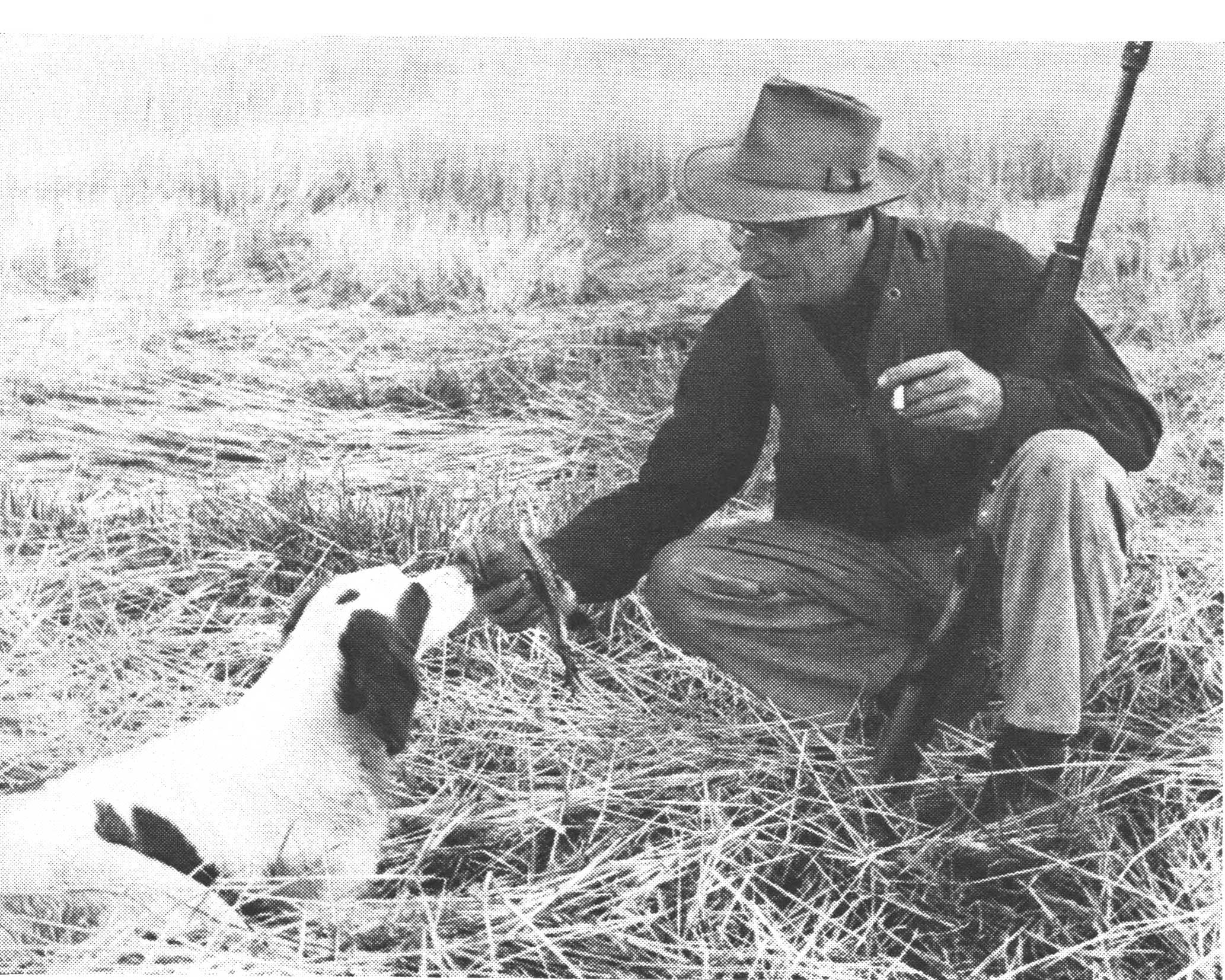
I grew up with such cannons. One of my first shotguns was a Winchester Model 97 pump with a 32-in. full-choke barrel. I was a rifle nut and I shot this ponderous old blunderbuss like a rifle. Give me plenty of time and something was liable to get hit. Doves flying innocently to roost or water, or ducks flying incautiously low, were my meat. But quail were something else. Where there was no brush and I could take my own sweet time, I wasn’t too bad. Complicate matters with some brush and trees, though, and I was sunk. I decided that for some mysterious reason I was just naturally attuned to doves and ducks, but that quail had my number.
Then a great light dawned upon me. Presently I discovered a sucker who had a 20 gauge L.C. Smith that weighed about 6 pounds. He told me he couldn’t hit anything with it because 20 gauge guns aren’t powerful enough—that it didn’t shoot hard because the barrels were too short. What he was looking for, he said, was a good old 12 gauge with a 30-in. fullchoke barrel. Trying to keep my eager voice from trembling, I asked him if he would swap for my 12 gauge pump and give me 10 bucks to boot. He would. I grabbed the 20 gauge and the sawbuck and ran. ( He couldn’t hit anything with the 12 gauge either. He simply could not shoot, but I didn’t tell him that.)
I’ve found it exceedingly important, in any upland hunting I’ve ever done, to have a fairly light gun. It’s also important that it be rather short of barrel, for a light, short gun handles fast. I know of nothing that weighs more than an extra pound—or even half a pound— in a shotgun. I have a fine pair of Winchester Model 21 doubles—a 12 gauge and a 16. Each has 26-in. barrels and stocks are exactly the same. The 12 weighs 7.2 lb.; the 16, 7 lb. The 16 seems much lighter than the 12. I often ask visitors to heft the two guns and estimate the difference in weight. Guesses run from 1 to 3 lb.
The duck hunter can sit in his blind and wait for the ducks to come into the decoys. Trap and skeet shooters have only to lug their guns from the clubhouse to the firing line. The upland gunner, though, must carry his shotgun many miles in the course of a hunt. When I hunted desert quail in Arizona, I’d walk from 10 to 20 miles during the day. A grouse shooter from New England tells me he probably walks 3 miles for every shot he gets at a ruffed grouse. In Idaho and Washington I have on occasion shot the limit of three cock pheasants after walking only a few hundred yards, but far more often I’ve climbed and walked for miles.
The heavier the gun, the wearier the hunter. For upland hunting that requires a lot of hiking a gun weighing 7.2 lb. is about as much as anyone should carry. One of 7 lb. is better, and he who latches onto a 6-lb. gun is lucky —if the gun throws enough shot and if he’s used to it.
The short-barreled gun is livelier, faster-handling, and quicker-pointing than the long-barreled one. To me a double with 26-in. barrels is exactly right. The weight is between the hands and the gun comes up fast. For upland hunting even a pair of 28-in. barrels on a double seems a bit sluggish.
I do most of my skeet shooting with a Remington Model 11-48 automatic with ventilated rib and a 26-in. barrel. It swings smoothly and beautifully, and I can break two or three more targets out of each 100 (or so I tell myself) than I can with any double. But the skeet shot knows when his bird is coming out, where it is going. Before he shoots, his feet are in position. And before he calls for the target, he does about 75 percent of the job of mounting his gun.
The overall length of my 11-48 is just under 46 inches, while the overall length of my doubles is 43. For upland shooting, that fine Remington has just 3 in. too much barrel on it. For most field shooting I can do about as well with it as I can with a double, but on the tough snapshots—when a quail is zipping behind a bush or a big rooster is about to get over a ridge— I’m a little behind with it. With the shorter, handier double I’d have my bird centered.
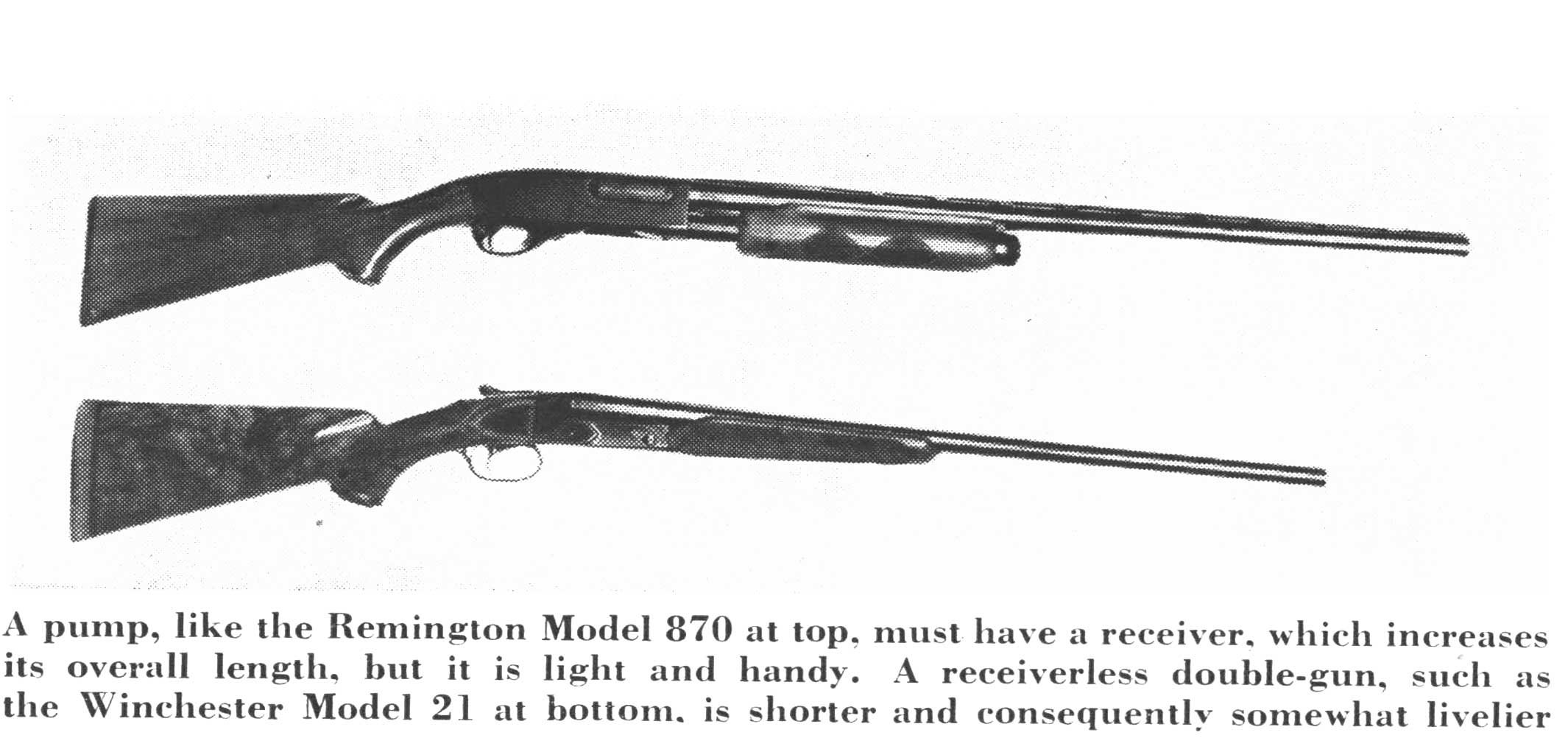
The difference lies, of course, in the receiver of the automatic, something which the double does not have. Stick a barrel of even moderate length on the end of a long receiver and your gun is overlong. For another Remington automatic, a little 20 gauge, I have two barrels—one 26 in. long and bored for skeet, the other 28 in. and bored modified. I’m going to have a variable-choke device put on the modified barrel to give an overall length of 23 in. Then I’ll really have an upland gun.
A short barrel often has a good deal of muzzle blast. The hunter next to it in a duck blind wouldn’t love the man shooting it, and at traps the shooters to the right and left would cry out bitterly. But that is no skin off the nose of the upland gunner, who does not shoot cheek by jowl with anyone else.
How should the upland gun be bored? That depends. The man who hunts grouse in heavy timber or bobwhite quail in the brush or follows the elusive cottontail—that man needs as wide a pattern as he can get. Skeet boring, which will usually cover from 28 to 32 in. at 25 yd., is about right for fast, short-range shooting. It’s also good for anyone with enough self-control not to shoot at over 30 yd. or so. It is no good at all for the man who shoots at everything that gets up, because beyond 30 yd. a lot of birds will get away wounded, even though they’ve been fairly centered.
Read Next: Best Over/Under Shotguns
It is routine to recommend improved cylinder boring for upland game, but the term covers a multitude of patterns. To one manufacturer, an improved-cylinder barrel is one that patterns 35-40 percent. To another it’s one that patterns 50 percent. With the new shells with wadless crimps and gasproof overpowder wads, many guns marked improved cylinder pattern from 55 to 65 and sometimes 70 percent. As a rule, guns bored improved cylinder on the continent but used with the latest American ammunition won’t miss modified patterns by much.
Read Next: Best Shotguns for Bird Hunting
One American improved-cylinder gun patterns consistently from 50 to 55 percent; another covers as much area at 25 yd. as its maker’s Skeet No. 1 barrels. But at short ranges this particular improved cylinder throws a pattern with a denser center that carries out farther and gives clean kills at ranges where the Skeet No. 1 boring would only feather.
The sloppy gun pointer in the uplands should use a wide-open bore and not shoot beyond its range. The sharp gun pointer can use more constriction and tighter, smaller patterns. Probably the ideal, all-round upland boring is one that gives 50 percent patterns at 40 yd. It’s easier to hit with such patterns at short ranges than with full-choke patterns, yet they’ll reach out and kill to 40 yd.—which is long range in the uplands. This 50 percent pattern is called quarter choke because in a 12 gauge it is often reached with a constriction of only 10 points (.010 in.), whereas in the old days 40 points’ constriction was considered necessary for full-choke performance. Very often this ideal 50 percent pattern is reached with barrels marked improved cylinder, sometimes with barrels marked modified. Actually, it is about the best all-round boring for the sporadic shooter, since most gunners do not have the skill to hit regularly at over 40 yd. anyway.
For my part, I do more shooting with a double-gun bored modified and improved modified (60 and 68 percent) than with anything else. I like to reach out and knock down the occasional wild pheasant that runs ahead of a dog and gets up at 35 or 40 yd. Modified will nail them! Actually, though, 90 percent of all upland game is killed within 30 yd., and for that you want skeet or improved-cylinder boring.
The 12 gauge gun tends to be a bit on the heavy side to be ideal for upland shooting, even if it’s a modern repeater with light alloy steel and dural receiver. My Remington Model 11-48 skeet gun weighs 7 3/4 lb., for example. A Remington Model 870 pump-action skeet gun in the rack weighs slightly less, 7 /12 lb., which is what my 12 gauge Winchester Model 21 double weighs. A Remington Model 11-48 skeet gun in 20 gauge with ventilated rib and 26-in. barrel weighs 7 lb. on the button.
The 20 gauge, on the other hand, is a weapon only for the expert upland gunner, since it cannot be opened up quite as much as the larger gauges and requires sharper pointing. Bored quarter choke and improved modified, or even modified and full, it is a delightful and deadly weapon with 1 oz. of shot.
I have a low-down, sneaking hunch that the queen of the upland guns is the 16 gauge, the gun that performs like a 12 and kicks and carries like a 20. About as near a thing to an ideal allround gun that I can imagine is a 7lb. 16 gauge bored quarter choke and modified—or, if a man is a pretty sharp pointer, even modified and full. Don’t let anyone tell you that a 16 bored modified is much behind a modified 12 in range; it isn’t. I have killed many pheasants at 45 yd. with a modified 16— and they didn’t move an inch when they hit the ground. I have killed plenty of ducks at 50-55 yd. with full-choke 16’s. The last two roosters I shot were a double. Four came boiling out of a brushy draw. I made a right and a left and the birds fell 43 and 48 yd. from the gun.
The .410 and 28 gauges are like the 20, but more so; they simply cannot be opened up enough. I have shot a lot of grouse with a .410 and I have broken some pretty fair skeet scores with a 28, but neither is an ideal upland gun by any means. For my money the 16 is tops, the 20 next, and the 12 excellent if you don’t mind extra weight.
Just as the upland gunner does not need full choke, neither does he need maximum loads, particularly in a 12 gauge. I like 1 oz. of shot in the 16, 1 1/8 oz. in the 12. Only in the 20 do I use maximum loads. The ordinary trap load in either 12 or 16 gauge is one of the deadliest upland-game loads known to man.
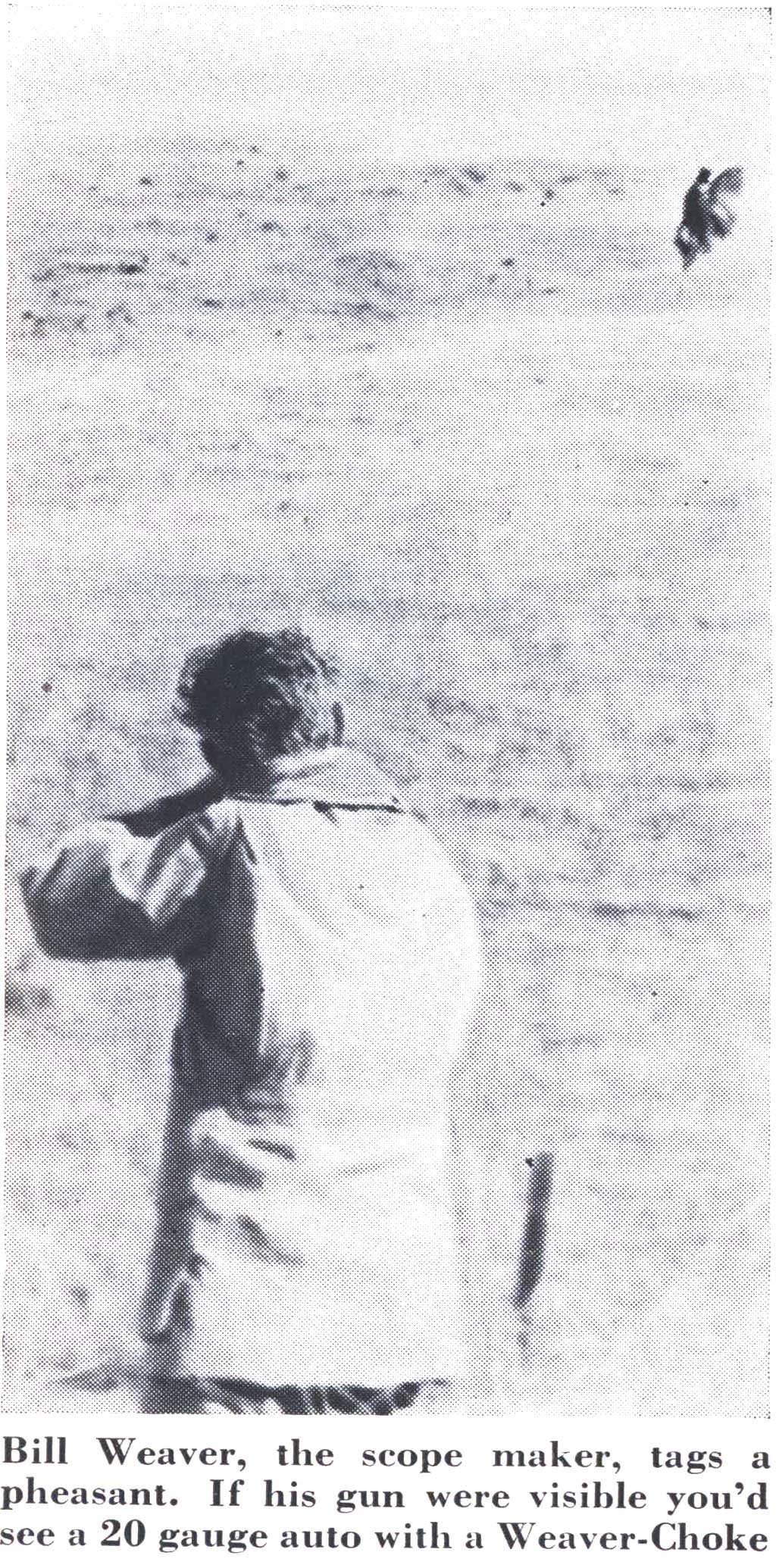
Since most upland birds are raising targets, the ideal gun would be stocked so that it tended to throw its charges a bit high. When shot at, quail are usually rising; so are Hungarian partridges. Pheasants bounce up faster and higher than anything else, and I believe that most flushing pheasants that are missed are undershot. If the gun centers its pattern from 6 in. to 1 ft. high at 40 yd. when it is thrown up and fired at a mark instead of being deliberately aimed, it is shooting about right for the uplands.
I like my own guns to be so stocked that I can look right along the rib at the mark when my cheek is pressed firmly against the comb. When I’m in the field I pay more attention to the bird than to the barrel, cheek my stock less firmly, see more barrel, and the pattern goes a bit higher.
For me a drop at comb of ½ in. is just right, and I like a drop at heel of 2 – 2 1/2 in. on a field gun. The short-barreled, muzzle-light gun tends to shoot a bit high. So does the gun with the straight grip. Just as the worst sin of the duck hunter is shooting behind his birds, the great fault of the upland gunner is shooting under them.
A light, short-barreled straightstocked gun bored fairly open is the medicine for upland game. Such a gun does not point itself but it comes on the mark so quickly and easily that it almost seems to. No one can do his best work in the uplands with anything else.