
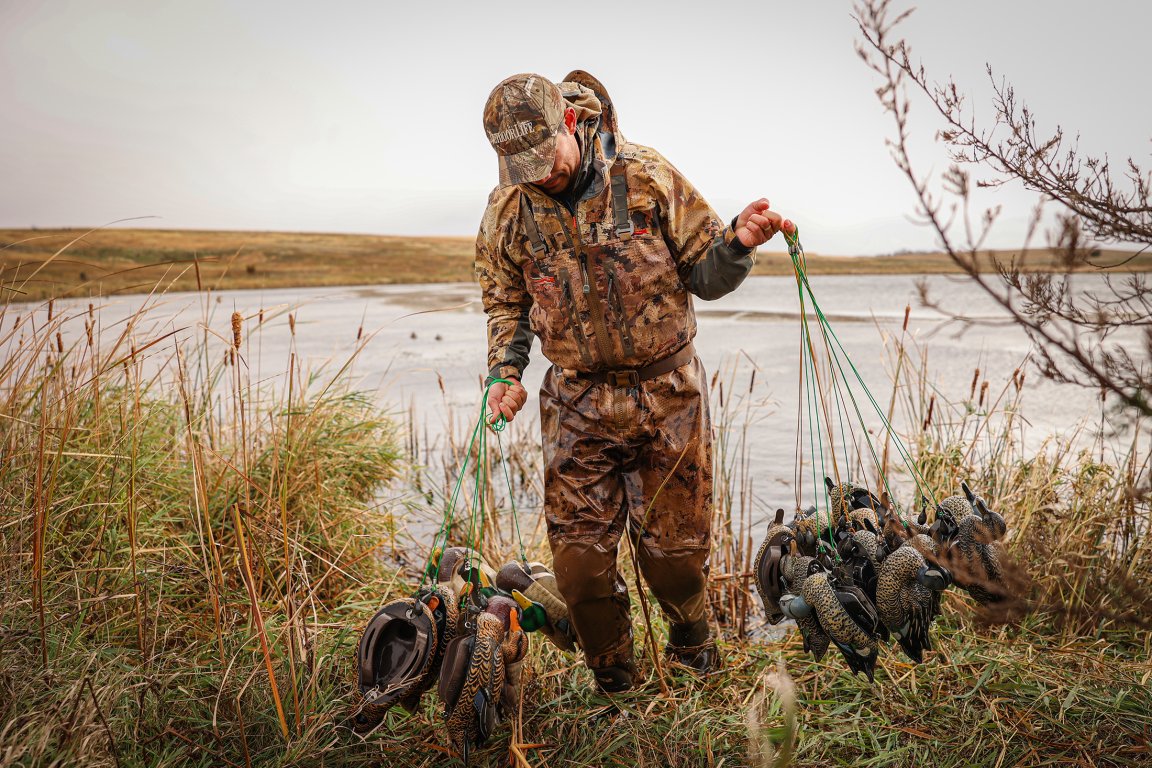
The way some hunters talk, you’d think good waterfowl hunting was a thing of the past. Sure, it was great 25 years ago. You could pick almost any field or pothole and shoot a limit of ducks. But millions of ducks and geese still sweep the flyways each fall, and a determined hunter can find good shooting. It’s just that you have to hunt the hard places.
That’s my name for spots that teem with ducks and geese but rarely see a hunter. Sometimes these areas demand too much effort, but more often hard places are open expanses that offer a hunter no place to hide. Pastures, the favorite haunts of Canada geese, are one example. How can you blind on a pasture as flat as a billiard table? A flooded field also is a problem. Hunters line the dikes of flooded stubblefields like fence posts, but few of them head for the middle because there’s no place to hide. The potential for open-water hunting on lakes, reservoirs, and bays, where waterfowl raft by the thousands, has hardly been touched. The windswept expanses of open ice where geese frequently rest has great possibilities too. In some parts of the United States a person has little choice about where to hunt. But in many regions, particularly in the prairie and Western states, hard places with excellent hunting abound.
Most hunters credit ducks and geese with too much intelligence. Some waterfowlers would have you believe that the Canada goose, for example, is second cousin to Einstein. That image of brilliance is ridiculous. Geese and other birds are smart just as dogs are smart. To teach a dog to sit, you push his rear down and say, “Sit!” After a few lessons he’ll sit when you give the command. Waterfowl learn similarly. On heavily hunted lands waterfowl avoid cover because they’ve learned that’s where the shots come from.
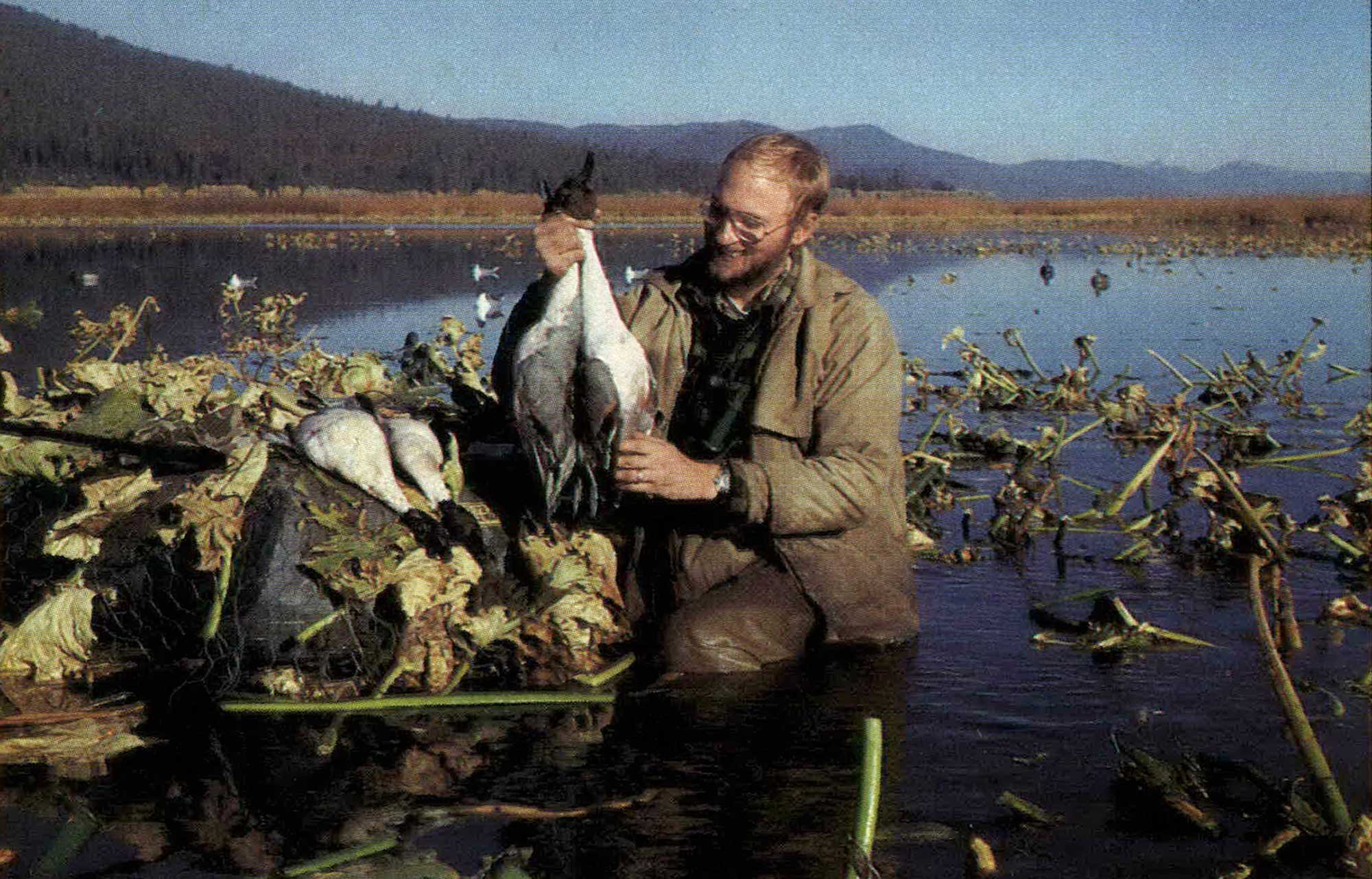
In much open country they’ve had no such conditioning. No one has shot at them, so ducks fall over themselves to land in decoys placed far from cover. In the hard places, waterfowl aren’t conditioned to be cautious. That is the basis for good bird hunting. It also accounts for the fact that you don’t need much of a blind in the open. Hunting hard places is more a matter of philosophy than of technique. Once you’ve decided to hunt a hard place you’ve cleared a major hurdle. Then you just get out there and start hunting. To show how simple it is, I’ll tell you about some ways my friends and I have hunted the hard places.
I usually don’t use a blind. In my part of Oregon, Canada geese spend a lot of time feeding and resting on pastures, and most ranchers don’t want their sod dug up for blinds. A blind above ground also is about as conspicuous as a high-rise apartment building. The only option is no blind. So you just lie on the ground.
Any hunter knows movement really spooks waterfowl, so being able to disguise yourself as a frozen clump of mud is the big step in making this work. I usually clump a few goose decoys around my body and put one in front of my face. The oversize shell decoys made today are especially good for this kind of hunting. A friend of mine has made silhouette decoys that are so large he can curl up behind one. In late season, when swans are present, I’ve used large swan silhouettes among my duck and goose decoys. This technique has worked especially well on ice, when I’ve worn a white suit and lain behind a swan silhouette.
Put your decoys as far from ditches and weed patches as you can. Set up where birds don’t expect danger. Look for small depressions, places where the grass is lumpy, or pressure ridges on the ice so you can hide. Even a slight variation will make you less obvious. And wear clothing that looks like the ground. The obvious choice after a snowfall would be to wear a white suit or to cover yourself over with a sheet. When the cover is green, pull a square of green camouflage cloth over yourself. Some of the pastures I’ve hunted in are muddy. My hunting coat is so impregnated with dirt it looks like part of the ground, so I often don’t cover myself with anything. An occasional roll in the mud keeps the blind fresh.
On windy days this simple approach is almost foolproof. The birds fly low and come directly in from the downwind side. Obviously you want to lie on the upwind side of a decoy. On calm days when waterfowl fly higher and sometimes circle, it’s not as easy, especially if you gawk at them.
In my region farmers flood their grainfields after harvest. Flooded fields draw ducks the way a candy store draws kids. For years I pondered the featureless expanses of water and mud, trying to figure out how I’d get out there without sinking out of sight forever. Then it struck me—an air mattress. Along with a huge bag of floating decoys, I dragged a well-inflated canvas air mattress into a partly flooded field. With the decoys downwind, I flopped the mattress on a clump of mud and lay on it, face up, and pulled a piece of camouflage cloth over me. Ducks and geese nearly landed on me. An air mattress will do the trick in any soggy spot where you can anchor it to some ground. But don’t try it in deep water.
A rubber raft is best for deep water. I use a two-man, rubberized, olive drab canvas raft. You can find these at big sports stores or surplus stores.
The raft can be dragged or carried to any location, and it often serves where a rigid, heavy duckboat won’t. I’ve used it in the same fields I used to hunt with an air mattress. It also works well in marshes where only a few inches of grass show above the surface of the water. I got this idea from watching a hunter one day in a flooded stubblefield. He had a low-profile boat, which he covered with chicken wire. He tied stubble all over the wire, then crawled under it into the boat. His simple blind looked like a mat of straw lying on the water. Ducks swarmed into his decoys as if he weren’t there.
From that example I made a chicken-wire cover for my raft, with a flap cut out of the middle so I could sit up and have an area to shoot through. I tied short pieces of decoy line on the chicken wire and used these to tie grass, stubble, lily pads, and other appropriate plants to the wire. In addition, I cut a floor for the raft made of 3/8-inch plywood. With some spar varnish for weatherproofing and a strip of outdoor carpet stapled around the floor’s edge to keep it from chafing the raft, I had a rigid bottom that made the raft stable. I can sit, kneel, or stand in it without much wobbling.
Another item that could be used in the same way as the rubber raft is a float tube, or belly boat. While these are made for fishing small waters, they’re well suited to hunting. I recently got one with a camouflage cover, and it looks like part of the marsh. With a chicken-wire cone covered with tules, it would look just like a muskrat house.
If the water is too shallow to use a float tube in the conventional manner—with your legs dangling in the water—you can use it as a shooting platform. One friend, Dave Hummel, did something similar with a tire inner tube. Dave saw lots of pintails on big marsh ponds. Those educated birds weren’t about to land within shooting range of the tule fringes, where a hunter could hide. They stuck to the middle of the huge ponds, where the only cover was a few patches of lily pads that stuck up a few inches above the water. There was no way to blind a boat out there, and a person couldn’t lie down in the foot-deep water. So Dave wired a round piece of plywood to the top of an inner tube. To hunt those smart pintails he threw his decoys onto the open water and put his inner tube table in the lily pads. He laid his gun and shells on the platform and camouflaged it with lily pads. Dressed in chest waders he was able to kneel behind it. To hide from circling ducks, he put his face down on the platform. When ducks were within range, he rose on his knees to shoot. Tough shooting? Yes. But it was the only way to get within range of those ducks, and Dave got his share of them.
I recently fished with a fellow who had a “boat” called a Bass Tracker Bantam. It’s a flat plastic hull about five feet long made for poking around backwaters for bass. It’s very stable and rises no more than six inches from the water. It looks to me like an ideal piece of equipment for hard-place hunting.
Read Next: The Best Duck Decoys
Another friend hunted from shallow water by using a piece of heavy brown plastic. The water, matted with weeds, was only three or four inches deep. He laid a 12×12-foot square of plastic on the water and jumped into the middle of it. The weeds held up the edges of the plastic to keep water out and he was able to lie down to hide from ducks without getting wet.
Open water may be the extreme example of a hard place to hunt. These days, with many huge reservoirs next to croplands, lots of ducks and geese rest on wide water. A sink box is the answer, but sink boxes are illegal. The next best thing is a low-profile boat. You can’t hide such a boat so you try to make it look like floating debris. My friend David Hagerbaumer hunts extensively on open bays along the Pacific Coast. He uses a Barnegat sneakbox, a flat boat that looks like a miniature hydroplane. Dave has a net for the boat that camouflages it, and he puts seagull decoys on the decks. On open water the boat just looks like a piece of flotsam drifting on the bay. Dave lies on his back in the boat, facing his decoys, which are downwind. This rig works well on diving ducks, and Dave often takes puddle ducks and brant while hunting from it too.
On an incoming tide, puddle ducks often work the shores of estuaries to feed on the flooding beaches and tidal marshlands. That’s when Dave hunts the edges, and he camouflages his boat by tying grass to the net covering, or by shoveling mud clumps onto the decks.
Dave has another rig, called an alligator, that should really do the job for you on mudflats or beaches. These are no longer available commercially, but you could easily make your own. The alligator is a fiberglass coffin, shaped like a mummy with an oblong hole cut out of one side. You drag it out to where you want to hunt, dig a hole, and bury the thing, except for the opening. Then you crawl in, lie on your back, and face up through the hole. It’s no more than a way to stay dry while hiding in a soggy place, but that’s all you need in the hard places.
Hunting hard places can be a little wet and dirty. A rugged, heavy pair of chest waders and a canvas coat that can withstand abuse are necessities. The right gun also is important. Guns get muddy in hard places, and most autoloaders I’ve used turn into single shots under these conditions. A pump gun is OK because you can grind shells through even if the gun does take on a load of grime, but the best choice is a double barrel, which is nearly impervious to dirt. Invariably in hard places you must shoot lying on your back, sitting, or from your knees. Your feet may be stuck in the mud, and you’ll feel like you’re caught in a spiderweb when you start trying to shoot through a chicken-wire cover. Add to that a good stiff breeze, which ducks can use to get quickly out of range, and you have a shooting challenge. A good idea is to practice shooting claybirds from awkward positions, also lie down and practice throwing your gun to your shoulder and swinging it. You may want to learn to shoot both right and left-handed so you can handle ducks coming in from both sides.
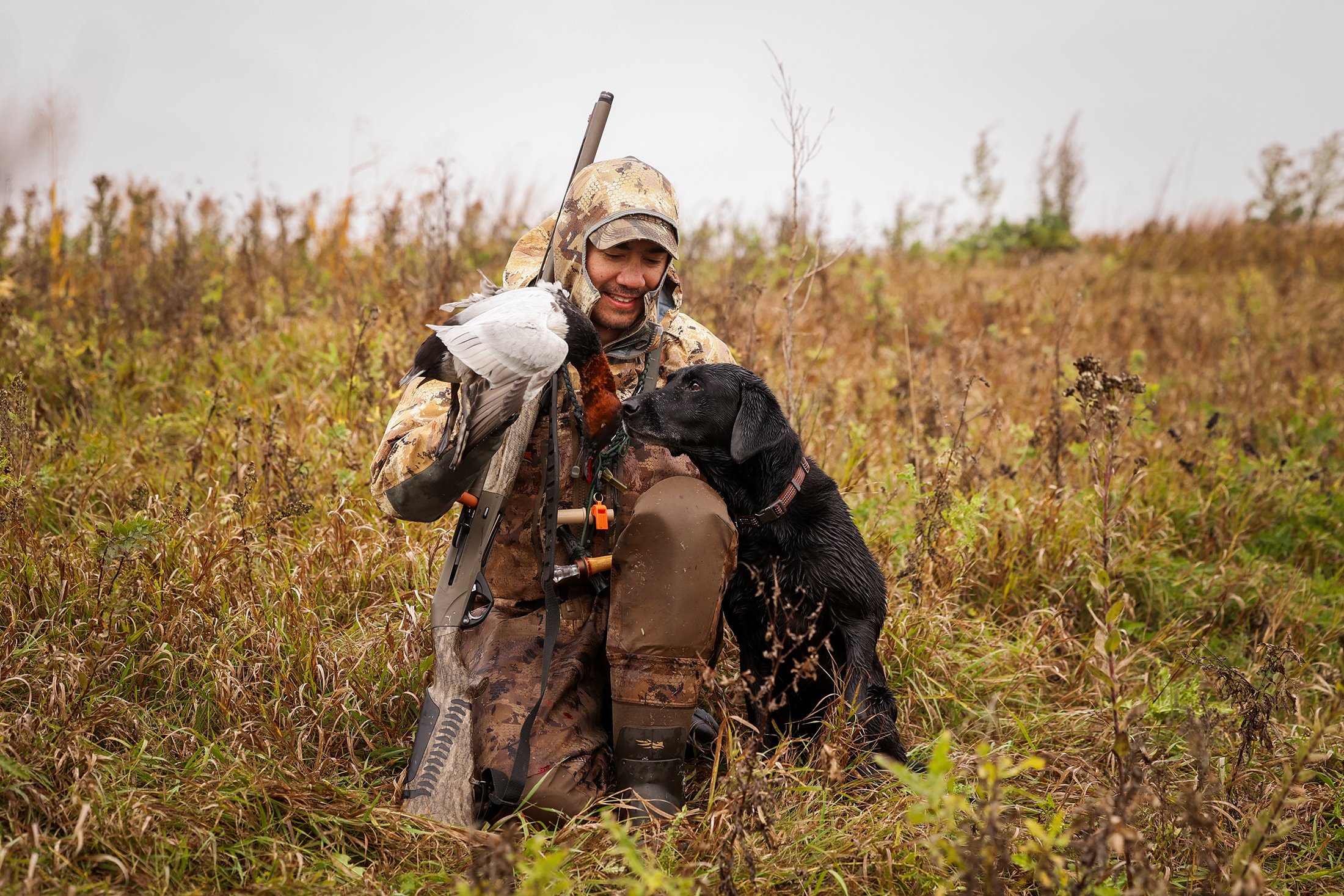
Hard places generally call for big decoy spreads. In open expanses, ducks in particular congregate in huge swarms. I can pile about five dozen inflatable ducks on my rubber raft so that’s about my maximum, but more decoys would be even better.
The last day of the season a couple of years ago typifies hard-place hunting. Ducks were streaming into a flooded stubblefield and hunters lined the dikes around the field. I waded out to the middle, found a small patch of mud to lie on, and threw out some decoys. Mallards broke their necks to get into that spread. But the mud was sticky and the wind was howling. By the time I could sit up to shoot, the ducks usually had flared to long range. The one box of shells in my pocket accounted for only four mallards and a honker. But it was an unforgettable afternoon of duck hunting. While hunters pass-shooting from the dikes only took an occasional high bird, I was at the center of a swarming, teeming mass of ducks.
Read Next: Duck Hunting’s New Reality: It Will Keep Getting Tougher for the Workaday Waterfowler
Great hunting still does exist. It demands some ingenuity and hard work. But if you hunt the hard places, you’ll find the birds. And that’s what duck hunting is all about.
This story was originally published in the November 1981 issue of Outdoor Life.