We may earn revenue from the products available on this page and participate in affiliate programs. Learn More ›
This story, “The Golden Age of Big-game Hunting,” appeared in the November 1948 issue of Outdoor Life.
From the sportsman’s point of view the three-decade span of years between 1870 and 1900 had a bright side and a very dark one. Looking back on its bright side, we see it as the Golden Age of American big-game hunting — not only because a still-abundant supply of game provided superlative sport, but also because in those thirty years improvements in firearms, and the building of railroads, changed big-game hunting from an amusement restricted to a few wealthy men to a democratic sport many could enjoy.
But looking back on the dark side, we see a tragic era in which greed, wastefulness, lack of sportsmanship, and — most costly of all — a dead-wrong idea came dangerously close to making American big-game hunters fold up their tents for good.
Let’s look at the bright side first.
There was plenty of big game to hunt — even east of the Mississippi. Although years of ruthless meat hunting had depleted the deer, the flash of a white-tail’s flag still was an often-recurring thrill to the hunter who worked the hardwood thickets of New England and Middle Atlantic states, the laurel tangles of the Southern mountains, or the endless woods of the Great Lakes region. Usually, where there were deer, there were black bears. Moose were plentiful in most of eastern Canada and in the Maine woods, and each October meat hunters and sportsmen alike took heavy toll from the thousands of caribou that migrated southward across Newfoundland.
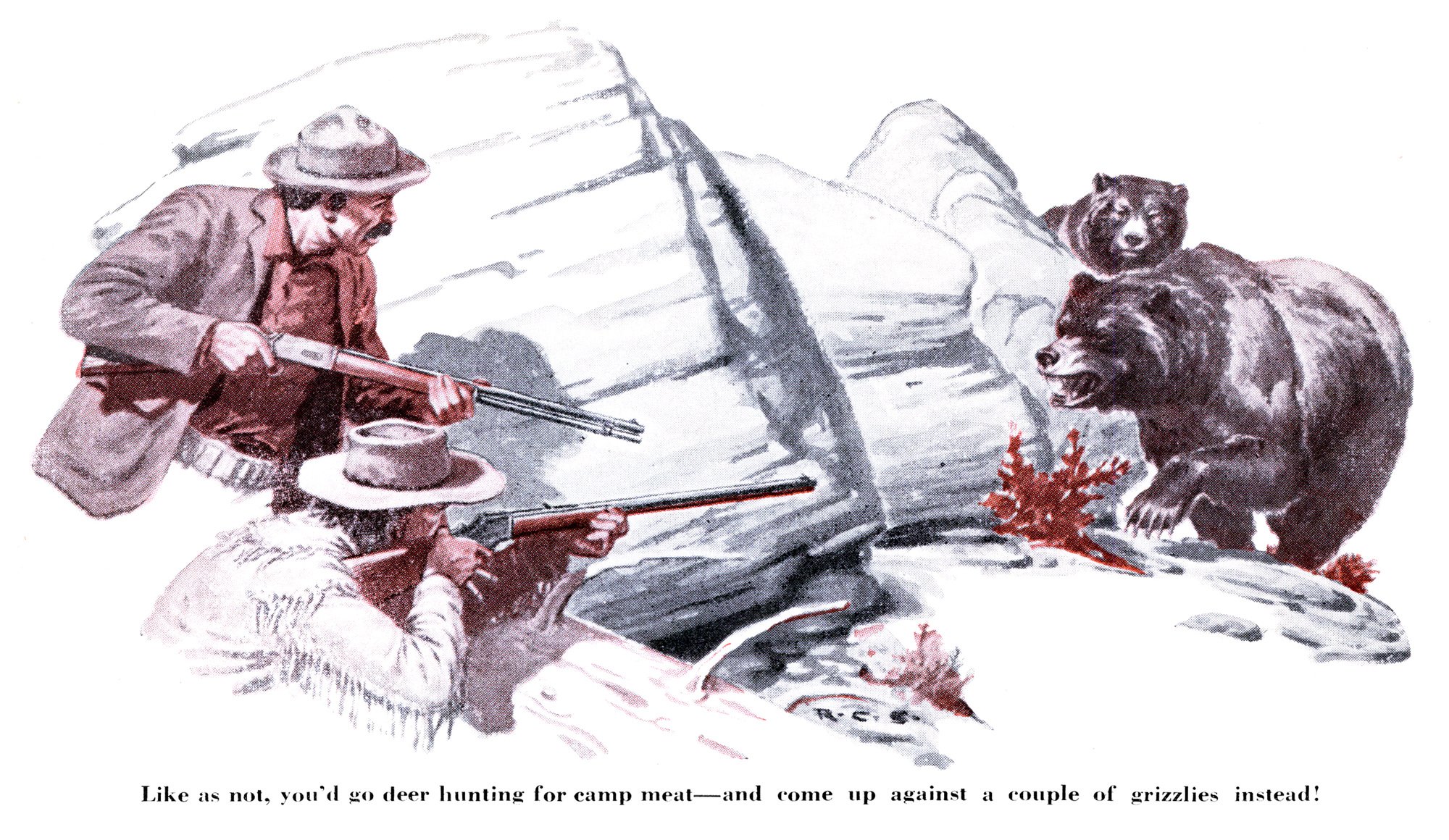
It was the West of the ’70’s and ’80’s, though, that was a hunter’s Garden of Eden. Dollar-greedy buffalo runners were stampeding the bison toward the last horizon, but the meat hunters had made little worse than a dent in other species of Western game. Deer were plentiful — water-loving white-tails under the shadow of the cottonwoods in the river bottoms; mule deer (which the men who hunted them nearly always called black-tails) in quiet pockets in the foothills, among the stunted pines and twisted cedars on rugged mountainsides, on the high deserts. In most districts grizzly bears were growing scarce, but there still were enough of them to satisfy any hunter who went out looking for trouble. There were huge herds of elk high up in the Rockies, and smaller herds in the foothills and sometimes even right out on the open plains.
Bighorn sheep and nimble-hoofed mountain goats dared the sportsman to match his nerve and hardihood against their craft on dizzy crags. And on color-splashed Southern mesas and high, lonely Northern prairies there were great bands of wary, keen-eyed antelope who could run faster than any but a top-quarter horse, and who asked of fate no more than that they should see the hunter before he saw them.
Barring Africa, the West of those years was the grandest big-game country in the world.
There was nothing new about that abundance of game beyond the Mississippi. What was new after the Civil War was the large and rapidly increasing number of sportsmen. Even in the East and South, where waterfowl and upland-bird shooting had been sports since Colonial days, until well into the ’70’s an overwhelming majority of rifle users went out mostly for meat.
In the West, until that time, about the only sport hunters were a few Army officers trying to relieve the boredom of Indian-country garrison duty, and an occasional wealthy Britisher or Easterner who was willing to foot a long bill for a wagon train manned by a retinue of professional hunters, guides, teamsters, and horse wranglers. Only a few of the pioneers and settlers whose sweat and blood pushed the frontier ever westward had time or desire to hunt for sport. To them the rifle was as much a tool as ax or plow — a triple-use tool with which they ran out the Indians, tried to clear newly opened sections of predators, and got meat for their cook pots.
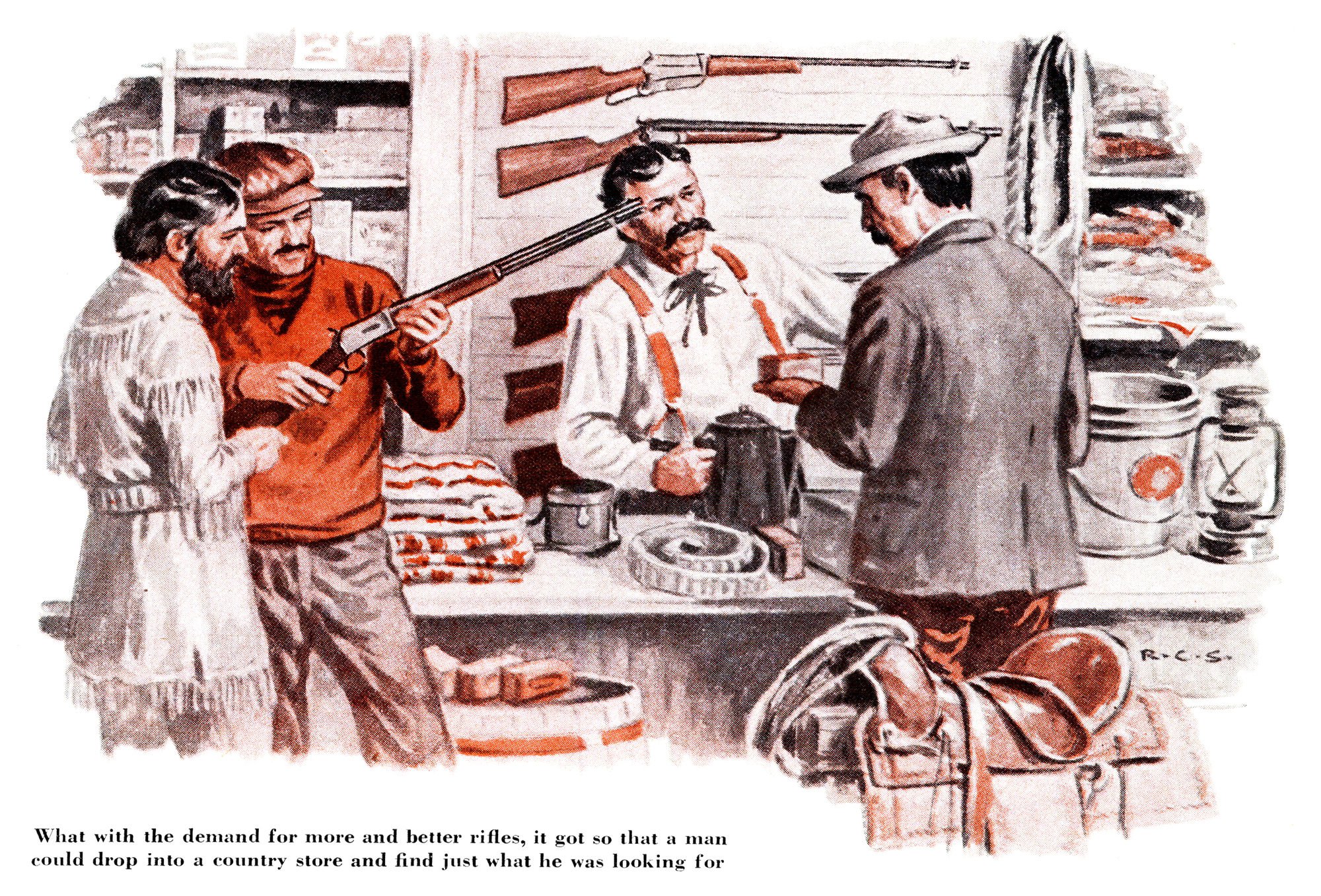
The coming of the railroads to the West opened the era of sport hunting for everybody. The first transcontinental line, the Union Pacific, was completed in 1869. In the next fifteen years more than 100,000 miles of steel was laid, much of it west of the Mississippi. Using the railroads, the fellow who was neither frontiersman nor millionaire could hunt the abundant game of the West.
And meanwhile the arms manufacturers worked overtime to provide the new army of sportsmen with better and better rifles to hunt with.
The rifle used by the Western big-game hunter of the early ’70’s nearly always was a single-shot weapon — there were a few Spencer and Henry Civil War repeaters in circulation, but they were rare. If the hunter was a wealthy British sportsman his weapon usually was a double-barreled rifle designed for East Indian or African game, for which he had paid somewhere between $750 and $1,000, and which likely bore the world-famous name of Purdey, Greener, or Holland. If the hunter was a settler out for meat or a tenderfoot looking for a thrill he might carry any of several popular single shots — perhaps a Maynard or a Peabody.
“Old Reliable” Single Shot
But if he was a professional hunter or a big-game-wise American sportsman he shot either a Remington or a Sharps — and the odds were heavily in favor of its being a Sharps for which he had forked over somewhere between $100 and $200. Frank H. Mayer, the famous buffalo runner, had half a dozen of them — the last one he bought, and the one he liked best, was a .45/120/550 superduper that had “Special Old Reliable” stamped on its barrel, and for which he paid $237.60. Col. W. D. Pickett, a Confederate veteran who had moved to Wyoming and hunted big bears for sport, shot a .45/110/340 Sharps with such devastating effect that of the twenty-three grizzlies he killed in a single season only six required more than one bullet. There are a few plainsmen still alive to tell us that the Sharps was the most effective single-shot big-game rifle ever made — and there are hunting records to bear out that contention.
Read Next: Guns of the Old West
But even those Sharps enthusiasts who were good enough to make a kill with practically every shot weren’t entirely satisfied with a single-shot rifle, and the arms manufacturers, realizing that fact as well as that an effective repeater would have a tremendous sale, were knotting their brains trying to give the hunters what they were looking for before some competitor did.
Of course the repeating-rifle idea wasn’t new. For more than a quarter century, firearms designers had been trying to develop a successful one. Among the earliest innovators was Col. Samuel Colt, who in the late 1830’s adapted his revolver cylinder to a rifle action, and who produced several improvements on his original model. His revolving-cylinder repeaters didn’t catch on, and neither did similar weapons produced by other makers. But in 1860 two practicable repeating lever-action rifles were patented — just in time for them to play a part in the Civil War.
One of them was the Spencer, a rifle or carbine using a .56 rimfire cartridge. Its seven-cartridge straight-line magazine was built into the stock, and it was capable of fifteen shots a minute. Nearly 100,000 Spencers were manufactured for the Union forces, and the soldiers — mostly cavalrymen — to whom they had been issued figured that they were mighty lucky to get them.
The other was the Henry, a .44 caliber rifle which had a fifteen-cartridge tube magazine under its barrel, the cartridges being carried to the chamber by a conveyor block operated by a lever. About 10,000 Henrys were manufactured for the Boys in Blue, and the comparatively few who got them liked them. The Boys in Gray who got shot at with them didn’t like them — they cussed the new repeater as “That damned Yankee rifle that is loaded on Sunday and fired all week.”
First Winchester Repeater
In 1866 Oliver F. Winchester, a Connecticut textile manufacturer who had been in financial control of the firm that made the Henrys for the government, decided to wind up its affairs and start manufacturing firearms under his own name. He bought the Spencer patents — not because he wanted to use them, but to head off competition. He also controlled the patents on the Henry rifle, and had got B. Tyler Henry, its inventor, to improve it. That was a smart business stroke. Basically, the Henry action proved so dependable and popular that it was used in all of the long line of successful lever-action repeaters which in a quarter century made the name “Winchester” practically synonymous with the word “rifle.” The “H” that still is stamped on all Winchester rimfire ammunition is the company’s tribute to its pioneering designer.
The first Winchester, the Model 1866, was an improved version of the Civil War Henry military rifle. It didn’t revolutionize firearms design, but neither was it entirely a flop. In seven years 170,000 were sold, but a large — now unknown — proportion of them were military weapons bought by the Turkish government. Probably the .44 caliber rimfire cartridge for which the 1866 was chambered didn’t have enough wallop to suit most Western hunters.
Read Next: The Best Repeating Rifles
So when the Golden Age of hunting dawned in 1870 the repeating rifle was available, but the men who were killing most of the big game still were doing it with the old single-shot Sharps and Remington.
Yet ten years later those time-tested favorites were being offered for sale at about a quarter of their original prices, with so few buyers that eventually many of them fell into the hands of the Indians.
The cause of their eclipse was the sensational and well-earned popularity of the second Winchester model, brought out in 1873. It was a .44 caliber twelve-shot repeater which looked and was very much like the Model 1866. The chief reason for its quick jump to fame was that it was the first rifle designed to use a center-fire cartridge — the still-manufactured .44 W.C.F.
The Model 1873 made a big noise. It was a real conversation piece — everyone who shot a rifle talked about it. Some hunters hailed it as a near-perfect weapon; others damned it as a piddling popgun. There weren’t any neutrals.
Eastern sportsmen welcomed it. Most of them had been doing their deer hunting with single-shot weapons that included even muzzle-loading Springfield muskets, and in consequence had been seeing a lot of wounded white-tails ghost back into the thickets to be lost. A repeater would enable them to get in a second or even a third shot when necessary, and the .44 W.C.F. cartridge packed enough punch.
Would It Stop a Grizzly?
Most Western hunters, grown up in the heavy-load, big-bullet tradition, were dubious about the new gun. Sure, it would do well enough on Eastern deer, but would it stop a buffalo — or a grizzly? Ballistically speaking, they had sound reason for doubt. The .44 W.C.F. cartridge, with its 200-grain bullet propelled by 40 grains of black powder, had a muzzle velocity of 1,245 foot seconds; that of the Sharps .45 caliber rifle, with a 550-grain bullet propelled by 120 grains of powder, was 1,400. The Sharps delivered almost three times as much lead a little faster. That ended the argument so far as most Western big-game hunters were concerned, but a few more open-minded chaps experimented with the Winchester “popgun” — sometimes with surprising results.
Frank Mayer, the buffalo runner, let himself be talked into buying one. One Sunday morning he took a busman’s holiday to try it out on jack rabbits. He ran into a bunch of seven buffaloes. Riding up close, and holding the Winchester handgun-fashion, he dropped one with his first shot. Then in the course of a mile run he killed the six others — and only three required a second bullet.
Three years later Winchester ended the argument by giving the big-gun addicts just what they wanted — the Model 1876, a twelve-shot enlarged version of the Model 1873, chambered for the Winchester .45/75 cartridge with a 350-grain bullet. Then in 1879 and in 1885 Winchester brought out six-shot .45/70 military and sporting Hotchkiss models. They were the first bolt-action repeaters made in America. A good many hunters liked the sporting model — but not nearly enough of them for it to threaten the supremacy of the lever-action rifle.
As soon as the popularity of the repeater was assured, Winchester began to turn out large numbers of rifles each year. Even three quarters of a century ago American manufacturers had the know-how for mass production. They had learned it from Eli Whitney, who had devised a system of interchangeable parts for army rifles he manufactured shortly after the Revolution; from Col. Colt; and from Christian Sharps.
As rifle production went up, rifle prices came down. No longer did a hunter have to pay from $100 up for a dependable weapon. Now he could buy one for $15 or $20.
Two new transcontinental railroads, the Northern Pacific and the Great Northern, were pushed across the plains and the Rockies. The “steam cars” made it possible for the man of moderate means who could take a month or so off from his job to hunt in wonderful big-game country.
The Northern Pacific, for example, ran through the heart of the Flathead-Kootenai region of Montana, which until then could be got into only by a long and expensive wagon or pack-string trip. Outfitters in the railroad towns rented horses and camping equipment, and provided guides. Sportsmen traveled a circular route which brought them back to the railroad after two or three weeks in grizzly-bear, elk, and moose country.
And what out-of-this-world hunting there was! Even to a tenderfoot, getting a white-tail or mule deer soon became a mere camp chore — but when a man started out after one he never knew what he’d run into before he got back to camp. Trouble, as likely as not, if he was doing his Western deer hunting in bear country!
But grizzly bears weren’t the only really big game that he was likely to run into. Although the great herds of buffalo which once blackened the plains were gone or well on their way out, even late in the ’80’s there were many small bands left, and an old bull’s scalp, as the head was called, made a fine trophy. Elk, once so plentiful on the plains that they had been “run” like buffalo by mounted hunters, still were easy to find in the mountains; and since they were subject to fits of stupid panic, sometimes meat hunters would slaughter twenty or more out of a band of 100.
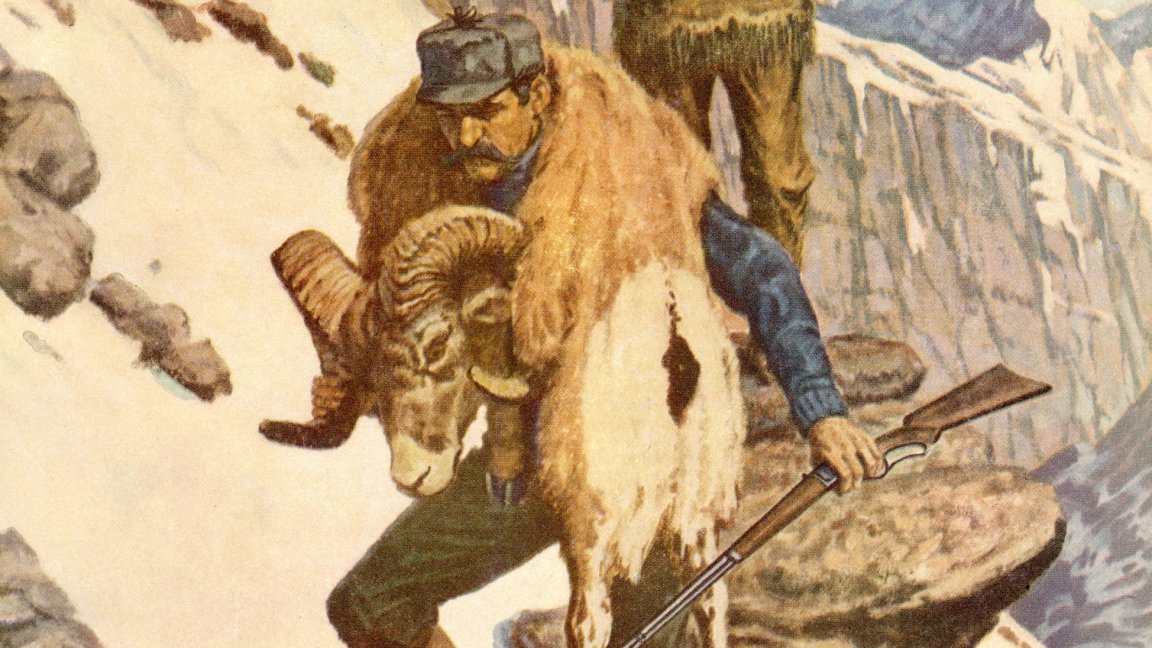
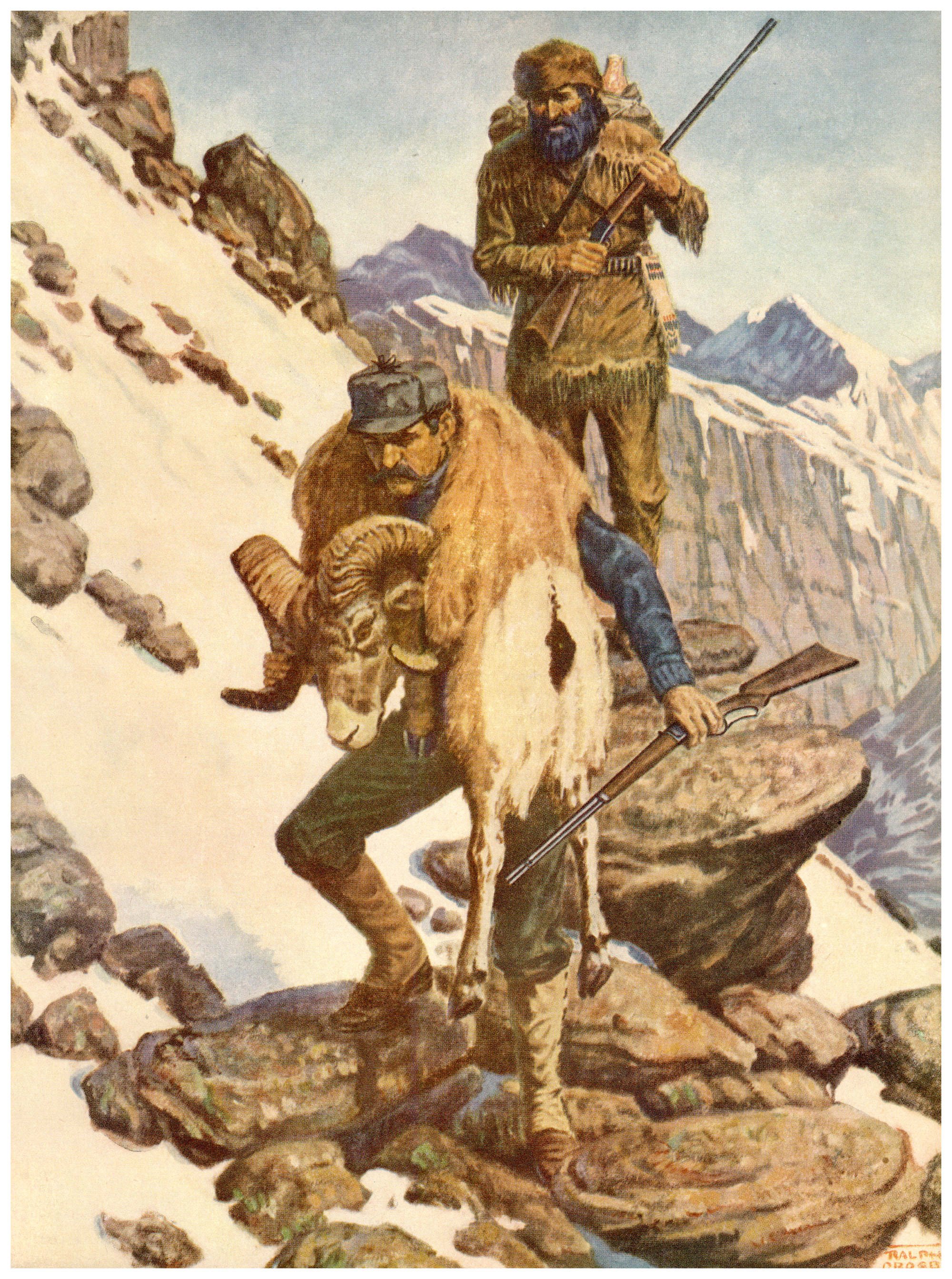
Hunting grizzlies, buffaloes, elk, or antelope was full of thrills, but the mountain sheep was the West’s grandest game and most-prized trophy. The bighorn had everything. It lived in the high and rugged places, where a man had to have whalebone muscles and plenty of wind to hunt it. Its eyes were as sharp as an antelope’s, and its nose and ears as keen as an elk’s. It could climb a steep, rock-cluttered slope like a flash, and bound down a sheer cliff like a rubber ball. Sometimes the hunter won — but more often he lost.
Embarrassing Moment
A ram gave one sportsman who had killed every other Western big-game species the biggest surprise and the most embarrassing moment of his long hunting career. High in the mountains he spotted the sheep through his field glasses, and after a difficult stalk got within 100 yards of it. Just as he was about ready to shoot he felt the breeze on the back of his neck and knew that it had shifted; before he could get his double-barreled rifle up the ram winded him and vanished.
Later in the day he came on the tracks of the same ram in the snow, and followed them. As he edged around a juniper he saw the bighorn climbing a steep rock slope; by the time he had raised his rifle it was standing on the skyline 125 yards away. It wasn’t a difficult shot, but he missed — with both barrels. The ram ducked over the ridge.
Glancing up as he finished reloading, the disgusted sportsman saw the bighorn back-tracking, at a gallop, right toward him. He waited until it was only fifteen feet away. Then he jumped up. The astonished ram reared up. Coolly the hunter stuck the rifle almost in its face and pressed one trigger, then the other. Nothing happened — he had forgotten to cock either hammer! The ram dodged past him and disappeared.
Winchester had everything its own way in the repeating-rifle field through the ’70’s, but early in the ’80’s other manufacturers, spurred by the tremendous demand for sporting firearms, began to put up serious competition.
The first challenge to Winchester supremacy was the Remington-Keene eight-shot repeater, which had a tube-type magazine and a bolt action, and was chambered for .45/70 and .44/40 cartridges. It was a high-class rifle, but it failed to win wide popularity — perhaps because it was difficult to clean — and its manufacture was discontinued after a few years.
Marlin came out with a .45/70 lever-action repeater in 1881, and from 1888 on introduced a new model almost every year through the ’90’s. They were good rifles which became very popular.
Winchester came back with its Model 1886 — as smooth-working a lever-action rifle as ever has been built. It was a nine-shot weapon which at first was chambered for the .45/70, and subsequently for other cartridges including the .50/110/300, the heaviest and highest-powered load then available.
The next Winchester big-game rifle was the Model 1892, a fifteen-shot lever action handling .25, .32, .38 and .44 caliber loads. Before this excellent deer rifle was discontinued in 1937 more than a million had been sold, and many of them still are getting game for their owners.
By the middle ’80’s many Western hunters were beginning to notice that each year they had to go farther and work harder to get big game. Wheat and corn were being grown on many thousands of acres of what a decade earlier had been virgin prairie. The buffalo was almost gone, the elk had been driven into the high hills, and even the deer and antelope were thinning out under the merciless killing of market hunters who sold their meat and skins in towns along the railroads. The cattle outfits fed their cowhands on venison, and saw nothing wrong about that. “We raise steers to sell, and kill deer to eat,” they said, and summed up with the ’80’s equivalent of “So what?”
Enthusiastic “Sportsmen”
The increasingly heavy sport hunting was an added drain — and some of the men who plumed themselves on being sportsmen took an enthusiastic part in shooting 100 or so sleeping wild turkeys out of their roosting trees, and similar cold-blooded exploits. Such states as had game laws made little if any attempt to enforce them.
Back of this callous slaughter of game was the dead-wrong idea mentioned early in this article. Theodore Roosevelt, ranching where the Little Missouri runs through the badlands near the North Dakota–Montana line, told how he killed what he knew to be the last elk left in that part of the country — told it without apology or shame. Fifteen years later he was to spearhead the conservation movement, and to sponsor the sound doctrine that game is a renewable natural resource which we can have always if only we have common sense enough not to kill it faster than we produce it; but in 1885 the idea prevailed that as the West was settled the game would have to go — so why shouldn’t every Johnny-on-the-spot kill his full share of it? Settlers, meat-hunters and sportsmen all felt that way. So the game was going — fast.
East of the Mississippi conditions were even worse because there hadn’t been nearly so much game to start with. Market hunters were killing many thousands of deer each year. Each fall an army of sport hunters invaded New York’s Adirondacks and other deer regions, and in the late ’80’s there were enough sport camps in the Maine woods to make publishing a directory of them profitable. Reputable hunters engaged in practices which would land them in jail today. Chasing deer into the lakes and then shooting them — or even clubbing them to death — from canoes was standard procedure in the Adirondacks. Jack-lighting deer, at first with a birchbark torch and later with a reflector lantern, was perfectly legitimate. The stealthy paddle along the shadowy riverbank or lake shore, the gleam of the quarry’s eyes in the dark, the quick shot before the light-fascinated deer bounded away, gave fire hunting an allure which made many hunters hate to give it up. But, to their credit, many did so — realizing that it was unsportsmanlike — long before it was made illegal.
Demand Game Laws
In the middle ’90’s, after most of the Eastern deer had been killed off and all species of Western big game had been dangerously depleted, sportsmen the country over woke up. They demanded that something drastic be done, and in a hurry, to save what was left of our big game; that game laws be made stricter, and be strictly enforced.
Repeating rifles, cartridge cases, and bullets all had been tremendously improved by 1890, but the black powder which propelled the bullets was essentially the same mixture of charcoal, sulphur, and saltpeter whose explosive properties had been demonstrated by Friar Roger Bacon back in the Middle Ages.
In military rifles, black powder had the obvious disadvantage of giving away the soldier’s position to the enemy. Used in any rifle, it quickly fouled the barrel and burned so nearly instantaneously that the gas pressure which propels the bullet began to decrease long before the bullet left the barrel. This progressively decreasing gas pressure kept muzzle velocities below 2,000 foot seconds, with resulting high trajectories and a loss of punch when the bullet reached its mark.
For more than half a century efforts had been made to develop a more efficient propellant. In 1846 guncotton had been made by treating cotton with a mixture of nitric and sulphuric acids. In the late ’70’s a smokeless powder had been produced by compounding guncotton with inorganic nitrates; it had been an instant success as a shotgun powder, but it burned too fast for use in rifles. In the ’80’s Alfred Nobel had produced ballistite by gelatinizing guncotton with nitroglycerin; and two Britishers had developed cordite — a smokeless powder, still used in England, composed of gelatinized guncotton, nitroglycerin, and mineral jelly. At about the same time Vieille, a French chemist, had produced a slow-burning smokeless powder by incorporating guncotton with a mixture of ether and alcohol and rolling the resulting paste into thin sheets which were cut into small squares; an improvement of his process, in which the paste is mechanically protruded into perforated cylindrical grains, was used in making American smokeless powder.
The first sporting rifle designed to fire the new smokeless-powder ammunition was the Winchester Model 1894. It had an eight-shot tube magazine, a new lever action, a new nickel-steel barrel. And it used the brand-new .30/30 — the “thirty-thirty” that became famous everywhere in America that big game is hunted. The (comparatively) slow-burning smokeless powder used in this cartridge kept the gas pressure propelling the bullet increasing until just before the bullet left the barrel, and gave it a muzzle velocity of more than 2,000 feet a second. The Model 1894 also was chambered for .38 and .32 caliber black-powder cartridges, and in 1895 for the .32 Winchester Special and the .25/35 Winchester, both smokeless loads. Well over a million rifles were sold before the model was discontinued a dozen years ago, and its carbine version still is manufactured.
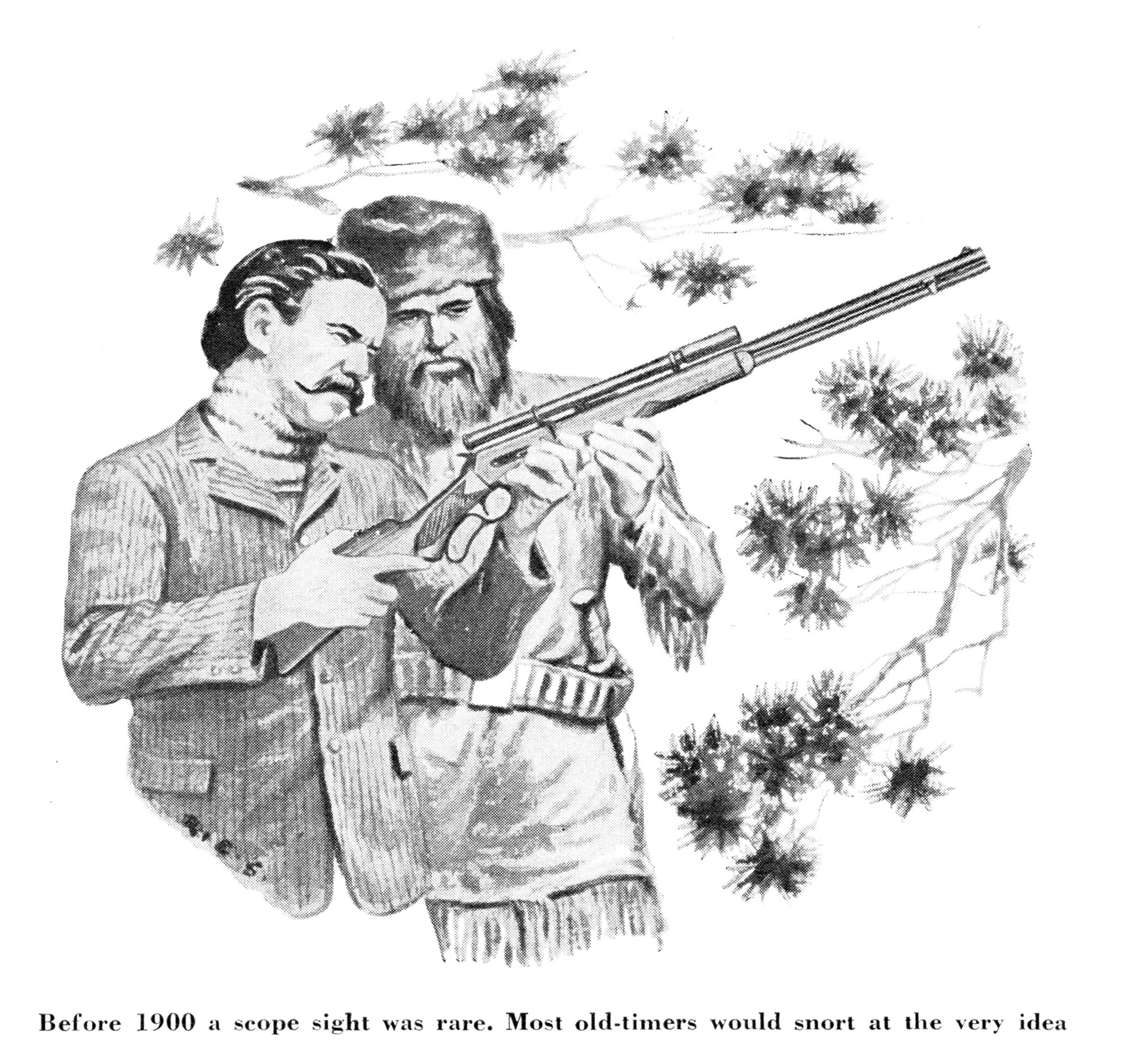
For some years a few big-game hunters had been experimenting with telescopic sights — Frank Mayer had used imported 20X ones on two of his Sharps buffalo guns — but they had not become widely popular. Now, with rifles of comparatively high velocity and low trajectory available, there was renewed interest in scopes, but they weren’t easily available to the average rifle owner until, shortly after 1900, the Stevens company absorbed a firm which specialized in popular-priced scope sights.
Read Next: Jim Carmichel’s 9 Greatest American Guns
In 1895 Winchester introduced a sporting version of the Lee Straight Pull, a military bolt-action rifle — manufactured for our Navy — which had a box magazine and was the first clip-loader; while Savage brought out a lever-action rifle, chambered for the new smokeless ammunition, which led to the Model 99 with its hammerless solid breech and rotary magazine.
So, at the end of the Golden Age of American hunting, the modern high-velocity hunting rifle was born. A later article will tell how it was developed, and about the game it killed.