
Remember last summer when hurricanes were chewing up chunks of Mexico and churning toward the Texas coastline? Remember the scenes on the evening news that showed long lines of people standing at grocery store check-out counters, their carts laden with such staples as canned meat and bottled water? Well, obviously those people knew that the storm was coming. They knew that they might not be getting out again to get groceries for a while, and they were laying in a supply of provisions to see them through the tough times ahead.
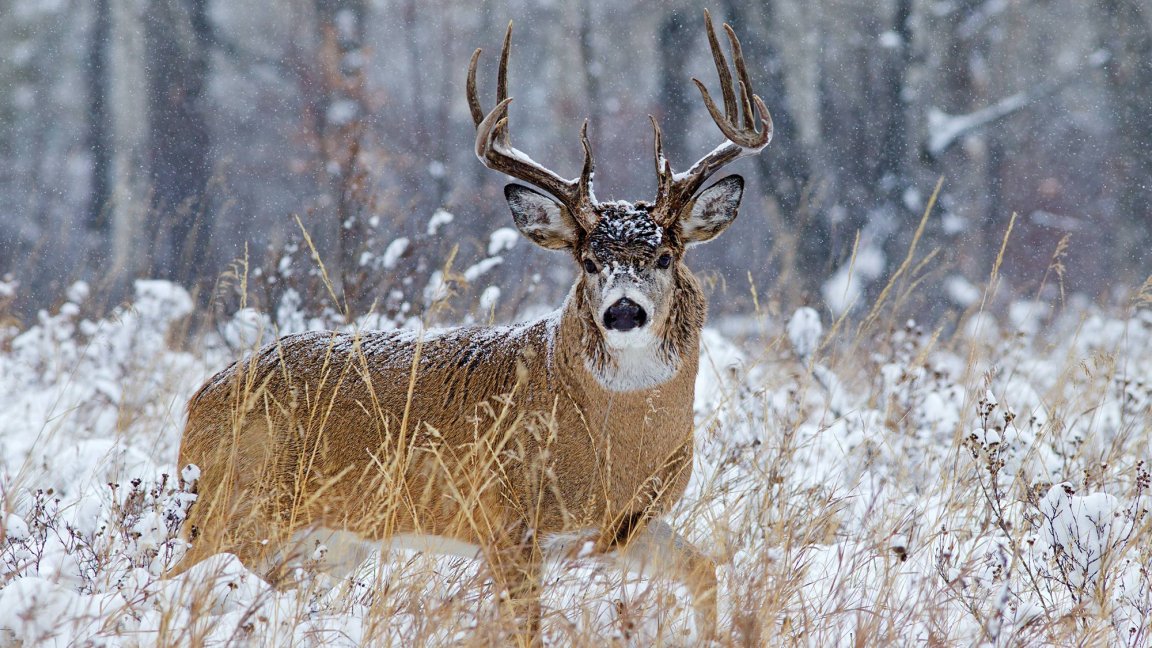
The birds and animals we hunt react similarly in the face of an approaching storm. Instinctively, everything from bobwhite quail to bull elk know when a storm is on its way. Without supermarkets to rely on for a cache of food, however, these birds and animals instead gorge themselves prior to the arrival of the bad weather. That is why one of my favorite times to hunt whitetails is when a storm has been forecast. Hunters who know where the deer will be feeding and who can arrange to be there when a dramatic change in the weather is imminent often experience the best hunting of their lives.
The first part of the puzzle, discovering where the deer are feeding, is up to you. I can tell you this much—animals do not switch feeding sites in the face of a storm. They know that when the need to fill their tanks is urgent, that is not the time to be shopping around for a new spread. If you know that the whitetails have been scarfing up acorns along a certain ridge of white oaks, for example, then that is the place where you want to concentrate your hunting efforts when a storm front is approaching.
And don’t worry about the time of day, either. Animals that normally feed only at twilight will be up and around at midday if a storm is bearing down. Even the big bucks, those that have evolved into nearly nocturnal creatures, will succumb to the urgency of the moment.
The second part of the puzzle—knowing when to be afield—is as simple as flipping the switch on your television. Nearly every local television station now gives its viewers a “satellite picture” of current and expected weather conditions. When that satellite picture indicates a storm front moving into your area, try your darndest to arrange your schedule so that you can be in the field just prior to the arrival of the bad weather.
If you have access to cable TV, you don’t have to wait for the evening weather report. During the hunting season, I spend a few minutes each day watching “The Weather Channel” as the forecasters walk me through the current weather conditions, the immediate forecast and the long-range outlook. Many times I have rearranged my schedule to take advantage of the fronts indicated by the pretty lady with the pointer. Contrary to all of the jokes and banter, I have found these forecasts to be reliable a good share of the time.
Of course, while actually at deer camp, most of us do not have access to a television, but we can still pick up the weather on the local radio station, or better yet, invest in an inexpensive weather radio. These handy units will constantly give you the forecast for your area, forecasts that are upgraded hourly by the National Weather Service.
Last December, during my state’s late bowhunting season for deer, the forecaster on “The Weather Channel” warned viewers that the first major winter storm of the season was building up strength and heading in from across the Rockies. The storm, which according to the forecaster would bring substantial amounts of snow and send temperatures plummeting, was due to arrive in my hunting area on Wednesday evening. I made the necessary arrangements and was in the woods by noon on Wednesday.
I put my stand in a clump of birch where I could overlook the intersection of three trails. The trails, all showing signs of frequent use, snaked down from the south-facing slope above, an area that I knew was laced with brush-choked ravines and was a favored bedding area for deer at that time of the year. After merging beneath my stand in the birch clump, the three trails became a single path leading down through a sumac thicket and emerging at the grassy edge of a strip-picked cornfield. I knew that the cornfield was being used by several dozen deer each night, but that steady hunting pressure along the trails leading to the corn had resulted in most of the deer postponing their trip until darkness had forced the hunters from their stands. I hoped that the approaching storm would cause the deer to abandon their nocturnal habits and make the trek to the cornfield while shooting light remained.
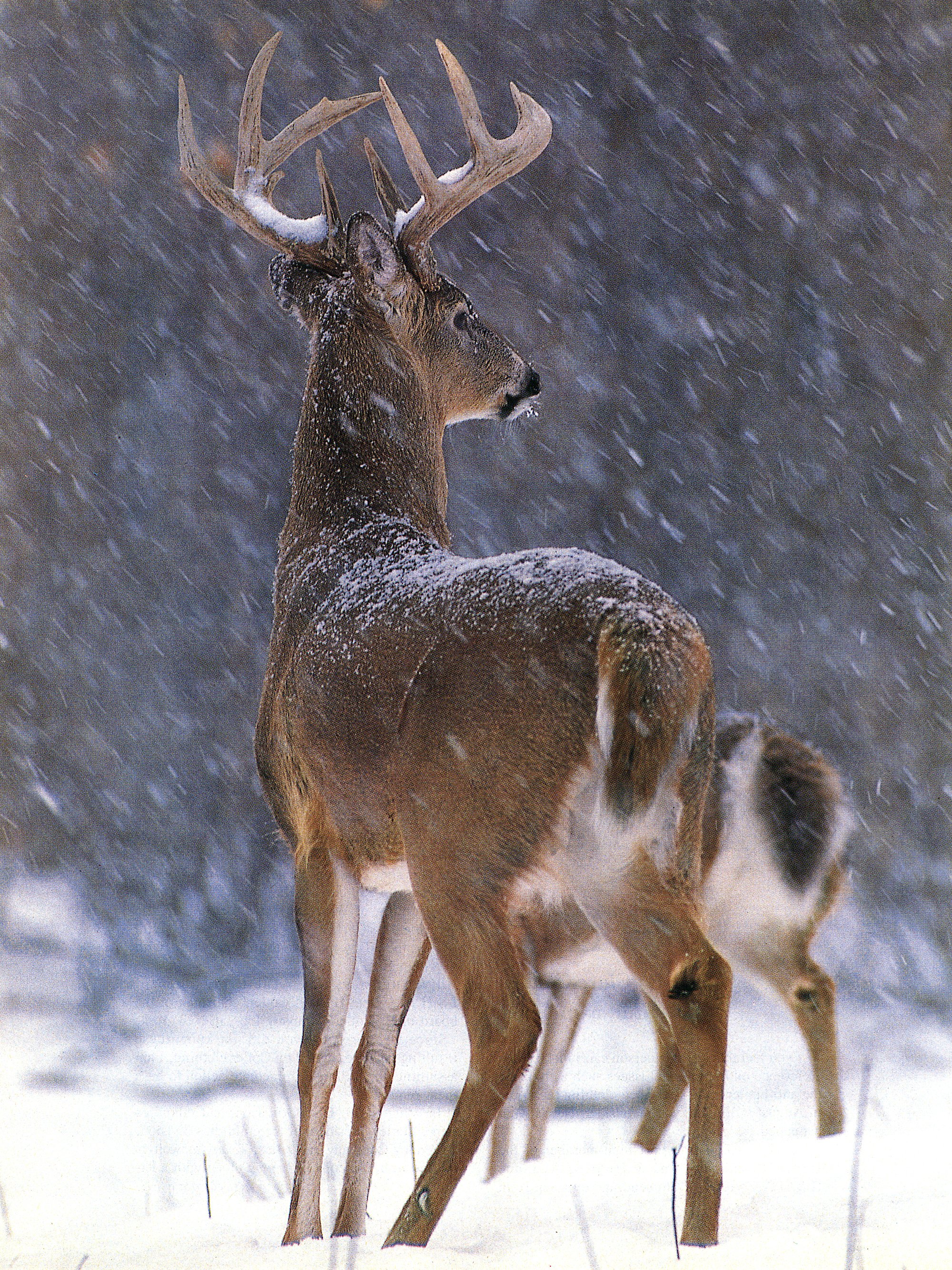
My hunch was right. I had been in the portable stand for only an hour when the first deer, a string of five does and fawns, came down the hill and past my stand. An hour later three more does made the trip; then a short time after that two more. By 4 p.m. there were two dozen deer feeding in the tattered cornstalks, but still no buck had shown. The first wind-driven snowflakes slapped me in the face. Somewhere in the leaden skies above, a flock of whistling swans, their voices it has always seemed to me mourning the end of autumn, made their way south. When I looked back at the cornfield, there was nothing but a sheer wall of swirling white. The storm had arrived.
A spike buck came slipping down the trail, moving with the quick steps that his kind make when they are anxious to fill their bellies. I had been holding out for a good buck, and had passed up several spikes earlier in season, but now time was running out. By the time I settled the argument going on inside of me and decided to take the shot, the spike was gone, just melting out of sight into that ever constricting sheet of white. Kicking myself, I tried to see through the snow, watching up the trail the spike had used and ready now should another buck show.
One did, but this boy was having nothing to do with the well-packed trails used by the other deer. Hard to my left I caught a shadowy blur of gray motion, but the longer I stared at the spot, the more I became convinced that what I thought I had seen had been only a figment of my imagination.
Then just as I was ready to turn my watery gaze back to the main trail, the buck took another step a drifting, silent, shadowy form floating in a world of swirling white. Like the spike, the big buck was hungry, but unlike the spike, this veteran was too smart to rush. He took things one step at a time. Stopping, he thrust his nose to the swirling wind and cocked his ears as he tried to sort out the danger sounds from the hissing whine of wind strumming naked branches. All I could do was stand on my platform and eyeball the buck. The big deer was plenty close for a shot, but there was no way that I could make the turn, lean out around the birch and draw on the buck without him detecting me. My only hope was that he would work his way around my position and give me a shot as he quartered away.
Then the buck did just that, passing directly downwind of my stand. He was close enough to the base of the birch that my scent, scattered as it was by the strong wind, blew over his back. I knew then that I was going to get my chance, and my right leg began to dance as it always does when a close-range encounter with a big whitetail draws to its conclusion. I made my turn on my heels. The buck stood in a clump of gray dogwood 15 yards away, his black nose up into the wind, his broad back dusted with falling snow, his heavy, nut-brown rack with 10 or 11 or 12 points angling back over his neck. I forced myself to forget about the rack and to concentrate on the opening six feet ahead of where the buck stood. When the buck lowered his head and took a step, I drew the old recurve. A black nose, a white-ringed eye and a mass of antlers filled the opening. One more step and I released.
The shot looked good; I can yet see that yellow fletching flying true to the mark. But at the last moment something went wrong. Probably the big buck squatted at the sound of the string. Maybe I held at full draw a tad too long and had just shot high. Maybe the arrow ticked a slender shoot of dogwood. I don’t know. I do know that I watched as the arrow sliced air just over the buck’s snow-flecked back and that quicker than I can tell it, the buck was gone, leaving me shaking and limp with disappointment.
I missed that buck, but I know that I would never have seen him if not for the storm forcing him to move while shooting light remained.
For several seasons after, I hunted without success during stormy periods. My mistake was that I wrongly assumed that the deer would be looking for the same thing that I was when the weather turned nasty: comfort. I tucked my stands into the quiet little draws and pockets where the wind lost its bite. I hunted the lee side of ridges and the downwind edges of evergreens and cedar swamps. And I saw very few deer.
A whitetail couldn’t care less about comfort when it comes to chowing down in the face of an approaching storm. After a buck has filled his tank and settled down to ride out the storm in his bed, yes, then he will search out the quiet places where the wind will not suck the heat from his body. But when hunting the storm fronts, forget about being comfortable. The deer will feed in their accustomed places, regardless.
Once while hunting the big-timber country of northwestern Wisconsin, where deer are not as plentiful as in some areas of that deer-rich state and hunting pressure is far less intense, I found myself at midweek of the rifle season virtually alone in the woods. Without the rut or other hunters to encourage deer to move, I was spending long uneventful hours on stand and trying unsuccessfully to stillhunt over dry, noisy forest litter. At noon one day I was sitting in the truck eating my lunch and listening to the radio when the announcer warned of a major winter storm moving rapidly across Lake Superior. Due to smack into my area by late evening, the storm was to bring strong winds pushing up to a foot of new snow and temperatures that would plunge below zero by dawn. I gulped down the last of my sandwich, shouldered a portable stand, grabbed my Ruger and struck off into the timber. There was a quickness to my step that I had not felt for a few days; call it anticipation.
I knew where I wanted to be. There was a clear-cut of maybe 100 acres a half-mile down an old logging road. The seedlings that had been planted by the timber company had grown to shoulder height. Those pines and the ever present scrub oaks gave the deer plenty of cover in the clear-cut, and the area was a favored feeding site, as well. On the northwestern corner of the clear-cut, a long tentacle of wrist-thick aspens snaked out of the dark timber into the relative open of the cut. Those aspens afforded the whitetails a natural travel lane from the timber to the chow line. A cluster of fence-post-thick pines decorated a mild slope just above the finger of aspens. I had hunted here before, and now put the portable into the pine that I had trimmed the previous season.
When the hump-nosed doe and her two fat fawns slipped out of the aspens and into the stubby pines of the clear-cut, I forgot about the cold. I glanced at my watch. It was 2 p.m. The approaching storm had the deer up and feeding early all right, now if I could just tough it out until a buck let his belly drag him from his bed to the clear-cut.
The doe and fawns fed slowly up to my stand and then moved off behind me. Soon after, a flicker of gray in the aspens caught my attention. Then there was another slight movement, and through the 8×42 binoculars I found the deer, both bucks—the first a forkhorn, the other larger. There was a yard-wide trail dissecting the finger of aspens, a trail that I had helped nurture over the years with a little judicious pruning of young shoots. When the forkhorn stepped into the slot, I put the crosshairs on his chest and waited for the other buck to make his move. The forkhorn stepped out of the frame and the bigger one, a nine-pointer, took his place. When he lifted his right front leg to step over a fallen aspen, I sent a 117-grain Federal Premium through his lungs. By the time I had taken pictures, dressed the buck and dragged him back to the truck, the wind was carrying the first of the foot of snow that would fall during the night.
After the Storm
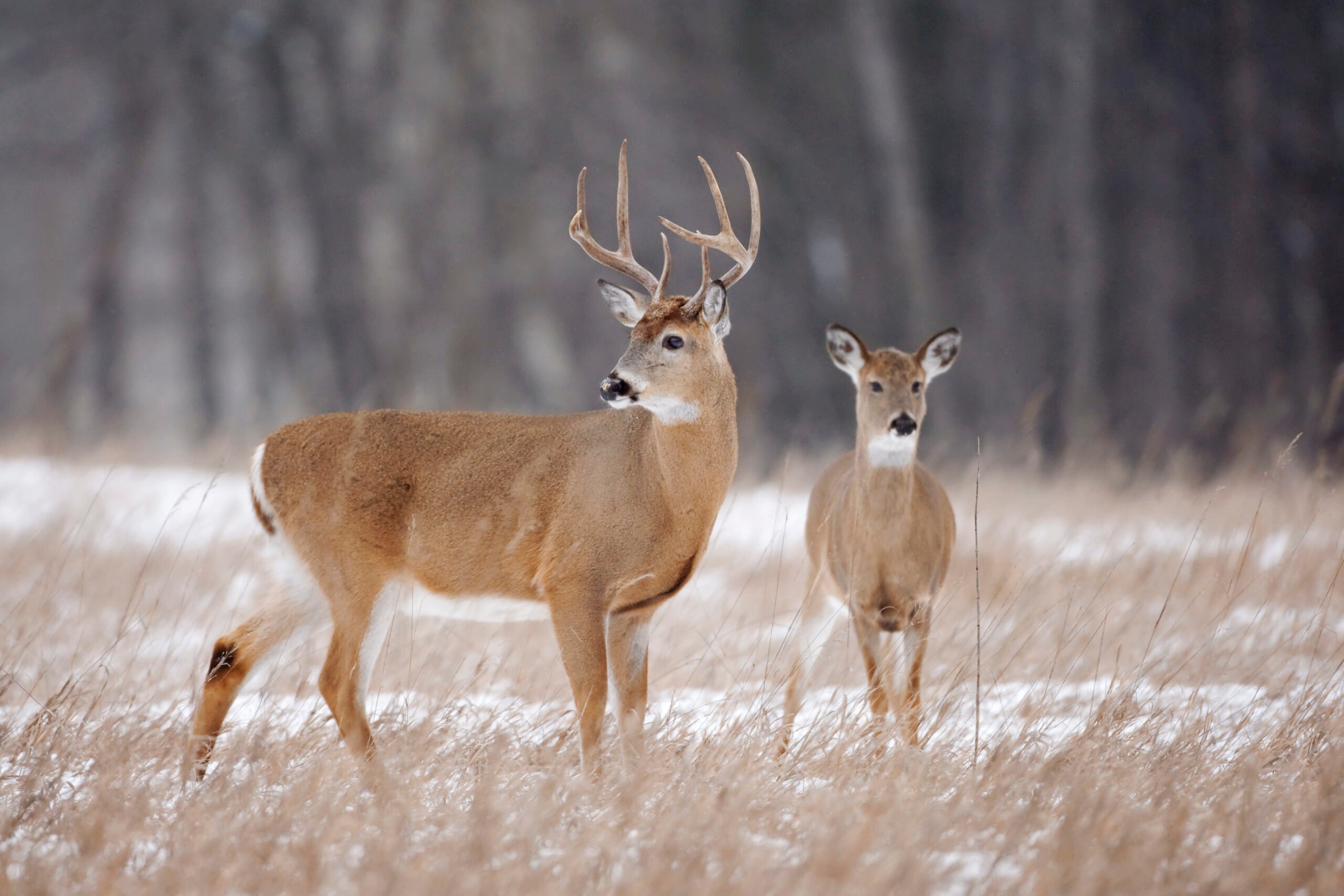
If you can’t get out before the storm arrives, try to be in the woods when the weather breaks. Deer that have weathered the storm will be hungry when everything has passed, and midday feeding is not uncommon at this time. The longer the storm lasts, the more pronounced the post-storm feeding binge will be.
Like other ruminants, the whitetail has four sections to its stomach and, of course, is a cud chewer. According to Leonard Lee Rue III’s excellent book The Deer Of North America, “There is a lapse of 14 to 18 hours from the time a deer’s food is eaten until it has been passed up again as cud, chewed, reswallowed and passed through the reticulum.” My observations have convinced me that a deer becomes most anxious to feed once the cud-chewing process has been completed. The whitetails that I have observed that have missed a feeding period but still have a cud to work over appear content in their beds. Animals that have been holed-up long enough to have passed the cud-chewing stage are antsy and anxious. If you have a storm severe enough to force deer to stay put for longer than 24 hours, you are reaching the point at which the stomach of a whitetail will be completely empty.
Several years ago, my brother-in-law and I were hunting a Northern state during a December muzzleloader season. A blizzard struck with force on the second day of the season, dumping two feet of snow in 12 hours and sending the temperature plunging to minus 27°. For two days after the storm the temperature remained in the minus-20° range. Although we hunted hard on both days, the only deer we saw were those that we pushed from their beds; the only tracks were those of the deer that we had disturbed.
But on the second night after the storm, the intense cold mellowed. When we rolled out of our sleeping bags in the black of predawn, the old thermometer hanging on the door of the pickup camper registered a balmy 1. We wolfed down our breakfasts, pulled on gaiters over heavy felt pacs, took the cold rifles from the cab of the truck and waded into the timber.
Deer tracks were everywhere. Shadowy forms moved off silently on our flanks. Larry and I parted company on the point of an outcropping. He dropped into the bottoms to hunt near a cornfield; I headed for a stand of white oaks on a distant ridge.
Read Next: 101 Best Deer Hunting Tips For the Rut
My tattered log book shows that I saw 27 deer that morning before the block-bodied buck made the mistake of pawing down through two feet of snow for an acorn within range of my stand. Larry saw nearly as many deer feeding in the corn. It seemed that every deer in the woods was up and feeding that morning. And, oh yes, we never encountered another hunter.
It takes a little something special in the way of dedication to stick it out in the face of an approaching storm, or to venture out in a storm’s wake. Our instincts tell us to stay home where it’s warm and comfortable. I am not advocating taking chances that could be life threatening. Once you see the number of deer that are active just before and again after a storm, that discomfort will seem a small price to pay.
This story was originally published in the November 1990 issue of Outdoor Life.