
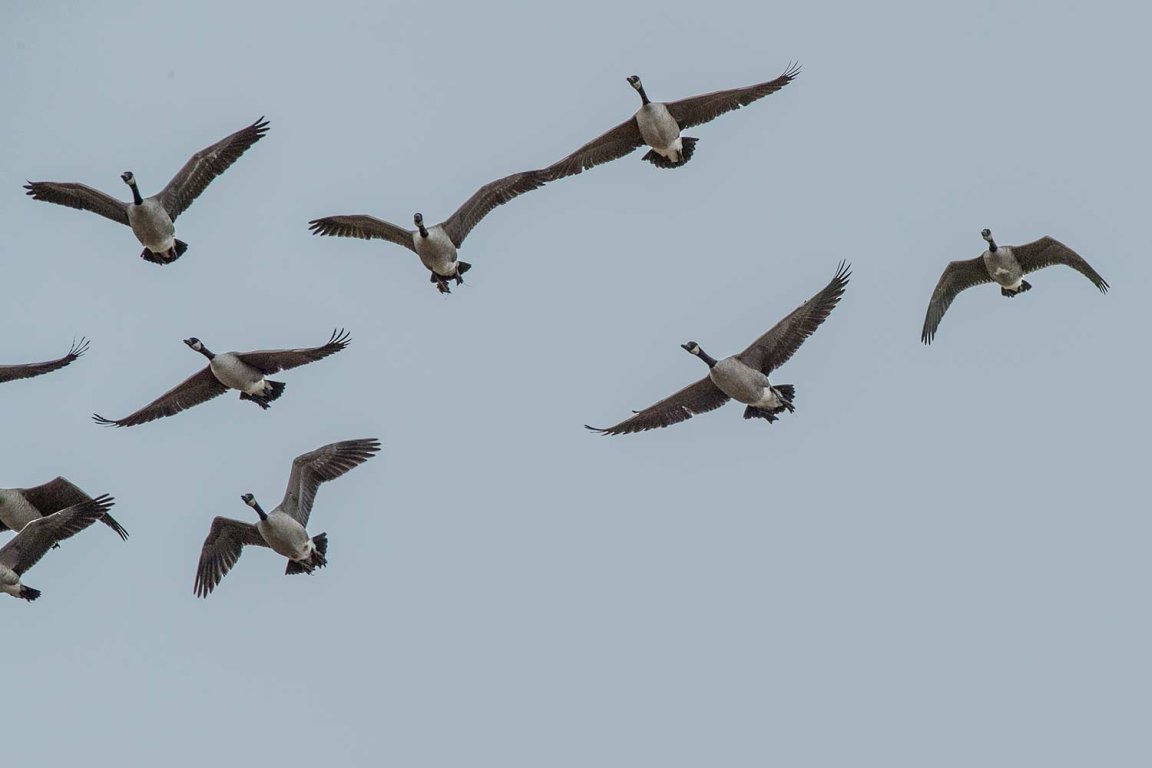
It was a good day for waterfowl hunters. Wisps of fog seeped out of the melting landscape, and the sky was so low and solid that the geese—if they came—would be close to the deck. And it was cold. Two days before, a savage cold wave had swept across Tennessee, plastering trees and highways with ice and freezing ponds thicker than anyone could remember. Ducks and geese had been sitting it out, but on this third day, the ice was melting, and they would fly.
I slid the overhead hatch back and stuck my head up and out of the blind. Earlier it had been too dark to see how we were situated. I found that we were in a soybean field of perhaps 300 acres, already plowed for the spring planting. There was sparse timber on all sides. To the south, the way hunters faced when standing in the blind, the timber was not so tall or thick, but there was the heavy undergrowth that grows at water’s edge. The lake is closer than I thought, I said to myself. It’s only 100 yards or so away.
The blind was one of the biggest I had ever seen, and it was also almost invisible. From a duck’s overhead view, it no doubt looked like a rush-covered finger of land surrounded on three sides by timber, water, and waterfowl decoys—hundreds of them.
Thus oriented, I closed the camouflaged hatch and placed my feet near the gas heater. Sheer luxury! Being there almost made up for all those miserable days I have spent crouched in freezing mud holes. Perhaps a time or two before, in Texas and Louisiana, I’d been in more luxurious shooting stands, but they were small houses built on stilts above the water. This was a blind dug into the ground, lined with concrete, and covered with earth that had been planted with suitable cover. The blind’s eyes on the outside world were 12 sliding hatches.
Inside, the padded theater seats were as comfy as easychairs. Theater seats! I thought. Who in hell would have thought of putting theater seats in a duck blind? But it was perfect! The spring-loaded bottoms snapped up out of the way when you rose to shoot. That gave a man more foot and leg room and eliminated bruised shins if he turned around for backyard shots. I’m forever scraping my shins on the sharp-edged board benches found in most blinds.
As the light increased, so did the yipping of the Canada geese rafted up on Lake Isom just beyond the brushy boundary. A few minutes before, the even din of honking had changed pitch when a raft of Canadas took wing. Moments later another flight heaved into the morning fog.
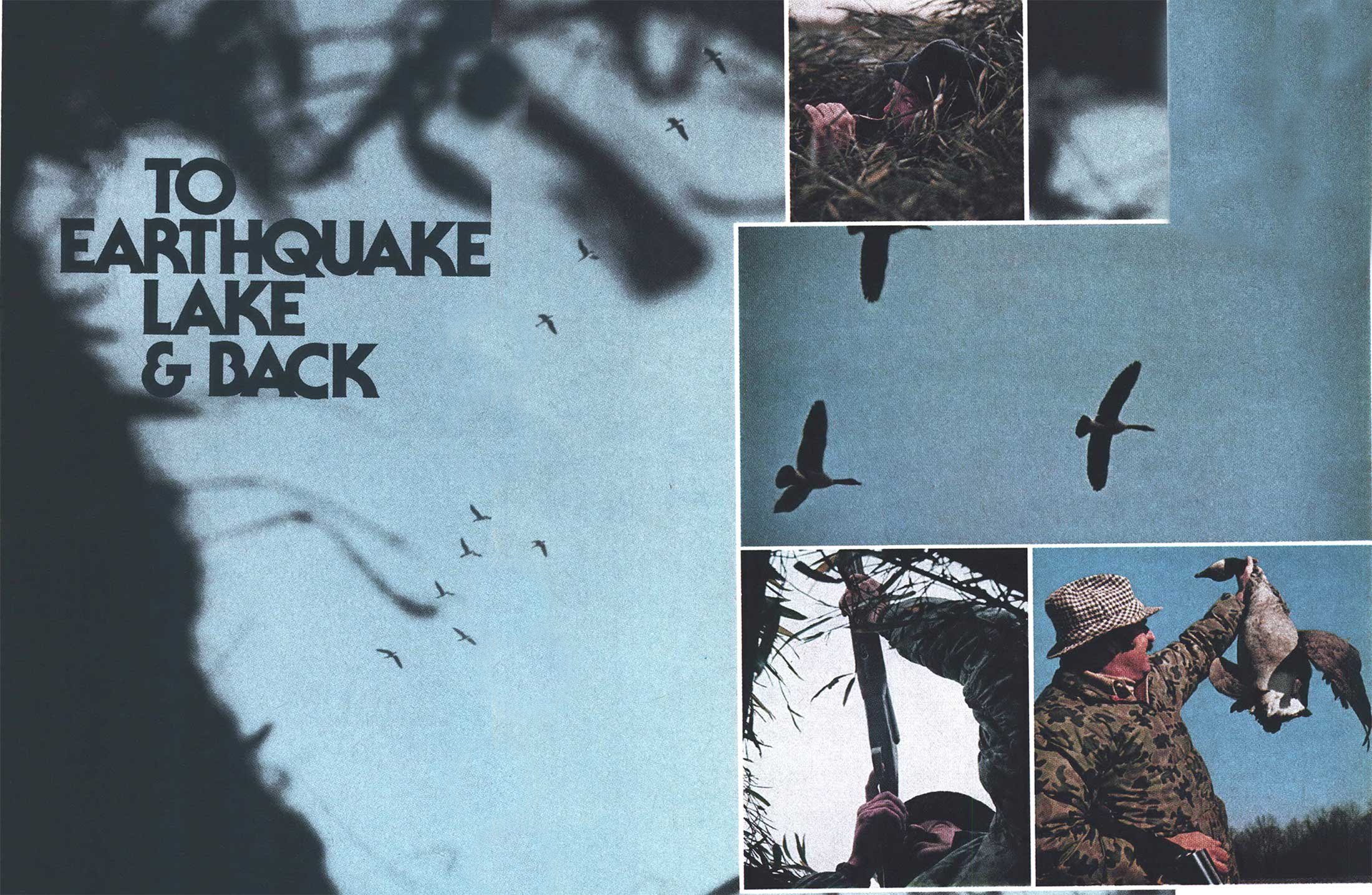
Our lookout Jerry Jones made no sign that geese were coming our way, but the atmosphere inside the blind was becoming so charged with excitement that you could almost touch it. Feet shuffled, experienced hunters quaked with anticipation, and hands rattled shotshells in jacket pockets to make sure fast reloads were ready. Overhead and close by, there was a whistle of teal. Jerry’s eyes followed their crossing flight, but he did not signal us to shoot, because he didn’t want to spoil our chances for the big honkers that could be only minutes away.
From the lake came another din of geese taking off, and Jerry pulled his head lower and tightened his grip on his Browning autoloading magnum. Then he crouched even lower, eyes level with his lookout hole, and said, “They’re ours boys. Get ready—now!”
Shotgun barrels poked out of the blind, and there was ragged fire at eight or nine geese that were angling by to our left. The closest bird went limp in midair, but the one I fired at twice merely did the double wobble of a wise old goose that knows he’s being shot at.
Long ago I learned that in each flight of waterfowl there are one or two obvious birds. They are closer or bigger or out in front, and they tend to draw fire. When I’m sharing a blind with other hunters, I therefore pass up the obvious targets and go for a more obscure member of the flight. That bird is all mine, and I know for sure if I hit or miss. This time the obvious bird did draw most of the fire and was the only one to fall. Happily there was no chorus of “I got him!” that sometimes mars such events. These men, most of whom I’d met only that morning, were too experienced and too polite for that. Instead, each one claimed to have missed by several feet and that the goose must have been felled by the youngest member of the party, 15-year-old Charlie Lawrence.
“I did?” he whooped in wide-eyed amazement. “And that means you’ll have to fetch it,” Charlie’s father almost managed to say before the young hunter was out of the blind and sprinting after the prize, his rubber boots going flub-flub and launching dollops of river-bottom mud from the Mississippi in all directions.
Whoever first said that you can tell a lot about a man’s character by hunting with him really knew what he was talking about. Settling back into my posh seat, I knew I had learned a lot about my new acquaintances already and had a feeling that we would all be good friends before the day ended.
The only one of us who hadn’t pulled a trigger on the geese was Ralph McDonald, the well-known wildlife artist. His sliding hatch had stuck when the action started, so he had to sit out the first round. But Jerry Jones fixes that in a hurry by leaving the hatch open and covering the opening with a layer of cane that could easily be pushed aside. I liked that arrangement better than moving the hatch, so he fixed me up the same way. It gave me a better look at incoming birds.
In addition to Jerry, Ralph, and myself, our shooting party included H. Lea Lawrence, his teen-aged sons David and Charlie, country-music star Jim Ed Brown, plus Bill Morrison and Tom Callery. Lea, who lives in Nashville, is an outdoor writer whose name is familiar to readers of OUTDOOR LIFE. Morrison and Callery are field and legislative assistants to U.S. Senator William Brock of Tennessee. When I met Morrison and Callery that morning and learned of their political connections, I made a mental note to bend their ears about pending firearms legislation.
But there was no time for that now—ducks were coming, and Jerry was making seductive sounds on his big-barreled duck call. I couldn’t see the incomers from my angle, but it was easy enough to pinpoint their position by watching Jerry’s eyes. As they came closer, he crouched lower in the blind, and I knew they were within range even before he whisper-shouted, “Now!”
About 10 spoonbills were winging low and fast from right to left in front of the blind. I swung my 12-gauge double, a Model 21 Winchester, through one of the trailers, but before I could press the trigger the bird’s head kicked back and he collapsed in midair. Then I was aware of three or four other ducks tumbling out of the formation, but my attention was concentrated on another spoonbill. I swung the barrels ahead by about two feet and pressed the trigger. The load of No. 4s folded the spoonbill so cleanly that there was no need to think about a follow-up shot, so I chased the barrels to the next closest bird and gave him the remaining round. It was a straightaway shot, and the range was rapidly increasing with each beat of his wings. For a moment it looked like a miss, but then the spoonbill did a turnover and went into a power dive before thumping hard on the semifrozen field. At 60 yards, perhaps more, it had been a lucky shot, but all eyes had been on me, and the welfare of my ego was at stake.
While David and Charlie fetched the downed waterfowl, I made the innocent mistake of asking Ralph if he had scored on the spoonbills. Though he is a leading wildlife artist whose paintings have twice been featured on the cover of the Ducks Unlimited magazine, he has a well-earned reputation as a hard-luck waterfowl hunter. On his goose hunts something always goes wrong, and he was still looking to shoot his first honker.
Jerry, who owns and operates Sunset Court and Dock on Reelfoot Lake, is one of those old-fashioned guides who believes that a day not spent hunting or fishing is a day wasted. Just to make sure that he and his customers get in plenty of both, his fees for a guided goose-and-duck hunt—including lodging, a heated blind, decoys, transport to the blind, plus some of the finest duck calling and yarn spinning you’re likely to hear anywhere—are no more than you’d expect to pay to spend the night in a rundown New York hotel.
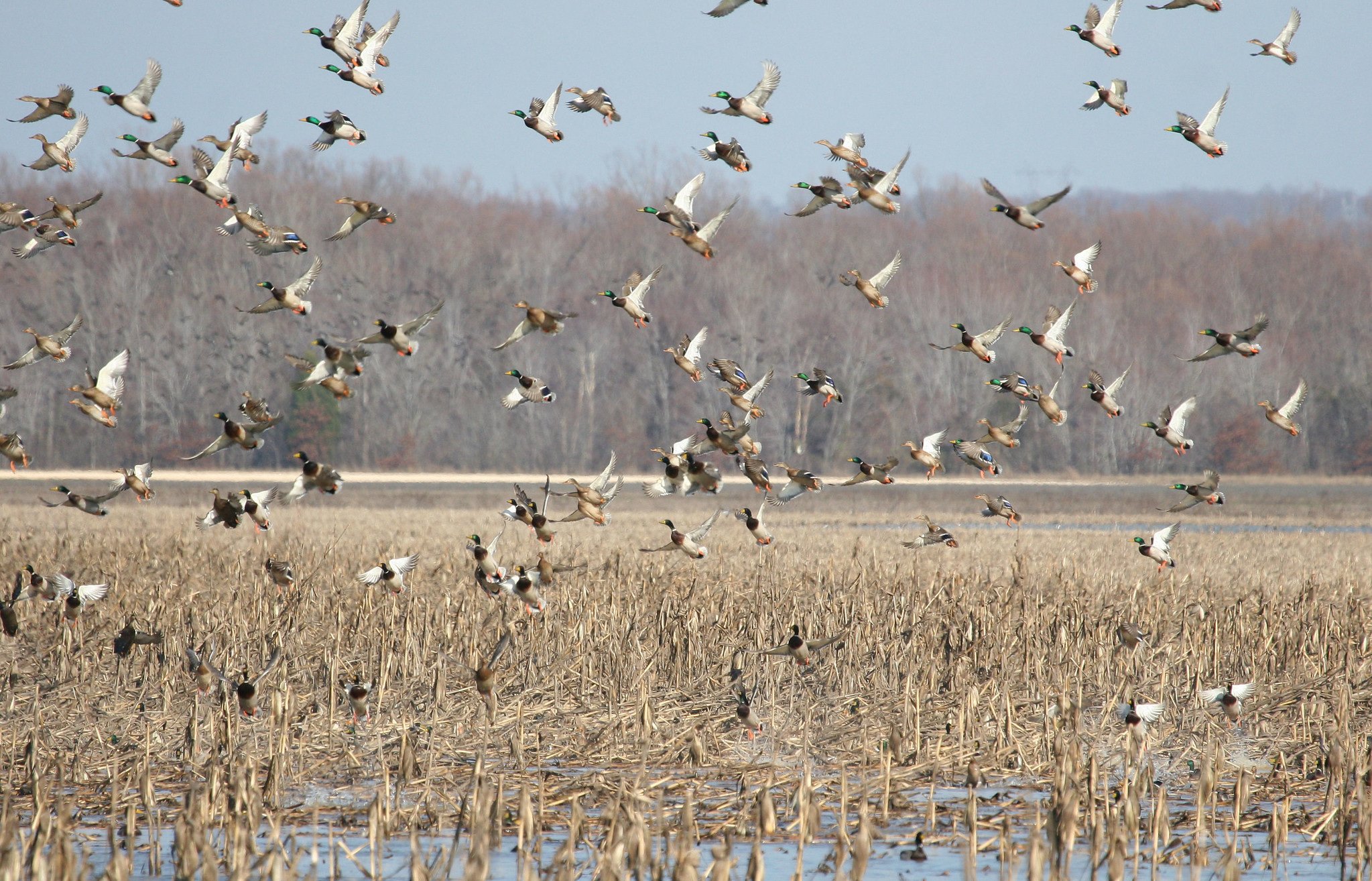
While I was hunting the Reelfoot and Lake Isom area, the local waterfowl population was estimated at some 70,000 geese and about a quarter of a million ducks, mainly gadwalls and mallards.
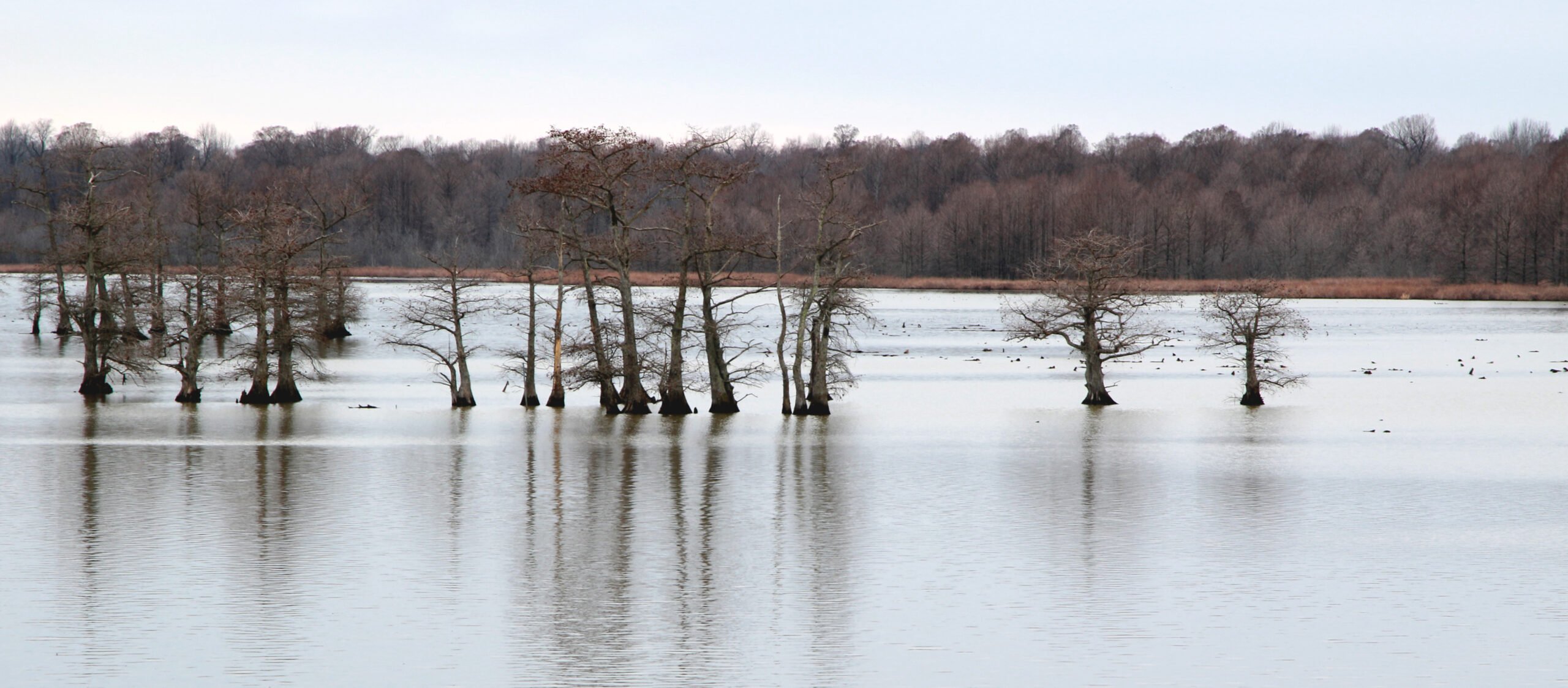
Historic Reelfoot Lake is well known among waterfowlers and it is an easy day’s drive from many large Midwestern and Eastern cities. Lake Isom, however, remains distinctly undiscovered, even though it is only a few miles away (see map, page 89).
Hunting seasons run from December into January. The duck limit is based on the point system. Some ducks, such as pintails and spoonbills (shovelers), are rated at only 10 points each, so it is possible to bag 10 ducks plus two geese in a single day. That’s a lot of shooting.
Ralph was about halfway through a lengthy explanation of how he had failed to get off a single shot at the geese when Jerry shouted “Get down!” at the two young Lawrence brothers, who were still gathering ducks. Another flight of spoonbills had just cleared Isom’s boundary and were coming directly at us. Charlie had left his shotgun in the blind, but older and wiser David had his pump ready and neatly dropped a drake.
The first half-hour had produced a goose and a half a dozen ducks—rich promise of a good day of shooting—but by midmorning the action tapered off to only an occasional shot at a passing duck. For some reason known only to themselves, the geese had decided to leave by the western side of the lake. We could hear their comings and goings, but none came within half a mile. Over a breakfast of ham and eggs cooked in a subterranean kitchen attached to the blind and complete with gas stove, we discussed the sagging action. Jerry allowed that we could move to a blind closer to the flyway the honkers had selected that day. Jerry owns or has access to 15 blinds.
After a quick scouting sortie, he asked for volunteers to try another blind situated where the honkers seemed to be heading, but he also told us the road was bad and we’d have to walk a ways. Jim Ed Brown, Lea Lawrence, and I volunteered, but not without some misgivings on my part.
Ralph McDonald elected to stay where he was, because, as he put it, he’d “… had a vision that the geese would soon come that way.”
Even before we got to our new blind, there was no doubt that Jerry was right. While walking about a quarter of a mile through a sparse stand of scrub timber, we spotted three flights of geese skimming low over a field of winter wheat. They landed almost in the new blind.
“Holy catfish!” said Jim Ed in the soft Southern accents that have made him a favorite of Grand Ole Opry fans. “All I need is two.”
Just then six or eight more honkers slipped in low over the wheatfield, wings cupped to land. Before they touched down, the leader thought better of it, and they flared hard left, leveled off treetop high, and headed straight at us. We were almost through the scrub brush by then, and there wasn’t much cover, but we ducked into what concealment there was.
“Get ready,” Jerry whispered just an arm’s length to my left. Like me, he was half hidden in a honeysuckle bank. Just then Jim Ed and Lea opened up, and two honkers dropped at once. A third, hit hard, scaled overhead, and Jerry or me, or both of us, hit him at less than 30 yards and folded him cleanly.
The rest of the formation had swerved violently when Lea and Jim Ed started shooting, and they were out of range before I could come to bear with my second barrel. The geese were still reasonably close to Jim Ed, and with the last shot in his Model 12 Winchester pump, another Canada pitched down, wing feathers humming in the rush of the fall.
“Friends,” drawled Jim Ed, “this is what I was brought up to call good goose hunting. I’ve got my limit, and we ain’t even in the blind.”
The timing was perfect, because less than an hour later Jim Ed was scheduled to leave by charter plane to tape his popular “Nashville On The Road” TV show. So he and Jerry took the four honkers back to the truck while Lea and I went on to the blind. Jerry got back as quickly as he could.
We had no more than settled ourselves when a flight of perhaps 20 geese came soaring up the field. Jerry called, and they began to circle. When we stood to fire, they flared sharply and momentarily gave us that near-motionless target goose hunters love. I shot at a bird on the far right end of the formation so there would be little chance that Lea and I would double on the same target. The Canada spun and fell without a flutter.
Meanwhile Lea was doing the same with a honker he had cut out of the flight.
That evening we feasted on lake-country froglegs, catfish, hush puppies, and tart cole slaw. It had been a great day for everyone except Ralph McDonald.
“I was sure my hunch about those geese was a good one,” he lamented, pouring himself a stiff snort of Reelfoot tea, “but I never got a shot. My record is intact.”
Read Next: I Gave Up My Duck Blind to Hunt Where the Mallards Actually Are
Reelfoot Lake and Lake Isom
Reelfoot Lake in far western Tennessee was formed by the New Madrid earthquakes of 1811-12. The catastrophe depressed some 50,000 acres that were later submerged by water from the Mississippi River. The surge was so great that the Mississippi is said to have flowed backward for a while. Due to siltation, plant succession, and drainage, Reelfoot Lake now covers about 18,000 acres.
A colorful legend accounts for the lake’s name. A Chickasaw chief suffered from a deformed or club foot and reeled when he walked. Chief Reelfoot could not persuade any of the Chickasaw maidens to become his wife, so he and his warriors kidnapped a Choctaw maiden named Starlight. Her father, who would not allow the marriage because of Reelfoot’s deformity, was so angered that he ordered his medicine men to bring down a terrible vengeance on Reelfoot and his people. That, the legend has it, was the cause of the earthquake.
Lake Isom, scene of the waterfowl hunt in this story, was isolated from the big lake when a road was built around the southern end of the lake. A water-control structure and a ditch aided in draining the land that lies between the lakes today. The lake was given a name when the site was acquired for a waterfowl refuge from the Isom family.
Reelfoot’s excellent waterfowl habitat made it one of the most famous hunting areas on the Mississippi Flyway. The open-water portions attracted a variety of diving ducks, particularly canvasbacks. Mallards were most abundant and most popular among gunners. Eventually, however, the canvasbacks almost disappeared, and restrictive limits were imposed on mallard shooting. In the late 1960’s, with a one-mallard limit, Reelfoot had an all-time low in hunter usage.
As the mallards and some other ducks increased in numbers after the low, and limits were increased, the popularity of Reelfoot Lake among gunners increased somewhat, but it is taking a while for hunters to realize that it’s the same hotspot. Reelfoot is as good today as it ever was, and Lake Isom is just as good. Neither Reelfoot nor Isom is managed by the state, but public hunting is permitted at Reelfoot. At Lake Isom the hunting is on private land.