
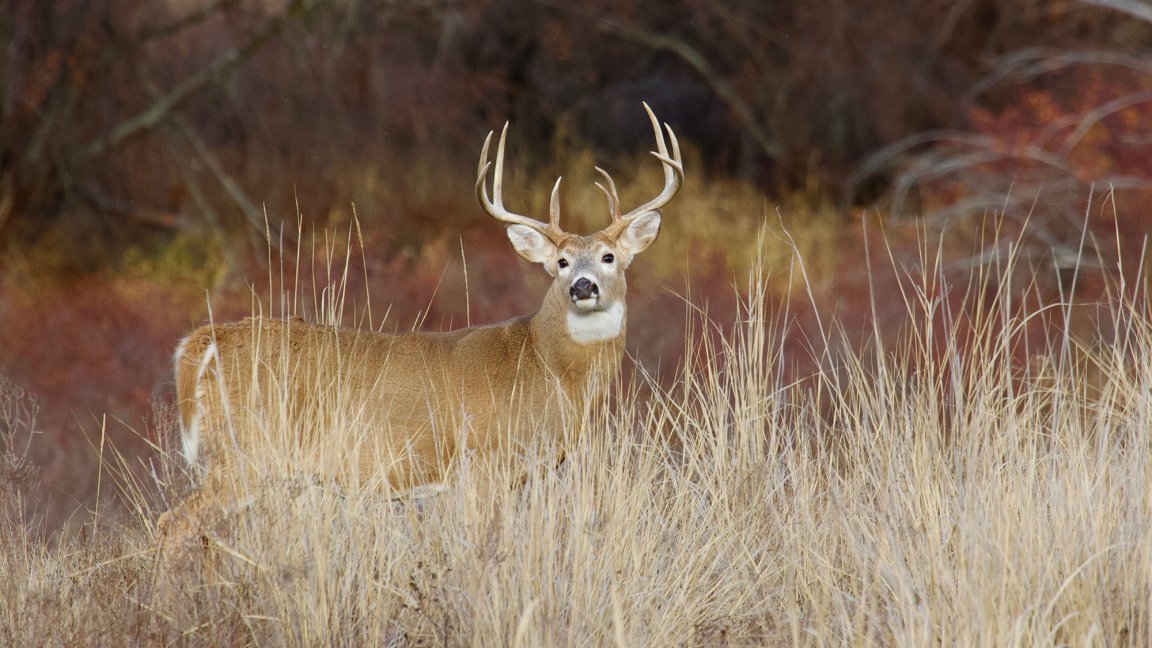
These days, a buck can’t grow to trophy proportions on hard-hunted public lands by folding up under the pressure exerted by the opening-day crush of hunters. A whitetail lives the 3½ years necessary to grow a bragging set of antlers by learning to cope with the annual influx of hunters during the season’s first days. Every opening day that the buck survives increases his chance of surviving the ensuing openers, as well.
Some big bucks live in locations that allow them to avoid the opening weekend crowd by slipping into the sanctuary offered by state parks, game refuges or private posted land. Others crawl into the most inaccessible and gosh-awful cover their “territory” has to offer — the kind of place hunters walk around, rather than through — and stay there until the crowds leave. And on more than one occasion, I have found a bruiser buck in a tiny, secluded patch of isolated cover — the kind of place most hunters never think to look in.
But the whitetail is a homebody at heart, and he is most comfortable on his loosely defined home turf. You can bet that once the steady crack of opening day rifles slackens to only an occasional pop, those big bucks will be right back to business as usual. And that is the precise reason why your best chance for bagging a wall-hanger occurs after the opening day madness has subsided.
Where you begin your search for that after-the-opener buck hinges upon one factor: the rut. Many states plan their firearms seasons to coincide with the rut, offering their hunters every opportunity to harvest the surplus bucks. Other states, bound in tradition, open the season after the main rut has ended. If you are planning to travel out of your home state to hunt whitetails, it makes sense to hunt a state where the season coincides with the rut, all other criteria being equal.
Hunting During the Rut
A mature whitetail buck is a different character during the rut than he is after it. A buck’s sole purpose at that time is to procreate, and this he does with obvious enthusiasm and the stamina of a teenager. There are stories abounding in every deer camp in the country of the crazy antics performed by bucks under the spell of the “rutting moon,” such as lovesick bucks strolling across open fields in broad daylight. Others tell tales of bucks putting their noses to does’ tracks and following those tracks, even after being shot at and missed several times. Rut-crazed bucks, while under the influence of a powerful rush of hormones, have even been known to either pick fights with or attempt to mate with assorted farm livestock.
So rampant are the stories that I’m afraid there exists a whole contingent of deer hunters laboring under the false assumption that all a hunter needs do to down one of these crazy buggers is to walk into the woods, lean up against a stump and wait for one of the poor, sex-addled dummies to saunter on by. Although such tactics work just often enough to keep the myth perpetuated, plenty of hunters have been sitting against stumps for more unsuccessful years than they will probably admit, and they’re still waiting for a buck to wander by.
Hunting whitetails during the rut and after the opening weekend of the season isn’t easy. You must employ all of the skill and woods savvy you have. Any breaks you receive because of a buck’s overactive glands should be considered a bonus.
After the opener, I refine my hunting strategy for big bucks by determining what stage the rut is in. This is important because the stage of the rut will determine where I concentrate most of my midweek hunting efforts.
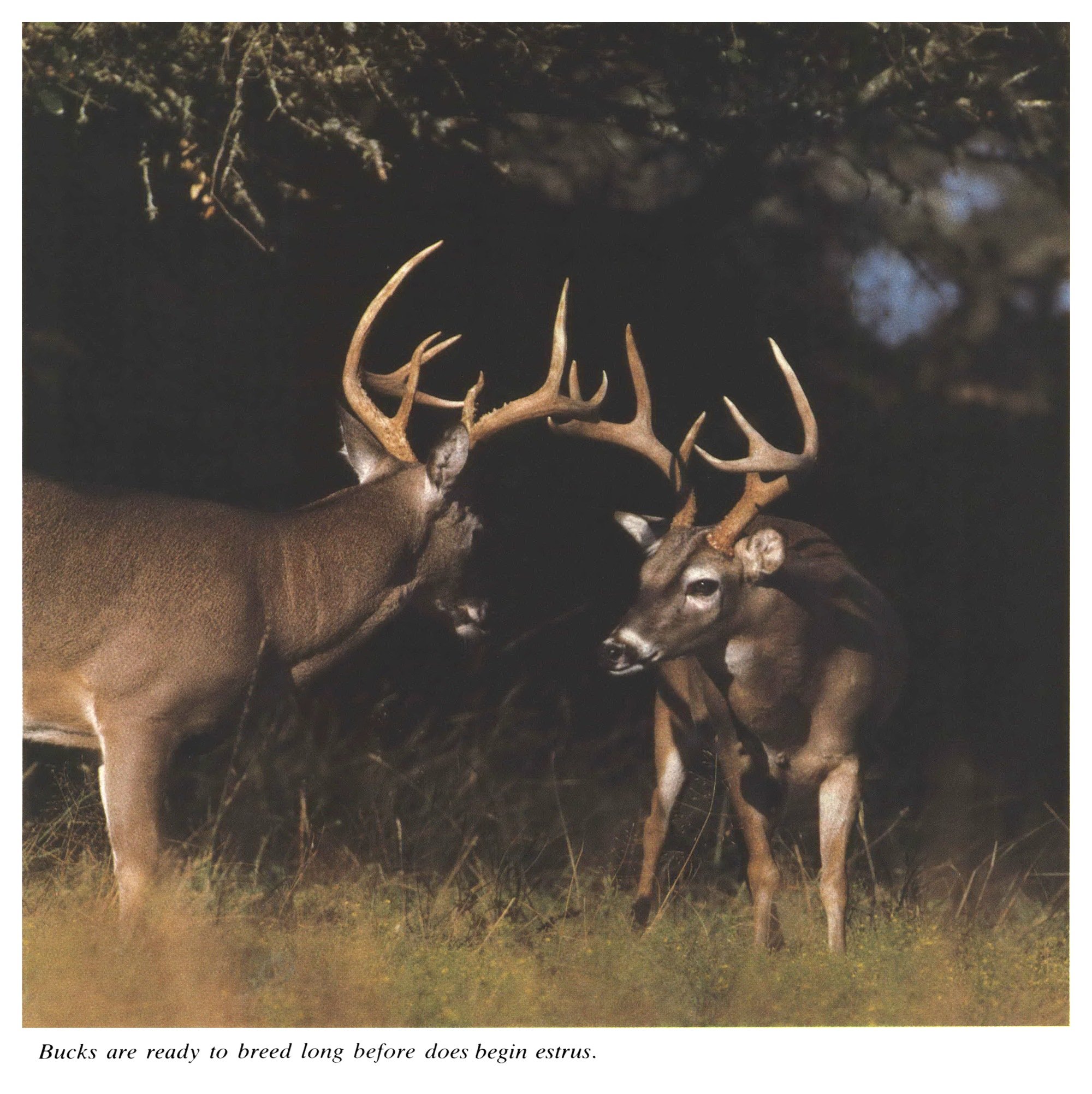
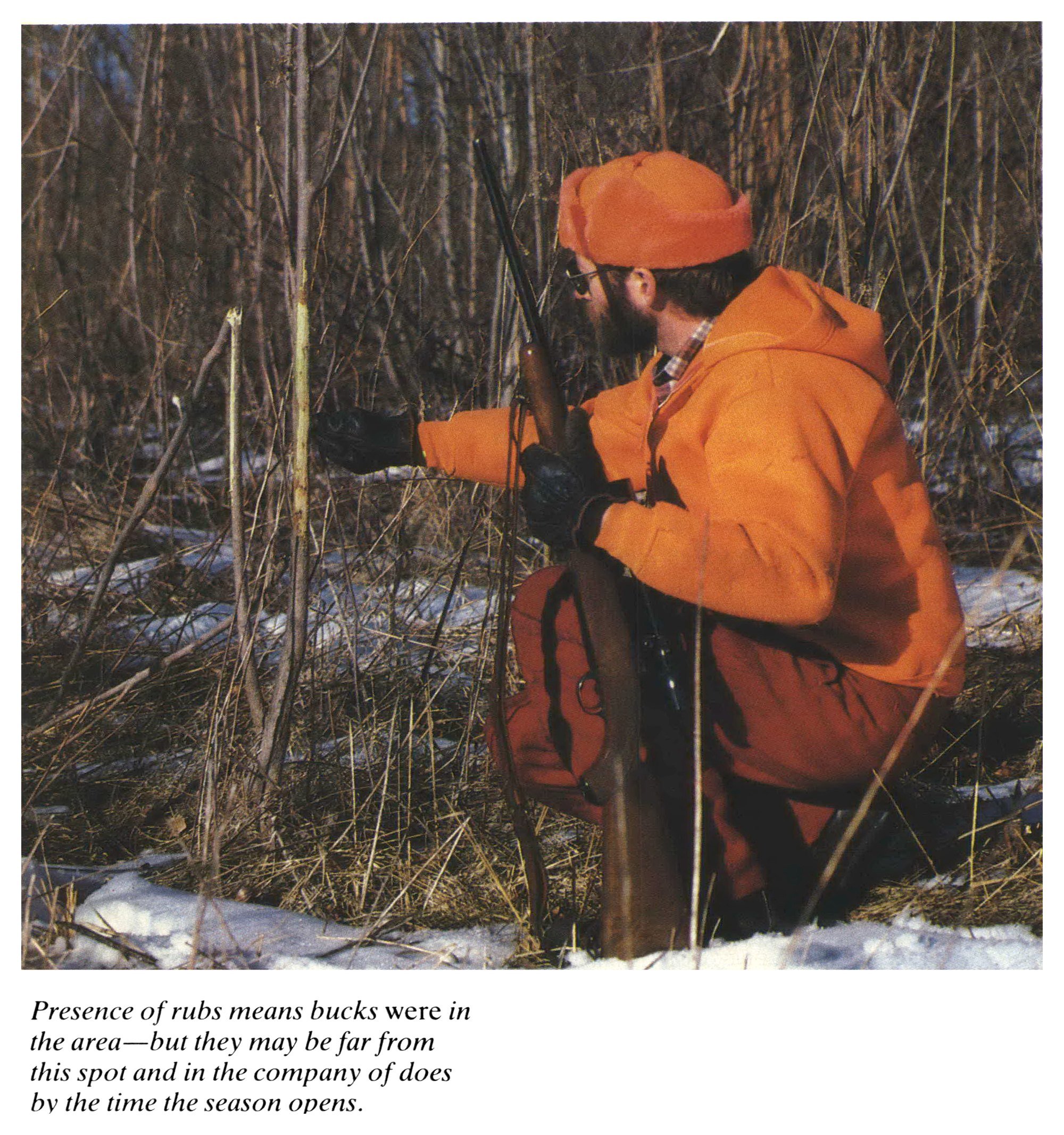
The whitetail buck is ready to breed long before the first doe enters estrus. During this period, the buck runs off excess energy by beating up saplings, sparring with bushes and, on occasion, duking it out with other bucks. In the process of making rubs on bushes and trees, the buck deposits scents that tell the rest of the whitetail community who was there.
Scrapes begin to show up in increasing numbers as the level of testosterone builds in the buck’s system. The buck paws out scrapes and leaves his scent both in the bare earth of the scrapes and on overhanging branches above the scrapes. Again, this is a means of communicating with other whitetails. The message to does is that the buck is now standing at stud, and it tells other bucks that they had best move along if they know what’s good for them.
A buck will paw out most of his scrapes in areas where they are most likely to be seen or smelled by does. Openings in woods, old logging roads and the edges of woodlots are common places to encounter scrapes. A buck may make a dozen or more scrapes, and he’ll check some of them daily, making sure they are free of debris and liberally doused with musk/urine. These are the scrapes to hunt over.
However, once the does begin cycling into heat, the dominant bucks that handle the bulk of the breeding chores are often so busy accompanying, tracking and servicing does that they neither have the time nor the need to freshen their scrapes. But if you find a string of scrapes that have not been freshened for several days, it doesn’t necessarily mean that the rut is over or that the buck that made the scrapes is hanging from someone else’s game pole. It may mean that the buck is out doing his job.
The best way to determine what stage the rut is in is to spend a day or two in the woods prior to the hunt. If fresh scrapes abound, you will be hunting the pre-coital period, and a stand near a scrape line is going to be hard to beat. If, on the other hand, you find that more than half of the scrapes are old and abandoned, it’s a good bet that the big bucks are out taking care of the does, while the lesser bucks are still hanging around their scrapes, waiting.
If you just don’t have time to get into the woods prior to the season, you can get a good idea about the stage of the rut by speaking with area game managers, milk haulers, rural school bus drivers, postal carriers, loggers, trappers, farmers, grouse hunters, bowhunters or others who spend most of their time in deer country. If the bucks are chasing the does, chances are these people will have observed some of the activity.
Why all of the fuss over determining what stage the rut is in? Because it makes a big difference when you have to decide how you want to hunt after the opening weekend of the season.
When the season begins, if the actual breeding season has not yet begun but bucks are busy pawing out new scrapes and freshening old ones, chances are the bucks will curtail this activity during the high-pressure days at the beginning of the season, resuming their rounds once the hunters thin out. I like to have at least a half-dozen scrape lines pinpointed prior to the opener, and I check them after the opening weekend for any sign of activity. I then concentrate my hunting efforts near the “hottest” scrapes.
If your pre-season scouting and snooping indicates that the actual breeding season is in progress, then hunting over scrapes may not be your best option for tagging a really good buck. Remember, it is often the big, dominant bucks in the area that handle the bulk of the breeding chores. Even in an area with an excellent buck-to-doe ratio, a breeding buck can be kept so busy that he has little time or need to tend his scrapes. Often, a buck will spend 24 hours with the same doe, breeding her several times before her cycle ends. At this time, it is the doe, not the buck, that determines where the pair will travel. Though I would not totally rule out hunting in the vicinity of inactive scrapes at this stage of the rut, there are other options that I’ve found give me a better chance at tagging a big buck.
One of my favorite methods during this period is to concentrate my hunting efforts in areas where I have encountered good numbers of does in the past. Does and fawns tend to hang around together, and they routinely congregate in specific areas, often bedding as a loosely knit group in a favorite swale or sunny hillside. I can’t direct you to these “ladies-only bedrooms,” but I’ll bet there is such a place in the chunk of woods you hunt.
You can locate these places that hold special favor with the does by simply noting those areas where you encounter the most doe activity. After a few years of hunting the same ground, a familiar pattern becomes apparent.
On several occasions, I have located a hotbed of doe activity by simply listening to other hunters. When you hear a hunter complain that he sat on his stand and saw 15 does but not a single buck, find out where he was sitting. You can bet that when the time is right, there will be a buck or two sniffing around the vicinity.
A dominant buck ranges well out of his home area during the actual breeding season. I don’t think he goes out of his way looking for does so much as he is drawn out of the territory when following the tracks of a doe that has visited his scrapes or just wandered through the area. A buck engaged in this activity moves with a single-minded purpose, shuffling along, nose to the ground, seldom looking up, intent upon finding the maker of the tracks he is following. I once missed a buck that trailed a doe past my tree stand in this manner, my arrow slicing harmlessly over the buck’s back only to skitter noisily through the carpet of dry oak leaves a few yards beyond. The buck lifted his head and looked in the direction of the commotion. Apparently satisfied that whatever had made the racket was not what he was looking for, he then ambled on his way while I frantically fumbled around trying to nock another arrow.
When a buck finally tracks down a doe, as often as not, she will then lead the buck on a little chase that, in all likelihood, will take the buck still farther from his home base. By the time the buck actually mates with the doe, he may be miles from his original starting point. On the way back to his core area, it is not unlikely that the buck will cut the track of another “hot” doe and repeat the scenario.
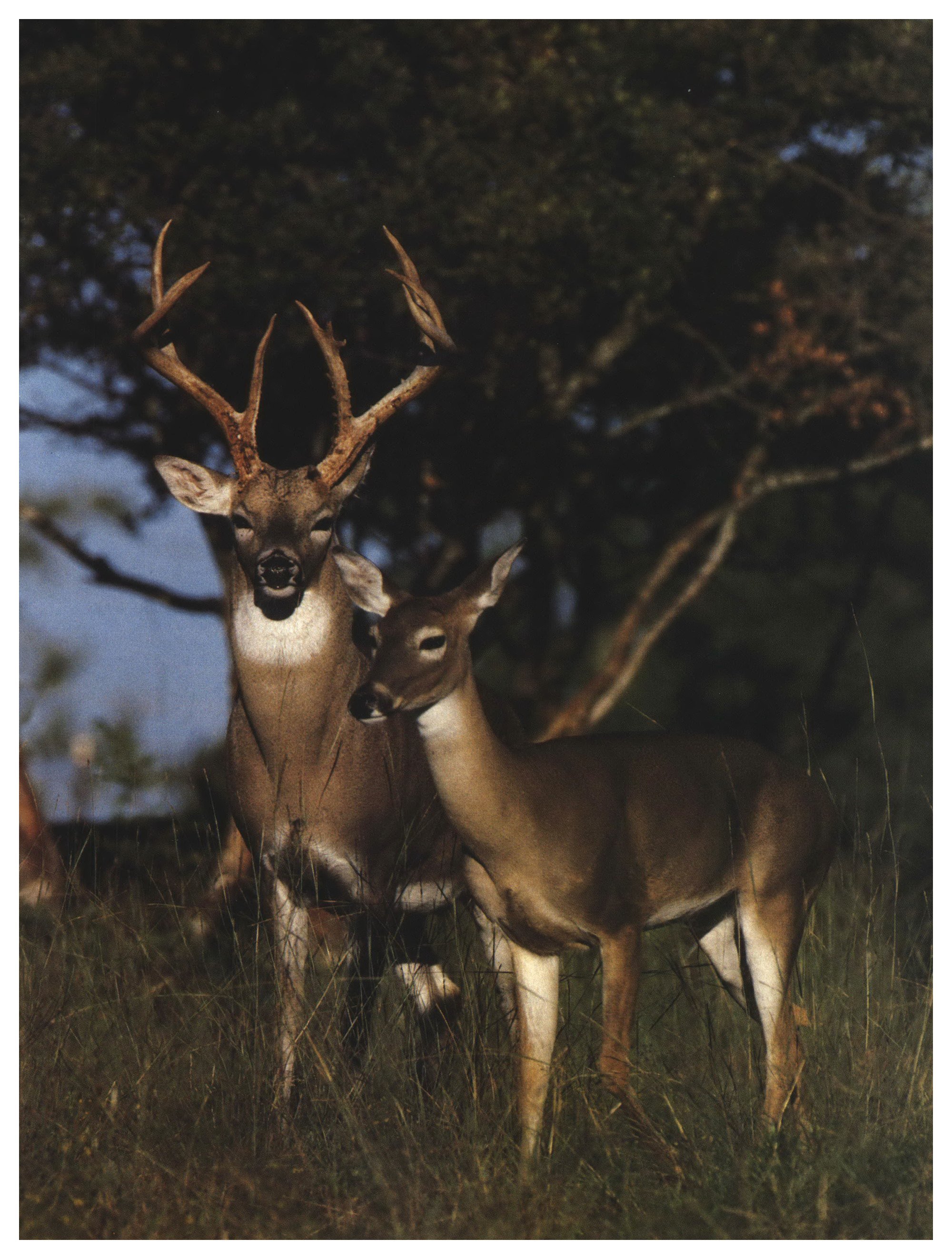
All of this rambling makes it impossible to pattern a buck during the height of the breeding season, prompting many knowledgeable whitetail hunters to claim that taking a good buck during the peak of the rut is mostly a matter of luck. I disagree.
Hunting near a known “doe hangout” can help. And you can stack the deck in your favor even more by hunting a funnel area near a concentration of does. A funnel is simply any natural or man-made feature of the terrain that restricts the movement of deer. An hourglass-shaped section of woods is the classic funnel. Deer moving from one wide portion of the hourglass to the other must pass through the narrow waist. In farm country, the funnel may be a brushy fenceline connecting two woodlots. In the rugged country of the West, where whitetails are becoming increasingly common, a jutting jaw of sheer rimrock can force whitetails into a confined passage. Funnels work well because even though a buck with a snootful of “hot” doe scent wouldn’t care if he was standing in the middle of Madison Avenue, the does do not lose their heads. Does will stick to cover when on the move, even when there is a grunting, panting Romeo dogging their every move.
Hunting After the Rut
In many whitetail states, hunters are left with no choice but to hunt well after the main rutting period is over. At first, hunting after the opening weekend under these circumstances appears to be a futile endeavor. Without the promise of the rut to keep the bucks on the move, and with the absence of hunters to jar deer loose, what chance does the midweek hunter have of scoring on a decent buck? He has a pretty good one, I would say.
First, although the bulk of the breeding chores are completed in about a two-week period, there is still some activity after the main rut is over. Does that were not impregnated will cycle back into heat 28 days after their first estrus cycle ends. In some states, this is just about the time the rifle season rolls around. In addition, in some of the best whitetail areas, it is not uncommon for female fawns of the year to breed. This often applies to as many as 40 percent of them. Frequently, these young breeders experience their first estrus cycle later than older does. So, don’t strike out the possibility of the rut working in your favor even though the peak has passed. In that part of Minnesota where I live, the bulk of the breeding is completed by mid-November, yet each year, I find active scrapes late into November and even December. Last season, during an especially mild December, I found a pair of bushel-basket-size recently freshened scrapes while hunting grouse on New Year’s Eve day. If you can find these “late scrapes,” concentrate your hunting efforts near them.
But even if you fail to find any of these scrapes later in the year, you still stand a good chance of tagging a buck during the middle of the week if you let the after-effects of the rut work in your favor. During the rut, a buck takes little time out to eat. By the end of the breeding season, a buck that began the rut in peak condition can be drawn and thin, actually haggard looking. Some bucks lose up to 20 percent of their body weight during the course of the rut. Across the Northern states and Canada, where winter-kill is an annual problem, the big, breeding bucks follow the fawns in death each winter simply because they run off all of their reserve fat during the rut and are often unable to replenish it before the onset of winter snows.
Although the largest bucks are often nocturnal in their feeding habits at other times of the year, when the rut is over, dominant bucks cannot afford to limit their foraging to the hours of darkness alone. In order to regain their strength and put on the layer of fat necessary to see them through the winter, they must forage during the day. This gives the after-the-opener hunter the chance he needs to find bucks up and about during shooting hours.
This need to feed heavily does not necessarily mean that a big buck will be found sauntering around an alfalfa field at high noon, scarfing down the last frost-tinged greens of the year. It does mean that rather than tucking himself safely away in a thicket long before the morning sun ever peeks over the ridge, a buck will now tend to linger at the feeding grounds longer in the morning. Does and fawns often feed for an hour after sunrise, and now, bucks will begin to do the same. In the evening, when they normally would not begin feeding until complete darkness had fallen, bucks will now arrive at the feeding sites earlier — often in that last precious minute of shooting light.
Even at midday, the big boys will not be content to simply lay in their beds and chew their cuds. I have noticed that once the rut is over, bucks are much more likely to rise from their beds and spend an hour or two at midday — often between 11 a.m. and 2 p.m. — browsing near their bedding sites.
All of this daylight activity is a big plus for the after-the-opener hunter who must depend upon natural deer movements, rather than other hunters, to put a buck in front of him. The natural inclination is to hunt from a stand near the feeding area, but this is a mistake when you’re after mature bucks. A big buck is constantly alert, using each of his senses to detect the slightest hint of danger. Never is a buck more alert than when he is feeding during shooting light because he knows he is most vulnerable then. The bucks I have observed feeding during the season have been wound-up tighter than a watch spring and ready to snap at the slightest provocation. One miscue on your part, whether it is movement or scent or whatever, will send him running. I try to avoid known feeding areas, and I concentrate my efforts near the bedding areas.
Hunting near the bedding area means that any shot I take will most often be attempted in good light. That’s important for a clean kill. A buck may not arrive back at his bedding area until the sun is an hour high in the morning, and he may leave his bed to begin a dawdling trip to the feeding area in late afternoon. Instead of risking a poor shot at a shadowy form in the gray gloom of dusk or dawn, I take my shot when the light is in my favor.
Also, by concentrating my efforts in the vicinity of the buck’s daytime haunts, I have a better chance of catching him up and about during the midday hours. If I am forced to move into the bedding area and take a stand at mid-morning, I risk detection by the buck. But if I move into my stand in the dark and set up quietly, I double my chances of scoring. If I fail to take the buck as he returns from breakfast, I will be there waiting when he gets up for lunch or dinner.
But you don’t have to confine yourself to a stand. If conditions allow for quiet stillhunting, I like nothing better than to either prowl the edges of a buck’s daytime haunts or simply tread my way along a ridge littered with the acorns of the white oak, moving only a few yards at a time and stopping often to look, listen and feel. Often after the crowds of opening day are gone from the woods for another year, it is just me and the deer — one-on-one. And that’s the way I like it best.
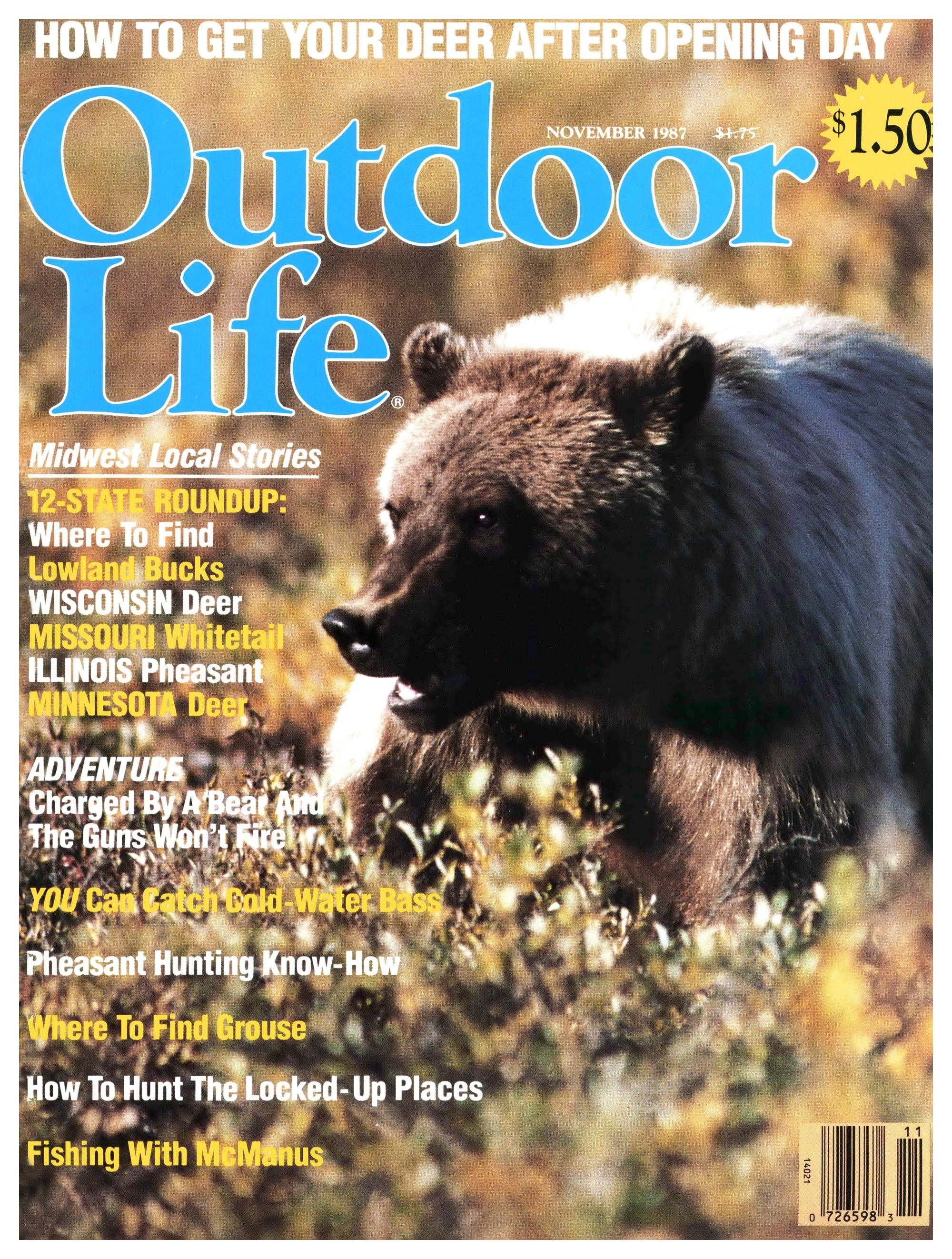
This story, “After Opening Day,” appeared in the November 1987 issue of Outdoor Life. Read more from this series: