

“Neighbor down the road had a squirrel dog,” said Larry White as he led a cast of dogs and hunters to the woods. “Got its legs cut off by a mowing machine. Had to hunt that dog from a wheelbarrow.
“One day a friend asked to borrow the dog, so the owner explained that you had to push the wheelbarrow in whatever direction the dog pointed his nose. If he barked, the track was hot, so you pushed faster. When he looked up and barked, he had the squirrel treed and you got a shot. The friend came back late that night with no squirrels. His clothes were torn to shreds and his skin was scratched up and looked like a road map. ‘What in the world happened to you?’ the hound’s owner asked.
“‘What’s it look like?’ the friend snapped. ‘Your fool squirrel dog hit a deer and we ran that thing all day long!'”
Larry White was judging a cast in the 1981 World Champion Squirrel Hunt. His tale got a laugh, but it also emphasized the importance of handler/dog teamwork in any form of hunting.
A good squirrel dog works for the hunter by locating squirrels through scent on the ground and on trees as well as by seeing and following bushytails moving through the treetops. The dog’s manner of barking signals its degree of progress to the hunter. A good hunter works for the dog by staying keenly and constantly aware of what the barking means and by following almost within sight so he can get to the tree quickly and shoot the squirrel before it escapes.
Good competition squirrel dogs are more decisive, accurate and consistent than average squirrel dogs. They do the job with less wasted time and motion.
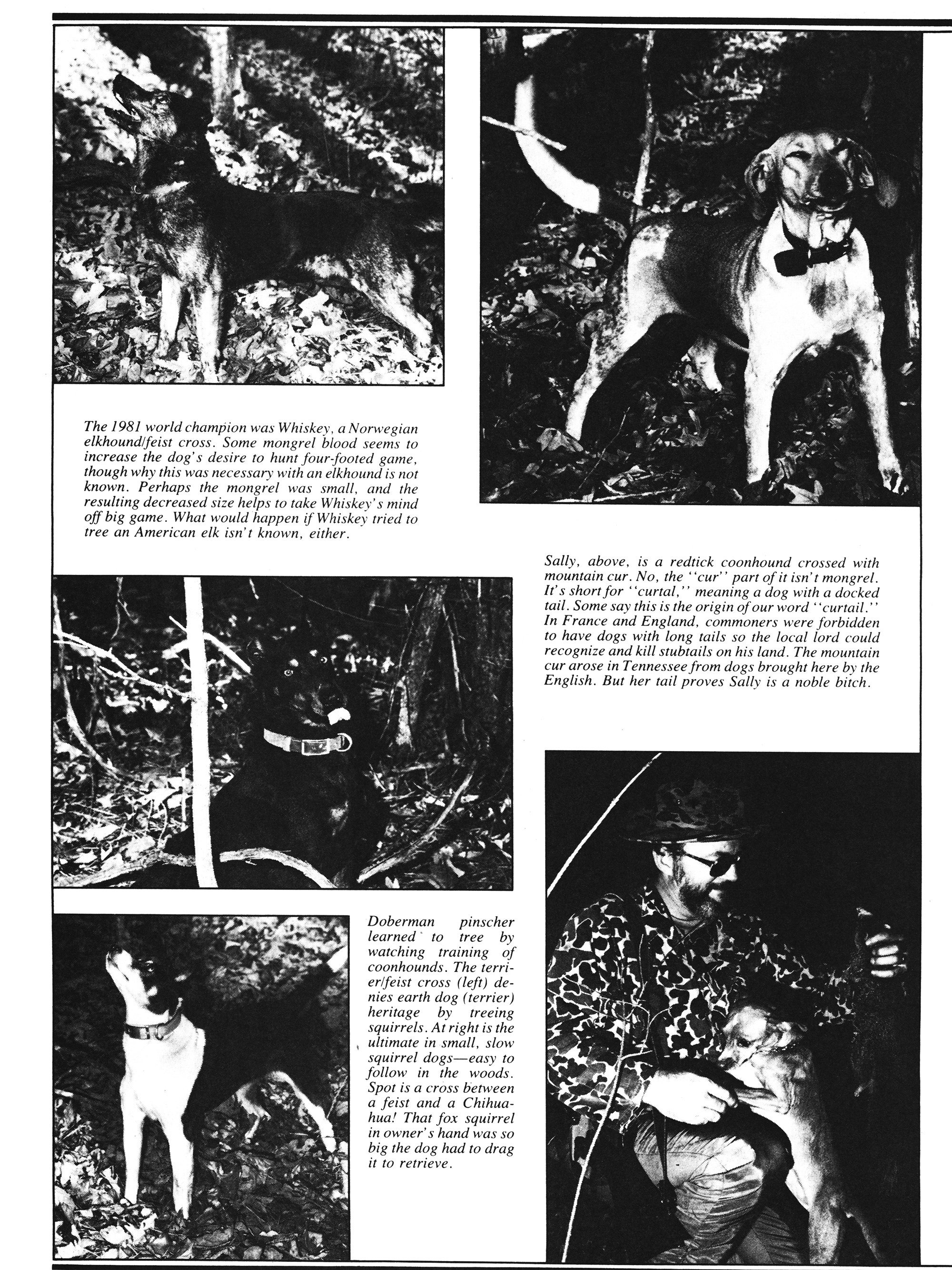
Squirrel-treeing talent always has been wherever you found it, but these days some unusual dogs are showing up in the woods. Chuck Trehern’s purebred Doberman pinscher learned to bark up a tree by watching the family coonhounds. Ronnie Liles’ 6-year-old Australian shepherd, Smokey, was never taught: he just started treeing squirrels. T.C. Jones won the 1980 Championship with a registered liver and white English pointer! Trophies similar to bowling trophies are awarded. The statuettes portray a dog barking treed.
Most squirrel dogs are not pedigreed, however. Two Illinois dogs were described as terrier and feist crosses. Randy Pannell, who trains 15 to 20 squirrel dogs every year, came over from Blue Springs, Mississippi, with a redtick coonhound/mountain cur cross. Fola Hart brought a Norwegian elkhound/feist cross from Virginia. And the 1981 winner was Orville Hart’s “Whiskey,” a 4-year-old Norwegian elkhound/feist from Leesburg, Ohio.
Feists, those wiry little mongrels that are intelligent enough to learn any job on the farm, are becoming rare because most people prefer to keep purebred dogs. As a result, many squirrel hunters are making their own mongrels by crossing two different purebreds. There’s a constant search for the best dog, and that’s one reason why Dick Sheets thought up the World Champion Squirrel Hunt.
Sheets reasoned that squirrel-dog competition would not only preserve and enlarge the sport, but that the dogs would improve through breeding. Perhaps breeds of purebred squirrel dogs of consistent ability would emerge from such an effort. The Yockanookany Coon Hunters Association of Ethel, Mississippi, agreed with Sheets and sponsored the first championship in 1980.
Yockanookany is Choctaw for “crawls on belly like snake” and also applies to the way hunters must cross a spongy swamp. The 100-mile-long Yockanookany Swamp is just two miles from the club grounds.
By 1981, competition had already influenced squirrel-dog breeding. L.E. Goutierez came over from Louisiana with two pups out of the 1980 second-place winner. The pups’ dam was Spot, his own small Chihuahua/feist cross.
Goutierez arrived a day early, pitched his tent and drove his dogs down the old Natchez Trace to the nearby woods where they could become accustomed to hunting new territory. The original Natchez Trace, which was once an extensive trading trail between the Indian tribes, runs right past the Yockanookany club grounds. The entire area is well forested with both hill-country and creek-bottom squirrel habitat.
Little Spot ran through the woods with her nose slightly down, searching for scent on the ground, on logs and on fallen limbs. Every tree got a sniff as she trotted past. But the squirrels weren’t moving. When Spot finally barked, L.E. didn’t become excited. “She scatter-barked,” he said. “It’s a cold track.”
Scatter barking is barking here and there instead of barking enthusiastically in one place such as on a hot trail or at a tree.
By the end of the championship hunt, Goutierez had learned one more thing about breeding squirrel dogs. “Have to get more size in my dogs,” he said. “My dogs can’t compete with the longer-legged, wider-running dogs.”
Four dogs were cast together in the first running of the championship in 1980 and many handlers thought that that was three too many. By nature, squirrel dogs do best alone. They’re highly intelligent, very independent and more than a little jealous of their relationships with their human partners. In 1981, a compromise was struck: only two dogs to a cast—male and female, if possible—and in weight categories of under and over 35 pounds.
The only reported fight occurred when the Doberman’s handler decided to be gentlemanly and let his competitor’s dog smell the dead squirrel, too. Getting to smell the squirrel is an encouraging reward of sorts and the Dobe was not ready to share that with another dog.
An impartial judge accompanies each cast, but it is up to the handler to “call” his own dog—that is, notify the judge when satisfied his dog has treed. As in coonhound competition, 100 points are earned by the first dog at the tree, 75 by the second. Unlike coonhound scoring, no points are awarded for striking (finding) a trail. This is because sometimes the trail is short, sometimes there is none and too many squirrel dogs are silent trailers. Also unlike coonhound scoring, tree points are not subtracted if no squirrel is found in the tree because squirrels all too readily travel from tree to tree.
If the squirrel is not found, the tree points are circled and do not count on the final score. Judges are allowed considerable latitude, however. If the squirrel is seen several trees away from the one the dog is treeing on and the judge is satisfied that the squirrel could have gotten there through the treetops, he can give the dog credit for that squirrel.
Six or eight squirrels an hour is not impossible in well-populated timber when the bushytails are really active. Ronnie Liles’ Australian shepherd treed 700 for him and his friends during the past two years. “The trick,” said Liles, “is to catch ’em stirrin’. You might not see a squirrel today. But you can come back through the same place tomorrow and see 10.”
Ronnie believes that the old hunters’ barometer, “If the cows are lying down, so are the deer,” also applies to squirrels. And as he says, the dogs are helpless if they can’t see, smell or possibly hear the bushytails. The squirrel that hasn’t been on the ground and is lounging on a limb or in a vine tangle probably won’t be discovered by a dog unless falling air currents allow the dog to “wind” it. This would happen mostly during the cool of late afternoon rather than during early morning when the warming sunlight causes air to rise.
Liles prefers hunting little cat squirrels (grays) in the big, swampy, bottom timbers. Shaking a vine spooks grays out of hiding faster and easier than it does fox squirrels. Other hunters choose the hills where more fox squirrels live because they don’t like the way grays often chase off through the treetops when a dog barks.
Randy Pannell minimizes that problem by staying fairly close to his dog and then getting to the tree fast. In competition, however, that’s not always possible. The second dog has five minutes in which to join the first dog at the tree. During that time, handlers and the judge stay clear.
Both Pannell and Fola Hart demonstrated the wisdom of walking apart from other hunters. At 79, Fola appeared to be walking far behind because of age. But he was the first to hear his dog bark treed while other members of the cast were busy talking.
The perceptive rapport between hunter and squirrel dog is nothing less than amazing. During a Friday afternoon cast, Orville Hart was reluctant to say that Whiskey had treed. “Them two dogs are looking at us,” he observed. “If they believed they had the squirrel, they’d be looking up the tree!”
When a squirrel was shot in Ronnie Liles’ cast, Smokey grabbed it and ran off with the second dog in hot pursuit. As Smokey raced past his master’s leg, Ronnie grinned. “That dog expects me to catch the other dog as it goes by. Then Smokey will bring me the squirrel. He won’t let the other dog have it. But if another dog gets to the squirrel first, Smokey won’t bother it.” Retrieving is an added nicety, but it isn’t rewarded with extra points during the Yockanookany competition.
Some dogs won’t bark if their masters happen to be present when the squirrel is treed, strongly suggesting that they have enough reasoning power to recognize that, in such a case, the boss doesn’t have to be called.
Read Next: The Ultimate Guide to Buying and Training a Squirrel Dog
One Mississippi hunter recalled a boyhood dog that would always dance around the opposite side of the tree, yanking and shaking every vine or sapling it could find. Invariably, this commotion chased the squirrel around to the gunner’s side. Since such a dog is quite rare, hunters often go in pairs, taking turns circling the tree and shaking the bushes after the dog has treed.
What’s it take to train a dog that shows interest in squirrels? Mostly, lots of time in the squirrel woods. But trainer Randy Pannell speeds things up with a slingshot and steel pellets. “Just hit the tree near the squirrel, and it will bail out or take off,” Pannell said. “The dog gets a sight chase through the treetops or maybe a short ground chase. This works best with gray squirrels, especially the young ones. And there’s no problem with game laws while training dogs because you’re not killing or hunting the squirrels.”
Never study treetops when the dog is in sight and isn’t treeing. A perceptive dog believes you see the squirrel and will start treeing. And never bring the dog running by shooting at something other than a squirrel. Fooling a squirrel dog ruins it fast.
The Yockanookany fox squirrels are flat out the most colorful in America. Some are rusty orange, as expected, but others are decorated with white noses, feet and tail tips and, occasionally, black scalps. Others are solid black. Two taken during the 1981 Championship were black with white tips. Southern grays are smaller than Northern grays, but the fox squirrels are bigger. Some, according to reliable reports, grow half again as big as their Northern counterparts and range—according to very unreliable exaggerations—up to the size of house cats, groundhogs and raccoons.
Yankee squirrel hunters are treated so many different ways during the Yockanookany event that they have to like some. They travel from as far away as Michigan to enter the event. “We welcome Yankees; it’s only the Damn Yanks we don’t like,” said one young Southern belle with a wink.