
We may earn revenue from the products available on this page and participate in affiliate programs. Learn More ›
It is a peculiar quirk of human nature that we tend to ignore the most common items of our lives while striving to learn all we can about obscure things and events. A good case in point is the omnipresent .22 rimfire cartridge. There are more .22 rimfire rifles and pistols around than any other caliber of firearms. More .22 rimfire cartridges are fired than all other calibers combined, and ammunition makers have spent more time and money developing and improving the little .22 than any other shell. We shoot them by the millions, yet we know very little about the cartridge that is, by any odds, the all-time favorite.
For example: Who invented the .22 rimfire? Where? When? How does the accuracy of the .22 compare with other calibers?
The warning on a box of .22s says “Danger, RANGE ONE MILE, Be Careful.” Will a little .22 really shoot a mile?
There’s a lot to know about the .22 rimfire, and everything we learn is bound to increase our appreciation of this wonderful gun.
The .22 rimfire is so vital to the shooting scene that if it did not exist, to paraphrase Voltaire, it would have to be invented. In fact, the necessity for just such a cartridge is exactly what caused a young French gunsmith, Louis Nicolas Flobert, to begin experiments with small-bore rifles back about 1845.
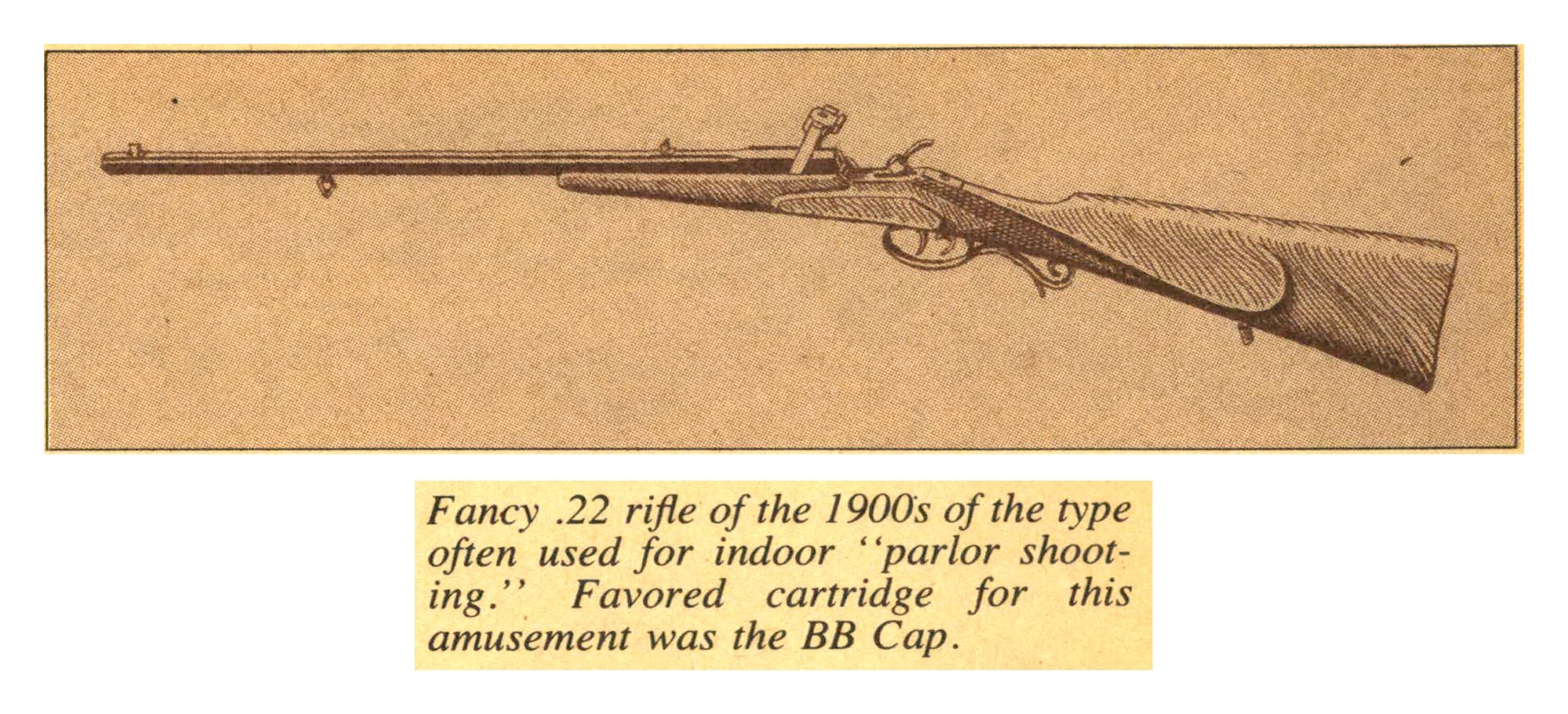
In those days well-to-do ladies and gentlemen liked to pass a cozy evening practicing a bit of refined target shooting with air powered rifles and pistols. Since the air powered guns make little noise and practically no muss they could be conveniently fired indoors. In fact, the amusement came to be known as “parlor shooting.” If you were invited to someone’s home for an evening of parlor shooting you were expected to wear your best coat or ball gown and behave accordingly. It was a refined pastime. Tea would be served along with a pastry or two, and the modest winner would be toasted with fine cognac.
This story, “.22 Rimfire: The All-Round Lightweight,” appeared in the December 1980 issue of Outdoor Life.
The problem was that the air powered guns of that time were hand-built by a few select craftsmen and very expensive. Sizing up the commercial prospects offered by parlor shooting, Flobert saw the need for less expensive low-powered rifles and pistols. So he built a few small-caliber guns that fired tiny bullets and very small charges of black powder. The projectiles were easily and safely stopped by almost any improvised backstop. But these guns didn’t work out well. Even the smallest charges of black powder produced sooty, foul-smelling smoke. After a few shots the parlor was as smoky as a poolroom, and particles of burned powder soiled the drapes and carpets and the ladies’ white gloves. Some other approach was needed.
Flobert then got the idea of pressing a lead ball into the open end of a musket-size percussion cap. The force of the fulminate explosion, he reasoned, might propel the ball with enough velocity for indoor shooting without the black powder smoke. It worked like a charm. The next step was reshaping the musket cap into a rimmed cartridge case and building a breechloading rifle to fire it. He quit his job and founded a gun making firm of his own that manufactured not only parlor rifles but hundreds of thousands of inexpensive .22-caliber rimfire plinking rifles.
One thing that remains to be answered is how Flobert happened to settle on 22/100 of an inch as the bore size for his little rimfire cartridge. Why not .20, say, or .23? Well, this is just one of those accidents that make history. During his experiments Flobert used round lead shotgun pellets for bullets. The size he liked and used was French size 3/0 shotgun shot, which just happened to measure — you guessed it — .22 of an inch.
Rimfire Ignition and Cartridges
Though once a common form of ignition, rimfire cartridges have faded away until only the .22 version is popular. As the name suggests, the explosive priming mixture, which ignites the powder charge, is contained in the rim of the cartridge. Unlike a centerfire cartridge, which is fired only when the firing pin strikes the primer more or less dead center, a rimfire cartridge fires when the firing pin hits the rim at any point in its circumference.
During the last century the rimfire system was applied to some large caliber cartridges, but these became obsolete even before the coming of smokeless powder. Though relatively easy and inexpensive to manufacture, rimfire cartridges have disadvantages. They cannot be reloaded, and they are not as strong as solid-head centerfire cases. Thus, though ideal for the little .22, rimfire ignition is not practical for more powerful calibers.
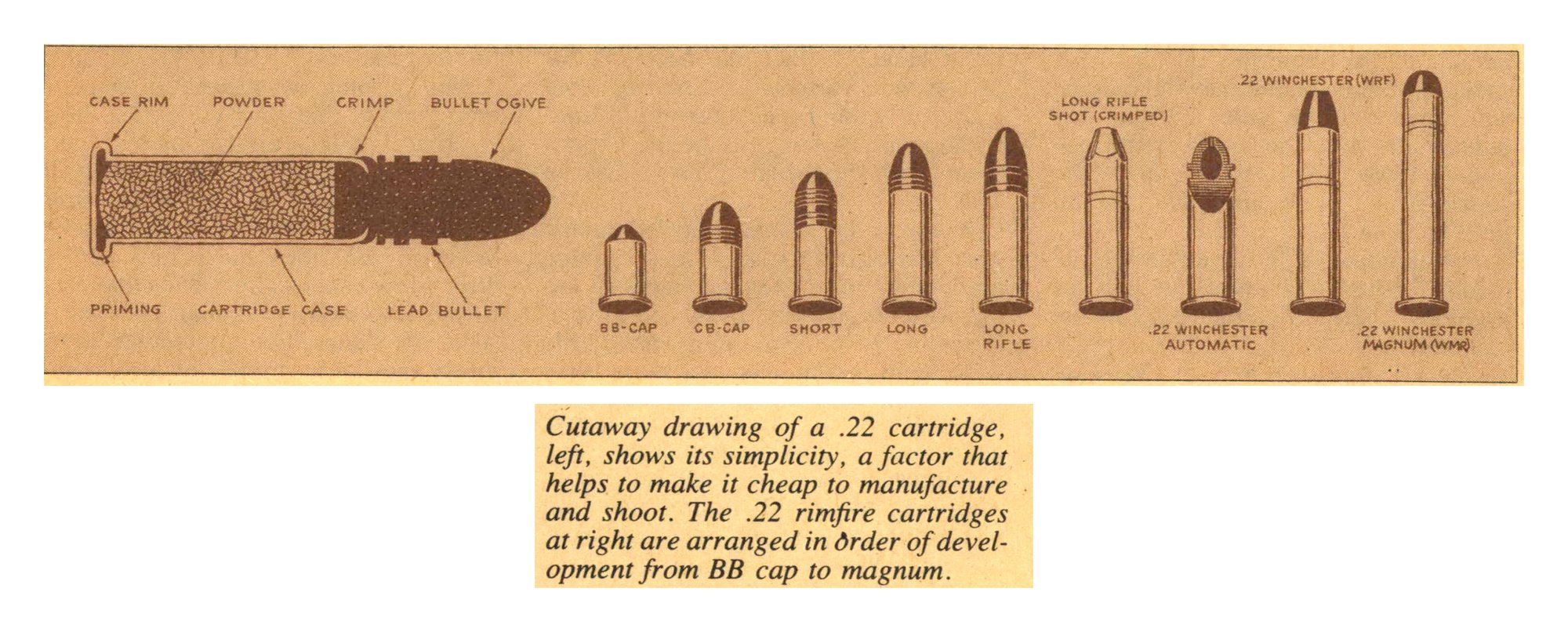
Though the original Flobert .22 rimfire shell, known as the BB cap, was loaded with a round lead ball propelled only by a priming charge, it was only a matter of time until gun makers built in a little extra power. In America, for example, ammo makers added a pinch of powder and gave the bullet a conical shape. This added pep gave the BB cap round enough power to kill mice.
American ammo makers no longer produce .22 BB cap shells, though they are still made in Canada and Germany. Modern BB caps have enough energy to shoot through an inch of soft pine. This is considerably more powerful than Flobert’s parlor ammo.
A somewhat more powerful .22 rimfire shell is the so-called .22 CB cap. CB stands for the 29-grain conical bullets with which they are loaded. Early CB caps were loaded with 1½ grains of black powder, but since about 1920, they have been loaded with smokeless.
A cartridge more familiar to American shooters is the .22 Short, which has been in continuous (since 1857) production longer than any other self-contained cartridge designed in America. Since it was first made for a Smith & Wesson revolver, the .22 rimfire cartridge has been widely rumored to be an invention of that company. But as we have seen, the .22 Short is only an outgrowth of Flobert’s invention.
From the time of its introduction until about 1920 the Short was the most popular .22 shell. Dozens of makes and models of rifles and pistols were chambered for it, including highly accurate target rifles. Originally it was loaded with a 29-grain conical bullet backed by 4 grains of finely granulated black powder. By the late 1880s it was loaded with smokeless powder, making it one of the first cartridges to be loaded with the new propellant.
Given the success of the .22 Short, it was only a matter of time until someone made a longer case, which would hold 5 grains of powder, and call it the .22 Long. This came to pass about 1870. In 1887, a longer and heavier 40-grain bullet was loaded in the .22 Long case. This is the popular cartridge we know today as the .22 Long Rifle, the most accurate and highly developed .22 of them all. Yes, a .22 Long case and a .22 Long Rifle are exactly the same length — .595.
Actually, the .22 Long Rifle was preceded by a round known as the .22 Extra Long. It fired a 40-grain bullet in a case that held 6 grains of black powder and was, therefore, somewhat more powerful than the Long Rifle. It proved a bit too long to function in some repeating rifle mechanisms, however, and became obsolete by the 1930s.
Winchester, when it introduced its first autoloading .22 rimfire rifle in 1903, had to deal with a perplexing problem. Rimfire ammo loaded with black powder was still available, as was the newer smokeless powder. It was essential that this new rifle be fired with smokeless powder ammo, because blackpowder residue would quickly foul the rifle’s complex mechanism and render it inoperable. But how to prevent the use of blackpowder ammo?
The solution was a new cartridge called the .22 Winchester Automatic. This round had about the same ballistics as the .22 Long Rifle but enough dimensional differences to prevent interchanging. Later, when blackpowder loads were no longer available, Winchester dropped the 1903 Autoloader and replaced it with the Model 63 Autoloader, which fired conventional .22 rimfire ammo. As it happens, Remington took pretty much the same course when it introduced the Model 16 Autoloader in 1914. This version of an “automatic” .22 was called, naturally, the .22 Remington.
In the meantime, about 1890, Winchester had introduced a special more powerful .22 rimfire cartridge called the Winchester Rimfire or, for short, the .22 WRF. This round had a somewhat bigger bullet and longer case than standard .22s, and considerably more killing power than other .22s of its time. Remington followed suit with a similar cartridge called the .22 Remington Special. Though the .22 WRF and .22 Special were loaded somewhat differently, they could be used interchangeably.
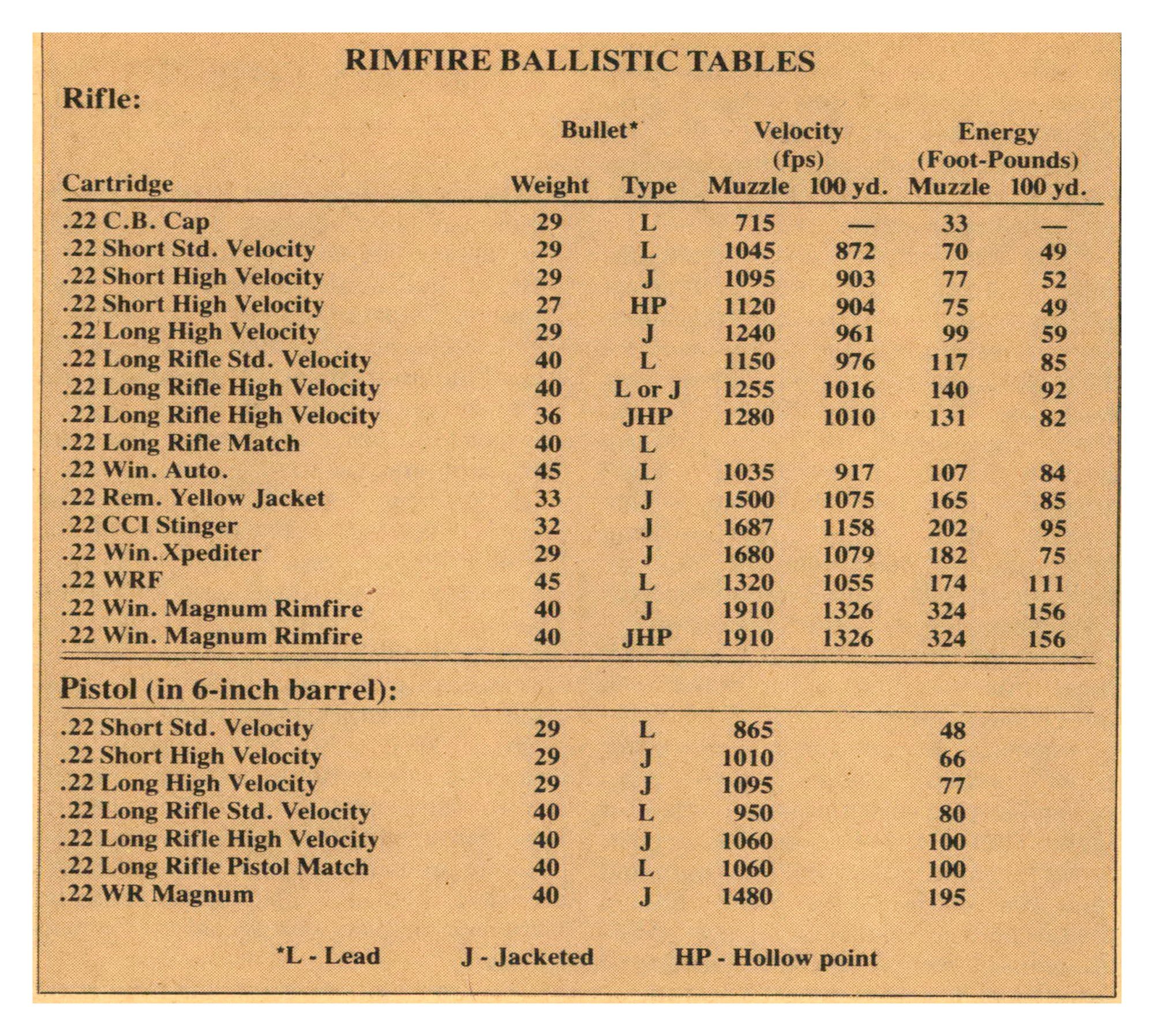
These two rounds faded away by the beginning of World War II, but an almost identical cartridge was introduced in 1959. Called the .22 Winchester Magnum Rimfire, this new version of the old .22 WRF has a muzzle velocity of 2,000 feet per second with a 40-grain jacketed bullet. Since the .22 Magnum generates much higher pressures than the old .22 WRF, the case is slightly different so that it cannot be fired in old .22 WRF rifles built for lower pressure levels.
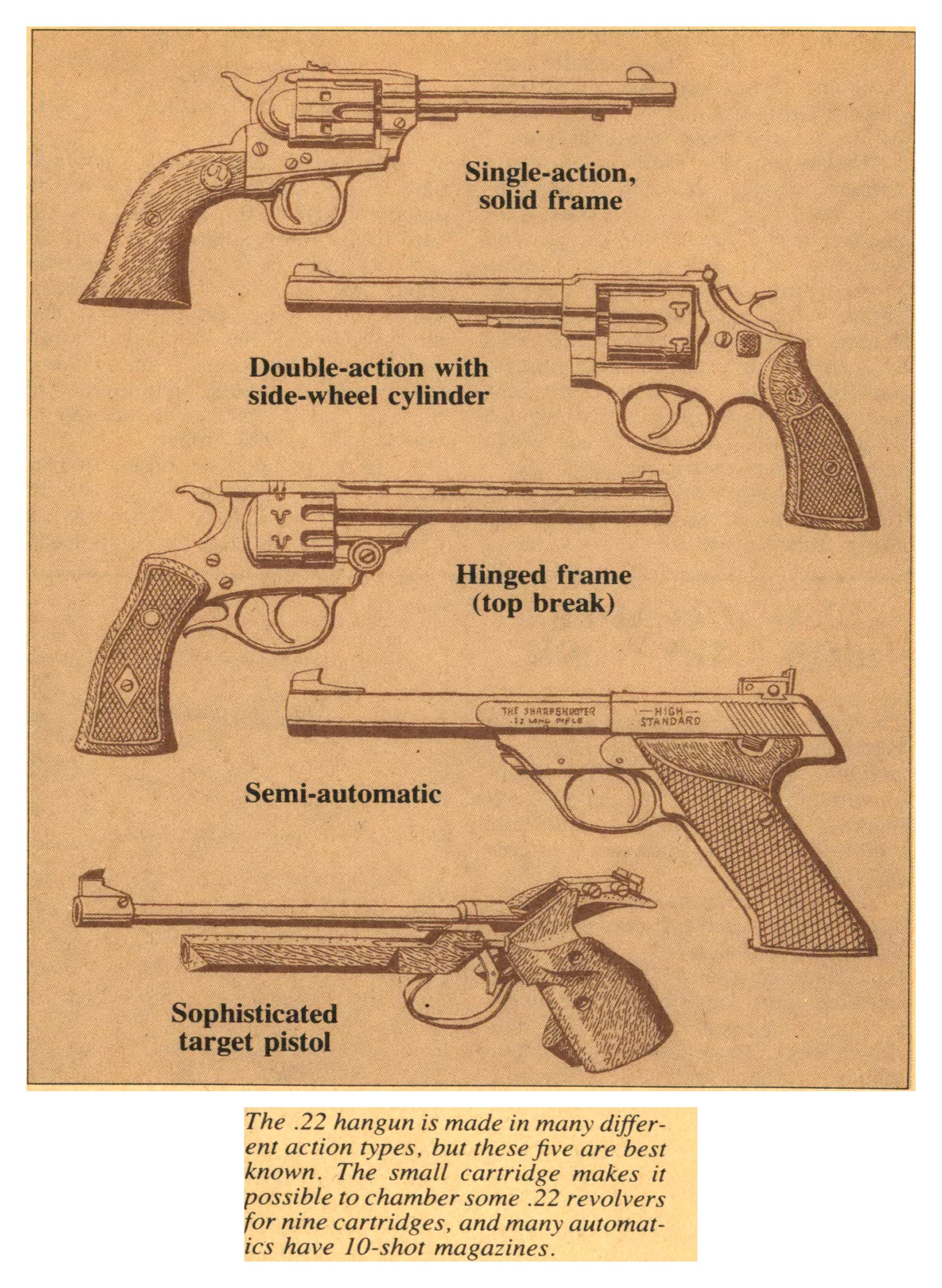
The latest chapter in the evolution of the .22 rimfire has been the development of a new class of extra-high-velocity loads known by the trade names of Stinger, Xpediter and Yellow Jacket. Unlike the .22 Winchester Magnum Rimfire, which is a dimensionally larger cartridge and can be fired only in specially chambered rifles, the new .22 hotshots fire and function in nearly every rifle and pistol chambered for the standard Long Rifle shell. The high velocities are obtained mainly by using lighter bullets combined with higher-energy powder charges that are carefully concocted so that they are safe in all but the weakest older .22 firearms.
Since the time of Flobert’s size 3/0 round lead shot, .22 bullets have taken many forms. The three most commonly used bullet types today are plain lead, copper-coated, and copper-coated hollow point. The lead bullets are of swaged construction and made of an alloy hardened somewhat by the addition of antimony. Copper-coated .22 rimfire bullets are not made by pressing a lead core into a copper jacket, as are centerfire bullets. That process would be too costly for rimfire production. Instead, swaged lead cores, either solid or hollow point, are plated with a layer of copper.
Uncoated lead bullets are covered with a waxlike lubricant that keeps the soft lead from leaving strips and streaks in the bore during the trip through the barrel. Bullets coated with copper and similar metals have a lower coefficient of friction and do not require lubrication. The characteristic knurled grooves on rimfire bullets, sometimes called grease rings, are really the “footprints” left by the machinery that spins the bullet during the case-crimping operation.
Another useful rimfire bullet is the so-called splatterproof gallery slug. Also known as frangible or “mossy” lead bullets, these are made by pressing lead particles together in a dry matrix. When they strike a reasonably solid object, they shatter into relatively harmless particles. This type of bullet has long been loaded in .22 Short ammo used in commercial shooting galleries.
Though the .22 rimfire shot cartridge is useful when dealing with some very small pests, its effective range is severely limited by the tiny charge of small-diameter shot and the random shape of the shot pattern. After passing through a rifled barrel, the pellets are severely distorted and tend to fly in unpredictable directions. Thus the effective range is seldom more than a few paces. Special smoothbore rimfire “shotguns” have been manufactured. They were intended to improve rimfire shot performance and for use in miniature skeet games. These games have not proved popular, however, and the guns have been discontinued.
In addition to controlling rats and sparrows, perhaps the most practical application of the .22 rimfire shot cartridge is for close-range personal protection against poisonous snakes. Currently manufactured .22 shot loads, depending on manufacturer, are loaded with lead pellets, measuring some .04 inch in diameter, known as dust shot, or with No. 12 shot measuring .05 inches. Rimfire shotshells loaded by Omark-CCI have the charge encased in a plastic capsule which helps protect the pellets from damage in the barrel. Omark-CCI also makes .22 Winchester Magnum shotshells loaded with No. 11 (.06 inch) shot. Rimfire shotshells are loaded to a muzzle velocity of 900 to 1,000 fps.
A common shooting myth has it that firing shotshells in a rifle or pistol will damage the rifled bore. In truth, while some leading may occur, no permanent damage results. A thorough brushing will remove any lead deposits.
Ballistics and Trajectories
Twenty-two caliber rimfire rifles and pistols have a nominal bore diameter of .217 inch and a groove diameter of .222 inch. They may have four, six, eight, or more lands and grooves. The rate of twist is usually one turn in 16 inches, except for guns chambered only for the .22 Short. These may have a twist rate of one turn in 24 inches. Modern rimfire bullet diameter is .2225 inch.
(Centerfire .22s, such as the .222 Remington, .220 Swift, etc., have groove and bullet diameters of .224 inch, except the older .22 Hornets, which have rimfire barrel dimensions.)
The .22 rimfire headspaces on the rim, with the allowable rim space between the faces of bolt and breech being .043 to .051 inch. High-grade target rifles usually have minimum chamber and headspace tolerance and may not even accept standard sporting ammo. They are intended for use with special high-grade target ammunition.
The .22 Winchester Magnum cartridge, besides being longer than the standard Long Rifle round, has bore and groove diameters of .219 inch and .224 inch respectively.
Velocities and energy data for the various .22 cartridges appear in the tables at the end of this article.
The sharply curving trajectory of .22 rimfire ammo causes considerable differences in the point of bullet impact in respect to point of aim at different distances. The variables of sight height above bore line cause still more differences. All other factors being equal, the point-of-impact/line-of-sight relationship for a rifle with low-mounted open sights will be considerably different if a telescopic sight mounted some 1½ inches above the bore is used.
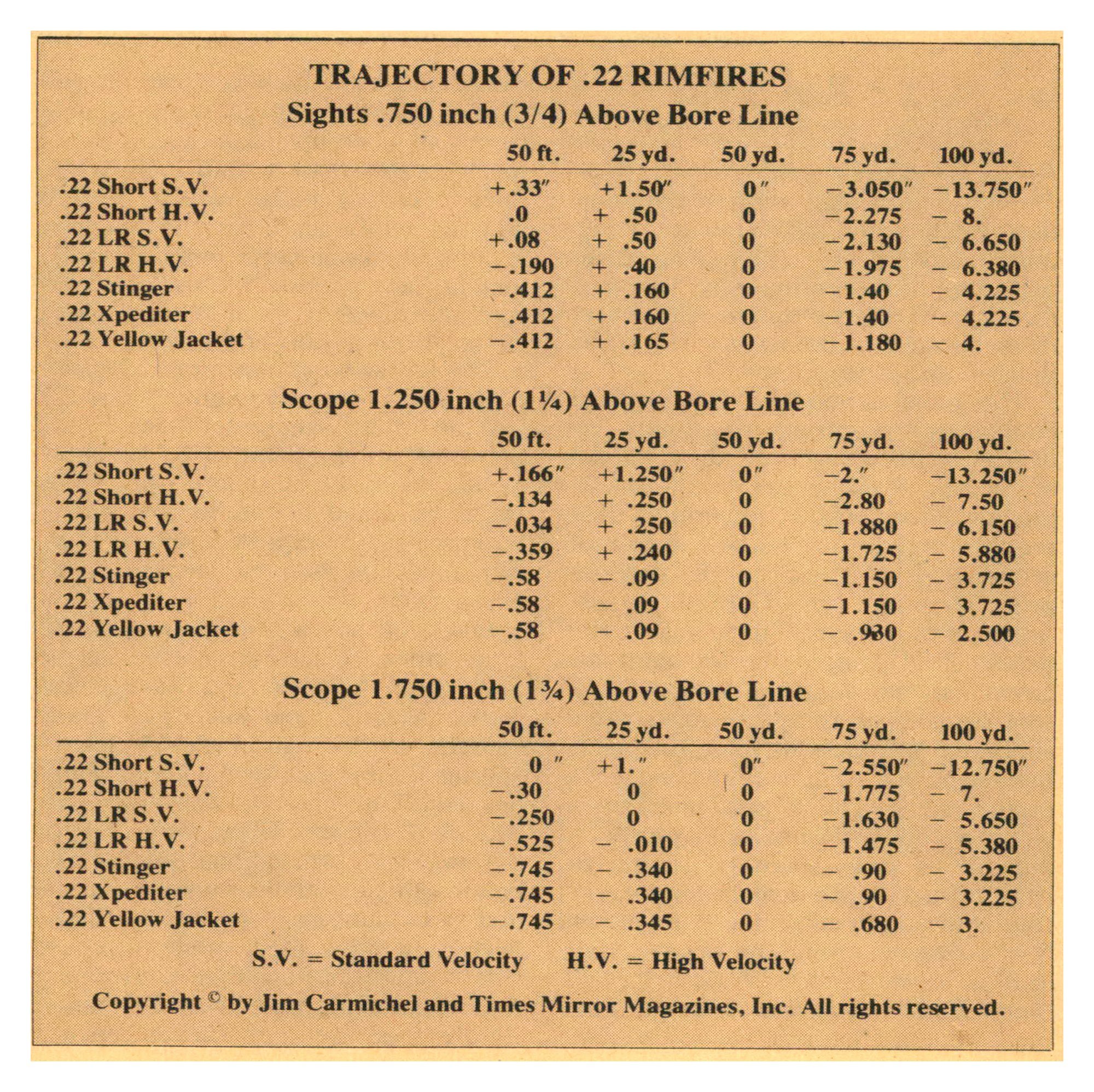
The tables are for sights mounted at three different heights above the bore line. Table No. 1 shows the relative point of impact at various distances for open sights mounted ¾ inch above the center line of the bore. Table No. 2 is for .22-type scopes (¾-inch tube) centered 1¼ inches above the bore line. Table No. 3 is for rifles with full-size (1-inch tube) scopes centered 1¾ inches above the bore line.
These tables are based not on computed predictions of bullet trajectories but on actual range tests of each of the loads listed. Though some variation from these tables will be noted (because of the individual variations of different guns) they are highly representative of rimfire rifle trajectories.
This is the first time these original “range proved” tables have been published. All rights reserved.
A .22 rifleman must be able to judge the range. For instance, a Long Rifle cartridge hits about 6 inches low at 100 yards if the rifle is zeroed at 50 yards. That’s more than enough to miss a crow on the ground. The only way to hit is to hold high by the needed amount. To do that, the shooter must first estimate range with precision.
Hunting With the .22
Practicing and hunting with the inexpensive .22 rimfire helps develop the skills necessary for successful big game hunting with powerful centerfire rifles, and it is itself very satisfying.
Probably the No. 1 quarry of rimfire hunters is the squirrel, followed by rabbits, bullfrogs, foxes, coyotes, raccoons, crows, woodchucks, ground squirrels, rats and turkeys. Though most squirrel hunters prefer a scope-sighted .22, handgun marksmen are demonstrating that a well aimed pistol is deadly. While more pistol hunters use open sights, some equip their guns with special pistol scopes that provide long eye relief. These can be adapted to most revolvers and some autoloaders.
Opinions vary as to the best type of rimfire ammo for small game hunting. Most shooters make their choices according to the average range at which they will be firing and the size of the game. Squirrels, for example, are not hard to kill, and ranges are usually 50 feet or less. Thus a popular ammo choice is the .22 Short, especially Shorts with hollow-point bullets. The mild report of the Short offers an advantage over longer, and louder, ammo, and the expanding hollow point provides some extra push needed to knock squirrels off limbs.
Long-range shots at bigger game, such as crows and ground hogs, call for higher velocity bullets, which have a flatter trajectory. Here the high-speed Long Rifle, and the super hotshots such as the Stinger, Xpediter, etc., serve best. The .22 Winchester Magnum Rimfire has proved a sound performer on foxes, coyotes and, especially, wild turkeys (in states where rifles are legal for turkey hunting). The key to successful .22 hunting is a correctly sighted rifle and a thorough knowledge of the bullet’s trajectory (see the accompanying trajectory tables at the end of this special section).
A 40-grain bullet fired from a .22 Long Rifle standard velocity cartridge has an extreme range of about 4,500 feet. High velocity .22s have slightly greater range. This is more than ⅘ of a mile, so one is well advised to heed the warning on every box of .22 ammo. Magnum Rimfire ammo has a range of more than a mile.
.22 Autoloaders: How They Work
The low chamber pressures and bullet velocities of .22s make them readily usable in self-loading guns. The mechanisms are so simple that they are inexpensive to make and .22 autos can therefore be sold at comparatively low prices.
Even .22-caliber machine guns have been manufactured for specialized use. During World War II a .22 rimfire look-alike of the M1917 Browning machine gun was used in gunnery training exercises. Likewise, a few .22-caliber Thompson submachine guns have been made, and a few miniature hand-cranked Gatling guns firing .22 Shorts were built.
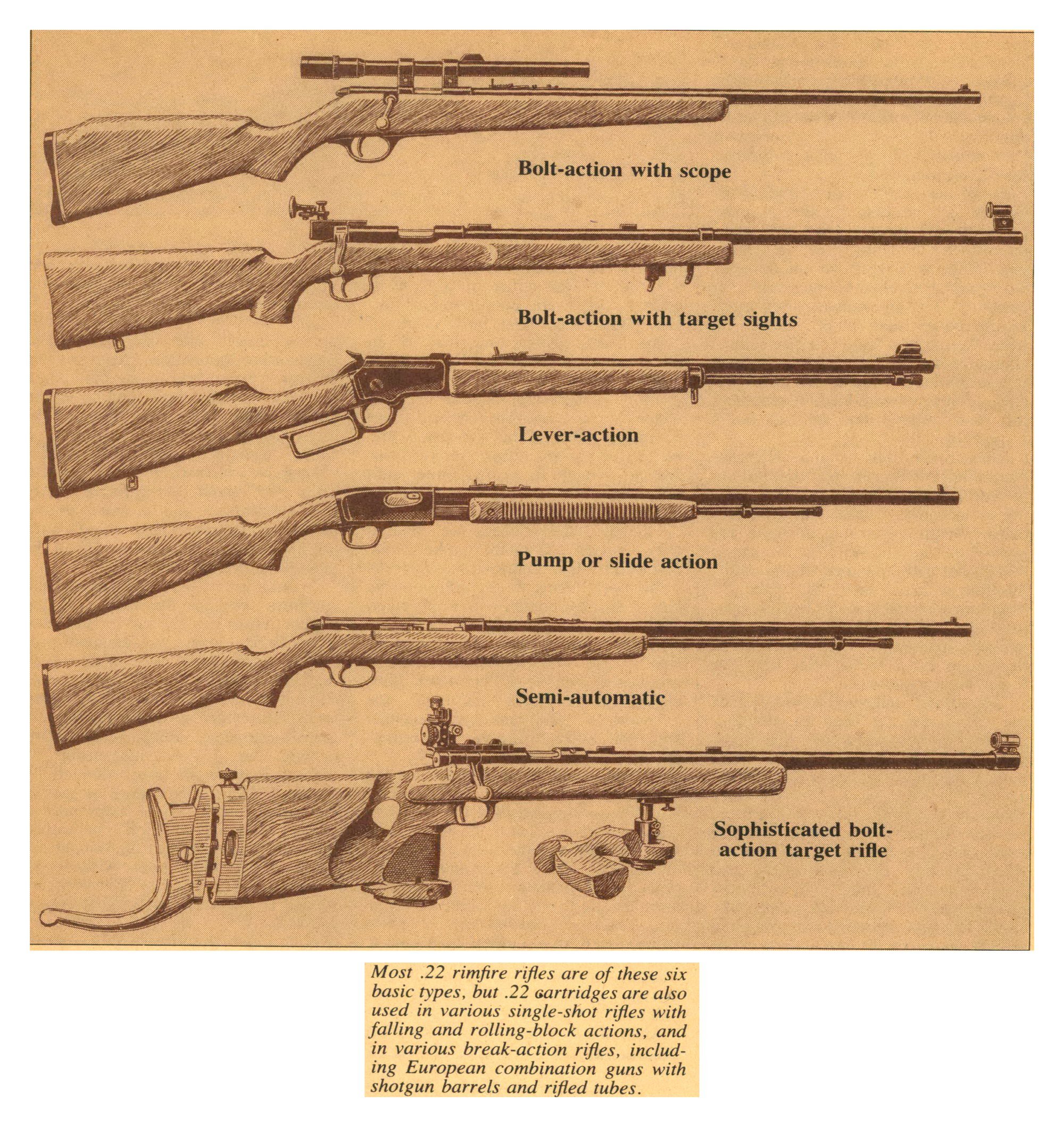
Today’s .22 autoloaders, pistols and rifles operate on the simple blowback principle. The rearward thrust of the expanding gas pushes the breech bolt all the way to the rear, or open, position. This ejects the spent case, recocks the hammer and compresses the bolt return spring. As the spring-powered breech bolt returns to firing position, it picks up a fresh round from the feeding mechanism and thrusts it into the chamber.
The .22 in Competition
Did you know that more countries and individuals compete in Olympic shooting events (1980 Moscow Olympics excepted) than in any other segment of the Olympic program? And of some 13 Olympic shooting events, no fewer than nine are fired with .22 rimfire rifles and pistols.
Of these, perhaps the most spectacular is the rapid-fire pistol event, in which the competitor fires one shot each at five separate targets. From a distance of 25 meters, the competitor first fires five shots within 8 seconds.
During the second phase he is allowed only 6 seconds and, finally, only 4 seconds, to raise his pistol and rip off a staccato of shots. Naturally, highly developed, smooth-working autoloaders are used for this event, usually firing the .22 Short cartridge. The reduced recoil of the .22 Short permits faster recovery time between shots, an important factor when you have less than a second to aim and fire.
A less dramatic (to the observer) but more intense Olympic event is the so-called free pistol match. The word “free” is used because the pistols are free of weight, length and other restrictions on their construction. The course of fire is simple: 60 shots, slow fire (2½ hours per match) at 50 meters. The catch here is that the 10 ring is only 2 inches across. That means the pistol has to be more accurate than most .22 rifles. To that end, a top .22-caliber free pistol represents the ultimate in handgun accuracy. The grips fit the shooter’s hand like a glove, and the trigger releases at the slightest touch. Needless to say, they’re mighty expensive — $1,000 and up.
The .22 rimfire rifles used in Olympic competition, depending on event, may be fired from the prone position only with no artificial support in some events, or standing and kneeling as well. Scopes are not allowed in the bull’s-eye events, meaning peep-type sights only are used, and the distance to the target is 50 meters. At that distance the competitor tries to hit a 10-ring less than ½ inch (.48 inch) in diameter. A target that small calls for the utmost accuracy from rifle and ammo as well as the shooter.
An Olympic shooting game for rimfire rifles that would appeal to most American hunters is the “running boar” event. Using a scope-sighted .22 rifle, the competitor tries to hit the heart of a wild boar target as it runs across a 33-foot opening at different speeds. It’s a tough game, but lots of fun for both shooters and spectators.
Probably the most popular rimfire rifle target game in the United States is 50-foot indoor gallery competition. This is the course fired in high school ROTC events and collegiate NCAA competition as well as in thousands of club leagues.
Usually the course of fire calls for the prone, kneeling and standing positions, though some tournaments may require the sitting position as well. Scopes or iron sights may be used, depending on the competition.
Read Next: The Best .22 LR Rifles of 2026, Tested and Reviewed
A similar form of competition is fired outdoors at 50 yards or 50 meters. The positions and equipment are the same, although the outdoor shooter has the very important problem of wind. The most popular outdoor rimfire rifle sport is the prone (only) tournament, which may last from one to four days. Fired at distances of 50 yards, 50 meters and 100 yards, this precision sport calls for the utmost in rifle, ammo and sighting equipment. Five-shot groups fired at 50 yards or 50 meters often form one ragged hole not much larger than a single bullet hole. These tournaments, which usually last two days and call for 160 shots for record per day, are fired with “iron” (peep) sights one day and the shooter’s choice of peeps or scopes on the other. Smallbore rifle competition calls for such a high degree of concentration and physical coordination that it is used as therapy for persons suffering from motor reflex disabilities.
Another rimfire rifle game rapidly increasing in popularity is metallic silhouette shooting. Reduced from the original long-range silhouette game for high-powered rifles, the rimfire rifle silhouette course is fired at distances of 40 meters (chickens), 60 meters (pigs), 77 meters (turkeys), and 100 meters (sheep).
American-style .22-caliber pistol shooting is perhaps the single most popular form of target shooting, both in numbers of participants and rounds fired. A typical outdoor match calls for 30 shots, slow fire, at 50 yards and 30 shots each, timed and rapid fire, at 25 yards. The timed fire stage calls for five shots in 20 seconds while the rapid fire stage allows only 10 seconds for five shots. A similar course of fire for .22 pistols is fired indoors at 50 feet at reduced targets.
The National Rifle Association has developed a brand-new silhouette game for .22 pistols, fired at ranges of 25, 50, 75 and 100 meters. Targets are half the size of full-scale silhouettes. Judging by the popular acceptance of other silhouette games, this new pistol sport should soon become a favorite among rimfire pistol owners.
Sights for .22s
Standard sighting equipment for .22 rimfires can be classified into three broad categories: “open” type sights, which are standard on most rifles and pistols; aperture or peep sights, used on target rifles and some hunting rifles, and telescopic sights.
The open type, with a U notched rear sight and front bead or post, is the least expensive and generally does not allow the precise aiming possible with aperture or scope sights. However, this type of sight is usually adequate for the short ranges at which .22s are fired. Its two chief disadvantages: When aligned, the front and rear sights obscure much of the target, making pinpoint shot placement difficult; its lack of precise adjustments makes proper zeroing difficult but not impossible. Once properly set, however, these sturdy sights tend to remain on target indefinitely.
Aperture or peep sights usually offer convenient adjustments, precise aiming and a relatively unrestricted field of view. The latter is because the shooter looks through, not at, the rear sight and therefore sees only the front sight on the target. Peep sights on sporting rifles are usually combined with a bead type front sight for plinking and hunting.
On target rifles the front sight is often a circular aperture that surrounds the target. The shooter aims by centering the bull’s-eye in the circular front sight. This arrangement is so accurate that shooters who use it frequently equal the performance of those who use high magnification telescopic sights. Target type peeps, however, often are too cumbersome for hunting.
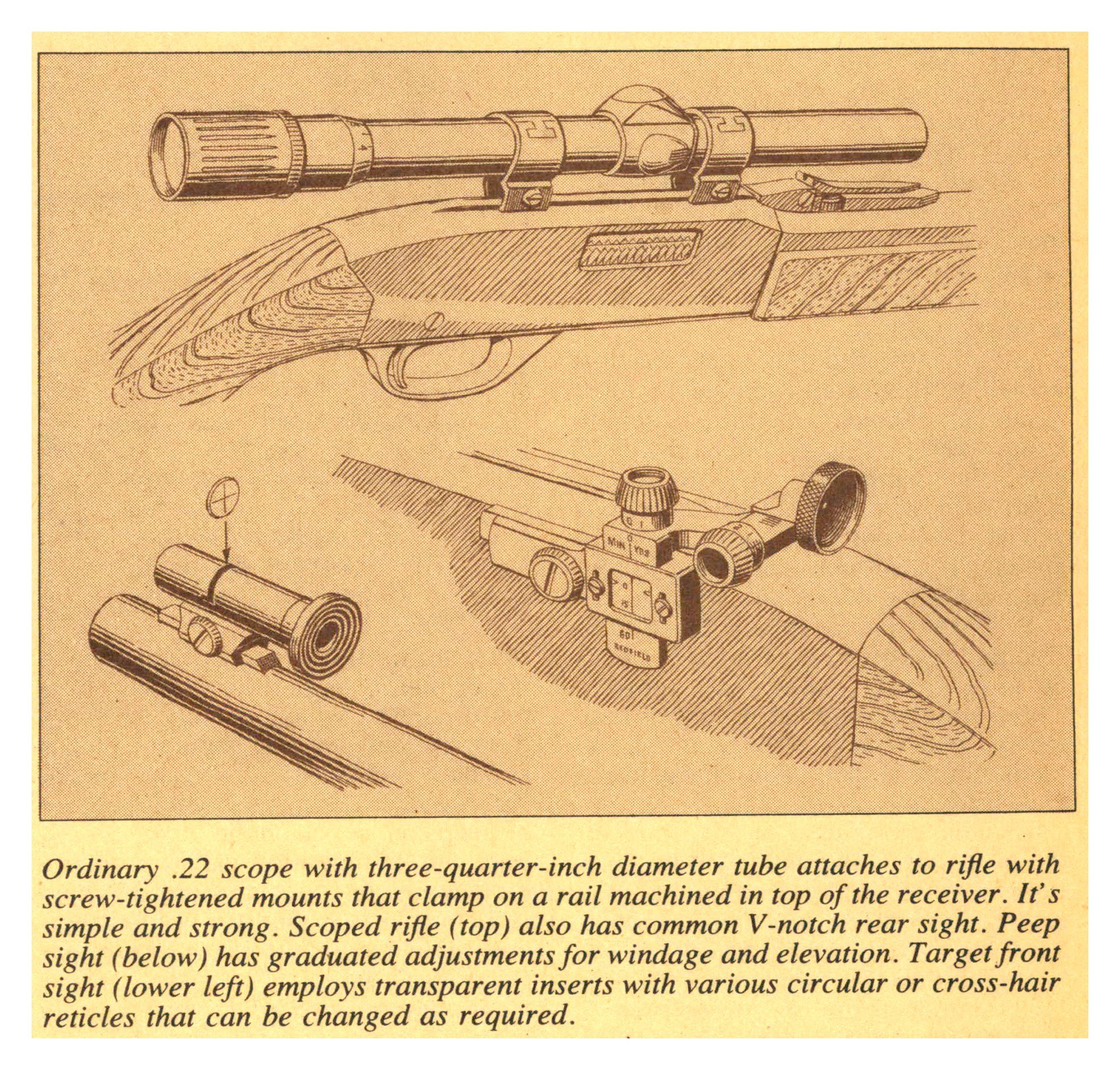
Telescopic sights have become the favorite for .22 rifles because of the availability of good quality, inexpensive scopes and convenient mounting systems. Most modern .22 rifles come equipped with twin grooves cut or pressed into the top of the receiver to hold a clamping device built into special .22 style scope mounts. Most .22 scopes come complete with this mounting system, and nearly all .22 scopes fit any rimfire rifle with U.S. standard size receiver grooves. It is a simple, reliable system. The scope can be attached or removed by adjusting two screws.
For most hunting 4X magnification serves best. This is ample for aiming at a squirrel in a tall tree, and you’ll have a wide field of view for shots at running rabbits. For varmint shooting or informal target practice, 6X magnification may be better.
Scopes designed for .22-caliber rifles usually have a ¾-inch tube and a small-diameter eyepiece. Their compactness allows them to be mounted quite low on the rifle, with the line of sight conveniently close to the bore. Some .22 shooters prefer to use full-size (1-inch tube diameter) scopes of the type used on high-powered rifles. Though considerably more expensive than smaller scopes, they usually offer clearer definition, longer eye relief and a more rugged adjustment system. They also give a .22 rifle a grown-up look much appreciated by rifle lovers. Most manufacturers of scope rings and mounts produce special 1-inch ring and base systems that fit grooved .22s.
For most mixed range hunting and plinking, a .22 rifle should be sighted in to hit dead on point of aim at 50 yards. This will put the bullet quite close to the line of sight from the muzzle out to about 60 yards. Beyond that distance the trajectory curve falls off rather abruptly (see trajectory tables).
Accuracy of the .22 Rimfire
Twenty-two-caliber rimfire ammunition and the rifles and pistols for which it is chambered are capable of astonishingly fine or disappointingly poor performance. The spectrum of .22 accuracy is, in fact, so broad that it must be divided into categories.
The most demanding category, of course, is tournament shooting. The degree of accuracy needed is defined by the size of the target and the shooting distance. The competition that requires perhaps the highest degree of accuracy is American-style outdoor prone shooting, which is fired at distances of 50 yards, 50 meters, and 100 yards. The 10-ring of the 100-yard target is 2 inches across. Theoretically a rifle capable of firing 10 consecutive shots into a 2-inch circle at 100 yards has sufficient accuracy to produce a perfect score. But a good marksman using a good rifle and ammo usually puts all his shots inside the 2-inch 10-ring. So a 1-inch circle inside the 10-ring is the tie-breaker; the most hits in this X-ring determine the winner. Naturally, target shooters strive to get all their shots inside the X-ring. This means that a good rifle has to be capable of at least 1-inch accuracy at 100 yards. The very best rifles are capable of 10-shot groups that average not much larger than a half-inch wide. Such accuracy calls for the best in sighting equipment, barrels, triggers, actions, stocks and very precisely made match-grade ammo. We use this performance level as a standard by which to judge other guns and ammo.
The world’s most accurate .22 rimfire rifles are the Remington Model 37 and the 40-X, Winchester’s Model 52, the BSA of England, the Anschutz Model 54 from Germany, the Swiss Hammerli, and a handful of others. Even these are frequently improved by fitting special barrels, stocks, sights and triggers.
One step below, the most accurate target rifles are such target rifles as the Remington 540-XR and Savage/Anschutz MK-12, and such high-grade sporters as the Anschutz Model 54 sporter, Remington 40-X sporter, Kimber Model 82 and the old Winchester Model 52 sporter. These fine rifles for the most part, are refined target-grade actions fitted with lightweight barrels and sleek hunting-style stocks. That’s why they are called sporters. These rifles usually are capable of grouping five shots inside an inch at 100 yards. Really good accuracy always depends on quality ammunition.
Read Next: A Precision .22 LR Can Help You Shoot Better. Here’s How You Can Build One on a Budget
The third .22 rimfire accuracy level includes those rifles, usually lightweight, bolt-action models, that can group five shots inside a 1½ to 2-inch circle at 100 yards. The fourth accuracy level is the classification into which most rimfire rifles fall. These rifles cannot group inside 2 inches at 100 yards. Usually they are tested at 50 yards because most .22 shooting is done at this range. A rifle that groups five shots inside 1 to 1½ inches at 50 yards is plenty accurate for most hunting, plinking and informal target practice. After all, that is sufficient accuracy to hit a squirrel’s head even if he’s in the tallest tree.
Rimfire handguns, as might be expected, are not as accurate as rifles, though there are some notable exceptions. The accuracy of the best “free style” target pistols challenges that of the better rifles. In U.S.-style pistol shooting, however, the demand for accuracy is established by the NRA 50-yard slow-fire pistol target, which has a 10-ring measuring 3.39 inches across with a 1.695-inch X-ring. Most competitors find a rimfire pistol that fires 10-shot 50-yard groups of an inch or less from a machine rest sufficiently accurate to win matches. Some target-type .22 pistols are capable of this degree of accuracy as they come from the box, while others require tuning to reach their full potential. Contrary to popular belief, autoloading .22-caliber pistols tend to be more accurate than revolvers. This is because the chamber is more perfectly aligned with the bore in a rigid, one-piece unit.
Accuracy of .22 rimfire ammo depends on a number of important factors. These include the uniformity of the priming mixture; uniformity of bullet shape; dimensional uniformity of the case, especially the rim; uniform crimp; and uniform lubrication. Surprisingly, exact uniformity of the powder charge is not as important to accuracy as some of the other things.

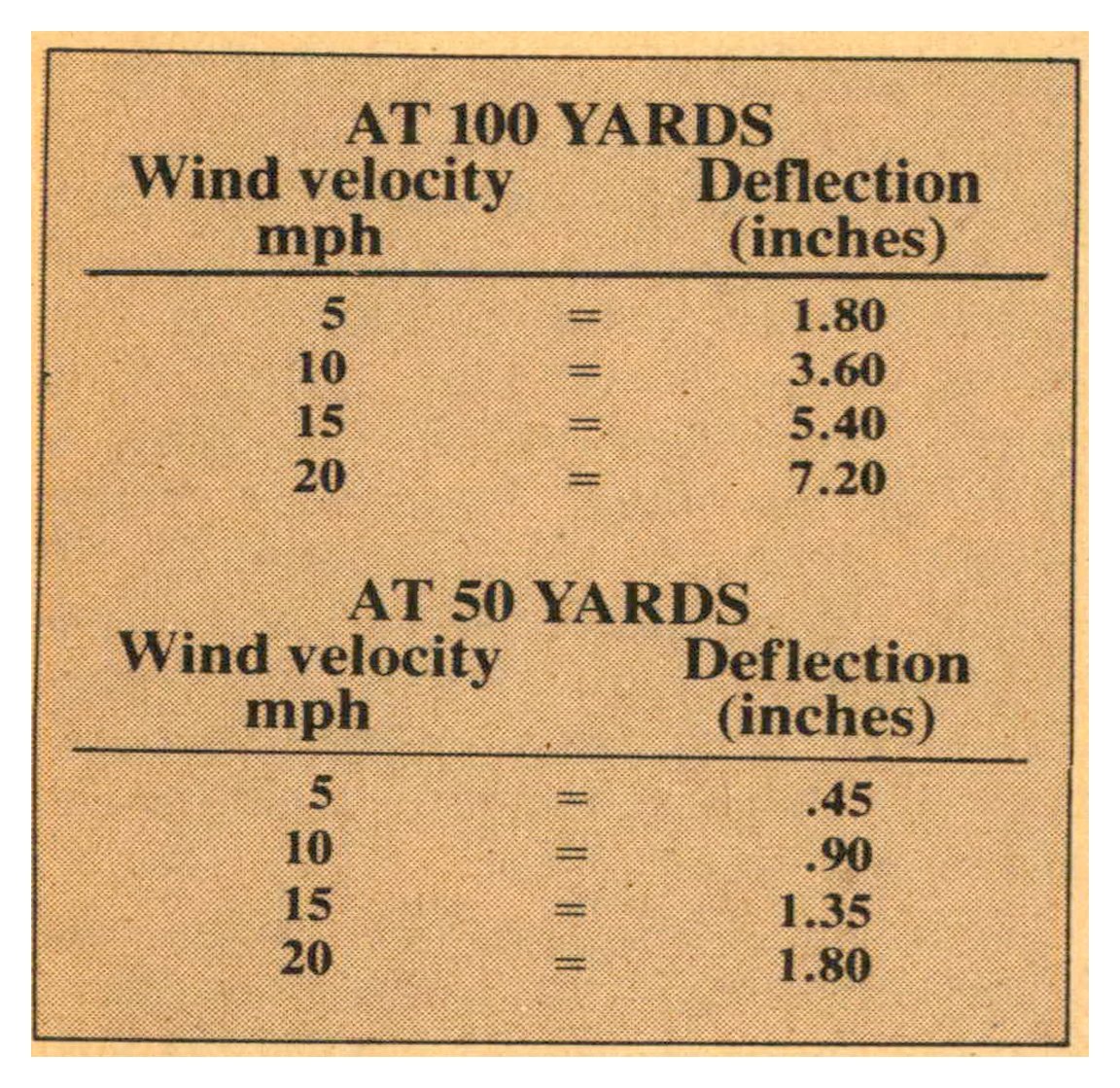
One of the most perplexing problems associated with shooting the .22 rimfire is the effect of wind on the flight of the bullet. Since the typical .22 rimfire bullet moves at a low velocity, compared with most centerfire rifle bullets, the effect of wind can be considerable. Target shooters who compete on outdoor ranges must deal with the wind on a shot-to-shot basis and go to considerable pains to calculate its effect. Hunters and sport shooters are no less affected. The following tables give one an idea of the effects of a 90° crosswind on the standard velocity Long Rifle.
Unlike high-velocity centerfire bullets, which suffer less wind effect as velocity is increased, standard-velocity .22 rimfire bullets are less subject to being blown off course than are high-velocity loads. This is due to a sharp increase in air resistance that occurs at velocities near the speed of sound. A simplified explanation is that the 1,150 fps, or less, standard velocity level is on the “safe” side of the barrier, while velocities of 1,300 to 1,500 fps are caught in the middle. Thus, low-velocity loads are affected about a third less by the wind. This is why .22 match-grade ammo is always loaded to low velocity levels.