
Congratulations on shooting a tight group at 70 yards. Go ahead and post it. But a good group doesn’t mean you’re ready to put an arrow in a deer’s vitals at that distance. Shooting a group at the range, in comfort, is a long way from making the shot in the field, under pressure, every time.
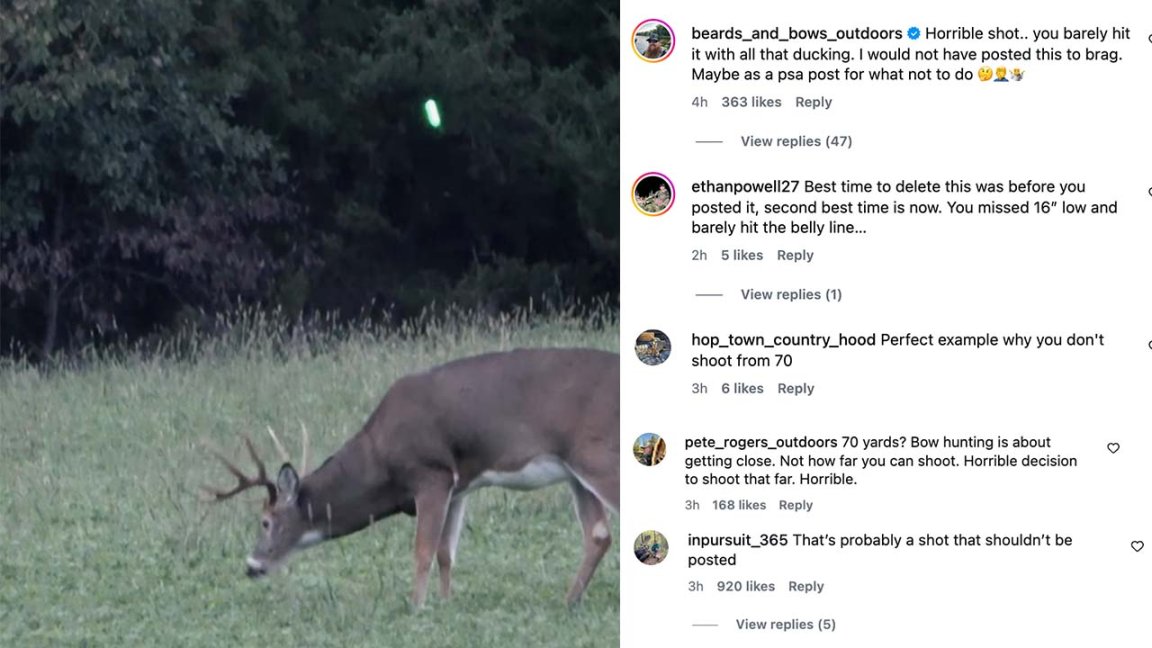
Instagram’s algorithm recently showed me a video of a hunter shooting a deer at 70 yards. The deer jumps the string and drops straight into an arrow that was headed for the dirt. The arrow hits low in the chest, but the shot turns out to be lethal.
I don’t know the person who posted it or what their experience is. But they were obtuse enough to post the shot as a success without any indication of regret or being fortunate. In fact, it seems they were boasting they made the shot and used it as an opportunity to promote their broadhead sponsor. That needs correcting. Here’s why the shot is so hard, and why this hunter was lucky, not good.
Why the Shot Is so Difficult
At 70 yards you need to know whether the deer is at 69.5, 70, or 70.5 yards, and you need to set your sight to match. That far out, a single yard of range error can move your impact by several inches, depending on arrow speed and fletching.
Then there’s wind. Headwinds, tailwinds and crosswinds all push an arrow differently, and the effect changes with wind speed. You need to know how each one moves your impact.
Say you’ve mastered all of that. You know your bow, you keep it zeroed and you regularly check your sight tape. That’s the easy part.
The hard part is the shooting itself. Can you honestly say you’ll hit a 6-inch circle at 70 yards day in and day out? I don’t mean on your best day. I mean on your worst day. If you can’t make the shot then, you have no business taking it at a deer.
Have you ever shot 70 yards under pressure? It is inescapable that your shot will feel different and be different from your relaxed practice sessions to an adrenaline filled scenario. The effects of those changes are amplified as the distance increases.
Then there’s the deer. Basic bowhunter education teaches that deer can and do jump the string. It’s a reflex. They hear the bow fire and the arrow in flight, and they react. One theory holds that a deer feeding with its head down drops faster than one with its head up. The deer in this video is feeding with its head down. Experts cited by Outdoor Life said deer jumped the string 80% of the time.
Reading how a deer will react takes woodsmanship at any distance. Every added yard gives the deer more time to move and makes its reaction harder to predict.
What Went Wrong

The arrow hits about a foot below where the deer’s vitals were when it was standing. Even after the deer ducks, the arrow still hits low. That tells me the hunter wasn’t aiming there.
One likely cause is a mistake in shot execution. A small change in grip pressure, peep alignment, or follow-through can send an arrow low. For example, pressure toward the throat of the grip instead of the heel will push your shots low. At 30 yards you might not notice. At 70 yards you will.
The other possibility is a problem with the aiming setup. Maybe the sight tape was off, or the deer was a yard farther than when the hunter ranged it. The hunter is shooting Easton FMJ arrows, which are heavy and drop more than a lighter shaft, so a small range error matters more.
Here’s the problem: even if the hunter had fixed whatever made him shoot low, he still would likely have missed, because the deer dropped so far. In the video, I marked the deer’s heart and the spot where the arrow hit. By the time the arrow arrives, the spot where the heart was is now above the deer’s back.
Now suppose the hunter expected the deer to jump the string and aimed low on purpose. There is no way to know how far a deer will drop, or exactly when it will drop as the arrow arrives. And even with the deer ducking into it, the arrow barely hit the deer at all.
The Upshot
This is a cautionary tale about an archer shooting beyond his ability. He says the deer went down quickly, and that’s a good outcome. But posting the video as a triumph does bowhunting a disservice. The hunter made a low-percentage shot, and the deer happened to duck into it.
Learn from this one. It’s OK to watch a deer that’s out of range, let it walk and try to get closer tomorrow. Bowhunting is meant to test your hunting skills, not just your shooting skills.