
We may earn revenue from the products available on this page and participate in affiliate programs. Learn More ›
You’ve surely heard these sentiments before: Big critters require big cartridges. Use enough gun. You need all the knockdown power you can get. But is this way of thinking actually true?
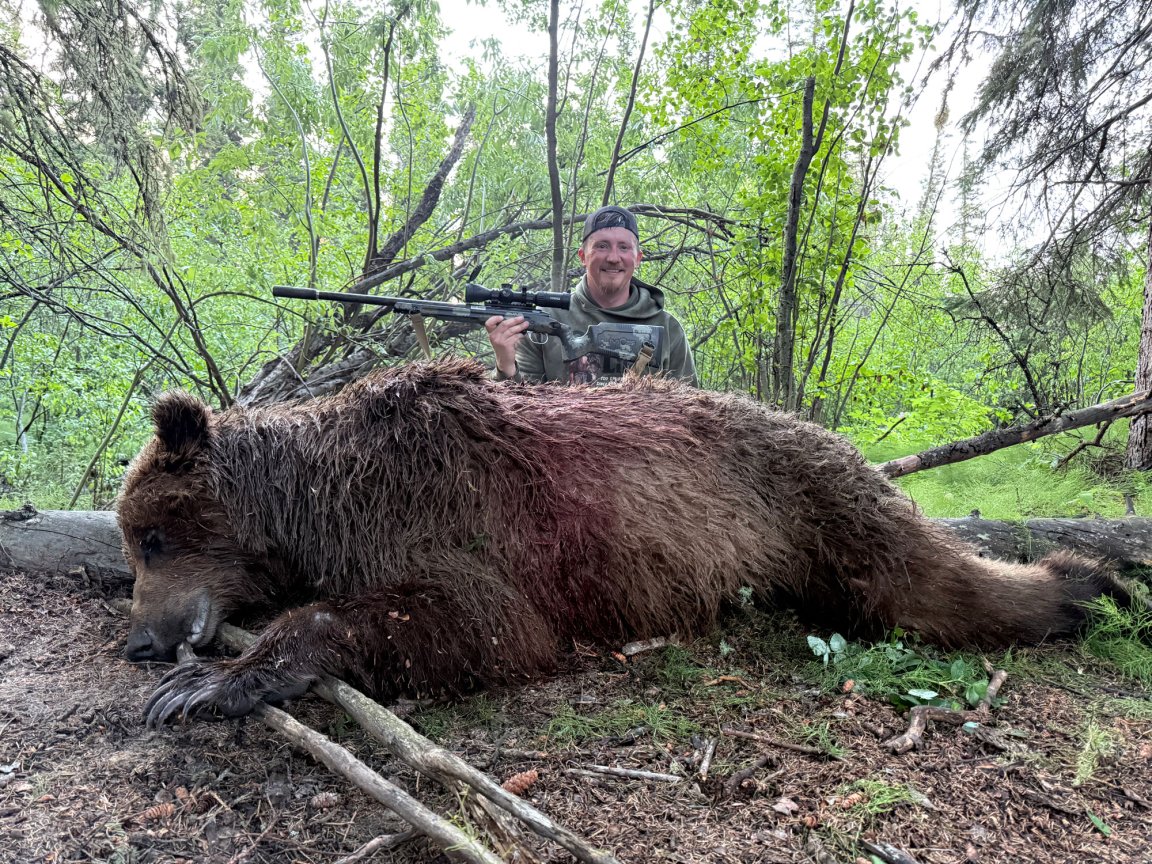
For more than a century, Outdoor Life has promoted cartridge selection that optimizes for accuracy and efficiency, not some idea of power. Our senior staff writer, Tyler Freel, recently put these concepts to use in the field, first by shooting a big old grizzly bear with the little .22 ARC. He also did some range tests around the idea of using an AR-15 for bear defense.
In this week’s episode of the Outdoor Life Podcast, Tyler will explain how he thinks about cartridge selection for bears and other big game animals too.
Listen to this episode on Apple, Spotify, or wherever you get your podcasts.
Full Episode Transcript
Alex Robinson: All right, Tyler Freel, our bear-killing man in Alaska. How you doing?
Tyler Freel: I’m doing okay, man. I’m working on it.
Alex: You’ve recently done two pieces for us that have kind of pushed the envelope, I guess, at least for a lot of people, in terms of cartridge size and their lethality around bears—kind of focusing on grizzly bears. The first piece you did was your story about hunting a grizzly with the .22 ARC. Would you tell me how you got that idea? Why did you think that might be something worth trying?
Tyler Freel: Well, there’s quite a bit that goes into that. Part of it’s maybe my vindictive nature.
A few years ago, which I think we did a podcast on, I shot a grizzly with a 6.5 Creedmoor. The premise behind that was just to demonstrate that, look, this is a pretty capable cartridge in normal context. Everyone poo-poos it as this weakling little cartridge and, actually, it’s kind of not. But the .22 ARC was kind of the next step.
And to lay a little bit of background, I’ve been kind of infatuated with the ARC, or kind of modern .22s —the .22 ARC and .22 Creedmoor — since I started shooting the .22 ARC a couple years ago. I’ve generally shot a lot of smaller cartridges over the years, but I’d always thought that a cartridge like a .22-250 or something like that would make a really good sheep cartridge.
Related: 22 ARC vs. 22 Creedmoor: A 3,000-Round Range Test
I’m a pretty passionate sheep hunter. But unless I went with a custom barrel to shoot a super-tight twist, to shoot a heavy-for-caliber bullet, you gave up too much in the wind to make it worth shooting a .22 caliber at sheep or whatever. So I just never really got into it.
Well, when I started shooting the .22 ARC, I noticed that with bullets like the 88-grain ELD Match and 80-grain ELD-X — these are newer bullets on the scene that function pretty well in a hunting capacity, or at the time I figured should — your wind performance is a lot better with those. And that kind of made the light bulb turn on for me. The next hunting season I had available was moose at the time.
So I took my .22 ARC moose hunting and killed a moose with it. And since then, I’ve killed a few bears with it, including big black bears. I have a few other cohorts in the outdoor space that are experimenting—and, well, I don’t know if experimenting really is the correct word, because we kind of know what’s going to happen—but have shot a lot of game with cartridges like the .22 ARC. It’s proving to be a pretty doggone effective little cartridge.

I guess my premise with all of this is that I think it’s panning out to be a pretty ideal cartridge for deer-sized stuff. In my context, if I was to hunt deer, I would have no issues with caribou. I think it’d be awesome for sheep and seems to work really, really well on black bears too. So that’s kind of the core of where I think this cartridge fits.
But I get the opportunity to shoot some other stuff as well. And within reasonable context, I knew it would perform well enough to kill a grizzly bear just fine.
So I’m kind of out to collect data points over a long term, because people will say, “Well, this is one bear, so it means nothing.” And in some ways, maybe. But compared to the very large amount of bears I’ve seen killed, it’s maybe not. It’s worth — yeah. And if this is only one bear and it’s a small sample size, I guess that means I just need to keep using it.
I’m kind of rambling, but hopefully that makes sense. My idea or impression of cartridges like the .22 ARC is that they’re pretty optimal for deer-sized stuff. But they will work fine for bigger stuff too, especially if you’re making good ethical decisions about your shot placement and making an informed choice on the bullets you’re using.
Related: I Shot a Grizzly with a 22 ARC — and the Results Were Not Surprising
And I ultimately just want to collect more data because I think it’s super interesting. There’s no big—I’ve heard some conspiracy theories in the feedback, which we can get into later — but it’s purely out of my own interest. And I think it’s a topic that deserves to be fleshed out and given justice.
Alex: Yeah. Well, you talk about this as a really ideal deer hunting cartridge. And anytime you write about that or put that out there, you get a ton of negative commentary about how it’s not big enough, in air quotes. It doesn’t have the knockdown power for big Midwest whitetails.
Tyler: Or a big-bodied mule deer.
Alex: A big-bodied mule deer, exactly. So to your kind of vindictive point, it’s like, okay, well, if I shoot a grizzly bear with this and see quickly lethal, ethical performance where this bear dies in a matter of seconds, obviously, that is a data point toward the fact that this is a totally capable whitetail cartridge. That’s basically the idea there.
Tyler: Yeah. If you can demonstrate pretty decisive performance on something like that, it kind of makes the argument that it’s too small for deer a little silly.
Alex: Right. I think the important thing here is that you’re not saying this is the best or even one of the best grizzly bear hunting cartridges. You’re just showing that it does work, and here’s how it did. Here’s one field anecdote where you shot this bear with the .22 ARC, and it did exactly what you thought it would, which is kill it nice and cleanly.
Tyler: Yeah. It killed it more quickly, probably, than any grizzly bear I’ve seen shot, which is quite a few.
Alex: So let’s get into the bullet quick. What bullet did you go with? And talk about what it is and why.
Tyler: For this one, I used a 71-grain McGuire Ballistics Copper Rose bullet. I’ve been shooting a lot of those bullets over the last year and a half or so. McGuire is a newer, smaller bullet company that makes just monolithic copper bullets, but they’re kind of in this class.
And I know on previous episodes we’ve talked a little bit about this class of kind of modern copper bullets. They don’t behave like what I would call a traditional copper bullet, or like a Barnes variation of a Barnes TTSX or a Hornady CX, where you get pretty dramatic but consistent mushrooming, and that bullet retains almost all its weight. They’re known for really good penetration.
Alex: It stays in one big hunk.
Tyler: Going through. Stays in one big hunk, yep. Whereas these modern-style copper bullets — the next iteration — and there are several different manufacturers. I’ve shot a bunch of stuff with Lehigh Defense’s version of them.
But the McGuires look like a full-metal jacket. They’re completely enclosed, but they have a big cavity inside the bullet and a pretty fragile tip, I would say. So when those things go into an animal, they expand violently and shed. The petals that would normally stay attached on a Barnes bullet shear off and kind of radiate out into a larger wound pattern. And the base of the bullet deforms slightly around the base, from the few that I’ve recovered. The base just keeps penetrating.
So depending on your outlook, you kind of get a best-of-both-worlds. You get an initial expansion that seems to produce wounds more like a cup-and-core lead bullet that’s going to expand rapidly and be really nasty. But you also get deep penetration and sometimes, at least in the gel I’ve shot, deeper penetration than traditional copper bullets.
With those or a bonded bullet that maintains that mass, they tend to parachute and catch themselves. They can still penetrate really well, but you have a larger frontal diameter. A lot of times they’ll end up backward, where there’s a slightly smaller frontal diameter of the shank of that bullet, and it keeps penetrating. I’ve shot a bunch of stuff — bears and moose and whatnot — with that style of bullet, and they do seem to do really, really well.
So that’s what I used here. I’ve also had really good luck with the 80-grain ELD-X. I killed a giant black bear with that last year at very close range — arguably a challenging shot from a physiological standpoint— through the front of the shoulder.

Detractors will say, “Well, you picked this bullet, so we know you picked this because none of the other ones would work,” and that’s not true. But that is the bullet I used for this bear, and they seem to work really, really well.
Alex: You had said before that it wasn’t really an experiment because you kind of knew what was going to happen. You just wanted to go out there and see the theory that you had take place. What had you seen previously that made you think, “Oh yeah, this will easily kill a grizzly. No problem”?
Tyler: We’ve seen black bears shot with that particular bullet, and they have always exited and produced really good-sized wound cavities. I’ve shot them in gel. We’ve shot them in big pigs with Sam McGuire down in California, including 6mms and .25s.
And I would say, from what I’ve seen, that a big 200-pound hog is probably the best animal if you’re worried about bullets being able to penetrate tough stuff. Because across the shoulders, one of those big hogs is way more dense than a grizzly bear. It’s not even close.
Alex: Just talking about how the actual tissue, the kind of muscle and tissue itself, is just so dense on a big boar pig.
Tyler: Yeah, and the shields. Some of a grizzly’s bones, some of their leg bones, might be bigger, but overall, especially when you consider some of those pigs have inch-and-a-half-thick shields of just gristle, they’re a tougher animal to get bullets through and less forgiving too. Their vital zones are smaller.
But without getting into that, based on all this stuff and talking to my friend Colton Bonioli, who has taken those same bullets and shot a bunch of plains game in Africa with them, we’ve seen really good results overall and not really any bad ones so far.
So with that, and knowing it’s going to produce a much bigger wound cavity than an arrow — and that works pretty good.
Alex: Yes. And you’ve shot grizzly bears with arrows before, and they died. So why not? Why wouldn’t this work? I wonder: Is the main skepticism that this little bullet at higher velocity will blow to pieces and won’t penetrate and create that internal damage? Or that it might pencil through and not create enough internal damage to kill a big animal ethically? What is the pushback against doing this?
Tyler: I don’t think they know, even. There’s a variety of stuff. Usually the pushback is a little bit vague because the people pushing back have not tried it. And probably don’t have the balls to try it.
But I’ve heard everything from, “It doesn’t have enough kinetic energy,” to which I’m like, “Well, how much is necessary?”
Alex: What is the number of kinetic energy needed to kill a grizzly bear?
Tyler: Well, if you’re talking about an arrow, like 100. What it boils down to is this whole thing that I think a lot of people misunderstand: the value, which is very little, of just a kinetic-energy number.
We can interpret impact velocity combined with the impact velocities that a bullet is designed to function really well at. That informs us a little bit about what we can expect, but KE is kind of just silly. It’s not useful to us.
I’ve heard a lot of “You don’t have enough margin for error.” It’s like, well, if everything’s perfect, then okay. But you don’t have the margin for error. And I think people bringing that argument don’t have any idea what kind of wound characteristics we’re looking at with this bullet or a combination, or a different bullet. They’re just going off the old dogmatic assumption that bigger cartridge equals more room for error. Although none of us can really quantify that in any way. We just believe it because it’s been repeated.
I used to have — and still have — a hard time fighting that mentality because it’s like so many other dogmatic things that we’ve grown up around and been told. You start to believe it. And there are always some aspects of validity, but it’s usually taken way too far, I think. And that’s what we’re really seeing with this
Tyler: All the feedback is mostly because it goes against the grain or the traditional way of thinking about these things. From my perspective, people will try to poke holes in it: “Well, you were in a tree.” I also shot a giant black bear on the ground, facing me at 10 or 15 yards. Different kind of animal, but I’m not afraid to do it.
Any time we don’t like something, a lot of us try to construct scenarios in which we think it wouldn’t work. And it just doesn’t really seem to fit too well with this.
If I’m going to take a .22 ARC and shoot a grizzly bear with it, of course, I’m going to take considerations, like I always should, of what’s the context in which this should work really well, and kind of limit myself to that. As hunters, whether it’s our own skill level or our equipment, we need to kind of stay within the bounds.
Alex: Yeah. Let’s get into that in a second. But first, let’s go over what happened on the ground. What was the result? Tell the shortened story of your hunt here.
Tyler: This was pretty quick. I’m hunting over bait, and I’m sitting in a tree stand. Long story, but I started out sitting on the ground for a while trying to get shots off with the bow. It was impossible to get shots off at these bears because they’d become aware of your presence too quickly before you could really get a good shot off. And that happens even in a tree sometimes.
So anyway, I was in a tree stand by myself. The bear comes in from right to left. I can kind of hear it coming and get prepared. It was about 12 to 15 yards broadside. As soon as it paused and I had a good shot, I shot it in the lungs and immediately started cycling the gun.
When I shot it, I’m using a suppressor, and it was whacking it like they often do. It kind of sat on its haunches and did the spin number to spin around and run the way it came from, which is usually what they’ll do. So I shot, cycled another one, and basically as soon as it got spun around and took off back for the alders, it was out of sight.
Just as it started getting momentum, I got back on it just on fur and shot, and it hit it again and just crumpled the thing right as it was kind of diving off this bank into the alders. Legs go up, and you can hear the sucking chest wound that we always want to hear on a bear.
He — or she; it ended up being a really old sow — didn’t go, didn’t go 20, as they say. That was pretty much it. Then I’m sitting there kind of like, “Wow, that was fast.”
Related: The Best Bear Cartridges
If you’ve seen the video, I didn’t bring my tree setup for my camera, and I don’t know if it would’ve been in the frame anyway. But if you saw the 6.5 Creedmoor video, this bear was on the ground dead in half the time. Less than three seconds.
Alex: What did those two bullets do? Talk about the entry, exit, and anything you found when skinning the bear out. What was the terminal performance like?
Tyler: The first round hit through the ribs in the lungs, kind of down through the bear as it was elevated. The base of that bullet exited, and it was about a three-quarters-of-an-inch exit wound. When you skin the bear back, it’s all bloodshot around that.
It was about 20 inches through that bear at that angle. The bear’s chest isn’t 20 inches wide, but when you’re talking down, coming in high and out low, it was about 20 inches that that bullet traversed.
The second shot hit the bear directly on what you’d call the shoulder knuckle of the scapula, or just above the shoulder knuckle — just that thick part of the scapula where it makes that connection — and completely shattered it.
Alex: Oh, I was going to say, that one obviously just ricocheted right off.
Tyler: Yeah, those bullets are — it’s like they don’t even impact bone. It’s like a magnetic force that just pushes them away.
Alex: Just bounced right off it, like a rubber bullet or something, right?
Tyler: Yeah. And after I managed to drag this bear up out of this hole it was in and skinned it, I started to move that leg and you could hear it crackling in there. So I cut the leg off, and I had a little video. I didn’t post too much of it because it’s pretty graphic.
But the whole base of that scapula was just shattered. The bullet kept going kind of forward into the bear, and it stopped somewhere in there. I didn’t cut the whole bear up to find that one.
Alex: But fully made it into the body cavity.
Tyler: Oh yeah. Into the chest cavity. It’s right through that shoulder knuckle.
Alex: Okay. So that’s the big one that critics would point to: “Well, yeah, but if you hit him in the shoulder, you’re not going to get him,” right? That’s kind of the critique.
Tyler: Yeah. The shoulder—as a follow-up shot, that’s fine. I don’t care. It would not have been my first shot. I preach on this with bears anyway: At that angle, especially angled forward, it ended up somewhere in a neck or in front of the other shoulder. That’s not a good way to get into the chest cavity by shooting them in the shoulder.
I think that’s a big cause of the reputation for grizzly bears and bears in general to be tough: people shooting them in the shoulder and screwing up, and then you don’t hit anything vital. It will not kill them just taking one shoulder out.
Alex: Yeah. People shooting them too far forward and then blaming the cartridge, maybe.
Okay. So this bear goes down basically how you expected. After this project, you took on another video and another story about considering AR-style rifles in a bear-defense scenario. This is another one where we’re not saying this is the best choice, but just considering it as an option.
These two things are related in possibly smaller cartridge choice than the old rule of thumb or the old idea of what a bear-defense firearm should be. Talk about how you got into that and what you ultimately did to test it out.

Tyler: The idea here and the question is: Is an AR-15 a reasonable bear-defense option? Bear defense is kind of this evergreen topic that everyone, regardless — you might not be in the same hemisphere as a bear—and you are interested in it.
Alex: And probably have strong ideas about it.
Tyler: Probably have very strong opinions, stronger than those who deal with bears.
I’ve heard this floated before, and I never really took it seriously because a lot of times the people presenting it are kind of the mag-dump-at-old-mattresses-and-TVs-at-a-gravel-pit type of characters. And that’s just not effective. As fun as it might be, it’s not an effective way to do things.
No matter what we’re doing, whether it’s bear defense or hunting, we need a certain level of precision to really be successful at what we’re doing.
What got me thinking about it was the video last year that came out of a guy — home-security, Ring doorbell-type footage. It was in the house.
Alex: Oh, of a guy coming downstairs. It’s like a home-security camera.
Tyler: Yeah. And shooting this black bear that had gotten into his house. The bear gets in the same room, kind of comes toward him, and he dumps the thing on the spot. And I’m like, huh, maybe this is — with what looks like an AR-15.
Alex: With what looks like an AR-15.
Tyler: An AR-15. And I think from what I could find, that was later confirmed. Just ball ammo or whatever. I don’t know all the details, but I’m like, hmm, maybe that deserves another look.
Because everyone likes talking about getting their .45-70 or their 12-gauge slug gun or their .458 Win. Mag. bear-defense gun. But for the small likelihood that most people are going to need it, whether it’s just having the truck or out camping or just bumming around in the woods, is the AR-15 you already have going to be good enough?
Alex: Yeah. The AR-15 is the most popular rifle in America. Lots of people already have one, and a lot of folks have shot theirs a lot, so they’re probably pretty comfortable with it.
Tyler: Practice ammo is plentiful and affordable. I’m not going to dissuade anyone from buying a new gun. If you want to get a bear-defense gun just to get a gun, have at it. I’m not going to try to discourage you.
But contrary to popular belief, we are not all about just keeping the gun industry afloat. It’s not just you and me, last man standing, to keep the gun industry afloat. We’re not trying to tell you to get a third mortgage on your double-wide to go keep the gun industry going.
There’s a time for buying new guns if you want to. I love that. But sometimes what you have is good enough.
Alex: Yeah.
Tyler: I just thought it was a really interesting question. I have a bunch of ARs and I never really considered them for that.
So with that in mind, I wanted to compare some handling drills to see how much faster or smoother running an AR would be than my .375 and my .45-70. A lot of it depends on how you’re carrying it, and I just kind of treated them as I would carry them in the woods, or as I do. And the AR is quite a bit faster and more precise.
The old dogmatic way of approaching bear defense is, “Well, you’re only going to get one shot, so it’s got to be something big.” That might be true, but from what I found, the chance of actually getting an instantly lethal shot—
Alex: On the first shot.
Tyler: On the first shot was best with the AR-15. So it’s not as simple as people like to frame it. We ran through some drills, and obviously the ARs mop the floor. Then we shot stuff in gel.
I needed a control, so I used 10mm, .44 Mag., and .45-70 hard-cast bullets, which aren’t my favorite. I don’t think they’re the best options, but they are proven to work in bear-defense applications.
Alex: You need some benchmark to start with on the gel. So it’s like a 10mm hard-cast bullet. We know that that has killed bears.
Tyler: Yeah. All three of these have been successful in bear defense, and they’re generally accepted. And the .45-70 was a hot-loaded one. I loaded them hot. It wasn’t like cowboy action.
So I shot all three of those through gel, and they penetrate. The trade-off with hard cast is you get excellent penetration and very little wound cavity, or very little terminal damage aside from what the bullet is going through.
The theory behind this is if we can compare .223 or 5.56 ammunition bullets and they don’t look that bad compared to stuff that is proven to work, then maybe it’s a reasonable option.
Tyler That’s what I did. For the .223, I used two different modern-style copper bullets, like I mentioned before: a G9 Defense load that’s a barrier-blind copper hollow-point load and a Lehigh Defense 62-grain Controlled Chaos.
Related: ARs for Bear Defense: Practical Choice or Potential Disaster?
Both of those don’t get the full penetration of a hard cast, but both got 21, 22, 23 inches of penetration of the shank of the bullet and a much bigger wound cavity than even the .45-70 in gel. Then also with a traditional style like Barnes TTSX, there was one of the lighter ones.
The point of this wasn’t to capture every possible bullet, just to demonstrate some options and how some of this stuff actually performs a little bit better than people might think it does.
Of course, gel is just a comparative medium. It’s not exactly how it’s going to do in tissue, but it’s a one-to-one that we can look at. My takeaway is that they’re pretty destructive. And considering if you have to use a gun in a bear-defense application, you need to be prepared to shoot the bear more than once — as many times as possible.
I’m not really bothered that I don’t get end-to-end penetration with a single shot to end this picture-perfect charge in dramatic fashion, just as I imagine it. Because it’s not going to happen how you imagine it.
The biggest benefit with that AR, especially when you’re practiced up and you can shoot and handle it well, is it just puts a lot of precise firepower in your hands. Every shot gives you the chance — often with a bear, just the way they react, it might not stop the bear immediately, but it’s going to give you a chance for another shot, and you can really pour it on them when you’re good with an AR.
Alex: I think what was interesting to me, watching you perform this, is if it were me in this scenario, I would just want the gun that I was most comfortable with.
I shoot 12-gauge shotguns all the time. I’m a duck hunter, a pheasant hunter. I’m used to shooting a small flying bird at 40 yards out of the air. I think I would want a shotgun with some good bear-defense loads in it, a short-barreled shotgun, just because that’s what I know in the moment I’m not going to fumble. Because I shoot it all the time, all fall. And it just seems like in these scenarios, that’s what’s going to—
Tyler Oh you’re going to fumble.
Alex: You’re just going to do what you’re going to do. And you either trained or you didn’t. And that is going to probably be the result, right?
Tyler Yeah. That’s what it ultimately boils down to. My taking this on, I still don’t think it’s the ultimate bear-defense gun. But I think it’s a lot more reasonable. And it’s going to be, like you said, a person-to-person, what’s-best-for-you-may-not-be-best-for-me type option.
Ultimately, we’re just dealing in odds. Do I have the best chance considering my experience and abilities?
The grizzly bear that I just shot is a good example of that. Over the last number of years, I’ve fired a lot of rounds through bolt guns. I’ve developed habits in how I run bolt guns. I got two shots in that bear. It just kind of is what it is.
Read Next: I’ve Killed Dozens of Bears. Here’s What Actually Makes a Great Bear Gun
Maybe I could have with my three-second — I don’t know. And no matter what I’d shot that bear with, I was going to take the same first shot, and it was still going to turn and run, because that’s what they do when you shoot them in the lungs.
There are some rifles I have, like my .30-06 guide gun that I carry on my boat a lot and drag through the woods a lot, I don’t know if I would’ve gotten a second shot on the bear. But the way I’m used to running those little short actions — those are all kind of — no single factor is the most important thing, but they all come together.
We stress practice. Ultimately, with these small cartridges, we just want people to shoot as good as they can. We want you to have something that you can practice with and that you’re likely to practice with, because if you’re in a situation where you need to perform, that’s what’s going to make the difference.
Alex: Can I tell you that you’re not doing anything new here at Outdoor Life? People see this stuff and they’re like, “Oh, Tyler’s just doing some online social-media stunt or something.”
This hasn’t been decades and decades of history at Outdoor Life from Jack O’Connor promoting the shootability of the .270 to—
Tyler Or even the .25 cals and .24 cals.
Alex: Yep. Back in the day. Jim Carmichael with all of his wildcatting around 6.5mm cartridges and just his love for that caliber. John Snow writing about the 6.5 Creedmoor when it came out, and the 6mm Creedmoor too. This is kind of Outdoor Life’s history forever.
I think this idea of shooting accuracy and its link to smaller, efficient cartridge choices and bullets for the scenario has been a part of Outdoor Life’s DNA. It’s just that now we’re in such a — O’Connor and Carmichael didn’t get the same sort of instant feedback that you get.
You had to write a letter and put it in the mail, and then some assistant at the Outdoor Life office would look at that and maybe forward it to Mr. O’Connor. Where now, they get to go right to your DMs and contact you.
Tyler Yeah. Fortunately, I’m a good sport about it because I know what I’m getting into. A lot of the responses are predictable at this point because they’re the same responses that O’Connor was getting back in the day.
It’s just more accessible, or I’m more accessible in that, which is fine. I like that. And I like the portion of people who are genuinely wanting to learn and willing to discuss stuff. Some people don’t want to learn, and that’s okay, I guess.

But yeah, this is nothing new. There are new tools, some new variations of cartridges, but the principles are kind of timeless. Ultimately, I just want to share the benefits I’ve selfishly seen myself in some of this stuff through a lot of shooting. I’ve definitely been compelled to change the way I think about some of these things.
There are always going to be people that think a different way than me, and that’s okay, because it would honestly be pretty boring if everyone just — I don’t want everyone to just buy what I say. Go try it for yourself, within a certain context. Don’t just believe me for the sake of believing me.
Alex: Yeah. I mean, that’s the other thing too. Some of this is mathematical, right? You can look at the data charts, understand some of these concepts in terms of physics. And then some of it — hunters are very anecdote-based.
Tyler Yeah. You can use physics, even if you can use physics just as an argument, even if you don’t understand it.
Alex: Yeah, exactly. Just say physics. Say data. It’s fine. But what people really relate to are anecdotes and what they’ve seen themselves.
Tyler Yeah. Especially in hunting, that’s a powerful thing. If we see one thing go wrong, one piece of equipment fail us miserably, or we interpret that as — I mean, I’m just fighting the desire to go down different rabbit trails.
Alex: I know. I’m going to keep you on track. But I think the final point that I’m coming to is that’s kind of what you’re doing, right?
Most people listening to this are never going to shoot a grizzly bear, let alone shoot one with a .22 ARC. But you are just providing a field anecdote, some field data in this scenario that hopefully they can use to be like, “You know what? Maybe the .22 ARC is a good choice for my next deer rifle, or my kid’s next deer rifle,” or whatever.
“Huh, I hadn’t really known that or considered that before, but I see what he did. I see how it worked. Maybe I’ll try that for my own shooting or my own experience.” That’s really what we’re doing here.
Tyler Yeah, totally. That’s why you try to stress that that’s the point. In this context, deer-sized stuff is the idea, and I do have quite a few anecdotes of that .22 ARC just melting deer, as my cousin from West Virginia says. I know Richard Mann is not my cousin, but a different guy.
People try to put a little bit more — I don’t know. When you see something that goes against the grain, a lot of folks try to come up with an explanation for that that makes sense. And I don’t know, I think—
Alex: I think the other thing is that with bears, people get extra emotional about it because to them, it’s like a life-or-death scenario always.
Tyler Well, they think that’s what it is. And there’s just so much nonsense, frankly, and fantastical — bear hunting can be dangerous. Grizzlies can attack you. But it’s just not like people imagine it’s going to be.
Ninety-nine percent of the time you shoot a grizzly bear, he’s going to run away and die. Your life isn’t in constant peril. And as we’ve documented here, I’ve had way worse luck with horses than grizzly bears. I’m 0-for-1 there.
Your horse is way more likely to kill you than a grizzly bear is.
Alex: Yeah. And you’ve talked about this before too. In a defensive situation, usually so many other things have gone wrong to the point where now we’re shooting a bear in self-defense, right? But we’re not talking about all of those other things.
I guess I should say, if folks were truly so concerned about others not getting mauled by grizzly bears, then instead of commenting on forums about what bear cartridge, they would be talking about being smart in bear country and how to stay safe, and tactics for avoidance in bear country.
I have a hard time. And statistically, your chances of getting jumped and mauled by a bear are so low compared to any other real danger in the backcountry. Not to say that it can’t happen and not to say that you shouldn’t be prepared, but it’s probably more likely, yeah, getting in a wreck on your horse or even driving out to the trailhead that you could get in an accident.
Tyler Tripping on a rock.
Alex: Tripping on a rock. Yeah, that’s the stuff that’s probably going to get you if something bad happens.
Tyler Yeah. If I could illuminate some of this stuff — so many times, “Oh, well, no, I’m carrying a .338 in griz country.” It’s like, well, why? You’re kind of missing the forest for the trees at that point.
Or maybe I’ve just been naive packing around for sheep for 20-some years and have my rifle strapped on my backpack or whatever. There are so many other factors that matter so much more than what gun you pick when it comes to bear safety. But a .22 ARC will definitely kill a grizzly bear.
Alex: Yeah. We’ve seen that. It’ll also kill moose, deer. So what’s next? What are you doing?
Tyler Moose again, actually. This is both in a home construction project I have going and my ribs are still not quite up to sheep packing, so I’m skipping sheep season this year and going right for moose. We’ll see what I take moose hunting this year.
Alex: All right. Well, thank you, Tyler. No matter what you take, I heard it’s all about shot placement. Someone told me that, so keep that in mind.
Tyler Mostly about shot placement. Keep that in mind. Shot placement and making good decisions. It’s just as important to know when not to shoot as when to shoot.
Alex: Wise words. Thank you, Tyler.