
We may earn revenue from the products available on this page and participate in affiliate programs. Learn More ›
Camping takes on a wide definition and can range from RVing to tenting, to hunting, to ultralight backpacking, and everything in between. But, regardless of how you camp, one of the greatest draws is the crackle of a campfire at night. Enter the camp axe. A good camp axe is an essential part of nearly every camping trip and campfire. They are also useful around the house, the hunting cabin, and the back 40. A camp axe can take down dead trees, process firewood, clear brush, open a backroad or trail after a storm, and generally make life easier around camp.
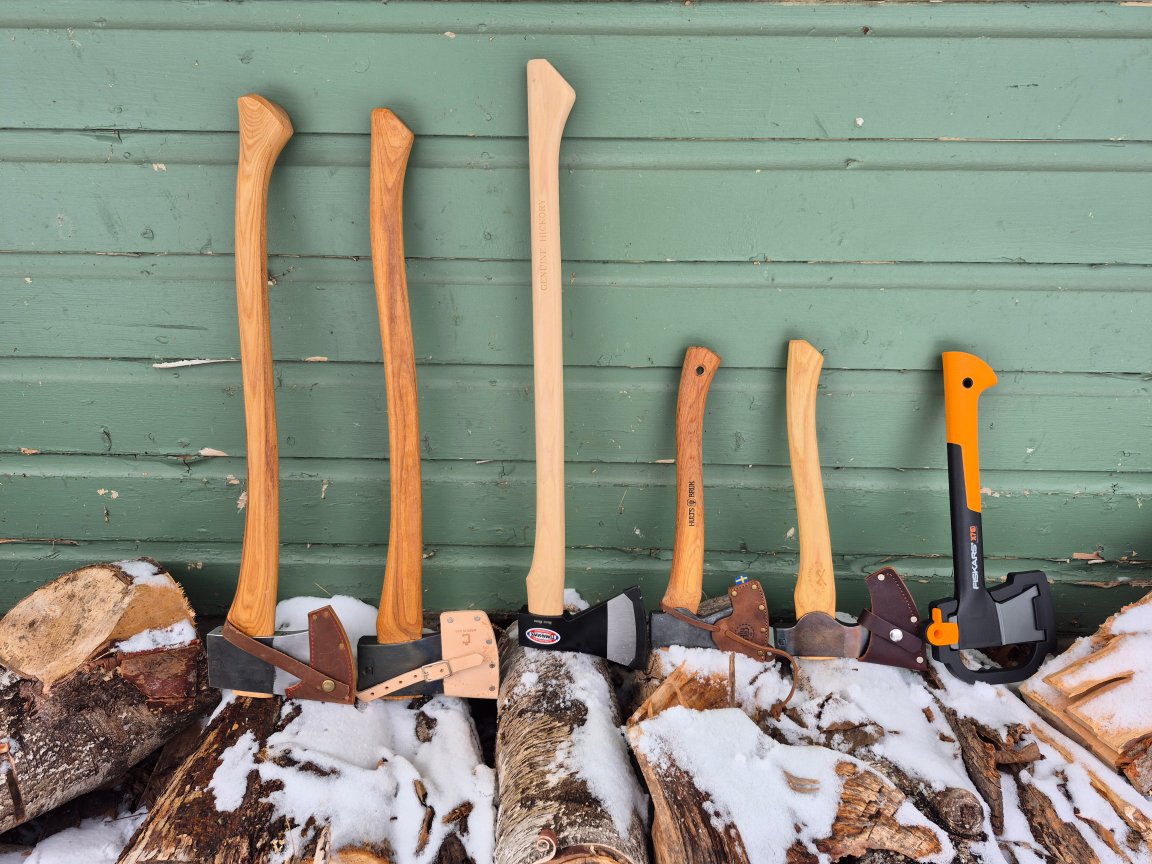
So, what makes an axe a camp axe? Generally speaking, it’s the size and weight. Camp axes are relatively light and portable and can be easily carried in or on a pack. Head weight is usually 2.5 pounds or less, and length is 28 inches or less. To break camp axes down further, there are axes and hatchets; hatchets are 16 inches or less. This test has three axes in each size category to help you choose the best tool for your camping needs.
- Best Overall: Brant & Cochran Allagash Cruiser
- Best Camp Hatchet: Council Tool Wood-Craft Camp Carver
- Best Value Axe: Council Tool Boy’s Axe
- Best Lightweight Hatchet: Hults Bruk Almike/ Hultafors Hultan
- Bust Budget Axe: Cold Steel Trail Boss
- Best Budget Hatchet: Fiskars X7
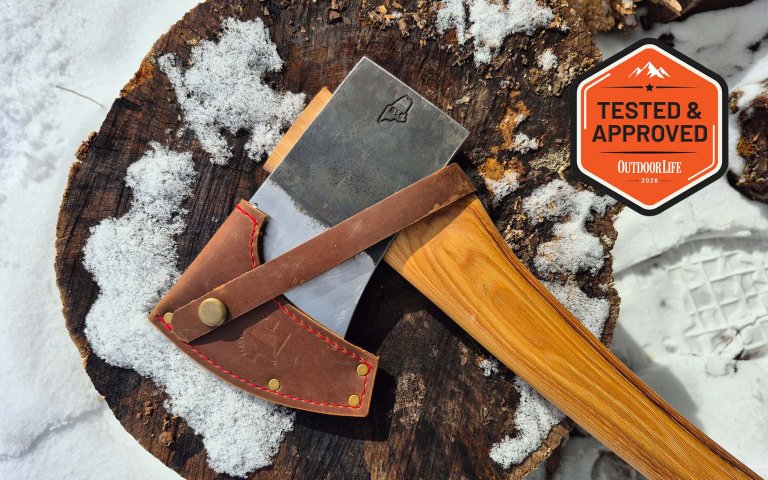
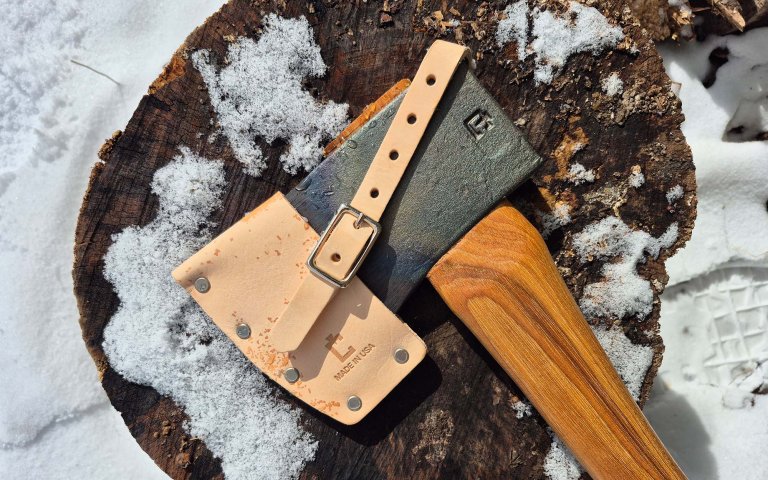
Best Overall: Brant & Cochran Allagash Cruiser
Pros
- Comes with premium leather mask
- Shaving sharp from the factory
- Top splitter and chopper
- Incredibly comfortable handle and swell
- Flawless fit and finish
Cons
- Sticker shock
Key Features
- Hand forged in Maine
- 27.5 inch overall length
- 2.5 pound head
- 4 inch edge
- A+ Grade hickory handle
- Pattern: Maine Wedge
- Price: $339
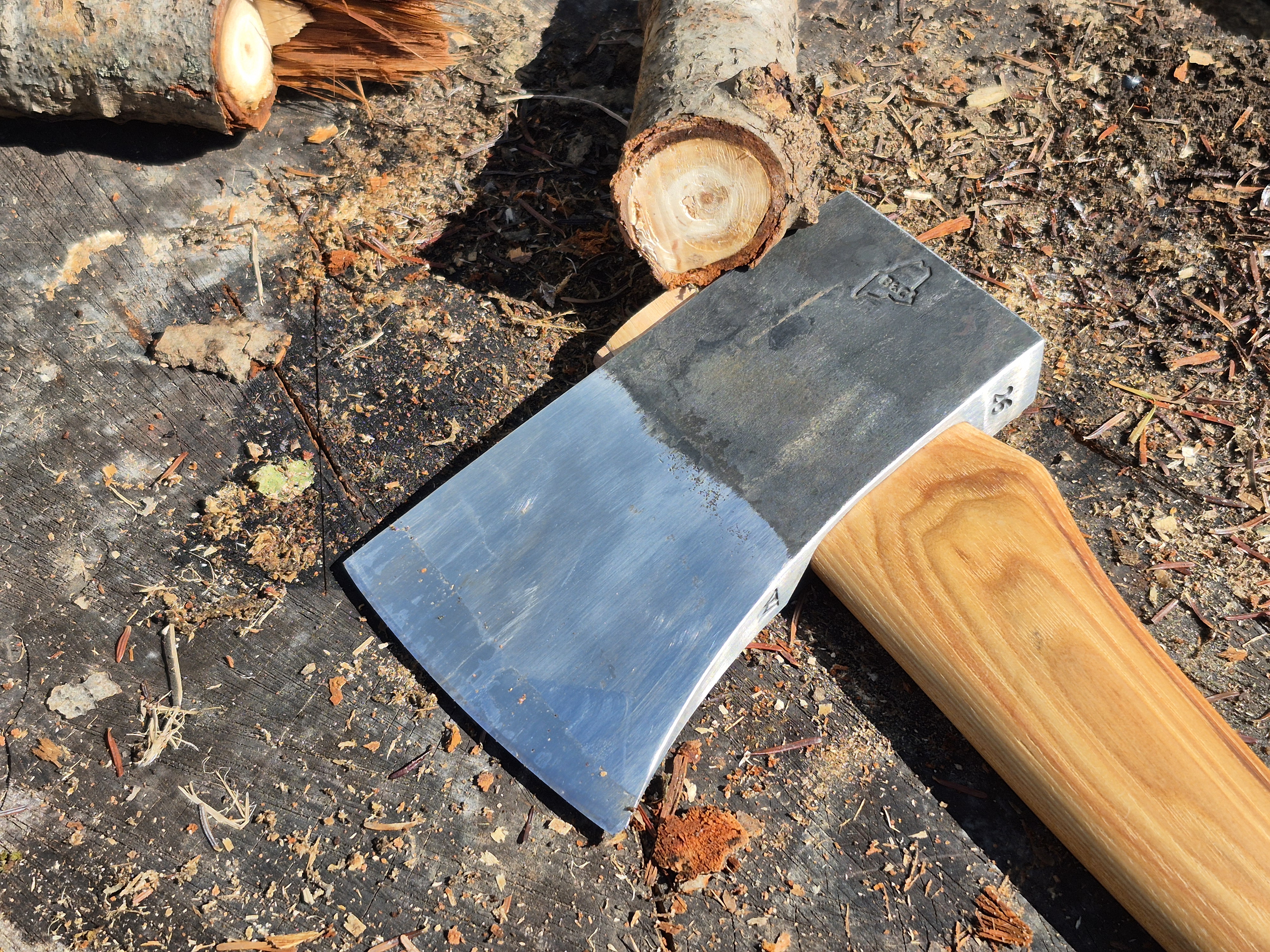
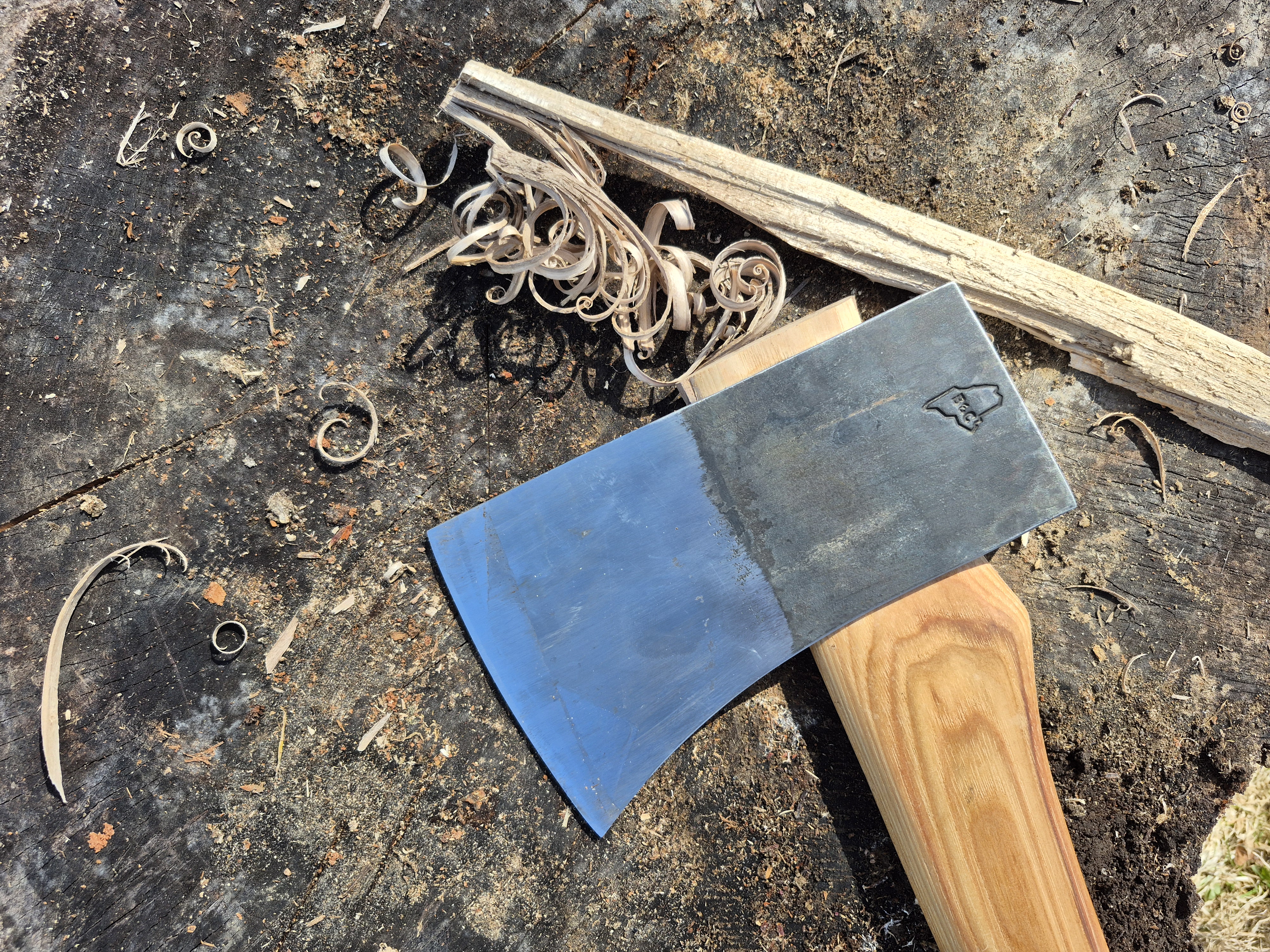
The B&C Allagash Cruiser is the perfect camp axe. Light enough for backpacking, heavy enough to do serious work, nimble enough to do detail work, and made with top-shelf materials and expert-level craftsmanship. The Allagash Cruiser has a wedge pattern, which makes it an excellent splitter, but also leaves the cheeks thin enough to chop deeply and slice through limbs with ease. In fact, this was the best splitter, chopper, and limber, which is amazing. Normally, those three attributes are trade-offs. A splitting maul is a terrible chopper, and a felling axe gets stuck while splitting… but somehow, the Allagash does it all. The wedge pattern head is complemented by a top-quality hickory handle with a generous swell at the bottom, which reduces fatigue and feels great in hand. The grain is super tight and parallel, with no run-outs, making for a very strong and durable haft. But what about the elephant in the room? Is the Allagash Cruiser worth the money? Honestly, for the occasional, casual user, no. But, I can say that when it came time to send this axe back to B&C after testing, I asked them to send me a bill, and not a shipping label. This axe is staying with me.
Best Camp Hatchet: Council Tool Wood-Craft Camp Carver
Pros
- Quality welted leather mask
- included LonBeard aids in carving and chopping
- Very sharp out of the box
- Hardened poll allows for driving nails/use as a hammer
- Upgraded 5160 steel is tough and holds an edge longer than the competition
- Excellent fit and finish
Cons
- A little heavy for finer bushcraft and fire making tasks
Key Features
- Made in USA
- 15.5 inches overall length
- 1.7 pound head
- 3.75 inch edge
- Premium hickory handle
- Pattern: Mixed/Proprietary
- Price: $183
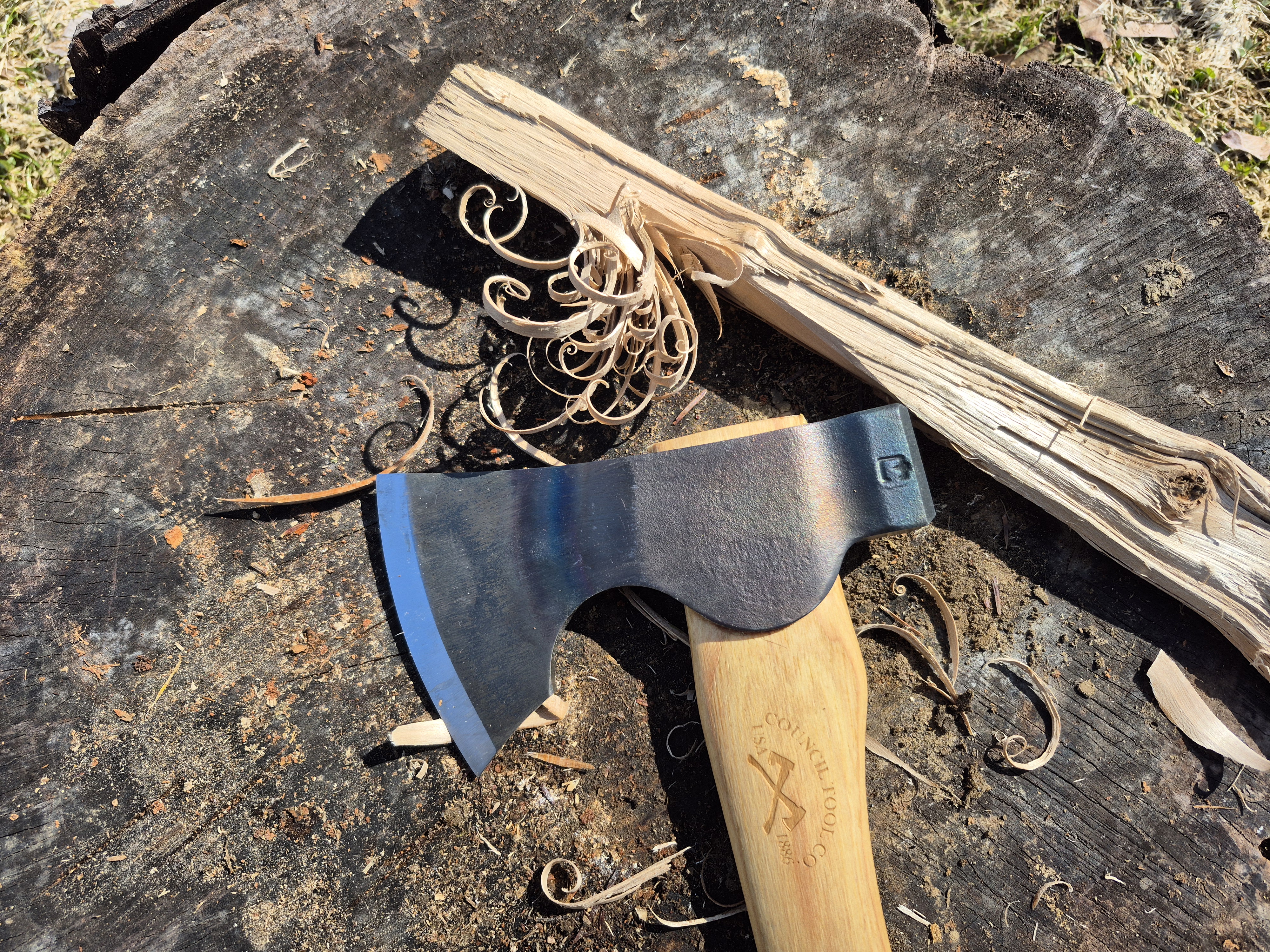
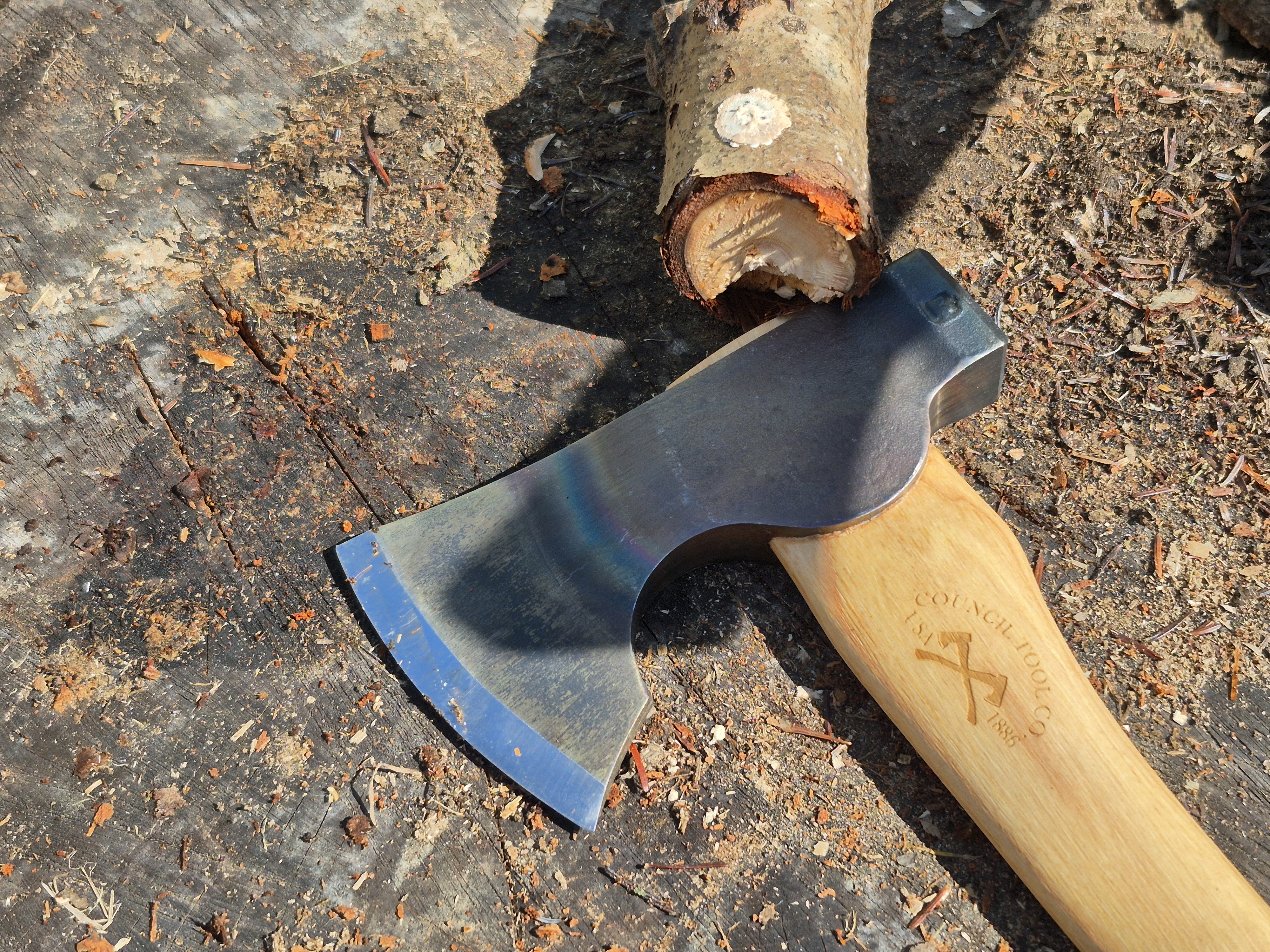
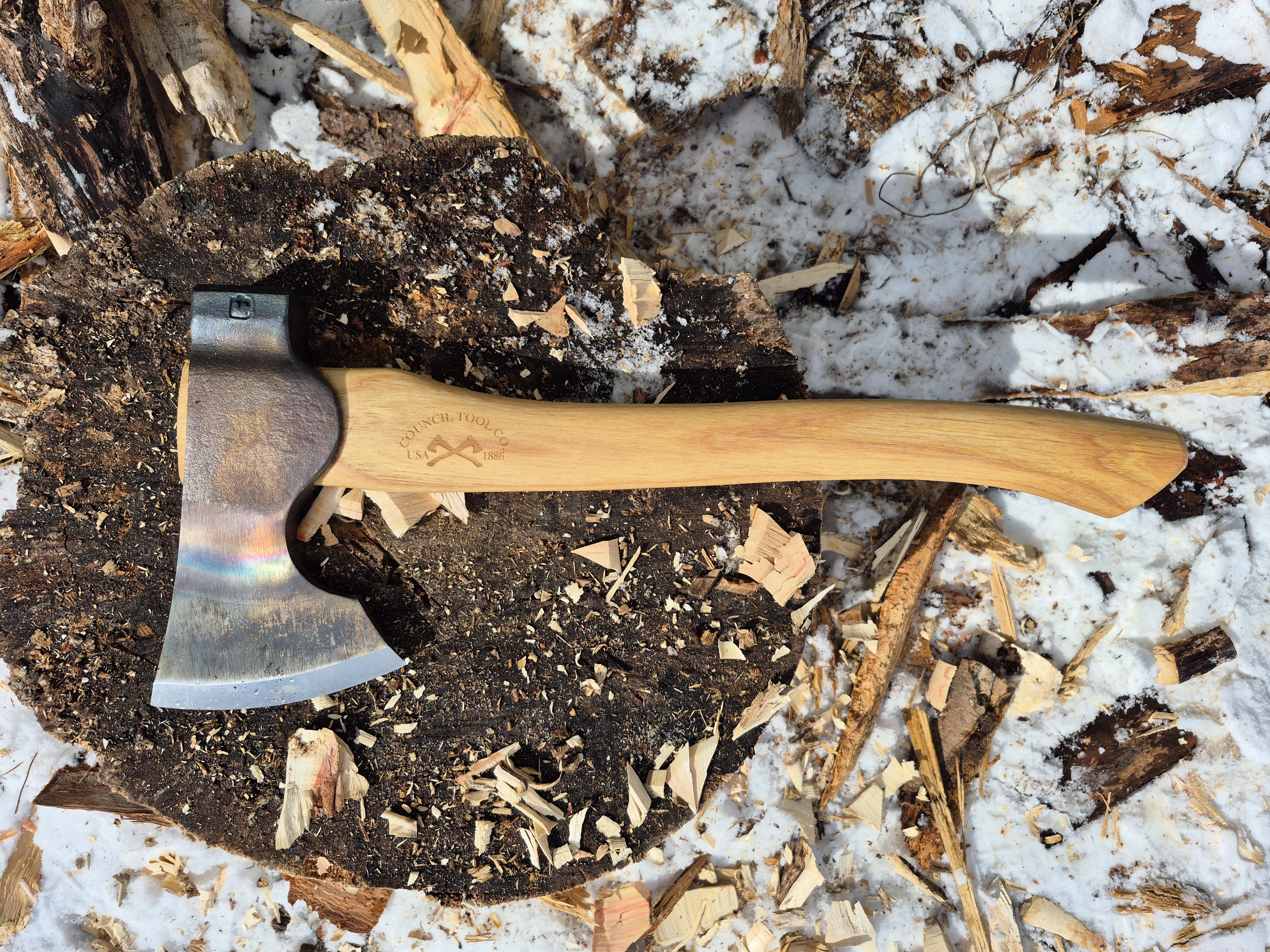
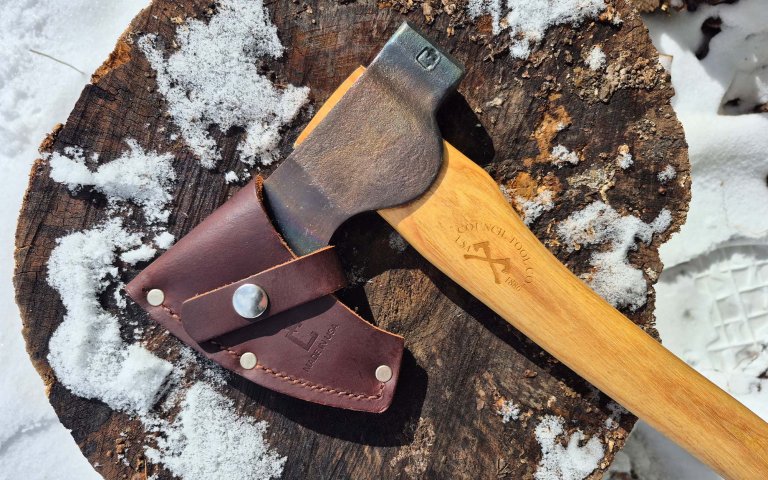
The Council Tool Wood-Craft Camp Carver is an excellent choice for someone looking for a highly versatile hatchet for camp. Easily packable, lightweight, and compact, the Camp Carver is a do-all tool while camping. It won’t split like a full-size camp axe, but it will make kindling easily, and does well making feather sticks for fires. This axe was really designed for bushcraft, so it shines as a multi-purpose tool, easily carving a tent stake or pounding a metal stake into hard ground. The Camp Carver fits your hand well, no matter where you’re gripping the handle, and the bit and poll are well balanced, so it’s pretty easy to swing and control. For finer chopping like spoon making or small stakes, the head is a little heavy, and so it’s slightly less precise than lighter heads, but the extra weight makes it a better splitter and chopper. The Camp Carver is made from premium steel and features a well-thought-out design, allowing you to press it into just about any role around camp. If you want a premium hatchet that can pretty much do it all, the Council Tool Wood-Craft Camp Carver might be for you.
Best Value Camp Axe: Council Tool Boy’s Axe
Pros
- Comes with leather mask
- Comfortable handle
- Great chopper and limber
- Treated with boiled linseed oil from factory
Cons
- Not very sharp from the factory and required sharpening for crafting tasks
Key Features:
- Made in the USA
- 28 inches overall length
- 2.25 pound head
- 4 inch edge
- Hickory handle
- Pattern: Dayton
- Price: $77
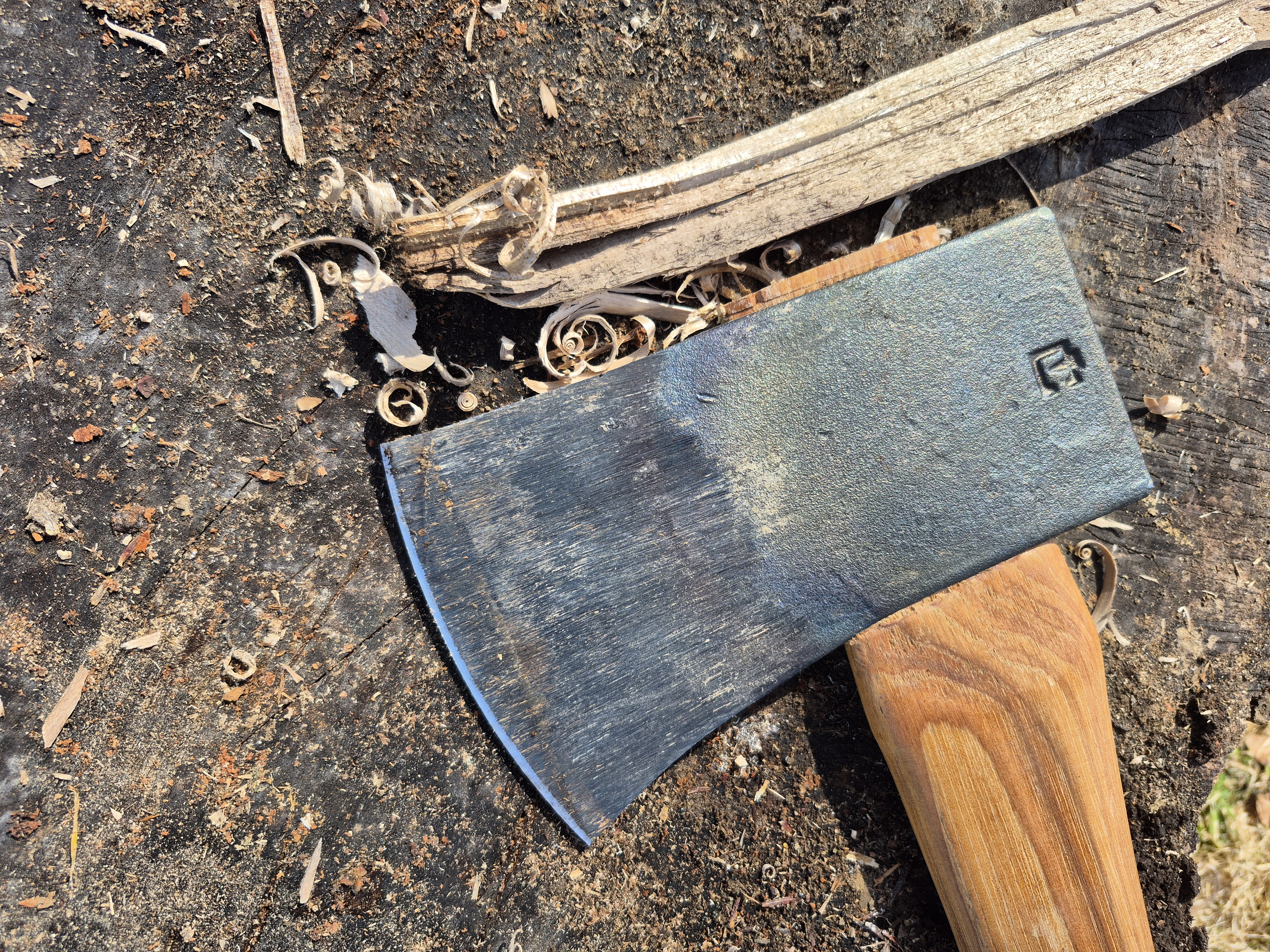
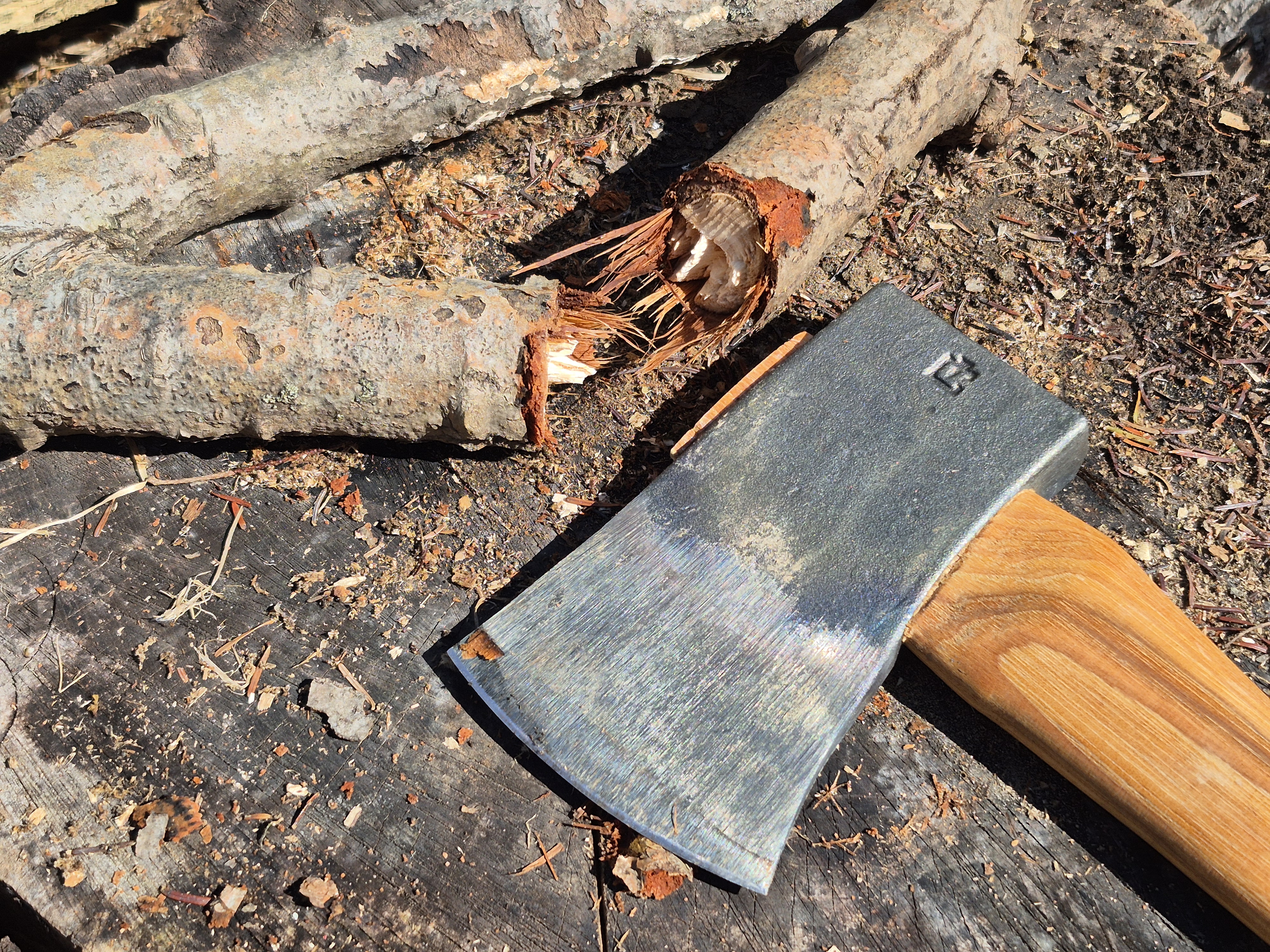
The Council Tool Boy’s Axe has been popular for years because it delivers great bang for your buck. I have owned and gifted a few of these over the years, and they are a great workhorse camp axe. They aren’t fancy, but they absolutely get the job done. The handles are comfortable, the heads are functional and built well, and the mask is full-grain leather. I treat every axe handle with at least one coat of boiled linseed oil, and my council tool axes usually only take one or two coats. They do a great job putting together a good, tough axe at a great price. The Dayton pattern is a little thin for heavy splitting and will get stuck, but for medium and small rounds/chunks the Boy’s Axe will work well. Limbing and chopping are where this will shine, and if you put a better edge on it, it will do pretty well with crafting and carving. The Council Tool Boy’s Axe is a HUGE step up from big box store brands, and if you want a good, solid axe that doesn’t bust your budget, this is a great option.
Best Lightweight Hatchet: Hults Bruk Almike/ Hultafors Hultan
Pros
- Comes with Premium leather mask
- Very sharp, polished edge from the factory
- Excellent grain pattern
- Precision forged
- Excellent fit and finish
Cons
- Premium axe, premium price
- Light head weight is great to carry, but limits splitting power
Key Features:
- Made in Sweden
- 15 inch overall length
- 1 pound head
- 2.75 inch edge
- Hickory handle
- Pattern: German/Turpentine
- Price: $199
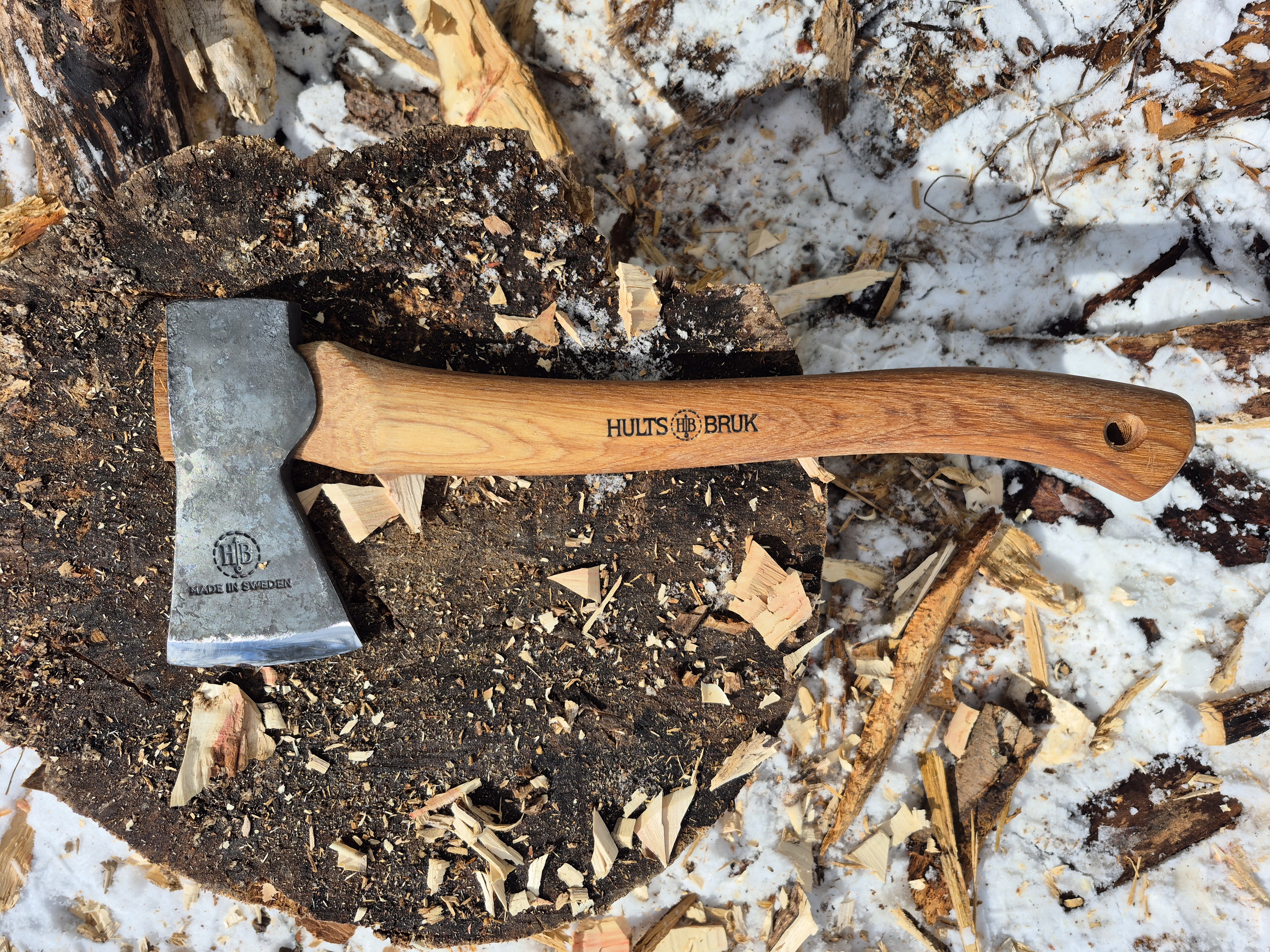
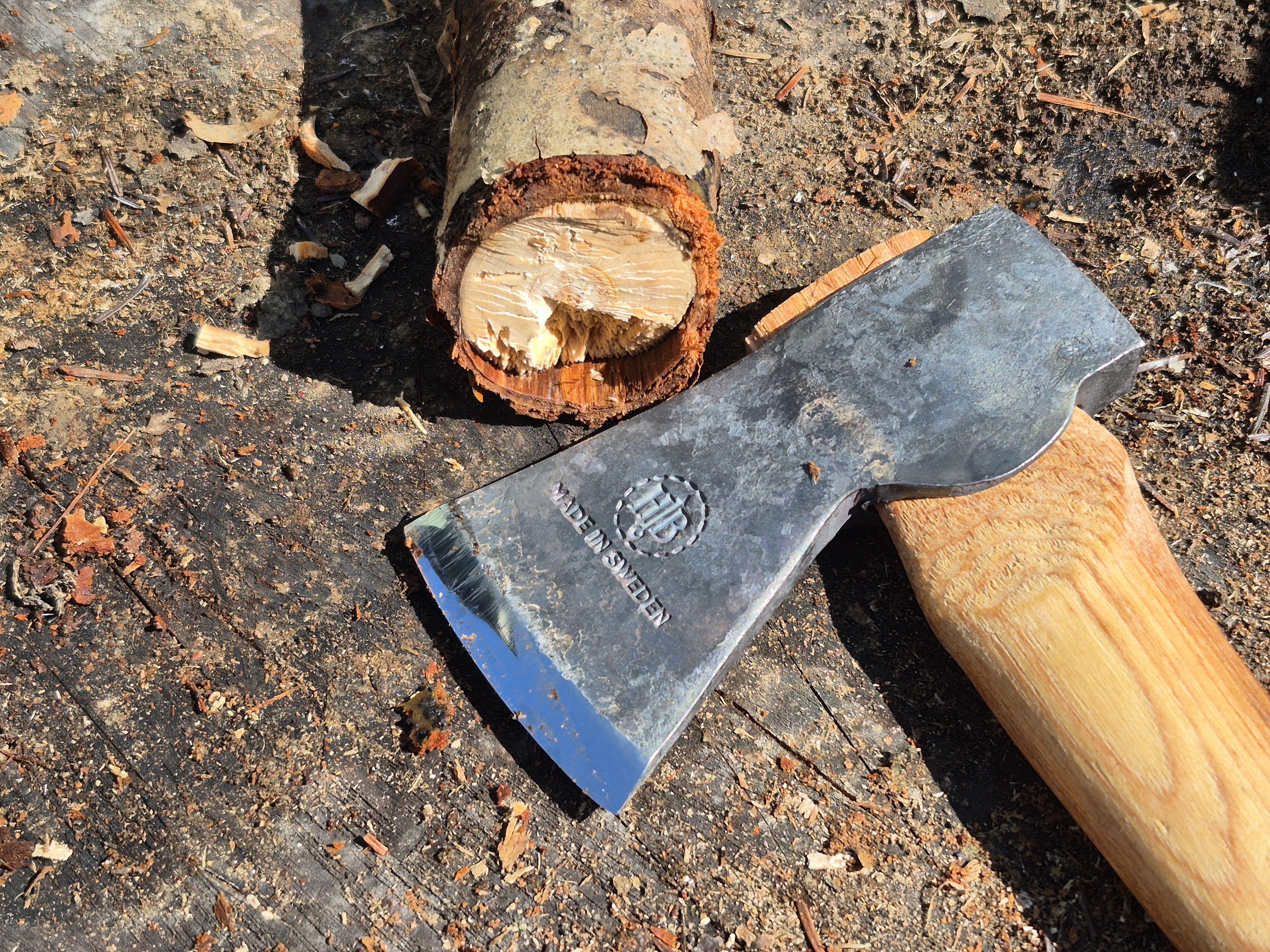
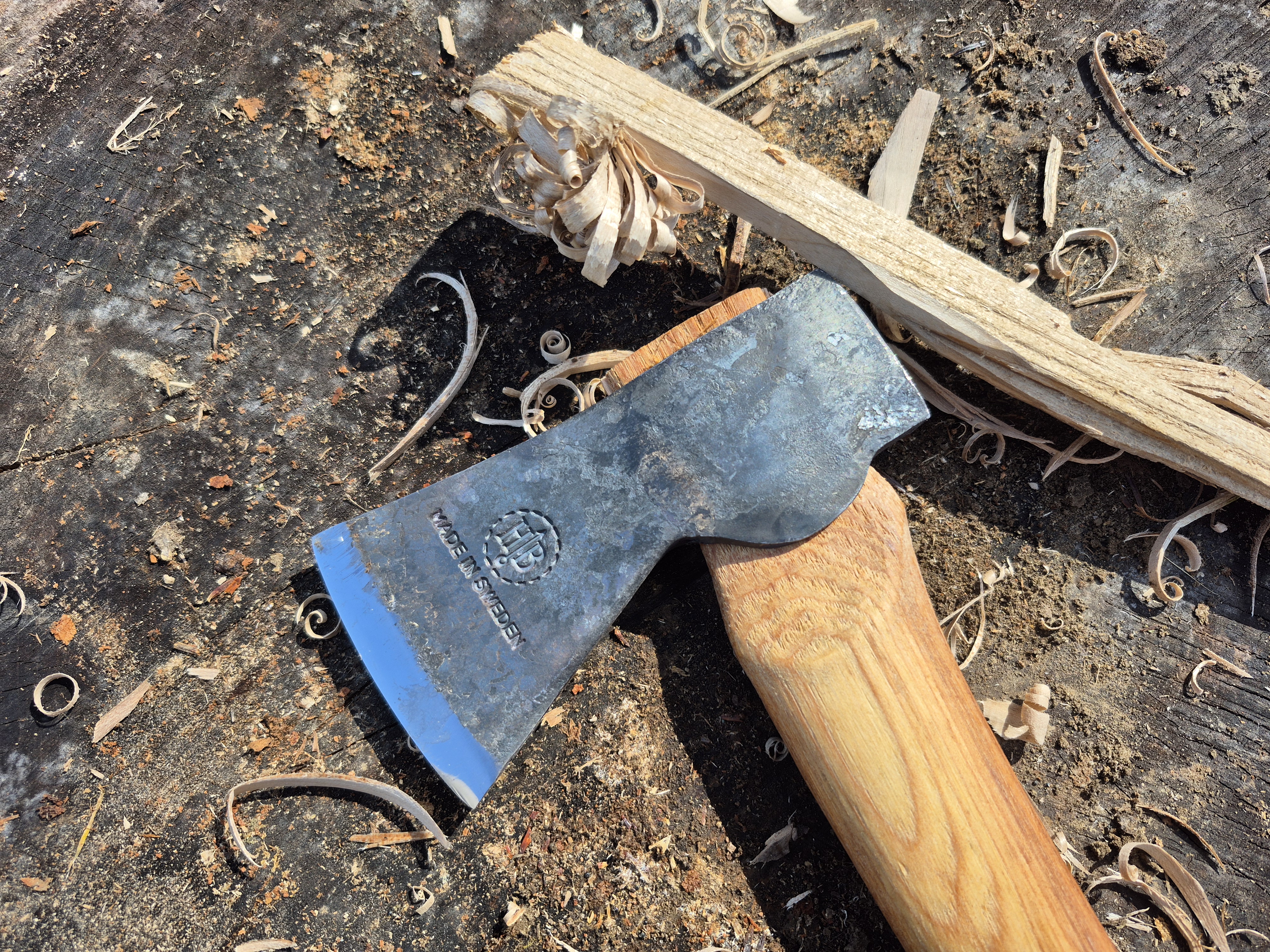
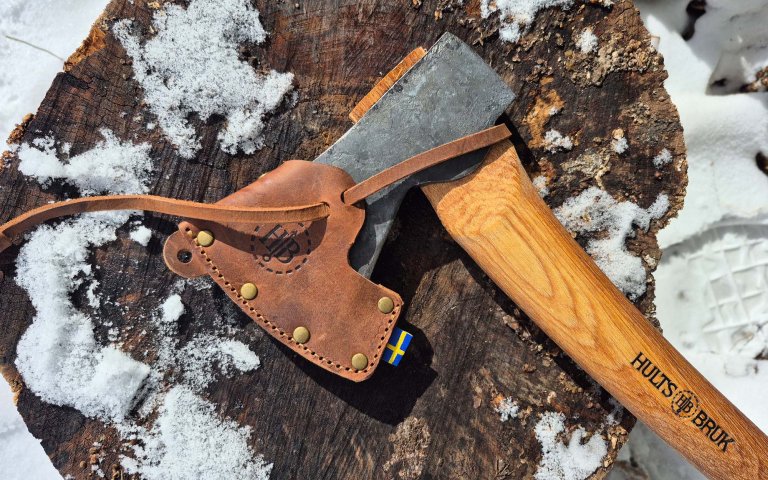
The Hults Bruk Almike and the Hultafors Hultan are the same axe, just sold in different markets. But, whatever name you find it under, you can be sure you’re getting a quality axe. They have been making axes since 1697 at the same forge, and they are very good at what they do. The Almike has a curved bit, and excels at precision chopping and crafting. Making stakes, spoons, pot holders, cutting joints or notches… all a breeze with this hatchet. Lighter limbing and chopping are also easy, and because of the sharp edge and thinner cheeks, the Almike will “one chop” limbs up to 3ish inches if you come at them at a little angle and give a good swing. However, due to the lower weight and thinner cheek, splitting anything other than smaller branches/chunks will be a challenge, and it may be advisable to make a baton with the Almike and use the baton drive the head through bigger logs. The Almike is very comfortable and unbelievably controllable and confidence-inspiring, and it can get most chores around camp taken care of. This would be a great choice for backpacking or anywhere else where weight is a concern. It is a premium axe with a premium feel, and premium performance. If you want a lightweight hatchet, the Hult Bruk Almike should be at the top of your list.
Bust Budget Axe: Cold Steel Trail Boss
Pros
- Good Chopper
- Head coated for corrosion resistance
- Doesn’t break the bank
- Pretty comfortable despite the low price tag
Cons
- Handle is varnished, not oiled
- Some dry-checking in the handle, most likely due to varnish
- Rubber mask is thin and wears out quickly
Key Features:
- Made in Taiwan
- 27.25 inch overall length
- 1.75 pound head
- 4.5 inch edge
- Hickory handle
- Pattern: European
- Price: $30
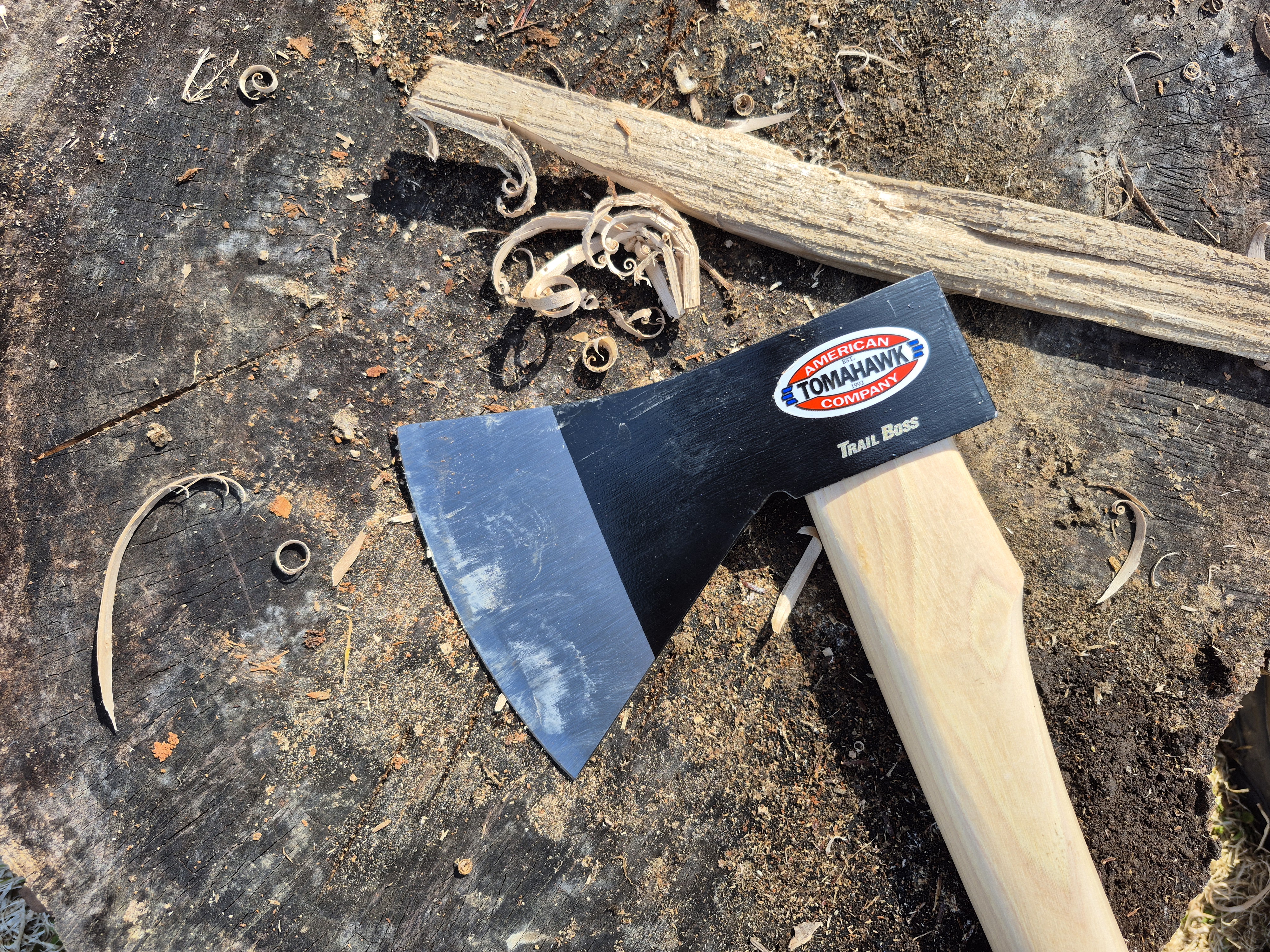
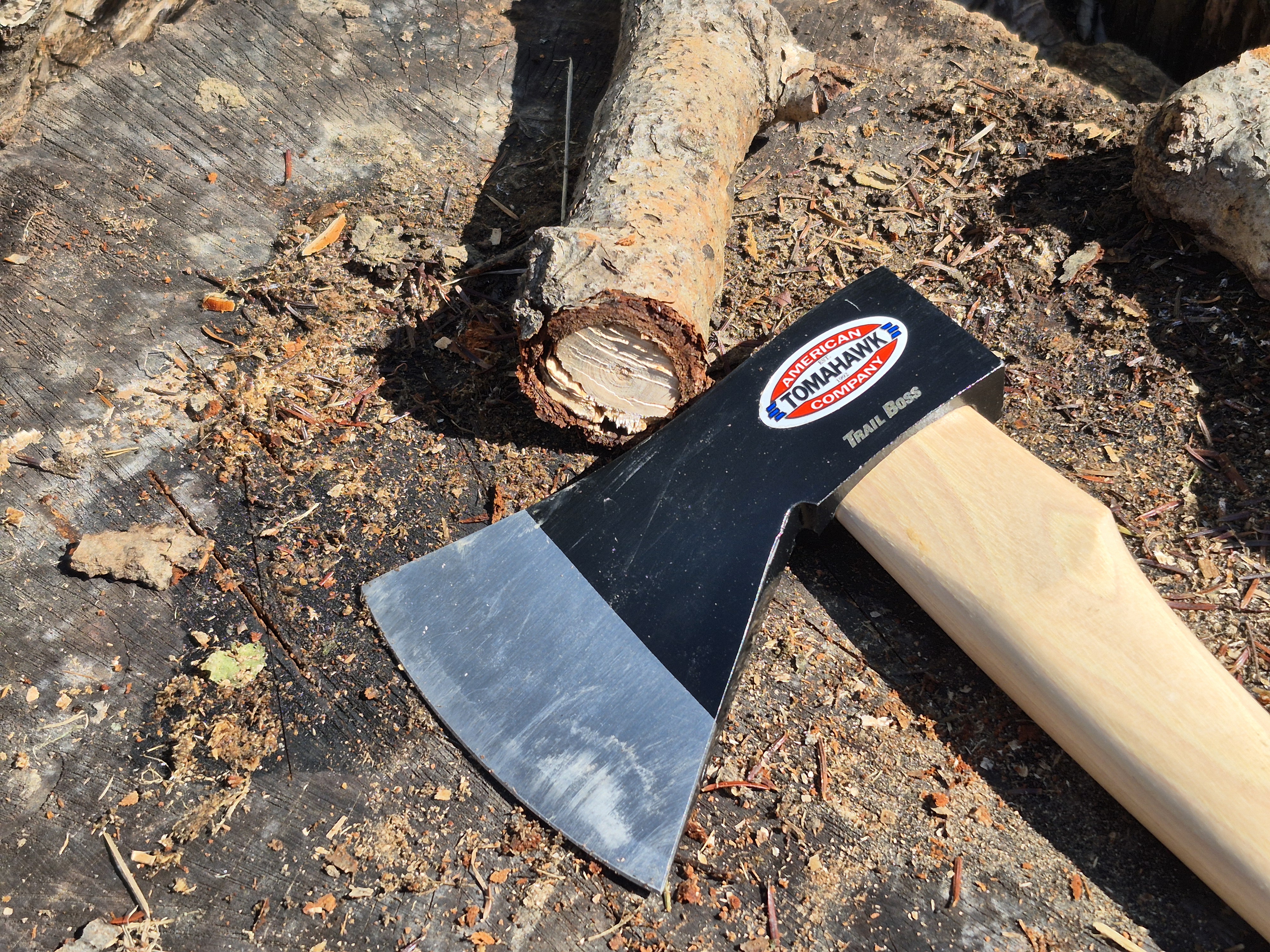
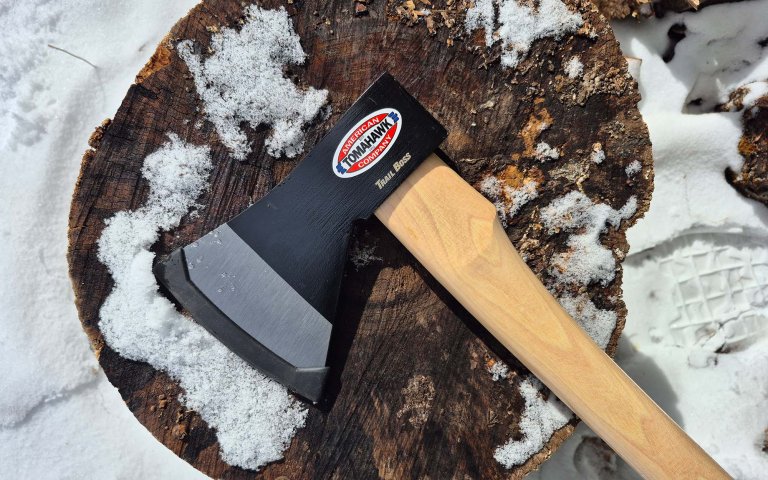
The Cold Steel Trail Boss is a solid performer and actually split a little better than the Boy’s Axe due to its slightly thicker cheek and wedge. For limbing and chopping, the Trail Boss was a solid performer again and surprised me. There are obviously places where Cold Steel had to save money to keep this axe so affordable, other than making it overseas. The thin rubber mask doesn’t last long at all, the handle has varnish, which makes it slippery when wet and uncomfortable with prolonged use, and the head is secured with two round wedges and cut flush. This method won’t last as long as a double wedge with some of the handle sticking out above the head to spread it, and the varnish is not nearly as comfortable or good for the wood as oil. However, if you want a camp axe to toss in your RV or car for occasional camping, or just don’t have much to spend, the Trail Boss will certainly do the job. And with some sanding and a few coats of boiled linseed oil, you will improve the grip significantly and really transform this budget tool. At the end of the day, the Cold Steel Trail Boss is a great budget axe that is easy on your wallet and tough on wood.
Best Budget Hatchet: Fiskars X7
Pros
- Polymer sheath with carry handle
- Very sharp from the factory
- Best Splitter among the hatchets
- “Hook” on handle provides secure grip
Cons
- Plastic everywhere
Key Features
- Made in Finland
- 14 inch overall length
- 1.4 pound head
- 2.75 inch edge
- Polymer handle
- Pattern: Semi-Wedge
- Price: $35
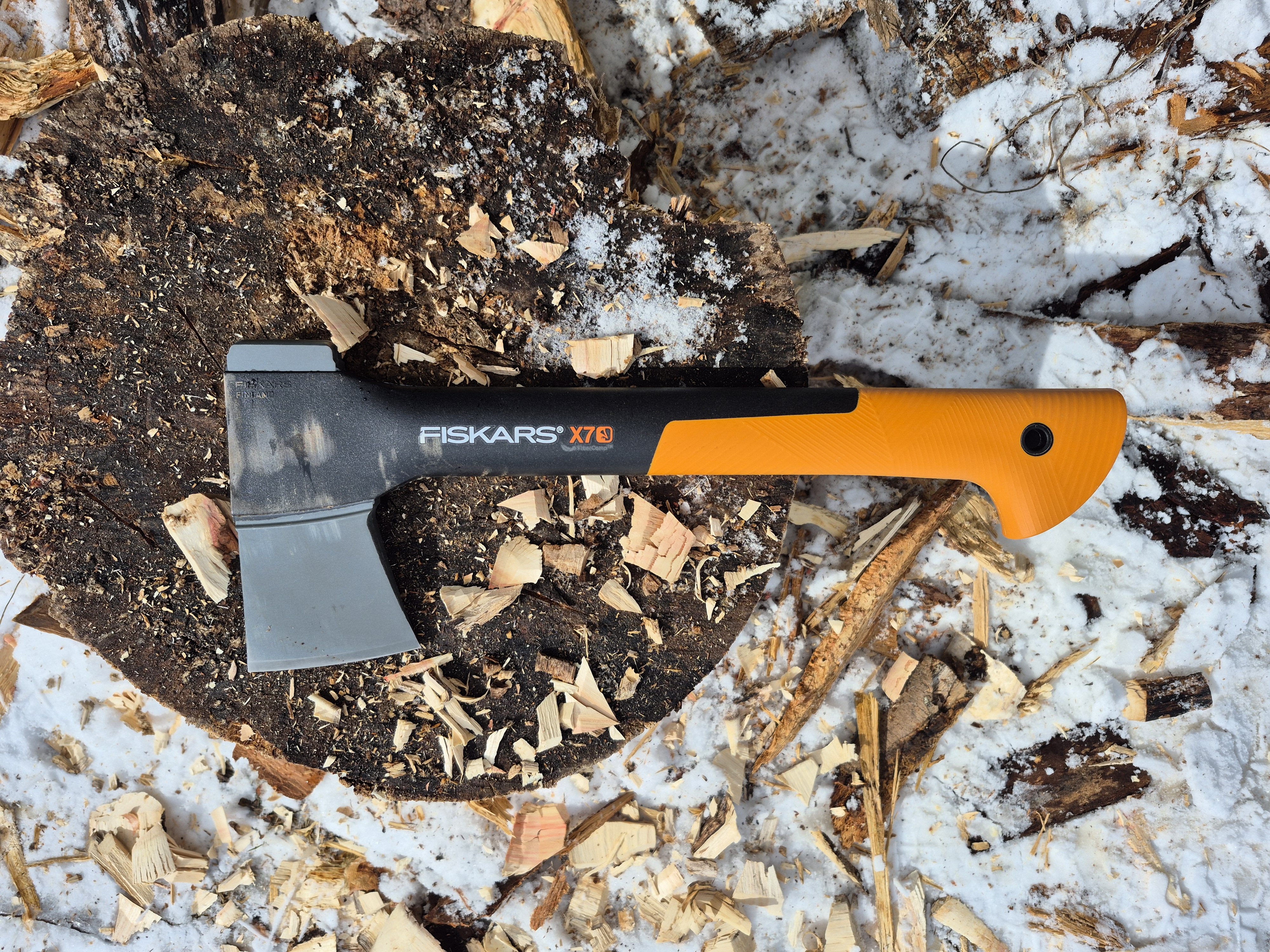
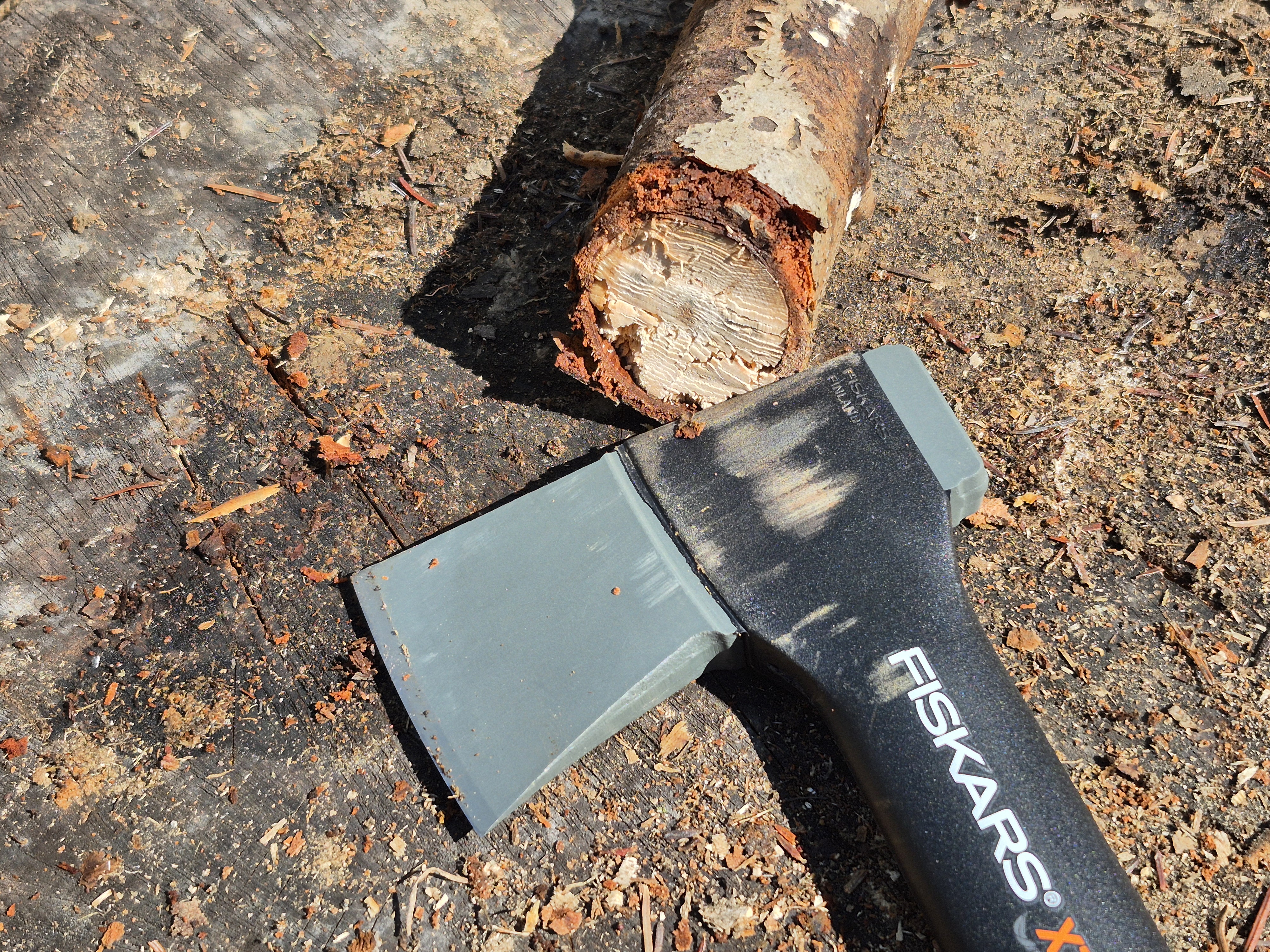
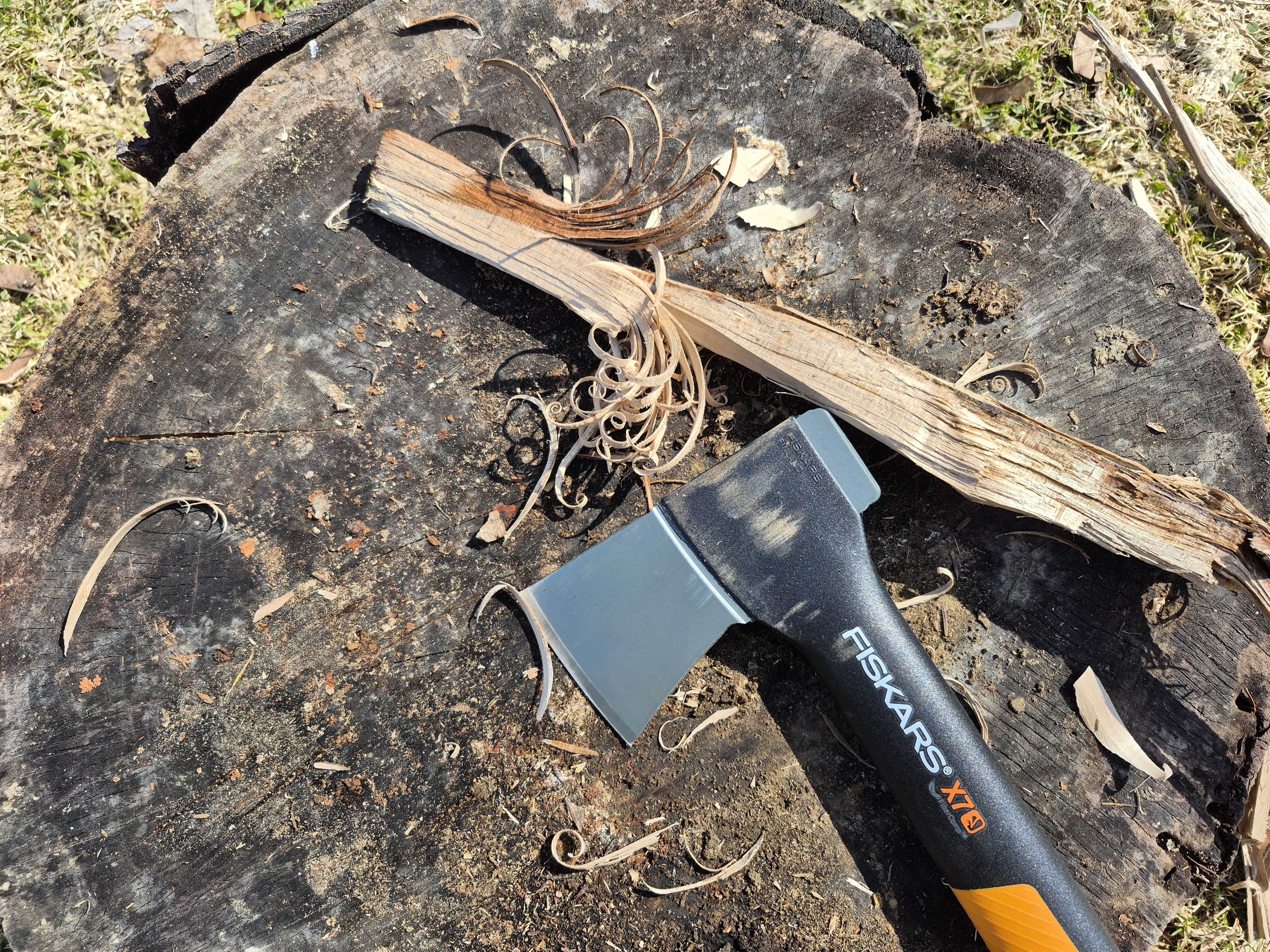
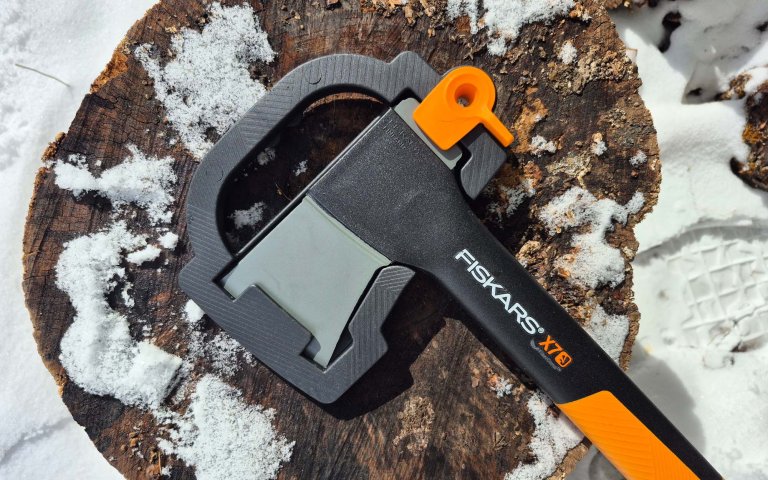
As much as I may not be a fan of the look and feel of polymer and plastic on an axe, there is no denying the performance that the Fiskars X7 brought to the table. The head shape is similar to the Allagash Cruiser, and so this almost acts like a smaller version of that. The semi-wedge shape makes it a great little splitter, and the edge is very sharp from the factory, which makes it a good chopper and limber as well. This is a great tool around camp, and it took everything I threw at it. The handle is not as comfortable as wood in my opinion, but it has a pretty good grip, and whatever they add to the polymer makes it very strong. The orange makes it easy to find if you have to set it down in the woods, and the carry handle on the plastic sheath is actually useful for carrying or hanging it. I have used a number of these Fiskars axes, and they have been consistently good, and the X7 is no exception. If you need a budget hatchet, the Fiskars should be the first place you look.
How I tested Camp Axes
For about 3 months, these axes and hatchets were tested on the same tasks: splitting logs into kindling, limbing downed trees, bucking, chopping, carving/crafting, and fire-making. I heat my home with firewood that I procure myself, and so I have no shortage of logs, rounds, limbs, and split wood to work with. Splitting was mostly making kindling out of regular-sized split wood, but I did split some larger rounds with the larger axes. This is probably the most common use for axes while camping. After the splitting, I limbed a variety of hardwoods and pine, and then bucked the trees down to campfire size. They were about 6 inches in diameter. I also tested how easily they would “one chop” 2-3 inch limbs laying on a splitting block, and then I made feather sticks out of the kindling that I processed down with them for fire starting. I also carved some tent stakes with each axe and made some pot hangers for the campfire. I used them in the snow, mud, and sun, with wet and dry handles, and they all put in plenty of work. All these tasks give me a good feel for the axe in terms of comfort, capability, and craftsmanship. In every task, I pushed the axes hard to really see how they hold up to real-world use. Some axes were strong in certain areas and weak in others, while others were more balanced. In each review, I’ll share the stats and numbers for the axe, and, more importantly, how they are to work with and where they shine and fall short.
Tips for getting the right axe for you.
Tip 1. Be honest about how you will be using the axe.
If this will be something that is only used a few times a year, then you probably don’t need to go grab the most expensive axe. Also, be honest about what you will be doing the most. If you’re looking at just splitting smaller wood that you buy at the gas station or campground to make kindling, a hatchet will do just fine. However, if you’re planning on felling dead trees and then breaking them down, or need to split larger pieces frequently, a larger camp axe will be a better choice.
Tip 2. When in doubt, size up.
If you are unsure about choosing between a hatchet and an axe, go for the larger axe. A medium-sized axe, like the ones in this article, can do what a hatchet can do with a little effort, but it’s much harder to take on big jobs with a smaller hatchet. Ideally, you have one of each, so you always have the right tool for the job.
Tip 3. Consider what it will take to maintain your axe.
Some people really don’t want to maintain tools/vehicles/firearms, etc. If you don’t want to do anything but sharpen your axe occasionally, the Fiskars will be a good option. No wood to dry out, no head to come loose. If you don’t mind occasional maintenance, you can buy a file and a small bottle of boiled linseed oil and maintain your axe for a lifetime. A simple file is all you need to sharpen your axe, and a coat of boiled linseed oil each year after 2-3 initial coats will keep your axe in tip-top shape. The oil can also be wiped on the head to prevent corrosion during storage.
FAQs
Q: Are more expensive axe’s really worth the money?
A: Yes, and no. It depends on you. Will you be using this frequently and putting in lots of hours clearing brush, getting a fair bit of firewood split for hunting camp, or do you want something you can pass down? Then a more expensive heirloom-quality tool might be right for you. I have tools from my grandfather because he bought once and bought quality, and they are on their third generation of work. The Allagash Cruiser is as much a piece of art as it is a top-quality tool. Working with it was such a pleasure that I had to buy it, so it was worth it for me. On the other hand, you might just need something to use a couple times a year, and you have other areas where you need something premium… in that case, there are good budget options out there, and a top flight axe won’t make sense.
Q: Is there a safe way to use an axe?
A: Yes, absolutely. And there are unsafe ways to use them as well. Remember that a tool that can chop through a tree can chop through you. To stay safe, make sure you aren’t swinging in anyone’s direction, and that people stay 10 yards from you on the sides and behind. When splitting with a hatchet, it’s best to be on your knees with the wood on the ground. If you glance off to the side, you won’t overswing and hit your legs/feet that way. For larger axes, its best to split on the ground and not up on a block, again to minimize hitting your legs and feet if you glance off. You can also bend your knees and “sit” a bit on the down swing to keep your arms and axe more parallel to the ground while striking so that glancing blows and understrikes won’t come back toward you, they will just go down. While limbing, have both feet on one side of the trunk, and chop limbs off the opposite side. The biggest danger with axes is hitting your lower extremities, so think your foot position through, and use some common sense.
Q: How often should I oil an axe?
A: It depends on how you get it. If you buy the Cold Steel and sand it down, you should coat it 5-10 times the first day and let it soak up as much as it can. Then oil it once a day for the next few days, and then maintain it with a coat each year. If your axe comes well oiled like the Allagash Cruiser or Hults Bruk or Camp Carver, it may only take one coat, and then once a year.
Q: What do I do if my axe head gets loose?
A: If your head starts working loose, sometimes you can save it with a good oiling. Find a container that your axe head can just fit in. Put the axe in upside down and pour some boiled linseed oil into the container so that the top of the handle that is above the head is submerged, and let it sit for at least 24 hours. The wood will soak up the BLO and the fibers will swell up and begin to harden. Sometimes that is all you need. Other times, you may have to get a metal axe wedge and use it to expand the wood and tighten things up. If a wedge or two isn’t enough, you can remove the handle and put a new wood wedge in. If that won’t work, you may need to replace the handle.
Q: What’s the difference between and axe and a hatchet?
A: All hatchets are axes, but not all axes are hatchets. What really divides them is length, and how they are used. A hatchet is a one-handed tool, whereas an axe is large enough and heavy enough to warrant two hands. Generally, hatchets are 16 inches and shorter, and 2 pounds and under for the heads.
Final Thoughts
Camping is a ton of fun (in my opinion),, and a good axe makes camp life easier, but the reality is that these tools are useful for plenty of chores outside camping life. I use mine for clearing micro food plots, cutting new ATV trails, brushing in turkey blinds, trimming trees around the house, and cleaning up after storms. I always have an axe and a hatchet in my truck, and there is almost always one strapped to the ATV and hung up at the hunting shed. Camp axes are versatile tools, and everyone who spends time outdoors would do well to have one, and know how to use it.