
We may earn revenue from the products available on this page and participate in affiliate programs. Learn More ›
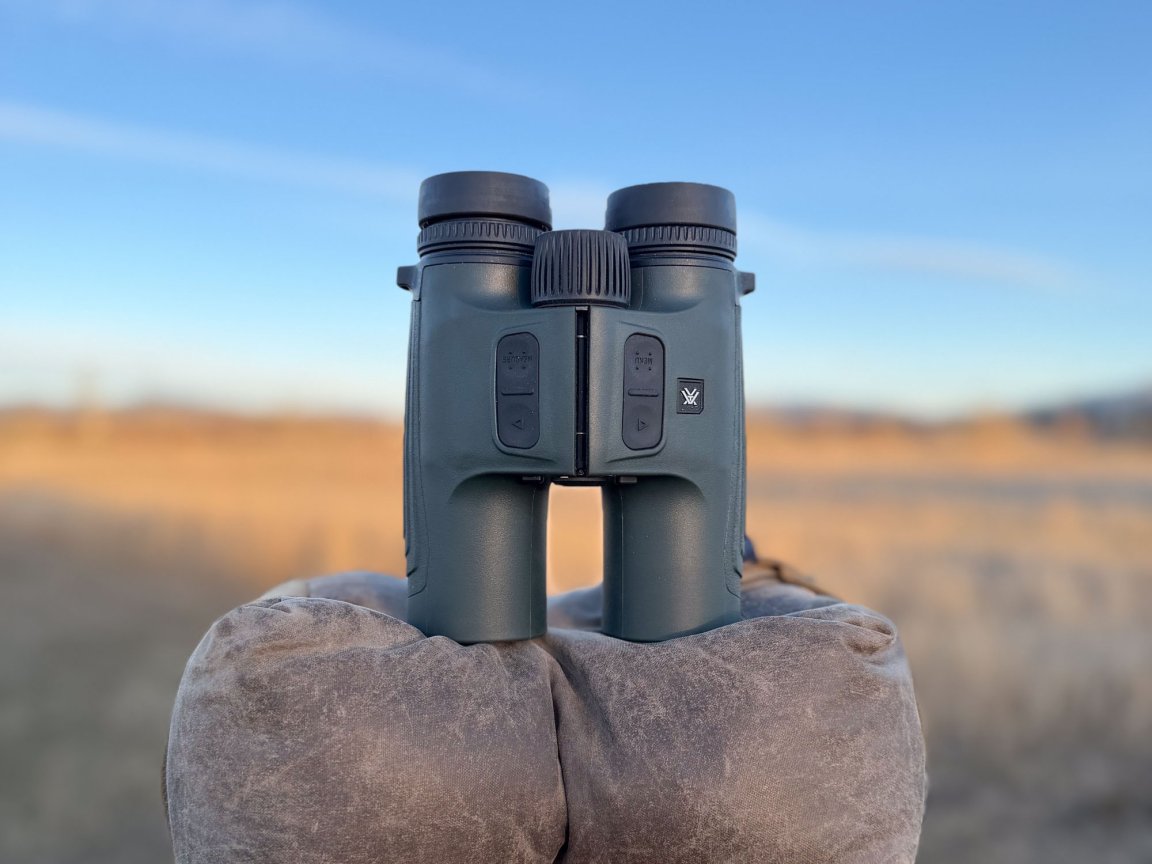
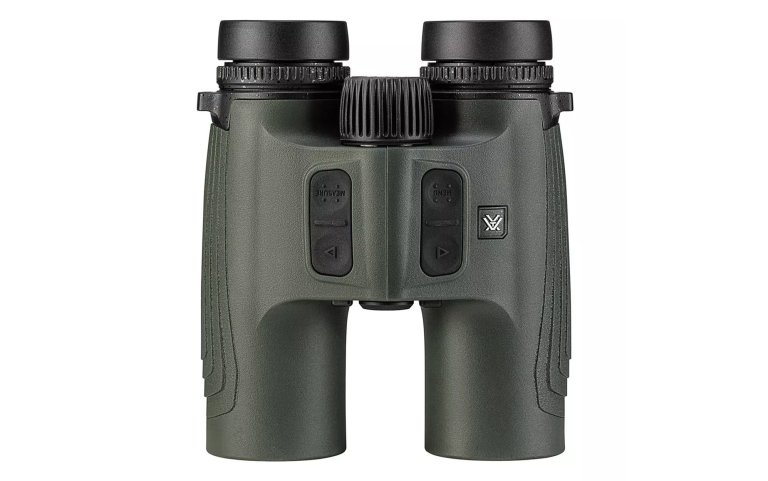
The Vortex Talon HD 10K 10×42 range-finding binocular solidifies the company’s position as a player in the high-end electro-optic market. This is a feature-rich unit that checks all the boxes you’d expect in a premium ballistic solving binocular. It has a powerful rangefinder that is quick and accurate, onboard environmental sensors, a high-quality ballistics calculator, the ability to drop pins on a digital map, and seamless integration with a phone app and other peripherals.
I’ve been testing a unit for the past few months by putting it to use in real-world shooting situations. In a nutshell, the Talon delivers impressive performance, and its no-hassle connectivity through Vortex’s Relay system elevates it above the competition. But there is a steep learning curve if you want to leverage all that the Talon and the other units in the Relay ecosystem can do.
Pros
- Precise lasing
- Fast ballistics solutions
- Very good glass
- Seamless Bluetooth connectivity
- Highly configurable
Cons
- Steep learning curve
- Some unintuitive menu navigation
- Price out of reach for many
Specs
- Magnification: 10-power
- Objective Lens: 42 mm
- Field of View: 321 feet at 1,000 yards
- Weight: 40.5 ounces
- Dimensions: 6.3 inches x 5.5 inches
- Price: $3,499
Key Features
- BC based ballistic solver
- On-board environmental sensors
- Active matrix display
- Part of Relay ecosystem
Binocular Controls
The Talon HD 10Ks come in two configurations: the 10×42 model I tested and a 12×50. I find the 10X more appealing because it has a wider field of view, more compact dimensions, is 6 ounces lighter, and costs a few hundred dollars less.
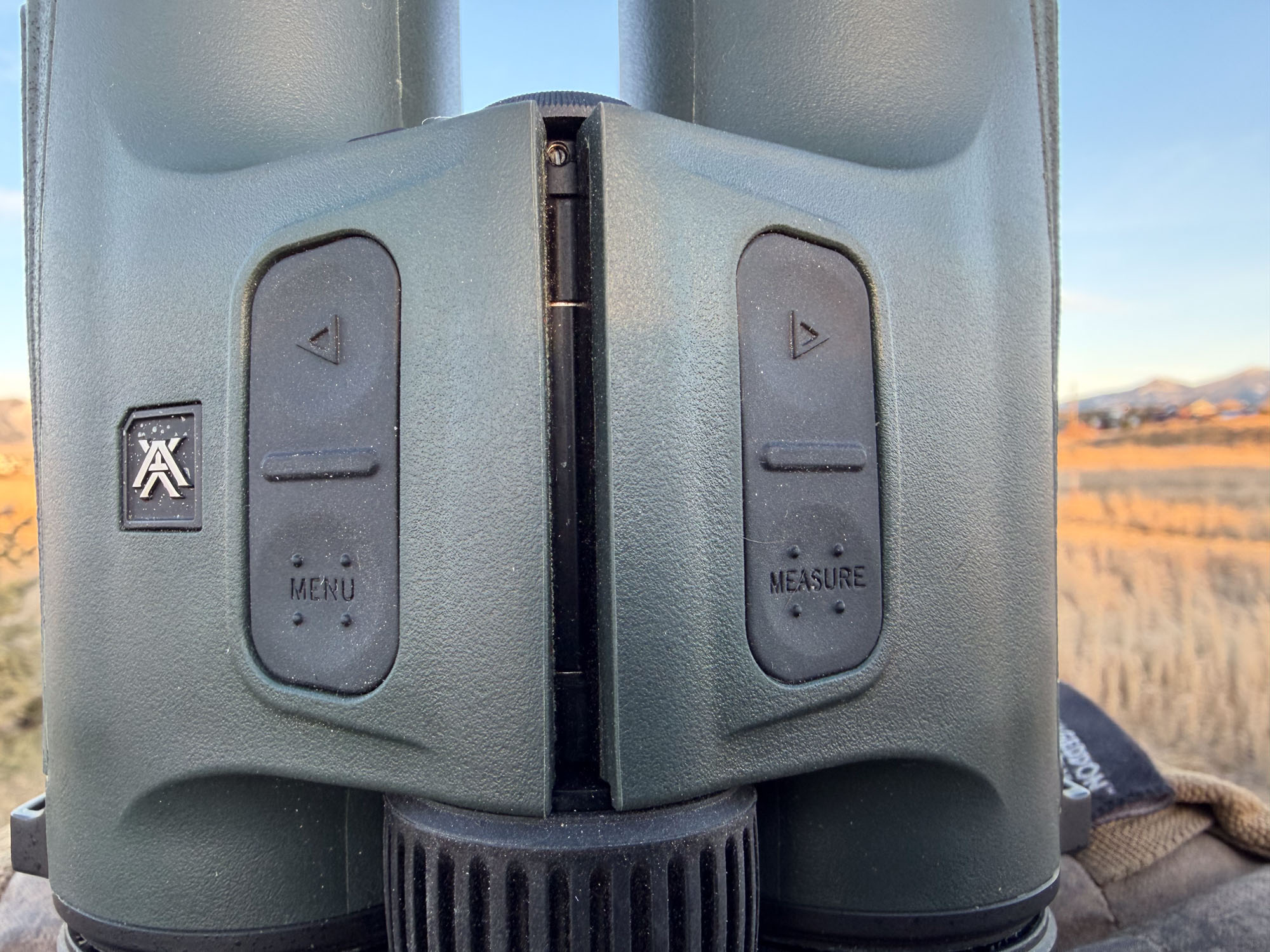
As with the Vortex Fury HD 5000 AB that preceded it, the controls are laid out intuitively and are easy to reach and manipulate. This has been a strong point of Vortex range-finding binoculars, and it’s good to see those ergonomics continued in the Talon HD 10K family.
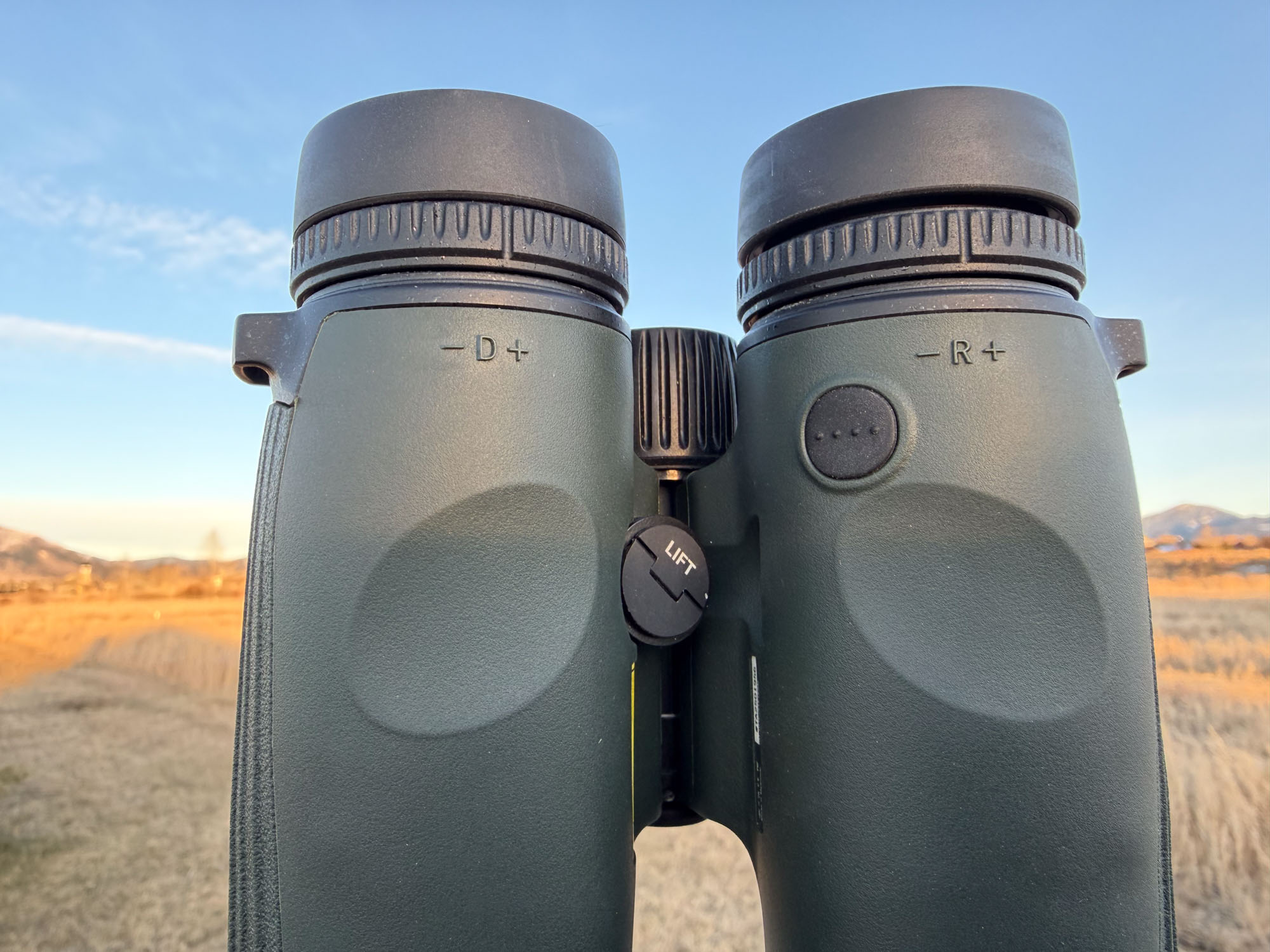
Each barrel has two buttons on top. The ones closer to the user’s face control the ranging (right side) and mode (left side) features. The buttons below each are used to cycle up and down through the various menus.
New to the Talon HD 10K is a button on the underside of the right barrel, which takes the user directly into a menu to manually adjust environmental, wind, and compass data.
The bino comes with a traditional center focus wheel and diopter adjustments on each barrel. The right diopter focuses the display, which you do first, and then you adjust the left side to match.
Talon HD 10K Display
The control buttons work in conjunction with the Talon 10K’s display, an active matrix red OLED, that conveys a wealth of information. In the ballistics mode you can have up to 11 different variables displayed in addition to the standard elevation and windage correction and target distance. They include data on which mode the binocular is in and which profile is active, as well as details like target bearing and inclination, wind direction and speed, bullet time of flight and remaining energy, and density altitude.
The binocular lets you toggle these 11 variables on and off to customize what you’re seeing.
You can set the display to one of five brightness levels or put it on auto mode. The auto mode works fairly well, though if you’re glassing a bright backdrop from a shaded area the display can initially appear faint.
One thing I really like is the display’s auto-leveling feature that keeps the image parallel to the horizon.
Vortex Talon HD 10K 10×42 Glass Quality
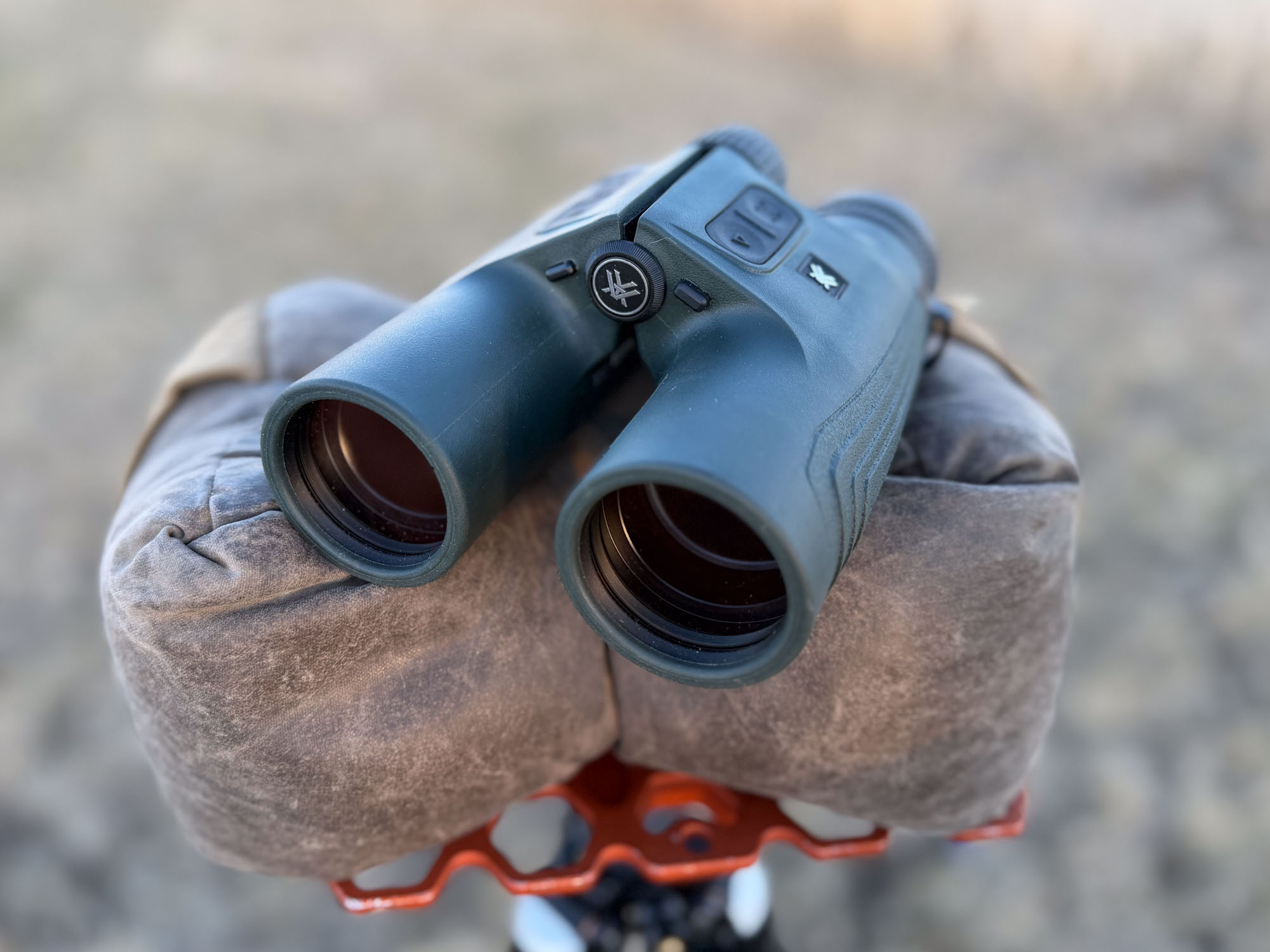
The glass in the binocular is very good. The edge-to-edge clarity is fantastic, with only moderate degradation on the rim of the image. It ranks among the best binoculars I have tested in this regard. It is legitimately impressive.
The contrast is very good as well and it is easy to pick out fine detail in what you’re viewing. The binocular is also true to color, with only a minor hint of blue tinge in the right barrel, which contains the display. Vortex did a solid job here.
A Potent Range Finder
No quality in a ballistic solving binocular is more important than its ability to accurately range targets, and here the Talon HD 10K excels. It easily ranges terrain features beyond 3,000 yards but its pinpoint accuracy on small targets at distance is what really won me over.
During one portion of my evaluation, I ranged the tips of a line of wooden telephone poles that stretched out in the distance. I had no problem getting readings out to a mile. For context, that’s a target that subtends less than .2 mils at that distance and that isn’t very reflective. At the other end of the spectrum, it can range targets as close as 9 yards.
Depending on the environmental conditions, and the nature of the target you’re lasing, you can select from five ranging modes: best, first, last, extended laser range, and rain/fog. For most scenarios “best” is the go-to, but the other settings are useful as well. The ELR mode is good for ranging distant terrain; “first” helps when you’re trying to pick out a smaller target situated in an environment with other reflective elements around it; “last” can help you get a reading on a target that’s behind obscuring vegetation; and “rain/fog” is designed to return accurate readings when there is poor visibility due to precipitation or dust.
Ballistics Versus Other Modes
My focus here is with the binocular’s ballistics setting, which is the most sophisticated of the Talon’s three available modes. The other two are line of sight and horizontal component distances. LOS gives the true distance between you and the target, while HCD calculates the horizontal distance between you and the target based on the angle of the shot. HCD is particularly useful for archers anticipating steep shots from tree stands.
Neither LOS nor HCD give a shooting solution. That’s exclusive to the ballistics mode.
By holding the range button down in any of these modes you enter a scan mode, which gives continuous distance readings while glassing.
Vortex Relay System Explained
The Talon HD 10K 10×42 can’t be understood — or appreciated — without diving into the Relay system. While the binocular can be used as a stand-alone product the Talon realizes its true potential in its ballistics mode, and while working in tandem with the GeoBallistics app and the ACE weather meter, which is also new this year from Vortex.
After you network the devices, which can be linked through the app or from one unit directly to another, the Relay system connects everything automatically. This happens via Bluetooth as each unit is powered up.
When configuring the network, you choose what inputs each unit is responsible for, which fall under three categories: ballistics, weather, and wind.
Typically, I set the binocular to control the ballistics data and make the ACE Weather Meter in charge of the weather (i.e. environmental data) and wind. If you don’t have the ACE Weather Meter, you can place the Talon binocular in charge of all three, or you can have the app source wind and/or environmental data. There are situations where it’ll make sense to employ these or other combinations while managing the network.
Relay is Flexible, But Complex
It’s really simple to change the Relay network settings and customize it to your needs. There’s a menu in the app that lets you select what unit is responsible for which data set. That menu also determines the pecking order, so that network knows which unit is next in line should the primary selection go offline. A word of warning though: If you aren’t familiar with how these settings interact, you can find yourself stymied.
I’ll give one example. As I mentioned above, the button on the underside of the right barrel of the Talon HD 10K takes you to a menu where you can input wind, environmental, and compass data. This ability to adjust your wind data on the fly can be very useful, whether hunting or during a competition. But if you’ve assigned wind data to a different part of the Relay system – either the app or the weather meter – that function will be disabled in the binocular. You need to go into the app and put the binocular in charge of the wind before you can use that feature.
Instantaneous Updates
While the learning curve to master the Relay system is significant, once you grasp the essentials it’s impressive to see how quickly data is shared across the devices. As soon as a change is made in one part of the network, all the other components instantly display updated information.
A cool demonstration of this is when you toggle through different rifle profiles. As soon as you switch from your MOA-based .30/06 to your MRAD-scoped 6mm Creedmoor all the outputs — the display in the binocular, the range cards in the app, the solution on the weather meter — reflect the change. There isn’t another ballistic ecosystem with this level of sophistication.
Creating and Managing Rifle Profiles
As with other ballistic solvers, the Vortex Relay generates firing solutions with rifle profiles. When creating a profile, you enter data including the bullet weight, ballistic coefficient, muzzle velocity, barrel twist, height of the scope above the bore, and other details. The solver uses BC values based on G1 or G7 curves, or custom segmented BC profiles, as do other point-mass solvers like Applied Ballistics.
A characteristic unique to Vortex’s take on this, however, is that you have to have 10 profiles loaded into the system — no more and no less. This means the binocular, weather meter and app come with 10 profiles preloaded.
You have two ways to get your rifle profile into the binocular. You can either go into one of the preloaded profiles and edit it to match your rifle’s particulars, or you can create a profile from scratch and assign it to one of the 10 available slots.
Growing Pains
Creating profiles like this is something I can do in my sleep — I’ve made hundreds in Applied Ballistics, Hornady 4DOF, and other solvers over the years — and I generated a bunch of them in the GeoBallistics app without issue. But for the life of me, I couldn’t figure out how to get them into the binocular. With some help from Vortex’s customer service, I got it resolved. (The information is on page 70 of the instructional PDF, if you’re interested.)
It turns out you need to use the “Sort” function in the “Armory” and then use the “Move” feature to shuffle profiles in and out of the 10 permanent slots.
I’ll be the first to admit that I read instructions only as a last resort (my bad), but the issue is that managing profiles in the Relay ecosystem is not intuitive. And profile management isn’t the only area where I struggled with the architecture of the Vortex Relay world.
Calibrating the compass in the binocular, for instance, isn’t found under the “Setup” menu, where I first looked, but is rather under “Environment.”
Learning any new system requires practice, and the more time I spend in the Relay universe, the easier it gets. With the understanding that this is the first generation, however, I’m sure some of these kinks will be worked out in future updates.
Robust Connections
One area where I give Vortex serious props is with the Relay’s bomb-proof networking. As I said, as soon as any device in the network is powered up, it automatically links to the other devices. Likewise, the network will drop it the moment it is powered off. I never experienced any glitches with this process.
On top of this, the connectivity is strong. Earlier iterations of similar Bluetooth enabled devices — Kestrels, ballistics apps, e-cards, smart watches, binoculars, etc. — commonly dropped connections, often at the most inopportune moments. And by the time the connection was reestablished the match stage was over, or the shooting opportunity had vanished.
Vortex seems to have cracked the code. No matter how the Relay devices are positioned in relation to each other, they maintain communication. I bring up the positioning of the devices because the Bluetooth transmitters and antennae in many products have historically been sensitive in this regard. They might work great side by side, for example, but as soon as one unit is moved in front of the other the connection becomes unstable.
Not only does the Relay system sidestep this issue, but I was impressed by the ability of the units to stay connected even when separated by distances of 50 feet or more.
GeoBallistics
The rabbit hole is deep when it comes to the capabilities of the Talon HD 10K. When talking about the binocular, it’s impossible to separate it from the Relay system and the underlying GeoBallistics programming. But to explain GeoBallistics in detail would require a series of stories on the topic, so what I’m covering here is necessarily cursory.
The app, for instance, has truing features based on muzzle velocity and BC, and can be tuned with a muzzle velocity-temperature scale. (Note that many of these features are part of the “Pro” level GeoBallistics, which has a one-time charge of $14.99.)
It can also calculate max point-blank distance (what it calls Max Vital Range) for the target size you want to use, and give you drop data for your reticle’s reference marks.
You can set up range cards in the app that you populate with the binocular to get dope for a series of targets, and you can also manually drop waypoints and make range cards in the GeoBallistics mapping feature. It has calculators for milling targets and for movers, and for converting MRAD values to MOA.
It has a huge amount of functionality that compliments the Talon HD 10K, ACE weather meter and other Relay-enabled products.
Final Thoughts on the Vortex Talon HD 10K 10×42
With the introduction of this binocular and the concurrent unveiling of the Relay system, Vortex has given shooters and hunters a powerful new tool.
The field of advanced electro-optics keeps expanding, and it’s good to see this new take on the world of interconnected devices.
The Relay ecosystem has tremendous capabilities but mastering it requires dedication. Once some of the user interface issues in this first iteration are addressed, it will be an easier lift but any product with this level of sophistication is by its very nature complex.
Read Next: Why Some Rifle Cartridges Endure, and Others (Even Favorites) Die Out
The effortless way the Talon HD, ACE weather meter, Impact 4000, and GeoBallistics interact is among the most remarkable achievements here.
But even considered on its own, the Talon HD 10K is a hell of a binocular. Between its image quality, range finding capabilities, and lightning-fast delivery of a shooting solution it has earned a place among the best ballistic solvers on the market.