
We may earn revenue from the products available on this page and participate in affiliate programs. Learn More ›
Despite what the internet might lead you to believe, the 6.5 Creedmoor did not start a movement to hunt big game with smaller-caliber cartridges. In reality, folks have been putting big animals down for over a hundred years with cartridges that would have social media commenters and magnum-obsessed YouTubers stirred into a tizzy. They did it without a second thought, maybe because nobody ever told them they couldn’t.
Col. Townsend Whelen and Jack O’Connor — both former shooting editors of Outdoor Life and legendary big-game hunters — had an affinity for mild-recoiling, accurate cartridges like the .250 Savage, .257 Roberts, and the .270 Winchester. As former Outdoor Life contributor Jim Rearden once wrote, legendary Alaskan hunter Frank Glaser favored the .250 Savage for market hunting sheep, moose, and caribou, and later stated that nothing killed hoofed game quicker than a lung shot with his .220 Swift.
Modern heavy-for-caliber bullets and efficient cartridges designed to shoot them have, perhaps, inspired a movement among contemporary hunters to opt for smaller calibers, but the idea isn’t new. With an entire suite of magnum cartridges at our disposal, why would we consider downsizing, and does it really offer any advantages?

Defining Small Cartridges for Big Game
Big or small is relative when it comes to cartridges. Traditional African dangerous game hunters would consider many of our magnums to be medium or small, but application matters. A .505 Gibbs would be little more than a novelty to most North American hunters, and for our purposes, I’d roughly define “small cartridges for big game” as anything from a .223 Remington through a 6.5 Creedmoor class cartridge — think .224s, 6mms, .25-calibers, and the milder 6.5s.
What Does More Power Get You?
It’s easy to get sucked into the mindset of “bigger is better.” After all, more powerful cartridges can certainly offer more devastating terminal performance, and sometimes a wider margin of error on shot placement. But even those potential advantages aren’t universal truth — they are a function of many variables.
A problem with cartridge selection today is that there are plenty of blowhards who will question whether you even belong in the woods if your rifle is not as big as theirs — regardless of whether they truly understand the advantages or disadvantages of a bigger cartridge. Because there are some big disadvantages, too.

More Recoil
Sure, more power is more power, but being able to shoot your rifle accurately and with confidence trumps all else. What a higher-powered cartridge does bring you is more recoil, and a cannon does you no good if you’re scared to pull the trigger. No one would admit to being scared of their rifle, but I’ve seen more than a few grown men with such a bad flinch they couldn’t keep bullets on a paper plate at 100 yards. More importantly, even the best shooters are affected by increased recoil.
Most large-caliber proponents confuse the ability to fire a rifle without crumpling to the ground and the very real effects that heavy recoil has on every shooter. Former shooting editor Jim Carmichel detailed these, as did Jack O’Connor. It’s for good reason that high-volume shooters almost always choose cartridges that are more manageable than the speed-demon magnums.
Selecting a large or magnum cartridge is commonly offered as a solution to excuse a shooter who might not practice much or could be prone to making a bad shot on their quarry. This is a mistake. Opting for an even more difficult-to-shoot cartridge will make it exponentially tougher for that shooter to place a precise shot. Even with a recoil-reducing muzzle brake, these cartridges come at a cost — a low-grade TBI — and they’re still more difficult to shoot accurately and quickly.
The single biggest reason why smaller cartridges and calibers are so effective is their lower recoil. Hunters can shoot them more accurately, not get blown out of their sight picture, and can make follow-up shots more quickly if necessary.
Better Terminal Performance — with a Catch
Perhaps our expectations of what happens after the shot dictate the direction we choose to go in cartridge selection. If we expect an animal to drop as if hit by lightning, then chasing power would be the natural direction, right? Intuitively, we’d think that the bigger the cartridge, the more quickly it will kill game. But it’s often not that simple.
In a one-to-one comparison, a larger caliber using the same bullet — a Nosler Partition for example — will certainly impart a larger wound channel and more damage on a given animal than the same bullet fired from a smaller caliber or slower cartridge. Many shooters use this advantage in terminal effectiveness to justify their choice of cartridge. Often, they believe that this increase will offer them more room for error if they make a poor shot. This can be true, but exactly how much authority or forgiveness that a big cartridge offers is fluid. It depends on many variables like specific bullet selection, impact velocity, impact location, shot angle, and some of the unpredictable variables that any given situation might present. With many bullets and situations, your magnum wound channel probably doesn’t offer the dramatic advantage you think it does.

With some bullet types, you will even see smaller, less forgiving wound channels than you can get with smaller cartridges using violently-expanding bullets. One example of this is a black bear I shot this spring with a .338 Win. Mag. and a 225-grain Hornady GMX monolithic bullet at 2,760 fps. The bullet quartered through the bear and left a neat little exit. It worked, but the bear flinched, ran off, and most magnum maniacs would be left scratching their head. Two days later, I shot two big black bears with a 6.5 Creedmoor and rapidly-expanding 143-grain ELD-X bullets. Those bears didn’t crumple either, but they traveled shorter distances, left better blood trails, and had dramatically more significant wound cavities than the first bear.
What Matters When Considering a Smaller Cartridge
When a skeptic of medium- or small-sized calibers feels that their way of thinking might be threatened, they’ll often say something like: “Well anything can be killed with a .22 LR but that doesn’t mean it’s a good idea.” This response is predictable and lazy, but more importantly, it’s a deflection. Bringing a rimfire into this conversation is an attempt to dismiss the topic and avoid confronting the real question about whether a cartridge is appropriate or not.
When selecting a cartridge, you need one that is capable of adequate penetration, and a projectile that will offer sufficient terminal performance at a given impact velocity. We all have notions of what good terminal performance means, but those notions are often quite different. A truly objective look at terminal performance examines the amount of tissue damage created by a certain projectile at a certain velocity — that’s it. Forget caliber, forget kinetic energy, forget what the bullet looks like when recovered. Instead, ask: What does the bullet do to the animal? Is the damage consistent and sufficient enough to kill the animal quickly with a reasonable shot to the heart and/or lungs? If the answer is yes, then you have enough gun.
Unpopular Facts About Effectively Killing Game

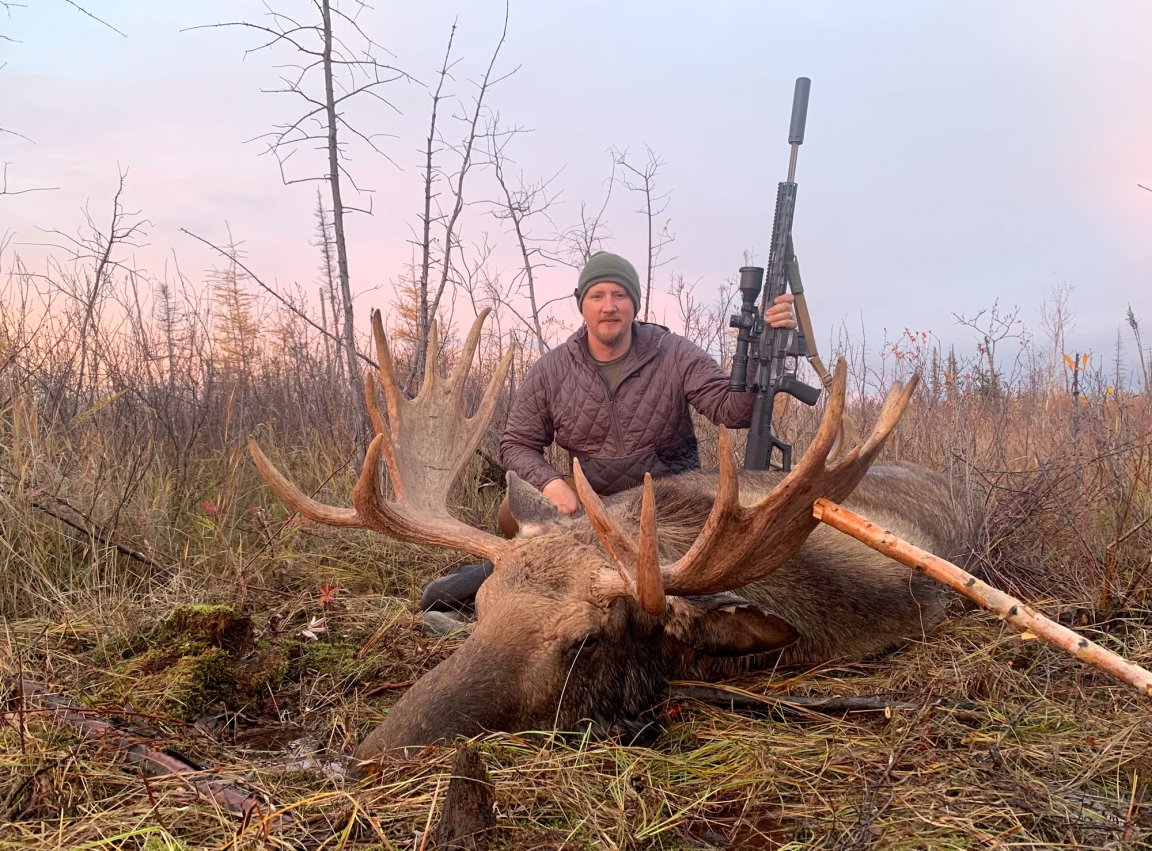
The fact is, if you punch a good-functioning bullet through the lungs of the toughest bull elk, moose, bear, or caribou, its going to die — pretty quickly. A bull moose shot through the lungs with a .25-06 or .270 might not crumple on impact, but he’s not going very far either. And moose don’t usually topple over quickly anyway. In fact, an instant drop is the exception. The most dramatic reaction I’ve ever seen from a moose was when using a 150-grain Hornady Inter-lock out of my .30-06 at 350 yards. Meanwhile, the bull I shot last year showed no immediate reaction when hit twice with a .300 H&H from 100 yards. That is, until he swayed and tipped onto his nose. The bull I recently killed with a 22 ARC ran about 20 yards, stood for about 30 seconds, then fell down dead.
An Alaska-Yukon moose is a behemoth of a critter that supposedly demands cartridges starting in the .33s. In reality, more moose have probably been taken with .222s, .30/30s, .250-3000s, and .243s in Alaska than any other cartridges. In Canada, the .303 is likely king, which is hardly a juggernaut. The .223 Remington is currently a dominant cartridge in the bush of Alaska, and it has proven to be plenty adequate for caribou when used with heavy expanding bullets at reasonable ranges.

What About Cartridges for Bears?
Bears, especially grizzly bears, are ripe subjects of cartridge contention. For guiding purposes, or as a backup gun, it’s not a bad idea to tote something in the .338 to .416 range. But for hunting purposes, it’s simply not necessary. Bears will rarely be anchored in place with a single shot, no matter the caliber. You’ll hear stories of shooting bears in the shoulders to “break them down,” but I know of a few instances where bears were never recovered because of this method. Shoot them cleanly through both lungs and their fate is sealed, usually very quickly. For black bears, a .243 with an Accubond, Partition, or Ballistic Tip bullet is absolutely deadly. Last season, my son took his first black bear with the pipsqueak .350 Legend. The bear ran about 10 yards and fell over dead. He killed another this spring with a 6.5 Creedmoor with similar results — and I killed two more on top of that. Based on what I saw with my moose, I predict that the 22 ARC will make an excellent black bear cartridge, too.

Grizzly bears garner a reputation of being a little tougher to kill, but that seems to have much more to do with a poor first shot than anything. In all the guiding and hunting he has done, my uncle still says the fastest death he ever saw of a grizzly was brought on by a .25-06. The only two rodeos I’ve ever been a part of with coastal brown bears both involved a poor first shot from a client with a huge magnum: a .416 Rem. Mag. and a 7.62 Warbird.
Read Next: The Best Bear Cartridges
A good first shot is much more critical than caliber. I killed a Boone and Crockett grizzly bear with a 6.5 Creedmoor last season, which was on the ground before the echoes of my first shot even subsided. He only made it 7 yards. Previously, I shot an equally large bear with a patched roundball out of a .50-caliber muzzleloader. He ran about 75 yards before expiring. Before that, I killed another big grizz with a sharp rock tied on the end of a stick. Even on giant coastal brown bears, a good shot trumps a big bullet. I know of several big Kodiak bears that were taken cleanly with a .308, and another recently with a 7mm-08.

The Takeaway
The common theme with many cartridge selections historically is ammo availability. The traveling hunter often has the luxury to bring whatever cartridge he or she wishes to the field, but in more remote areas, folks have always used what they had available; often that meant standard, mediocre cartridges with rapidly-expanding cup-and-core bullets. They made it work and still do.
As caliber selection applies to us today, this shouldn’t be interpreted as license to try and outdo each other with the smallest cartridge possible — rather it should inspire us to take an objective look at the real advantages and disadvantages of picking a larger or smaller cartridge, and choosing what will help make us most effective. Depending on your skill level and the game you hunt, that could be a .308 Win. or 6.5 Creedmoor or, perhaps, something like a 22 ARC; pick your poison. For most hunters, the most effective cartridge will rarely be a big magnum.
Read Next: The .270 Winchester Was Your Grandpa’s 6.5 Creedmoor
A cartridge’s adequacy rests much more in a good-shooting rifle, the function of the bullet, and what’s between the ears of the person pulling the trigger than in some curmudgeon’s ballistics charts. If you’re one of the folks who just needs one good hunting rifle, pick an accurate gun that you’re comfortable shooting and do your best to burn the barrel out of it. If you shoot enough to master the magnums, that’s great. They offer a lot too. I’ll warn you though, when you’re shooting enough to really refine your skills, you’ll probably wake up one day to realize that you’ve left your magnums behind.