
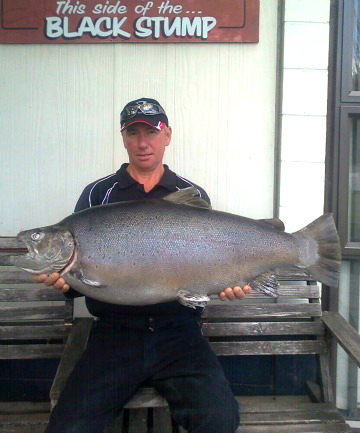
Evan Johnson of Timaru, New Zealand set a national record Monday when he landed a female brown trout weighing 39.7 pounds, according to the Timaru Herald. And although the International Game Fish Association record for a brown trout is listed at 41.5 pounds, Johnson's catch is a female, and will likely set the world record in that category.
Johnson was threadline fishing in the Upper Waitaki hydro canals. The trout went for his Tasmanian Devil lure and put up a solid 20-minute fight. When Johnson finally managed to bring it close enough to grab, the trout broke his net as he pulled it from the water.
Huge trout like Johnson's brown aren't unusual catches in the area. In 2002 American angler Mike Was landed a 37.4-pound rainbow trout. One year later, New Zealander Tony Washington caught an even bigger rainbow that weighed in at 38.5 pounds.
Some anglers in the area argue the monster fish pulled from these canals aren't legitimate catches. Many of the canal fish live under salmon farms, where they subsist on feed that falls through the cages. Others argue a great deal of effort and skill still goes into landing fish that size.
Do you think these canal catches are legitimate? Comment below!
Comments (3)
Well, it is a little artificial, having these fish getting all that hatchery spillage. But, does it violate IGFA's rules for "fair chase"? I mean, the Boone & Crockett Club has rules about high fences, unfair advantages, game farms and whatnot. So, what's the IGFA's take on it? I don't think this fish is a hatchery escapee or illegal equipment was used. So, Natalie, why do you think this fish shouldn't be considered for a record?
They could also add a second category that would allow these fish to be in the record books.
I would have to agree with allowing these fish into the record books. Otherwise we would have to eliminate all record fish that came from reservoirs, tailwaters or benefited from some other man-made structure which led to their ability to reach record sizes.
I've wondered how the bass fisherman are going to take it when the next world record is caught out of a private pond where the fish are bred and fed for size. Since I don't care for bass fishing very much I'll just sit back and watch that one play out.
Post a Comment (200 characters or less)
I would have to agree with allowing these fish into the record books. Otherwise we would have to eliminate all record fish that came from reservoirs, tailwaters or benefited from some other man-made structure which led to their ability to reach record sizes.
I've wondered how the bass fisherman are going to take it when the next world record is caught out of a private pond where the fish are bred and fed for size. Since I don't care for bass fishing very much I'll just sit back and watch that one play out.
They could also add a second category that would allow these fish to be in the record books.
Well, it is a little artificial, having these fish getting all that hatchery spillage. But, does it violate IGFA's rules for "fair chase"? I mean, the Boone & Crockett Club has rules about high fences, unfair advantages, game farms and whatnot. So, what's the IGFA's take on it? I don't think this fish is a hatchery escapee or illegal equipment was used. So, Natalie, why do you think this fish shouldn't be considered for a record?
Post a Comment (200 characters or less)