

Largemouth bass are the most popular game fish in America for one key reason: Accessibility. No matter where you live, there’s a strong possibility there are largemouths close by. Furthermore, you don’t need an expensive boat or loads of fancy gear to successfully catch giants. The same can be said of smallmouth bass, which rank pretty close behind largemouths in terms of popularity. Even though there are plenty of bass in waters all across the country, you still need the best bass fishing tips to catch them consistently.
Given the sheer volume of lures and tackle available for both species, folks who may be new to the sport might need a little guidance. Likewise, understanding how, where, and when to fish takes time and experience. But the learning curve can be shortened by understanding some of the basics regarding gear, presentation, and fish behavior. These tips and tricks will get you on a faster track to landing those hog largemouths and tank smallies. Here’s what we’ll cover:
- Quick Bass Fishing Tips
- Bass Gear Tips
- Using Electronics
- Bass Fishing Lure Tips
- Bass Tactics
- Catching Bass from Shore
- Bass Fishing Q&A
Quick Bass Fishing Tips
- When you catch a bass, return it to the water quickly. This is especially important on warm days.
- Gear up for a quick release. A small net and good pliers will help you release fish unharmed.
- If you want to keep bass to eat, the best tasting fish are mid-sized and caught from cold water.
- Bass are ambush predators. Target cover like docks, lilly pads, and submerged logs to get easy bites.
- Don’t forget about live bait. A leech, nightcrawler, or crayfish soaked beneath a slip bobber makes for a killer bass rig.
- If a bass misses your topwater bait, immediately throw a worm (texas rigged or wacky) at the spot of the blowup. You’ll often get a follow-up bite or even catch a different bass that was attracted to the action.
- Movement patterns in any waterbody can be complicated. But an oversimplification of a summer pattern is this: fish shallower at first light and evening; fish deep during hot midday hours.
- Avoid targeting highly pressured areas. Find backwaters, secluded ponds, and hard to reach river stretches for the best action.
- Watch (and listen) for topwater activity. When you see bass and hear bass blowing up on the surface, tie on your favorite topwater lure.
- Buy a kayak. If you’re a new bass angler and don’t want to commit to a souped up bass boat, a kayak will get you in the game. These are the best kayak fishing tips from a pro bass angler.
- Remember that bass like to school up. When you catch one fish, you’ll likely catch more in the same area. This is especially true in deep water. —Alex Robinson
Bass Gear Tips

Pick a Line for Bass Fishing
Choosing the proper line for bass fishing can be daunting with so many options on tackle shop shelves. The perfect line can also vary from one tactic to another, but if you’re looking for a “middle-of-the-road” option that will perform up to task across a wide variety of techniques, opt for 20-pound braided line. Though it has a 20-pound breaking strength, its diameter is more akin to 8-pound-test monofilament, which means you can pack plenty on a medium-sized spinning reel or standard sized baitcaster, and you’ll be able to deliver any lure accurately and at long distances. Twenty-pound braid is light enough that you’ll be able to quickly detect the subtlest bites when employing finesse tactics, but strong enough to rip a trophy fish out of heavy cover when throwing a frog lure in the pads.
Use Leaders
With most bass fishing techniques, you’ll need to add a length of leader to the end of your line if your reel is spooled with braid. This leader can be made of monofilament or fluorocarbon, and the proper line size will vary by application. As an example, you’d want a 12- to 15-pound leader for throwing jerkbaits or swimbaits, as these lures tend to get hit very hard. For a drop-shot application in clear water, you might scale all the way down to a 6-pound leader because what’s most critical is that the fish don’t see the leader as they study your small soft-plastic lure. There are several knots for connecting leader to braided line with some of the most popular being the uni-to-uni-knot splice, Alberto knot, and the more advanced FG knot.
Leaders make lures look more natural underwater. They also provide a bit of stretch, which aids in firm hook sets because braided line has no stretch and can tear a hook right out. One exception to the leader rule is when frogging or flipping jigs in thick aquatic vegetation. In these situations, lures can be directly tied to your braided line because you want to muscle the fish out of that cover quickly and forcefully, and the additional strength and lack of stretch is an advantage.
Learn to Use a Baitcaster Reel
Getting the hang of using a baitcasting reel can take time and practice. It’s not uncommon for beginner bass anglers to suffer through plenty of bird’s nests before dialing in their reels. Baitcasters feature two systems for adjusting the spool tension or how fast it spins—the brake and the tension knob. Adjusting the brakes can be tricky, but most reels come from the factory with proper brake settings. So, if you’re new to bass fishing, don’t worry about the brakes right away and focus on the tension knob, which is a round dial located behind the reel’s handle. This knob controls how quickly or slowly the spool spins when you cast, and it often needs to be adjusted every time you put on a lure of a different weight.
Read Next: The Best Baitcasting Rods for Bass
A simple way to minimize backlashes is to tie on your lure, hold the rod level in front of you, click the reel into free spool, and let the lure drop straight to the ground. If the spool doesn’t backlash when the lure hits the dirt, your reel tension settings are sufficient. If, on the other hand, the lure hits and the spool continues to spin, creating voluminous loops twirls, you need to tighten up that tension knob before firing a long cast.
Use Electronics to Catch More Bass
- Electronics aren’t just for fancy bass boats. Even if you’re on a jon boat or kayak, a small graph with sonar and depth readings can make a world of difference. 2D down-scan or side-scan will not only show you the bottom contour and structures like rock piles or submerged trees, but it will also show you marks in the water column signaling bass or other fish species. When you find structure or marks that look like fish in the water column, it’s probably time to wet a line.
- Understand how live imaging works. Live sonar imaging and 360 imaging show you real-time sonar readings that allow you to find bass swimming through the water column, and track your bait as you make a cast at them. It’s as close to using an underwater camera as you can get, and it gives you the power to keep your bait around the fish, rather than fishing empty water.
- Electronics are helpful to shore anglers, too. Small handheld devices like a Deeper sonar allow you to cast out a transducer ball that links via bluetooth to your phone. Once paired, you can see the sonar readings from wherever you’ve casted the sonar device. This can be an incredibly helpful tool if you’re not sure how deep a body of water is, or even if there are fish living there.
- Utilize fishing apps. Even if you don’t want to throw down for electronics right away, it’s worth using more affordable lake map apps like Navionics. A good app will give you a general idea of the depth and contours of the spot you’re fishing. —Derek Horner
Read Next: Best Fish Finders
Paint Your Fishing Line Black
When using a flipping jig to punch through thick grass mats, or when working a hollow-body frog through the pads, it’s common practice to tie these lures directly to your braided main line. The lack of stretch is beneficial to cut through the salad and rip fish out quickly. If the water around or under that vegetation happens to be super clear, however, braided line can be seen more easily by the fish, especially if it’s a high-visibility line in yellow or blue. The simple solution is to carry a black permanent marker in your tackle bag. Before casting, run the marker over the first 6 to 10 feet of your line to make it dark. Dark colors blend in more easily around vegetation, and this easy camouflaging trick can help you score a few more bites on the days when bass are being line shy.
Fish with Multiple Setups
If you ever watch bass fishing tournaments on TV, you’ll notice that the pros always have 8 or more rods on the bow of their boats. Each one is rigged with a different lure for a different presentation. It may seem like overkill, but it’s all about efficiency. With the clock ticking and money on the line, every second counts. Taking the time to dig out another lure and retie can add up and cost a lot of fishing time, and if a line isn’t in the water, you can’t get a bite. It’s impractical to carry as many rods as the pros during a day of fun fishing at the lake if you’re on foot. Likewise, not everyone can afford that many outfits. But carrying two rods while bass fishing will catch you more fish over the course of a season and is well worth the investment.
Related: Old-School Tips for Catching Big Bass Right Now
That might be two baitcasting outfits in slightly different sizes, or one baitcasting rod and one spinning rod. Either way you can adjust your presentation as scenarios change on the water. What if you’re fishing a worm on the bottom and suddenly the bass are blowing up shad on the surface? By the time you find a topwater, cut off the worm, tie on the new lure and cast, the opportunity could be over. Start out by rigging your rods with the lures you think are most likely to work based on the conditions, and then alter them based on what you’re seeing and catching on the water. Most of the time, you’ll dial in the two perfect baits for the day and can quickly switch rods as needed.
Bass Fishing Lure Tips

Wacky Rig Soft Plastic Baits
The number of bass lures in any given tackle shop can be downright overwhelming, especially if you’re new to the sport. There are so many categories of baits designed for specific scenarios and seasons that whittling them down to the best “all-around” lure is tricky. But if you’re looking for a jumping off point, go with a wacky rigged soft-plastic stickbait. The most popular is arguably the Yamamoto Senko, though similar baits like the YUM Dinger and the Gambler Ace work well, too.
These stick-like lures don’t look like much, and they’re certainly not flashy, but when wacky rigged — meaning pierced right through the middle perpendicular to the hook shank—they are highly effective in any kind of water at any time of year. All you have to do is cast out, let the bait touch down, and impart the occasional twitch with the rod tip. Work them back painfully slow, because bites often occur when the bait is sitting still. There’s not a bass pro in the country that doesn’t have stickbaits handy, because when nothing else is working or the going gets tough, they know these simple baits will produce.
Throw Skirted Jigs
Ask 10 bass pros for bass fishing tips and half of them will tell you one of the biggest bass they ever caught was on a weedless skirted jig. These simple baits are available in loads of styles, but they’re all made up of the same basic components—a lead head, rubber skirt, and a thick weed guard. What makes jigs so lethal is that they are designed to be cast into thick cover like brush piles, laydowns, and stump fields without getting snagged. Bass gravitate to these types of structures for safety and to ambush prey, and a jig allows you to put food in front of inactive bass that aren’t out looking for a meal.
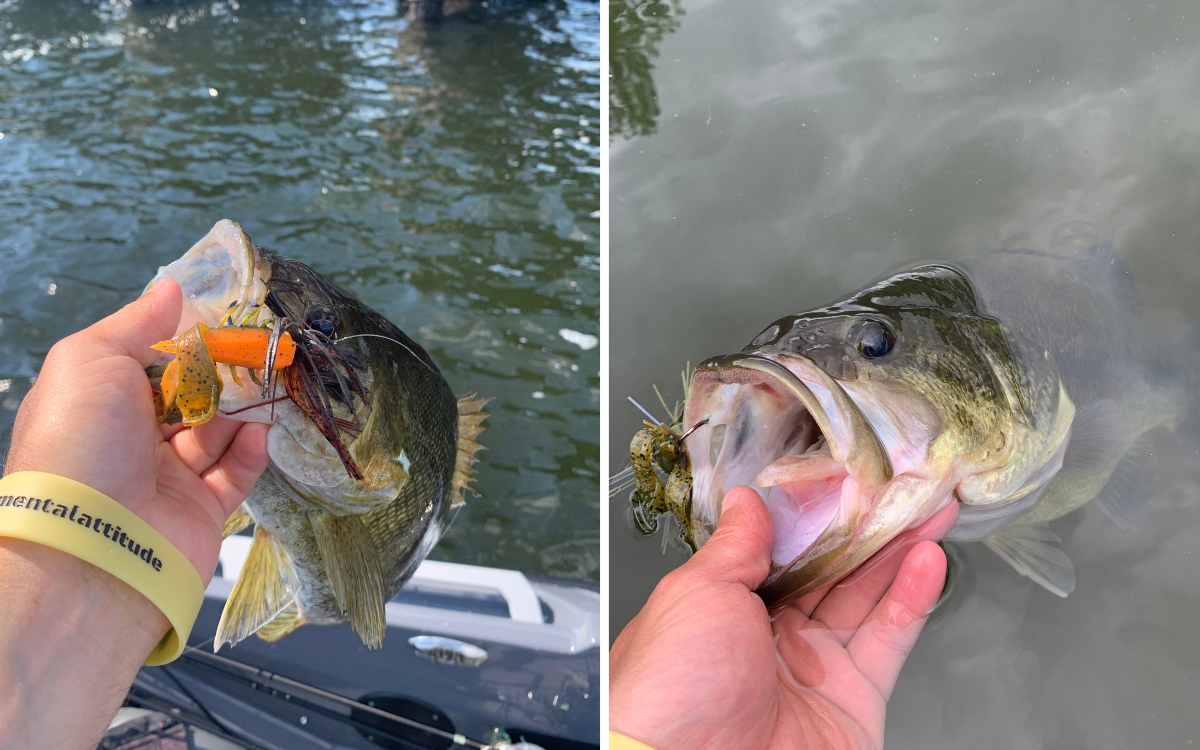
A common mistake with jigs is making too long of a cast and allowing them to enter the water with too much splash. This can easily spook any fish tucked up in the structure. Step one—whether on a boat or only foot—is to try to get into a range that allows you to make a short, soft pitch or flip into the cover. Step two is to use a low rod angle when making the presentation. This will minimize splash and allow the jig to slip in and surprise a bass, hopefully prompting a vicious reaction strike.
Tweak the Rings on Your Topwater Lures
Nothing gets an angler more charged up than watching the surface turn to froth as a bass explodes on a topwater lure like a popper or walking bait. It is one of the biggest adrenaline rushes in the sport. The problem is that bass have a nasty habit of spitting and shaking topwaters free, flipping that adrenaline high into deep depression. It happens because bass often get more leverage on large topwater lures than other baits, and as they head shake and change direction during the battle, the hook can twist right out.
Read Next: The Best Topwater Lures for Bass: 9 Classics That Still Catch Big Fish
A simple solution to minimize this and reduce that leverage is to add a second split ring to your topwater baits. These lures typically come from the factory with one split ring on the belly and tail hook hanger, and the treble hooks ride on these single rings. By adding a second split ring at each position—making the combo split ring, split ring, hook—you create more range of motion between the lure’s body and the hooks. This means as the fish fights, the lure can twist farther in any direction without twisting the hooks free.
Burn Crankbaits
Crankbaits are very versatile bass lures. You can find models that dive as deep as 20 feet or run as shallow as 2 feet or less. The beauty of these lures is that all you really have to do to make them produce is cast and reel. Of course, there are several tricks to getting the most out of crankbaits. As an example, squarebill cranks are designed to be knocked off of hard cover like stumps and rocks to produce reaction strikes. But if you’re fishing a standard crank in open water, “burning” is a method often overlooked because to many anglers because it just doesn’t feel like it would draw strikes.

All you have to do is make a long cast and then reel (quite literally) as fast as you can for a few seconds and stop. Wait another second or two and repeat the process. It may seem like you’re moving the lure too fast for a bass to catch, but burning produces savage strikes, and it’s particularly effective when the fish are suspended in the middle of the water column in deeper areas.
Change Up the Presentation
Soft-plastic jerkbaits like the Zoom Fluke, Bass Assassin Shad, and BPS Shadee Shad catch big bass in a wide variety of scenarios throughout the entire season. The most popular ways to rig them are on a wide-gap worm hook for a weedless presentation; on a jighead for fishing deep, open water; or on a light hook pierced right through the tip of the nose for a finesse presentation.

The thing is bass see jerkbaits rigged with these methods all the time. To change up your approach, hit the hardware store and grab a small box of finishing nails. On the water, pin your bait right through the back about an inch forward of the tail. Next, jam a nail right into the bait’s nose so it’s completely hidden. When the lure touches down, it’s going to fall nose first at an angle. When you twitch the rod tip, it’s going to be pulled backwards before falling again. The technique does a great job of mimicking a dying, wounded baitfish, and it works especially well on pressured bass in clear water.
Read Next: The Best Jerkbait Rods of 2026
Use Frog Baits in Heavy Cover
Hollow-body frog lures are deadly in heavy cover like lily pads and grass mats. They’re designed to slide through and over vegetation without getting hung up, allowing you to hit tucked-up bass few other lures can reach. When a frog gets inhaled, the take is rarely subtle, but these lures come with their own set of challenges. For starters, if you don’t wait a second or two before swinging, you’re likely to pull the frog right out of the fish’s mouth. You need to give the bass time to turn downward and compress the bait. This will expose the hooks, increasing the odds they’ll connect.
Read Next: Best Frog Lures
You can up the odds even more with a pair of pliers. When you buy a frog, take a look at how the hooks are oriented along the bait’s back. They’re often pointed downward slightly. Using pliers, bend them up just a bit so the points are even with the back. As long as you don’t bend them too far the bait will remain weedless, but those points will get exposed even faster after the hit, increasingly the likelihood that they’ll find meat when you set.
Recycle Plastic Baits
Soft-plastic lures catch tons of bass, but a downside to these baits is that they get destroyed easily. Even if it’s not the fish that are causing the destruction, hooks and jigheads can tear up the baits when you remove them to switch colors. So, what do you do with all the discards? You could toss them, but you’ll save money and catch more bass in the long run if you put them in the trailer pile. While these baits might be too far gone to function on their own anymore, you don’t need a whole soft-plastic to tip a weedless skirted jig, spinnerbait, chatterbait, or hair jig. You might have a paddle-tail swimbait, as an example, with a shredded nose, but you can cut it in half and that tail will continue to add thump as a jig trailer. Longer plastic worms also make great jig trailers, as do crawfish baits since you generally only want those flapping claws when flipping a smaller jig.
Color Code Your Lures
Saying that the number of bass lure color options are vast is an understatement. It can be downright overwhelming when trying to decide which hue of worm is perfect for your lake, or which shade of crankbait is ideal for your home river. Over time, you’ll come to land on favorite patterns for your waters, but early on, lure color can be simplified by thinking in tones.
Read Next: Best Bass Lures
Whenever the water is clear, opt for natural colors such as white, olive, brown, or black. Even if a lure is brown and pink and purple, focus on the predominant color. If that’s brown, consider it a natural tone. Bright colors like chartreuse, neon orange, or bubblegum pink are great options for dirty, stained, or murky water. To give an example, Sexy Shad is an extremely popular color of crankbait. It features white, yellow, and blue hues. But it’s unlikely to outperform the same crankbait painted all white. Action and vibration will matter more since crankbaits are designed to move quickly. So, despite the pizzazz that blue and yellow add, Sexy Shad could simply be classified as natural color because it’s predominantly white.
Tactical Bass Fishing Tips

Be a Night Stalker
Largemouth and smallmouth bass don’t shut down when the sun dips behind the horizon, especially in the summer. In fact, during the hottest months, these fish can become more active after dark as the water temperature cools a degree or two. The best part about fishing at night? Competition from other anglers drops way off, giving you a crack at less pressured and less wary bass.
Several tactics can score you late-night behemoths, but one of the most effective methods is fishing with a loud topwater lure like a buzzbait, Jitterbug, or Spook. These lures create a lot of surface disruption as they move, giving fish something to home in on as they track the target in the dark. The key is working them as slow as possible while still allowing their knockers, propellers, and blades to froth up the surface. At night, you’re relying on feel and sound to detect a bite. It makes the pursuit more challenging, but there isn’t a more gratifying sound than when the gurgle of a buzzbait or Jitterbug is quickly drowned out by the toilet-flush take of a bass and you feel that rod load up.
Understand the Spawning Season
One of the most complicated aspects of bass fishing is understanding how the fish change location throughout the seasons. Volumes have been written about it over the years, but to strip it down and simplify, bass move based on food, water temperature, and the need to reproduce. It is during spawning season that the fishing can be some of the best but also some of the most challenging.
We can break this season down into three distinct periods: pre-spawn, spawn, and post-spawn. Spawning occurs in the spring across the country, though the exact timing varies by temperature. This means spawning in South Florida or Alabama can occur as early as late February, whereas the spawn in Upstate New York or Minnesota may not occur until late June.
Regardless of location, pre-spawn refers to the period just before the bass move to shallow water to build beds, and during this window they can be incredibly aggressive as they pack in protein for the pending spawn. Look for them in deeper areas and channels near shallow flats. During the actual spawn, the fish will move into the shallows and pair up, with larger females generally staying on the beds and the smaller male guarding the area.
During this more territorial phase, fish will attack almost any lure that gets close to them. After spawning, however, bass can get much trickier to catch. The big females are typically recuperating during the post-spawn period, and they gravitate to deeper water near the shallow spawning flats. Any channel or depression leading out the shallows has potential to hold fish, but if you can find a point of land jutting out into these deeper areas, it is often a magnet for post-spawn females.
Find the Cover
No matter where you fish in the country, from lakes and rivers to ponds and roadside ditches, bass can be found in and around cover. Whether it’s a bridge piling, a fallen or submerged tree, a rock pile, or a dock, these ambush predators will use every advantage they have to hide and wait for unsuspecting baitfish to swim by.
Whether you’re using electronics to find the cover, or just casting to visible cover, you should fish each cast with the mindset that a bite is coming any second. The key to actually landing a bass caught near heavy cover is being ready to set the hook and start winching the bass away from its hiding place. If you wait too long, you’ll be wrapped around branches or dock pilings before you know it and the heart break that comes with breaking your line will keep you up at night.
By finding and casting near cover, you’ll be consistently keeping your lure inside the strike zone for a longer period of time. If you want to catch more bass this spring, finding the best cover is a great place to start.
Learn to Skip Cast
No matter where you live or what kind of local bass water is available, having a solid handle on skip casting is going to come in handy at some point. The technique can be employed with a spinning rod or baitcasting rod, and it allows you to send a lure deep under overhead cover, which could be anything from low-hanging tree branches to bank brush or a dock. Bass gravitate to areas with an overhead canopy several times throughout the season. During the post-spawn, male bass will tuck into these areas to guard their fry, as the “ceiling” thwarts aerial attacks from birds. These are also great spots to hit in mid-summer as they provide plenty of shade from the bright sun.

In simplest terms, skip casting means casting with a low rod tip angle—almost parallel to the surface—and with enough force to send a bait skipping across the surface like flat stone skipped on a pond. The trick to mastering the technique is understanding which styles of lures will skip and which won’t. As an example, a crankbait with a lip and multiple treble hooks would be too bulky and awkward to effectively skip. Compact baits like jigs, weedless soft-plastics, and small swimbaits, conversely, skim the surface nicely, allowing you to get them in front of the hogs that are tucked up under the deepest, darkest corner of the dock.
Follow Your Nose When Using Scented Baits
One of the most heavily debated topics in bass fishing is the importance of adding scent attractants to artificial lures. These scents come in many styles, from roll-on sticks, to gels, to sprays, and flavors can range from shad to crawfish to garlic and beyond. Some anglers believe stinking up their lures is always an advantage, while others rarely (if ever) lean on these products. So, how do you parse it out?
Looking at it from a scientific angle, the importance of scent will vary based on conditions. With a fast-moving lure like a crankbait or spinnerbait, fish are generally striking out of aggression. In other words, the whole attack goes down so quickly that they don’t have time to smell the lure. Conversely, in a finesse situation where a jig or soft-plastic is being slowly worked along the bottom, it would make sense that smell could offer an advantage given that the fish has more time to study the lure. This is why you’ll often see anglers lean into scent in clear water or dirty water when a slow, methodical presentation is required. This is a good general rule to follow, and it’ll keep you from gunking up all your swimbaits and jerkbaits with garlic gel.
Face the Wind When Casting
Whenever it’s windy on the water, anglers have a natural tendency to position themselves upwind of their target area. In other words, they cast with the wind, which certainly helps extend casting distance and makes presenting lures easier. However, bass generally face up current, and it doesn’t matter if that’s constant river current or a temporary current created by wind on a body of still water. One of the primary reasons they do this is because current carries food such as small baitfish that have a harder time swimming against it. Bass will face into the current—therefore into the wind—to get eyes on incoming food faster.
If you cast with the wind, your lure will be approaching the fish from behind, moving from their tails to their heads. But this is not what the fish are expecting, and it creates a completely unnatural presentation. Though you’ll sacrifice some casting distance, always cast directly into the wind so your lure moves naturally with the current and directly to the fishes’ mouths.
Pay Attention to Storms and Weather Patterns
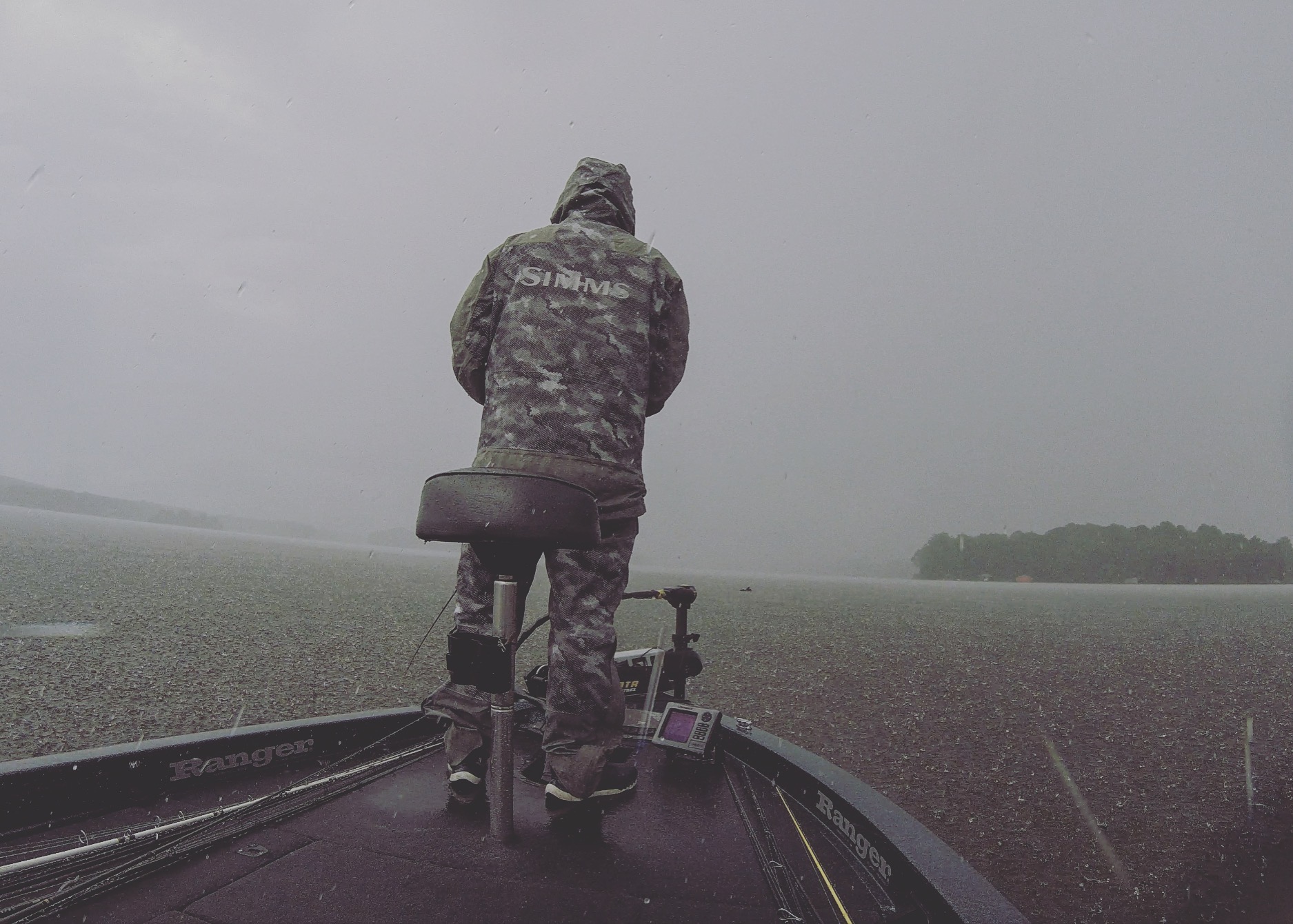
Barometric pressure in the atmosphere absolutely effects the behavior of bass. There are countless theories as to why, and many anglers believe that high pressure makes the fish feel bloated and full. Others will tell you that a sustained low-pressure system will shut the bite off. There is evidence for each of these theories, but one thing that’s widely agreed upon is that a fluctuating barometer generally gets bass feeding. The more severe the change the better, which is why so many bass anglers pay attention to weather fronts.
Related: We Fished Through a Tornado Until It Flipped My Boat
If there are storms forecasted for some point in the day, you can expect the bass to feed hard from a few hours before the storms arrive until they hit. Naturally, you need to be smart when fishing ahead of fronts for safety reasons, but the rapid pressure drop preceding a storm can produce incredible action. On the flip side, few would argue that one of the most difficult times to catch bass would be within minutes or days after a big storm front. Post-front conditions often feature blue bird, cloudless skies, and these conditions usually create sustained high pressure. Until the barometer begins to fluctuate or level out again, you can expect a tough bite.
Persistence Pays Off When Learning New Water
One of the biggest mistakes new bass anglers make is changing locations too often. They choose a spot, make a handful of casts, and if the bite doesn’t come fast, it’s off to another part of the lake or river. On a grander scale, some anglers also give up on entire bodies of water because success doesn’t happen fast enough. The reality is that it’s always better to have intimate knowledge of a handful of water bodies instead of knowing just a little bit about a whole bunch of places. While it may not feel like this approach will land you more fish, you’ll pick up a lot more valuable information and it will make you a better angler in the long term.
Read Next: The Best Bass Fishing Rods, Tested and Reviewed
As an example, if you’ve had success on a plastic worm, you’re naturally inclined to use that same worm on the next visit. If it doesn’t produce the same results, you may move to a new area but keep fishing the same worm. The better move would be to assume the fish are still in the same location and try new lures until you’ve exhausted several likely possibilities. By fishing this way and sticking to just a few bodies of water over the course of an entire season, you gain a better understanding of how the fish move and behave. As that bigger picture becomes more complete, you’ll end up catching a lot more fish with these bass fishing tips than the impatient guy who is constantly on the move looking for fast action.
Tips for Catching Bass From Shore
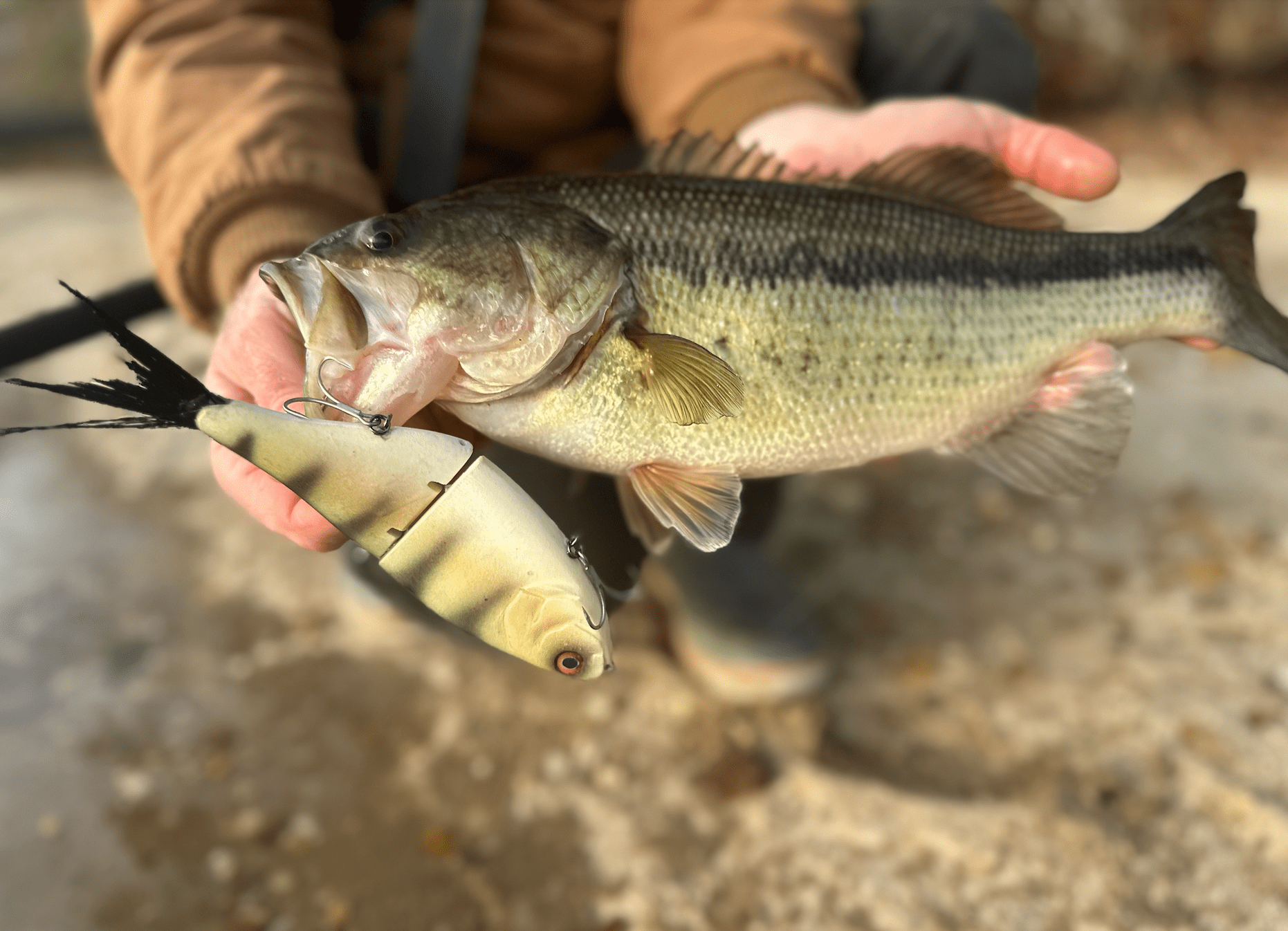
Are there advantages to having a bass boat loaded with the hottest new electronics and a 200-horsepower motor? Of course. Even a canoe, kayak, or belly boat that allows you to cover more water or access hard-to-reach areas can help you catch more bass. But one of the things that makes the largemouth “America’s favorite gamefish,” is that not having a boat isn’t as much of a disadvantage as it would be for chasing species like walleye, lake trout, or myriad inshore saltwater species. Throughout most of the season, largemouths gravitate to areas of lakes and ponds within casting range of the bank. So, if all you’ve got to carry you to the fish is your own two feet, here are some pointers that will hopefully take some of the legwork out of your missions.
Find the Edges
Aside from spawning, one of the primary reasons largemouth bass spend a lot of time in shallow water close to shore is because that’s where they find food. Smaller species like bluegills, shiners, and even juvenile bass understand that shallow water provides more safety. Shorelines are also where bass find terrestrial meals like frogs and have a better shot at catching aquatic insects like dragonflies.
Related: How to Fish a Laydown for Giant Bass
During warmer months when lake vegetation is in full bloom, bass will spend more time in the shallows, as weeds and grass mats will conceal them from their prey. During colder times of year, however, bass can often be found within striking distance of the shallows along deeper edges. These can be created by submerged creek channels or natural bottom contours, but any location where you can cast into deeper water and bring your lure across the edge into shallower water is a great place to fish.
Cast to Anomalies
Anglers have a bad habit of only looking for major targets. If there’s a corner loaded with lily pads or a massive laydown in the water, they draw us in like a magnet. Those are great places to fish around, but in waters that are easily fished from shore, those spots usually get hit hard. It’s often better to look for the more subtle features.
As an example, if you see just two or three isolated lily pads in the middle of what appears to be a barren flat, cast at them. If there’s a lone sticking poking out in a cove, hit it. You’d be surprised how a slight difference like a small depression, a thin patch of weeds, or a lone log in a featureless area can create enough of an ambush point to hold a big bass.
Rocks & Docks
Although bass can be found around docks and rocks throughout the course of the season, these areas are particularly appealing in the early spring. Wood and rock that is partially submerged acts a bit like a heater, absorbing the warmth of the sun and transferring it to the water. It’s not going to heat up a vast area, but when the water is cold, it only takes a degree or two of difference to make fish holding tight to these structures bite when fish elsewhere may not be as eager to feed.
If you’re fishing on foot, avoid walking out on the dock to cast. The smarter move would be fishing from shore next to the dock, presenting casts along the edges and pilings to coax any fish holding underneath. When fishing along rock faces or manmade retention walls, don’t be afraid to cast parallel to shore, working baits down the length instead of casting out and reeling straight back.
Your Bass Fishing Questions, Answered
Bass can be caught all year long. Most anglers like to fish during April and May in the South and June and July in the North when the weather is nice and bass are feeding aggressively. Fall is a great time to target smallmouths.
During the heart of bass season, fish are typically most active early in the morning and in the evening (dawn and dusk). However you can find great nighttime bites during the summer, too.
Largemouth and smallmouth are aggressive predators, strong fighters, they grow to large sizes, and they’re found all over the country. What’s not to love?
Bass like both shallow and deep water, depending on the time of year. Bass spawn in shallow water. They typically move to deep water during the hottest periods of the summer. —Alex Robinson